2014 AUDI TT COUPE belt
[x] Cancel search: beltPage 200 of 284

Downloaded from www.Manualslib.com manuals search engine Safe
driving
Group 3 child seats (rear seat)
Applies to vehicles: with rear seat approved as a Group 3 child
seat
Fig. 175 Label on the rear seat
Fig. 176 Child in the rear seat
Rear seat
Children from the age of around 7 and a height of
approx. 1.30 m to 1.45 mare best seated in the
rear seat.
The label on the rear seat c::> Fig. 175 tells you
whether the rear seat of the vehicle has been tes
ted as a Group 3 child seat and approved under
the ECE-R 44 standard. Children should be buck
led in without a child seat with the normal three
point seat belt.
.&_ WARNING
- The shoulder section of the belt must be fit
ted across the centre of the collar bone
close to the upper body. It must never run
against or across the neck. The lap belt
must be worn tightly across the hips, and
not over the stomach or abdomen. Pull the
belt tight if necessary to take up any slack.
- The distance between the occupant's head
and the rear window must be at least 2.5
cm when sitting upright in the rear seat -
198 otherwise
serious head injuries could be
caused when closing the boot lid or in the
event of an accident. Always pay close at
tention to passengers in the rear seat when
closing the boot lid.
Securing a child seat
Securing child seats with ISOFIX
Applies to vehicles: with ISO FIX
Fig. 177 Rear seat: Securing child seat with ISO FIX
Child seats of the categories 0, O+ and 1 with
ISOFIX can be secured without a seat belt using
the ISOFIX anchorages on the rear seats and on
the front passenger's seat*.
� Push the mountings on the child seat into the
ISOFIX anchorages until they engage audibly
c::>Fig. 177.
� Pull on the child seat to check whether both
sides have engaged properly.
If you wish to attach an ISO FIX child seat to the
ISOFIX anchorages in your vehicle, please ensure
that it is approved for the seats in your vehicle.
The following table ¢ table on page 199 shows
the installation options. The necessary informa
tion can be found on the orange label on the
child seat.
An ISOFIX child seat categorised as "vehicle-spe
cific", "restricted" or "semi-universal" (IL) is suit
able for a seat if:
- your vehicle is listed in the model list provided
by the child seat manufacturer and
-your child seat is marked with IL in the follow-
ing table. ..,.
Page 201 of 284

Downloaded from www.Manualslib.com manuals search engine 0
N
co
....
\D Lfl An
ISOFIX child seat categorised as "universal",
(IUF) is suitable for a seat if:
-your child seat is marked with IUF in the follow
ing table and
- the child seat can be secured with top tether 1
>
¢page 199.
Weight class
ISOFIX
Outer Front
size cate- rear
seats
passeng-
gor y er's
seat"'>
Category 0: E
IL IL
up to 10 kg
E
Category O+:
D IL IL
up to 13 kg
C
D
Category 1: C
IL
9 to 18 kg ILJFb) IL
B
Bl A
Catego- -
ry 2/3: X
IL c)
15 to 36 kg
a) This function is not available for all export versions.
b) Only ISO FIX size categories Band Bl may be fitted on the
(outer) rear seats.
c) It may be necessary to adjust the backrest angle in order
to fit the child seat correctly.
A WARNING
- Note the important safety notes¢ A in
Safety notes for using child seats on
page 196, ¢ A in Child seat categories on
page 197 and the instructions provided by
the child seat manufacturer.
- Never install a rearward-facing child seat on
the front passenger's seat unless the front
passenger's airbag has been deactivated -
this can result in potentially fatal injuries to
the child.
- The anchorages in the vehicle are designed
only for child seats with ISOFIX. Do not at-
N
� l)
This function is not available for all export versions. Safe
driving
tempt to secure other types of child seat,
seat belts or other objects to these ancho
rages -this could result in serious or possi
bly fatal injury.
Securing child seats with ISOFIX and top
tether
Applies to vehicles: with top tether
Fig. 178 Rear backrest: Top tether anchorages
.. Push the mountings on the child seat into the
ISOFIX anchorages until they engage audibly
¢page 198, Fig. 177.
.. Pull on the child seat to check whether both
sides have engaged properly.
.. Guide the top tether strap of the child seat to
wards the rear into the luggage compartment.
.. Hook
the strap into the top tether anchorage 1
>
¢Fig. 178.
.. Pull the tether strap tight so that the top of the
child seat rests securely against the backrest.
A WARNING
- Note the important safety notes¢ A in
Safety notes for using child seats on
page 196, ¢ A in Child seat categories on
page 197 and the instructions provided by
the child seat manufacturer.
- The anchorages in the vehicle are designed
only for one child seat with ISOFIX and top
tether. Do not attempt to secure other types
of child seat, seat belts or other objects to
these anchorages -this could result in seri
ous or possibly fatal injury.
199
Page 202 of 284

Downloaded from www.Manualslib.com manuals search engine Safe
driving
Securing child seats with seat belt
If you wish to use a child seat in the approval cat
egory "universal" (u), please ensure that it is ap
proved for the seats in your vehicle. The follow
ing table shows the installation options. The nec
essary information can be found on the orange
label on the child seat.
Weight class Front
pas-
Rear seats
senger's
seat
Category 0 u u
up to 10 kg
Category O+ u u
up to 13 kg
Category 1
u u
9 to 18 kg
Category 2 u u
15 to 25 kg
Category 3
u u
22 to 36 kg
To adjust the front passenger's seat to the child
seat and to achieve the best possible seat belt
positioning, move
- the front passenger's backrest as far forward as
possible and
- the front passenger's seat as far upwards as
possible.
_& WARNING
- Note the important safety notes¢.&. in
Safety notes for using child seats on
page 196, ¢ .&. in Child seat categories on
page 197 and the instructions provided by
the child seat manufacturer.
- Never install a rearward-facing child seat on
the front passenger's seat unless the front
passenger's airbag has been deactivated -
this can result in potentially fatal injuries to
the child.
200 Pedal
area
Pedals
The pedals must always be free to move and
must never be obstructed by floor mats or any
objects in the footwell.
... Make sure that none of the pedals is obstructed
and all of the pedals can be pressed all the way
down to the floor.
... Make sure that all pedals are able to return
freely to their original positions.
Only use floor mats which leave the pedal area
free and can be securely fastened in the footwell.
If one of the brake circuits should fail, increased
brake pedal travel will be required to bring the
vehicle safely to a stop.
_& WARNING
Any obstructions that restrict pedal travel can
cause loss of vehicle control and critical situa
tions in traffic.
- Never place objects in the driver's footwell.
Such objects could move under the pedals
and interfere with their proper function. In
the event of sudden braking or a change of
direction, you would not be able to use the
pedals. This could result in a loss of control
and possibly cause an accident.
Floor mats on the driver's side
Use only floor mats which can be securely fas
tened in the footwell and do not obstruct the
pedals.
... Make sure that floor mats are securely fastened
and cannot interfere with the pedals ¢.&_ .
Use only floor mats that leave the pedal area un
obstructed and are firmly secured to prevent
them from slipping. You can obtain suitable floor
mats from your dealer or a specialist retailer.
_& WARNING
Any obstructions that restrict pedal travel can
cause loss of vehicle control and increase the
risk of serious personal injury.
Page 203 of 284

Downloaded from www.Manualslib.com manuals search engine 0
N
co
....
\D Lfl
N
Lfl
.... -Always
make sure that floor mats are prop
erly secured.
- Never lay or install additional floor mats or
other floor coverings over the existing floor
mats; this would restrict the pedal area and
possibly obstruct the pedals, which could
cause an accident.
Stowing luggage safely
Luggage compartment
Fig. 179 Heavy items should be placed as far forwards as
possible.
All luggage and other objects must be safely se
cured in the luggage compartment. To maintain
safe handling on the road, please observe the fol
lowing points:
� Distribute the load evenly in the luggage com
partment.
� Place heavy items as far forward as possible in
the luggage compartment and secure them
properly ¢Fig. 179.
� Secure the load with the luggage net* or with
non-elastic straps secured to the fastening
rings*¢ page 202.
A WARNING
- Loose items in the luggage compartment
are a safety hazard: they can move suddenly
and impair the handling of the vehicle as a
result of the change in weight distribution.
- In an accident or a sudden manoeuvre, loose
objects in the passenger compartment can
be flung forward -risk of injury! Always
stow objects safely in the luggage compart
ment and secure them on the fastening Safe
driving
rings*. Use suitable securing straps, particu
larly when transporting heavy objects.
- Transporting heavy objects may affect the
vehicle's handling by shifting the centre of
gravity -this could cause an accident. Take
extra care when driving and adjust your
speed accordingly.
- Never exceed the maximum axle loads or
the maximum gross weight for the vehicle
¢ page 257. Exceeding the permitted axle
loads or gross weight limit can affect the ve
hicle's handling characteristics, and increase
the risk of accidents, personal injuries or
damage to the vehicle.
- Never leave your vehicle unattended when
the boot lid is open. Children could climb in
to the boot and close the boot lid from the
inside. In this case the child would be un
able to get out of the vehicle without help.
This could have fatal consequences.
- Never allow children to play in or around the
vehicle. Always close and lock the boot lid
and all the doors when you leave the vehi
cle.
- Never let passengers ride in the luggage
compartment. All occupants must be prop
erly restrained by the seat belts at all times
¢page 204.
CD CAUTION
Make sure that no hard objects chafe against
the wires of the heating element in the rear
window and damage them.
(D} Note
- Adjust the tyre pressure to match the vehi
cle loading -the correct pressures are speci
fied on the sticker on the end face of the
driver's door.
- Air circulation in the vehicle helps reduce
fogging of the windows. Used air escapes
through ventilation slots in the rear of the
vehicle. Make sure that these ventilation
slots are not obstructed.
- Suitable belts for securing loads to the fas
tening rings* are commercially available.
201
Page 206 of 284

Downloaded from www.Manualslib.com manuals search engine Seat
belts
Seat belts
Why is it so important to
use seat belts?
Seat belts provide effective protection
The common belief that passengers can brace
their weight with their hands in a minor collision
is false.
Fig. 183 Driver with properly positioned seat belt -good
protection if the brakes are applied suddenly
It is an established fact that seat belts provide
good protection in accidents. Therefore wearing a
seat belt is required by law in most countries.
Properly worn seat belts hold the occupants in
the best position for maximum protection
¢ Fig. 183. The seat belts are capable of absorb
ing much of the kinetic energy arising in a colli
sion. Also they help to prevent uncontrolled
movements which could lead to severe injuries
¢ page 204, Important safety notes when using
seat belts.
If they wear the seat belts correctly, the passen
gers benefit greatly from the ability of the belts
to reduce the kinetic energy gradually. The front
crumple zones and other passive safety features
(such as the airbag system) are also designed to
absorb the kinetic energy generated in a collision.
Taken together, all these features reduce the
forces acting on the occupants and consequently
the risk of injury.
Although these examples are based on a frontal
collision, the physical principles involved are the
same in other types of accidents. This is why it is
so import ant to put on the seat belts before ev
ery trip -even when "just driving around the cor-
204 ner".
Ensure that your passengers wear their seat
belts as well ¢ ,&.
Properly worn seat belts have been shown to be
an effective means of reducing the potential for
injury and improving the chances of survival in a
serious accident ¢ page 205, Forces acting in a
collision.
For information on how children can travel safely
in the car refer to¢ page 195, Child seats .
.lD.. WARNING
- Seat belts must be put on before every trip -
even when driving in town. This also applies
to the rear passengers -risk of injury!
- During pregnancy, women should always en
sure they wear a seat belt. The best way to
protect the unborn child is to protect the
mother ¢ page 207, Wearing and adjust
ing the seat belts during pregnancy.
Important safety notes when using seat
belts
There are a number of safety points concerning
the seat belts which you should remember. This
will help to reduce the risk of injury in an acci
dent.
.lD.. WARNING
- The seat belts can only provide maximum
protection if the seats are adjusted properly
¢page 46, Seats and storage.
- To ensure proper protection, it is important
to wear the seat belts in the correct position
¢ page 206, How to wear seat belts prop
erly. Ensure that the seat belts are worn ex
actly as recommended in this chapter. Belts
which are not worn properly can increase
the risk of injury in accidents considerably.
- Do not allow the seat belt to become twis
ted or jammed, or to rub on any sharp
edges.
- Never allow two passengers (even children)
to share the same seat belt. It is especially
dangerous to place a seat belt over a child
sitting on your lap.
�
Page 207 of 284

Downloaded from www.Manualslib.com manuals search engine 0
N
co
....
\D Lfl
N
Lfl
.... -
Do not wear the belt over hard or fragile ob
jects (such as glasses or pens, etc.) because
this can cause injuries.
- Loose, bulky clothing (such as an overcoat
over a jacket) impairs the proper fit and
function of the belts.
- The belts must be kept clean, otherwise the
retractors may not work properly
¢ tab. Cleaning the interior on page 238.
- The slot in the seat belt buckle must not be
blocked with paper or other objects, as this
can prevent the latch plate from engaging
properly.
- The latch plate of the belt must always be
engaged in the correct buckle for that seat,
otherwise the belt will not be fully effective.
- Check the condition of the seat belts at reg
ular intervals. If you notice that the belt
webbing, fittings, retractor mechanism or
buckle of any of the belts is damaged, the
belt must be replaced by a qualified work
shop.
- The seat belts must not be removed or
modified in any way. Do not attempt to re
pair a damaged belt yourself.
- Seat belts which have been worn in an acci
dent and stretched must be replaced by a
qualified workshop. The belt anchorages
should also be checked. Seat
belts
Forces acting in a
collision
The physical principles involved in a frontal
impact
Very large forces are generated during a colli
sion; these forces have to be absorbed.
Fig. 184 Passengers of a vehicle which is headed for a
brick wall. They are not using seat belts.
Fig. 185 The vehicle crashes against the wall
The phys ical principles involved in a frontal colli
sion are relatively simple:
Both the moving vehicle and the passengers pos
sess energy, which is known as "kinetic energy"
¢ Fig. 184. The amount of "kinetic energy" de
pends on the speed of the vehicle and the weight
of the vehicle and passengers. The higher the
speed and the greater the weight, the more ener
gy there is to be absorbed in an accident.
The most significant factor, however, is the speed
of the vehicle. If the speed doubles from 25 km/
h to 50 km/h, for example, the kinetic energy in
creases by a factor of four. Because these passen
gers are not restrained by seat belts, the entire
amount of kinetic energy has to be absorbed at
the point of impact ¢ Fig. 185. This would result
in serious or potentially fatal injury.
..,.
205
Page 208 of 284

Downloaded from www.Manualslib.com manuals search engine Seat
belts
Even at urban speeds of 30 km/h to 50 km/h, the
forces acting on the occupants in a collision can
reach the equivalent of 1 ton (1000 kg) or more.
At greater speed these forces are even higher.
Again: if the speed doubles, the forces increase
by a factor of four.
Passengers who do not wear seat belts are not
"attached" to the vehicle. In a frontal collision
they will continue to move forward at the speed
their car was travelling just before the impact.
What happens to passengers not wearing
seat belts?
Passengers not wearing seat belts risk fatal inju
ries in the event of an accident.
Fig. 186 A driver not wearing a seat belt can be thrown
forwards
Fig. 187 A rear passenger not wearing a seat belt can be
thrown forwards
In a frontal collision, unbelted passengers will be
thrown forwards and make violent contact with
the steering wheel, dashboard, windscreen, etc
¢ Fig
. 186.
Passengers not wearing their belts
risk being thrown out of the car. This could result
in potentially fatal injuries.
The common belief that occupants can brace
their weight with their hands in a minor collision
206 is
false. Even at low speeds the forces acting on
the body in a collision are so great that it is not
possible to hold yourself in the seat.
It is also important for the rear passengers to
wear seat belts, as they could otherwise be
thrown forwards violently in an accident. Rear
passengers who do not use seat belts endanger
not only themselves but also the other occupants
¢Fig. 187.
How to wear seat belts
properly
Putting on the seat belts
Alwa ys
fasten
your
seat belts before driving o
ff .
Fig. 188 Driver's seat: Seat belt
Fig. 189 Driver's seat: Belt buckle and latch plate
.,. Adjust the front seat correctly before putting
on the seat belt¢ page 46, Seats and storage.
.,. To fasten the belt, take hold of the belt above
the latch plate and pull it evenly across your
chest and lap¢ A.
.,. Insert the latch plate into the buckle for the ap
propriate seat and push it down until it is se
curely locked with an audible click¢ Fig. 189 .
.,. Pull the belt to check that it is now securely fas-
tened. liJI,,
Page 209 of 284
Downloaded from www.Manualslib.com manuals search engine 0
N
co
....
\D L/'l
N
L/'l
.... The
three-point inertia reel belts are tensioned
automatically. The retractor system gives com
plete freedom of movement, as long as the pull
on the belt is slow. Hard braking locks the belt.
The belt will also lock when you accelerate, drive
up or down a steep hill or in a sharp curve.
A WARNING
- Always make certain that the belt is posi
tioned properly ¢ Fig. 188 -risk of injury
¢ page 207, Adjusting the seat belts.
- The latch plate of the belt must always be
engaged in the correct buckle for that seat.
Otherwise the belt will not be fully effective
and the danger of injury increases.
Adjusting the seat belts
Always position seat belts properly for maximum
safety.
Fig. 190 Adjusting shoulder/lap belt
The following equipment is available for your ve
hicle to help you position the seat belt properly
to suit your height:
- Seat height adjustment (front seats)
A WARNING
- The shoulder section of the belt should be
fitted across the centre of the collar bone
close to the body. To fasten the belt, take
hold of the belt above the latch plate and
pull it slowly down across your chest. Wear
the lap portion of the seat belt as low as
possible over the hips so that there is no
pressure on the lower abdomen. The belt
should always be worn tightly¢ Fig. 190 . Seat
belts
Pull the belt tight if necessary to take up
any slack.
- Always make sure that belt is positioned
properly. Incorrectly worn seat belts can
give rise to injuries even in a minor collision.
- Seat belts worn too loose can result in inju
ries because they allow excessive forward
movement in a crash; the occupant will be
brought to a sudden stop by the belt web
bing.
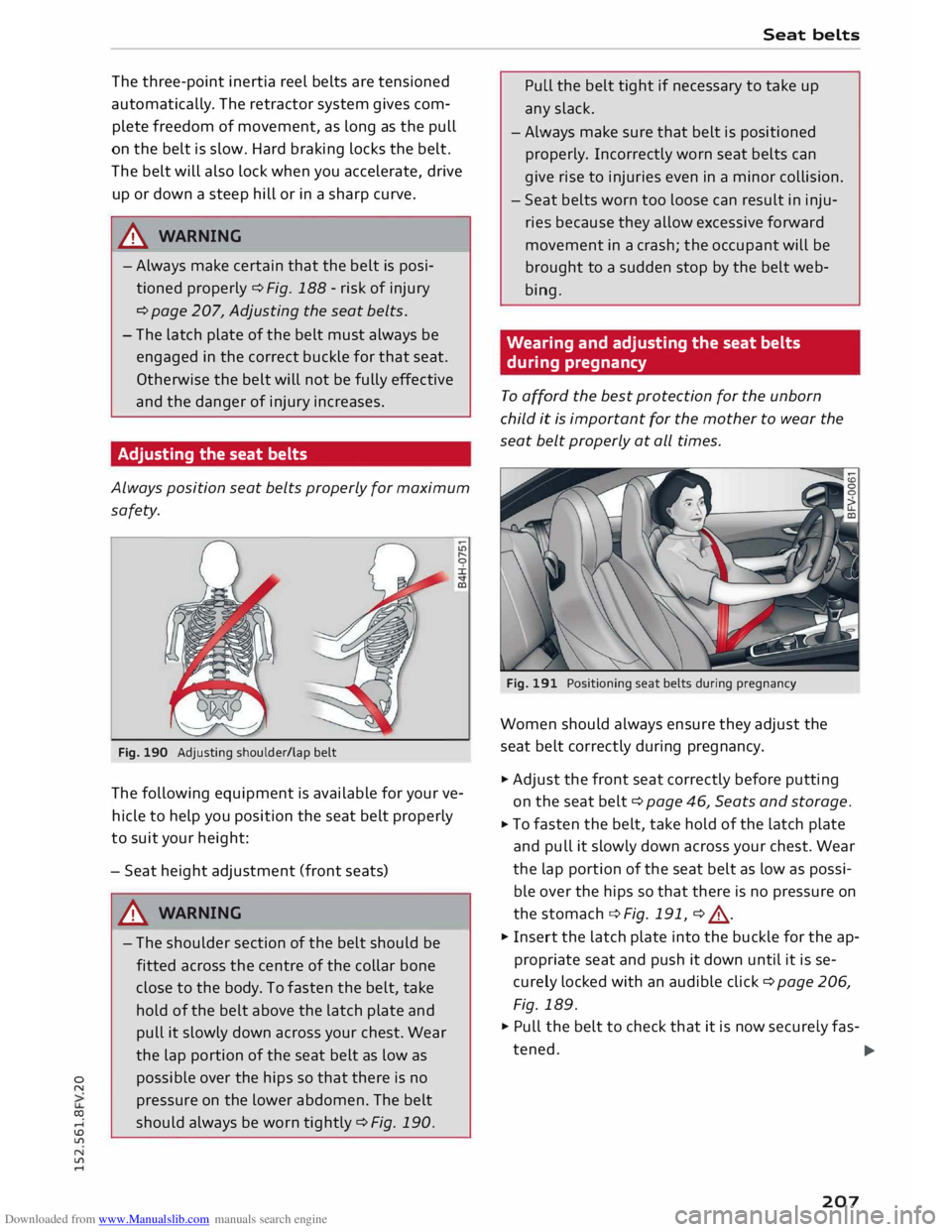
Wearing and adjusting the seat belts
during pregnancy
To afford the best protection for the unborn
child it is important for the mother to wear the
seat belt properly at all times.
Fig. 191 Positioning seat belts during pregnancy
Women should always ensure they adjust the
seat belt correctly during pregnancy.
� Adjust the front seat correctly before putting
on the seat belt¢ page 46, Seats and storage.
� To
fasten the belt, take hold of the latch plate
and pull it slowly down across your chest. Wear
the lap portion of the seat belt as low as possi
ble over the hips so that there is no pressure on
the stomach ¢ Fig. 191, ¢ ,&. .
� Insert the latch plate into the buckle for the ap
propriate seat and push it down until it is se
curely locked with an audible click¢ page 206,
Fig. 189.
� Pull the belt to check that it is now securely fas-
tened. IJJJ.
207