2014 AUDI TT COUPE child seat
[x] Cancel search: child seatPage 206 of 284

Downloaded from www.Manualslib.com manuals search engine Seat
belts
Seat belts
Why is it so important to
use seat belts?
Seat belts provide effective protection
The common belief that passengers can brace
their weight with their hands in a minor collision
is false.
Fig. 183 Driver with properly positioned seat belt -good
protection if the brakes are applied suddenly
It is an established fact that seat belts provide
good protection in accidents. Therefore wearing a
seat belt is required by law in most countries.
Properly worn seat belts hold the occupants in
the best position for maximum protection
¢ Fig. 183. The seat belts are capable of absorb
ing much of the kinetic energy arising in a colli
sion. Also they help to prevent uncontrolled
movements which could lead to severe injuries
¢ page 204, Important safety notes when using
seat belts.
If they wear the seat belts correctly, the passen
gers benefit greatly from the ability of the belts
to reduce the kinetic energy gradually. The front
crumple zones and other passive safety features
(such as the airbag system) are also designed to
absorb the kinetic energy generated in a collision.
Taken together, all these features reduce the
forces acting on the occupants and consequently
the risk of injury.
Although these examples are based on a frontal
collision, the physical principles involved are the
same in other types of accidents. This is why it is
so import ant to put on the seat belts before ev
ery trip -even when "just driving around the cor-
204 ner".
Ensure that your passengers wear their seat
belts as well ¢ ,&.
Properly worn seat belts have been shown to be
an effective means of reducing the potential for
injury and improving the chances of survival in a
serious accident ¢ page 205, Forces acting in a
collision.
For information on how children can travel safely
in the car refer to¢ page 195, Child seats .
.lD.. WARNING
- Seat belts must be put on before every trip -
even when driving in town. This also applies
to the rear passengers -risk of injury!
- During pregnancy, women should always en
sure they wear a seat belt. The best way to
protect the unborn child is to protect the
mother ¢ page 207, Wearing and adjust
ing the seat belts during pregnancy.
Important safety notes when using seat
belts
There are a number of safety points concerning
the seat belts which you should remember. This
will help to reduce the risk of injury in an acci
dent.
.lD.. WARNING
- The seat belts can only provide maximum
protection if the seats are adjusted properly
¢page 46, Seats and storage.
- To ensure proper protection, it is important
to wear the seat belts in the correct position
¢ page 206, How to wear seat belts prop
erly. Ensure that the seat belts are worn ex
actly as recommended in this chapter. Belts
which are not worn properly can increase
the risk of injury in accidents considerably.
- Do not allow the seat belt to become twis
ted or jammed, or to rub on any sharp
edges.
- Never allow two passengers (even children)
to share the same seat belt. It is especially
dangerous to place a seat belt over a child
sitting on your lap.
�
Page 209 of 284
Downloaded from www.Manualslib.com manuals search engine 0
N
co
....
\D L/'l
N
L/'l
.... The
three-point inertia reel belts are tensioned
automatically. The retractor system gives com
plete freedom of movement, as long as the pull
on the belt is slow. Hard braking locks the belt.
The belt will also lock when you accelerate, drive
up or down a steep hill or in a sharp curve.
A WARNING
- Always make certain that the belt is posi
tioned properly ¢ Fig. 188 -risk of injury
¢ page 207, Adjusting the seat belts.
- The latch plate of the belt must always be
engaged in the correct buckle for that seat.
Otherwise the belt will not be fully effective
and the danger of injury increases.
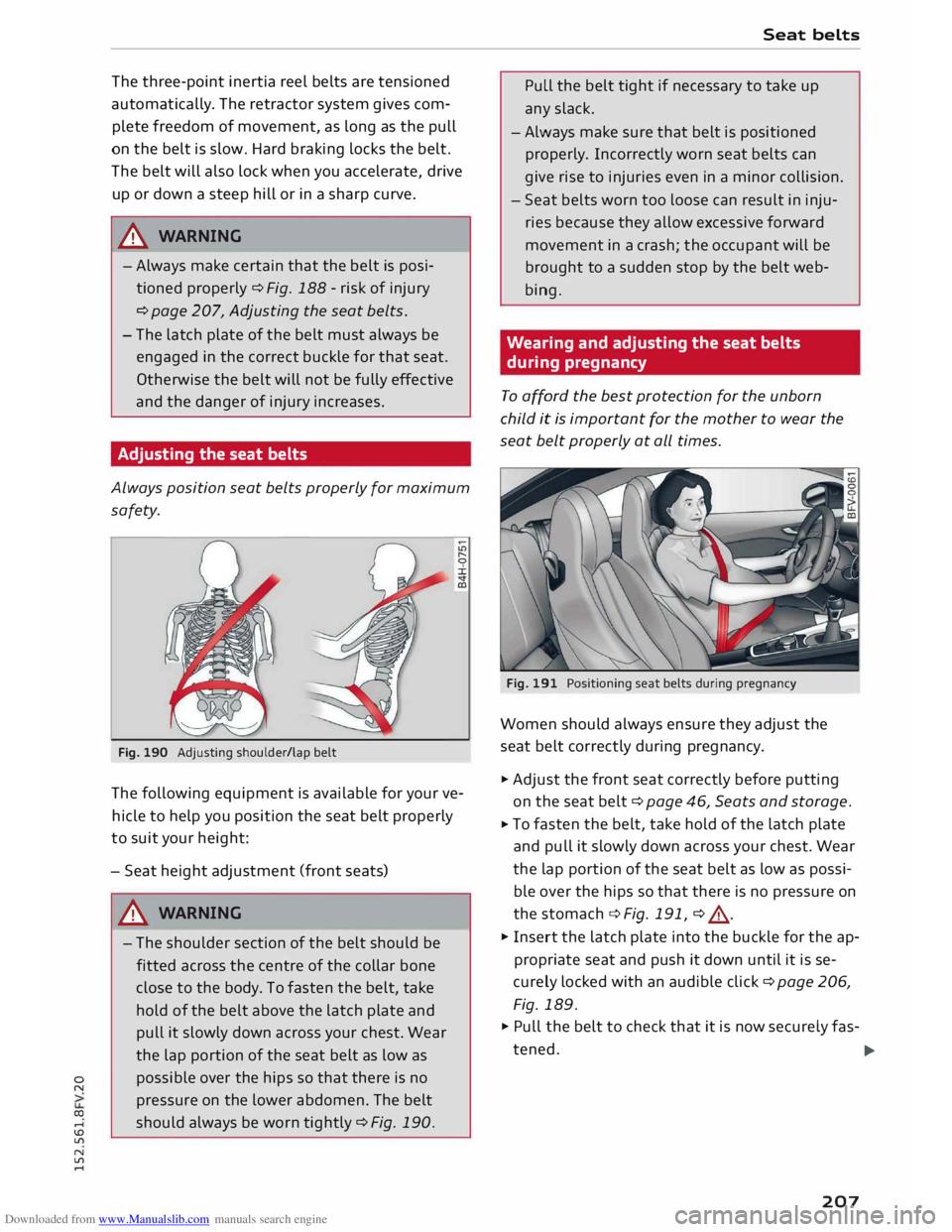
Adjusting the seat belts
Always position seat belts properly for maximum
safety.
Fig. 190 Adjusting shoulder/lap belt
The following equipment is available for your ve
hicle to help you position the seat belt properly
to suit your height:
- Seat height adjustment (front seats)
A WARNING
- The shoulder section of the belt should be
fitted across the centre of the collar bone
close to the body. To fasten the belt, take
hold of the belt above the latch plate and
pull it slowly down across your chest. Wear
the lap portion of the seat belt as low as
possible over the hips so that there is no
pressure on the lower abdomen. The belt
should always be worn tightly¢ Fig. 190 . Seat
belts
Pull the belt tight if necessary to take up
any slack.
- Always make sure that belt is positioned
properly. Incorrectly worn seat belts can
give rise to injuries even in a minor collision.
- Seat belts worn too loose can result in inju
ries because they allow excessive forward
movement in a crash; the occupant will be
brought to a sudden stop by the belt web
bing.
Wearing and adjusting the seat belts
during pregnancy
To afford the best protection for the unborn
child it is important for the mother to wear the
seat belt properly at all times.
Fig. 191 Positioning seat belts during pregnancy
Women should always ensure they adjust the
seat belt correctly during pregnancy.
� Adjust the front seat correctly before putting
on the seat belt¢ page 46, Seats and storage.
� To
fasten the belt, take hold of the latch plate
and pull it slowly down across your chest. Wear
the lap portion of the seat belt as low as possi
ble over the hips so that there is no pressure on
the stomach ¢ Fig. 191, ¢ ,&. .
� Insert the latch plate into the buckle for the ap
propriate seat and push it down until it is se
curely locked with an audible click¢ page 206,
Fig. 189.
� Pull the belt to check that it is now securely fas-
tened. IJJJ.
207
Page 212 of 284

Downloaded from www.Manualslib.com manuals search engine Airbag
system
- For safety reasons, the alternator and the
starter are both disconnected from the bat
tery via a pyrotechnic circuit breaker in se
vere accidents.
-Any repairs to the pyrotechnic circuit
breaker must always be performed by a
qualified workshop - risk of accident!
- The relevant safety requirements must be
observed when the vehicle or the circuit
breaker are scrapped.
When are the airbags triggered?
One or more airbag systems are triggered in se
vere collisions, depending on the circumstances.
The airbag system is not triggered in minor colli
sions, or in rear collisions, or if the car overturns.
In these situations, the occupants are protected
by wearing the seat belts.
Factors determining the triggering response
It is not possible to define the exact triggering
response of the airbag system in all possible sit
uations, since the circumstances in different
types of accident will vary considerably. Impor
tant factors include, for example, the nature
(ha rd or soft) of the object which the car hits, the
angle of impact, vehicle speed and so on.
Whether the airbags are triggered depends pri
marily on the vehicle deceleration rate resulting
from the collision. By processing the signals from
the sensors located in the vehicle, the electronic
control unit is immediately able to evaluate the
severity of the collision and activate the restraint
systems accordingly. If the deceleration rate is
below the predefined reference value in the con
trol unit the airbags will not be triggered, even
though the accident may cause extensive damage
to the car.
([J) Note
The airbag releases a fine dust when it in
flates. This is quite normal and does not
mean there is a fire in the vehicle.
l l
Not available in all export vehicles.
210 Front
airbags
Important notes on front passenger's
airbag
A AIRBAG
�� � t4 (ill
c::::::=J
®
CJO
00
\1 '� ,�(]
-� ,Y
.;::p
Fig. 193 Front passenger's sun visor: Airbag sticker
A sticker 1
>
with important information about the
front passenger's airbag is provided on the front
passenger's sun visor. Please refer to the safety
notes in the following chapters:
- Child seats and front passenger's airbag
¢ page 195, Safety notes for using child seats
- Safe distance from front passenger's airbag
¢ page 213, Important safety notes on the
front airbag system
- Objects between front passenger and front pas
senger's airbag c:::>page 213, Important safety
notes on the front airbag system
Page 213 of 284

Downloaded from www.Manualslib.com manuals search engine Deactivating
the front passenger's airbag
Applies to vehicles: with key-operated switch for front pas
senger's airbag
If an airbag has been deactivated, it should be
reactivated as soon as possible so that it can
continue to give the required protection.
Fig. 194 Glove box: Key-operated switch for deactivating
front passenger's airbag
Fig. 195 Headliner: Warning lamp lights up when pas
senger's airbag is deactivated
... To deactivate the front passenger's airbag, use
the key to turn the key-operated switch to@
(OFF) ¢ Fig. 194 .
... The front passenger's airbag can be reactivated
by turning the key to position (D (ON).
Deactivating front passenger's airbag when a
child seat is in use
If you have no alternative but to install a rear
ward-facing child seat on the front passenger's
seat you must deactivate the front passenger's
airbag beforehand.
Monitoring of airbag system
The indicator lamp JJI ¢ page 14 will light up for
"' a few seconds every time the ignition is switched
� on.
,-1
\D U'l
N
U'l
,-1 Airbag
system
If the front passenger's airbag has been deactiva
ted, the indicator lamp "PASSENGER AIR BAG
OFF "or" AIR BAG OFF" will light up con
stantly as a reminder ¢Fig. 195.
When the front passenger's airbag is deactivated,
the seat belt warning lamp for the front passen
ger. ¢ page 13 is also switched off.
A WARNING
- If you have no alternative but to install a
rearw ard-facing child seat on the front pas
senger's seat, the front passenger's airbag
must be deactivated beforehand. Potentially
fatal injuries to the child can result if the
front passenger's airbag is not deactivated
¢page 195!
- If you have deactivated the front passeng
er's airbag, reactivate it as soon as the child
seat is no longer needed so that the airbag
can continue to give the required protection.
- It is the driver's responsibility to ensure that
the key-operated switch is set to the correct
position.
((J) Note
All the
other
airbags in the car will remain
functional if the front passenger's airbag has
been deactivated with the key-operated
switch .
211
Page 215 of 284

Downloaded from www.Manualslib.com manuals search engine 0
N
co
....
\D U'l
N
U'l
.... Important
safety notes on the front airbag
system
There are a number of safety points concerning
the airbag system which you should remember.
This will help to reduce the risk of injury in an ac
cident.
Fig. 199 Minimum distance from steering wheel
A WARNING
- It is important for the driver and front pas
senger to maintain a distance of at least
25 cm from the steering wheel or dash
board ¢Fig. 199. The airbag system will not
be able to give the required protection if you
sit too close to the steering wheel or dash
board. There is also a risk of injury if the air
bags are inflated. Additionally, the front
seat position should always be adjusted to
the body size of the occupant.
- If you do not wear a seat belt, if you lean
forward or to the side, or are not seated cor
rectly while the vehicle is in motion, you are
at greater risk of injury. Should the airbag
system be triggered in an accident there is
an even greater risk of injury.
- Never let a child travel on the front seat
without an appropriate restraint system. If
the airbag is triggered in an accident, the
child could sustain serious or fatal injuries
¢page 195, Child seats.
- Child seats in which the child faces the rear
of the car are located directly in the path of
the front passenger's airbag if it inflates. In
this case, the child could sustain serious or
fatal injuries if the airbag were to be de
ployed. 0
lt')
"
0
sf
CD
- Airbag
system
- Applies to vehicles on which the front pas
senger's airbag cannot be deactivated: Do
NOT use a rearward-facing child seat on
the front passenger's seat.
- Applies to vehicles with key-operated
switch for deactivating the front passeng
er's airbag: Do NOT use a rearward-facing
child seat on the front passenger's seat
while the front passenger's airbag is ac
tive. If you have no alternative but to use a
rear ward-facing child seat on the front
passenger's seat, the front passenger's
airbag must be deactivated beforehand via
the key-operated switch* ¢ page 211.
Make sure that the front passenger's air
bag is reactivated by means of the key-op
erated switch* as soon as the child seat is
no longer needed on the front passenger's
seat.
- Occupants sitting in the front of the car
must never carry any objects or pets in the
space between them and the airbags, or al
low children or other passengers to travel in
this position.
- Do not cover or stick anything on the steer
ing wheel hub or the soft plastic surface of
the airbag unit on the passenger's side of
the dashboard, and do not obstruct or modi
fy them in any way. These parts should only
be cleaned with a dry cloth (or with a cloth
moistened with plain water). It is also im
portant not to attach any objects such as
cup holders or telephone mountings to the
surfaces covering the airbag units.
- Any work on the airbag system or removal
and installation of the airbag components
for other repairs (such as repairs to the
steering wheel or removal of seats) must be
performed by a qualified workshop.
213
Page 216 of 284

Downloaded from www.Manualslib.com manuals search engine Airbag
system
Side airbags
Description of side airbags
Applies to vehicles: with side airbags
The airbag system is not a substitute for the seat
belts.
Fig. 200 Location of side airbag in driver's seat
The side airbags are located in the backrest pad
ding of the front seats¢ Fig. 200. The locations
of the airbags are marked with the word "AIR
BAG".
In conjunction with the seat belts, the side air
bags give the occupants additional protection for
the whole upper part of the body (i.e. the chest,
stomach and pelvis) in the event of a severe side
collision ¢&. in Important safety notes on the
side airbag system on page 214.
In a side collision the side airbags reduce the risk
of injury to the areas of the body facing the im
pact.
How the side airbags work
Applies to vehicles: with side airbags
When fully inflated, the side airbags reduce the
risk of injuries to the upper part of the body.
Fig. 201 Side airbag in inflated condition
214 In
certain types of side collision, the side airbag
is triggered on the impact side of the vehicle
¢ Fig. 201. Further airbag systems may also be
triggered, depending on the circumstances.
When the system is triggered, the airbag is filled
with propellant gas.
In order to provide the desired extra protection in
an accident, the airbags have to inflate extremely
rapidly (within fractions of a second). The airbag
releases a fine dust when it inflates. This is quite
normal and does not mean there is a fire in the
vehicle.
When fully deployed, the airbags cushion the im
pact for the occupants and help to reduce the risk
of injury to the whole upper part of the body (i.e.
the chest, stomach and pelvis) on the side facing
the door.
Important safety notes on the side airbag
system
Applies to vehicles: with side airbags
There are a number of safety points concerning
the airbag system which you should remember.
This will help to reduce the risk of injury in an ac
cident.
A WARNING
- If you do not wear a seat belt, if you lean
forward, or are not seated correctly while
the vehicle is in motion, you are at greater
risk of injury should the side airbags be trig
gered in an accident.
- If children are not seated correctly, they are
at greater risk of injury in an accident. This
is particularly the case if the child is travel
ling on the front passenger's seat and the
airbag system is triggered in an accident.
This could result in serious or potentially fa
tal injury ¢page 195, Child seats.
- It is also important not to attach any acces
sories (such as cup holders) to the doors.
This would impair the protection offered by
the side airbags.
- The sensors for the airbags are located in
the front doors. You must therefore not
make any modifications to the doors or door
�
Page 228 of 284

Downloaded from www.Manualslib.com manuals search engine Checking
and topping up fluids
Brake fluid
&
8cm DOT 4 0
0
Fig. 215 Engine compartment: Cap of brake fluid reservoir
Checking brake fluid level
The brake fluid Level must be between the MIN
and MAX marks on the reservoir ¢ page 222,
Fig. 211.
If the Level goes down noticeably in a short time,
or drops below the MIN mark, there may be a
Leak in the brake system. Obtain professional as
sistance. The brake fluid Level is also monitored
via a warning Lamp on the infotainment display
¢page 11.
In right-hand drive vehicles the brake fluid reser
voir is on the other side of the engine compart
ment.
Changing brake fluid
Your vehicle's Service Schedule will tell you the
regular intervals at which the brake fluid is due
for renewal. We recommend that you have the
brake fluid changed by a qualified workshop dur
ing a service.
A WARNING
- Brake fluid is poisonous; it must be stored in
the sealed original container in a safe place
out of the reach of children.
- Heavy use of the brakes may cause a vapour
Lock if the brake fluid is left in the system
for too Long. This would seriously affect the
efficiency of the brakes and the safety of the
car -risk of accident!
226 CD
CAUTION
Brake fluid must not be allowed to come into
contact with the vehicle's body, otherwise it
will attack the paintwork.
Battery General notes
ALL work on batteries requires specialist knowl
edge.
The battery is virtually maintenance-free. It is
checked as part of the Inspection Service.
When an airbag is triggered, the battery will, un
der certain circumstances, be disconnected from
the on-board power supply for safety reasons
¢ .&.. in General notes on airbag system on
page 209.
Disconnecting the battery
The battery should always be Left connected. If
the battery is disconnected, some of the vehicle's
functions will become inoperative (e.g. electric
windows). These functions will require resetting
after the battery is reconnected. For this reason,
the battery should only be disconnected from the
vehicle's electrical system when absolutely nec
essary.
If the vehi cle is not used for long periods
If you do not drive your vehicle for a period of
several days or weeks, the power management
will gradually shut off the on-board systems one
by one, or reduce the amount of current they are
using. This Limits the amount of power consumed
and helps to ensure reliable starting even after a
Long period ¢ page 106. Certain convenience fea
tures, such as interior Lighting or electric seat ad
justment, may not be available. These functions
will be restored when you switch on the ignition
and start the engine. Even though some systems
are deactivated automatically, certain electrical
equipment continues to draw current even when
the ignition is off. If the vehicle is Left standing
for several months, this can result in total bat-
tery discharge. If the battery is allowed to dis
charge completely, an internal chemical reaction
..,_
Page 267 of 284

Downloaded from www.Manualslib.com manuals search engine 0
N
co
....
\D L/'l
N
L/'l
.... Bluetooth
Audio player ........................ 171
Connecting a mobile phone . . . . . . . . . . . .
124
Device search . . . . . . . . . . . . . . . . . . . . . . .
134
Handsfree Profile . . . . . . . . . . . . . . . . . . . .
123
Remote SIM Access Profile (rSAP) . . . . . . .
123
Secure simple pairing . . . . . . . . . . . . 124, 137
Settings . . . . . . . . . . . . . . . . . . . . . . . . . . . 134
Boot see Luggage compartment . . . . . . . . . . . . 201
Boot lid
Manual release . . . . . . . . . . . . . . . . . . . . . . .
33
Opening/closing . . . . . . . . . . . . . . . . . . . . . .
32
Brakes . . . . . . . . . . . . . . . . . . . . . . . . . . . . . .
101
Brake assist system . . . . . . . . . . . . . . . . . .
102
Brake fluid . . . . . . . . . . . . . . . . . . . . . . . . .
226
Brake pads worn . . . . . . . . . . . . . . . . . . . . . . 14
Brake pedal . . . . . . . . . . . . . . . . . . . . . . . .
200
Brake servo . . . . . . . . . . . . . . . . . . . . . . . . .
101
Driving away on a slope . . . . . . . . . . . . . . . . 69
Emergency braking aid . . . . . . . . . . . . . . . 102
Emergency braking function . . . . . . . . . . . .
68
Indicator lamp . . . . . . . . . . . . . . . . . . . . . . .
14
New brake pads . . . . . . . . . . . . . . . . . . . . . 101
Parking brake . . . . . . . . . . . . . . . . . . . . . . . . 66
Warning lamp . . . . . . . . . . . . . . . . . . . . . . . 11
Bulbs, changing . . . . . . . . . . . . . . . . . . . . . . 256
Buttons MMI control console . . . . . . . . . . . . . . . . . 109
Multi-function steering wheel.. . . . . . . 19, 21
C
Cables AUX adapter . . . . . . . . . . . . . . . . . . . . . . . .
174
USB adapter . . . . . . . . . . . . . . . . . . . . . . . .
174
Calling up a menu . . . . . . . . . . . . . . . . . . . . .
109
Calling up media . . . . . . . . . . . . . . . . . . . . . . 179
Call list
MMI control console . . . . . . . . . . . . . . . . .
128
Speech dialogue system . . . . . . . . . . . . . .
118
Call options . . . . . . . . . . . . . . . . . . . . . . . . . .
134
Calls Answering/ignoring . . . . . . . . . . . . . . . . . . 128
Hold/resume . . . . . . . . . . . . . . . . . . . . . . . 129
see also Telephone . . . . . . . . . . . . . . . . . .
123
Call waiting . . . . . . . . . . . . . . . . . . . . . . . . . .
134
Camera-based traffic sign recognition . . . . . 23 Index
Capacities Fuel tank .......................... .
258
Washer fluid reservoir . . . . . . . . . . . . . . . .
258
Caps for wheel bolts, removing . . . . . . . . . .
244
Car care
Washing/cleaning . . . . . . . . . . . . . . . . . . .
236
Car keys . . . . . . . . . . . . . . . . . . . . . . . . . . . . . . 25
Car telephone kit
see Telephone . . . . . . . . . . . . . . . . . . . . . .
123
Catalytic converter . . . . . . . . . . . . . . . . . . . .
220
CD ............................. 169, 170
Central locking system . . . . . . . . . . . . . . . . . .
25
Boot lid . . . . . . . . . . . . . . . . . . . . . . . . . . . . .
32
Central locking switch . . . . . . . . . . . . . . . . .
29
Convenience key . . . . . . . . . . . . . . . . . . . . . .
28
Electric windows . . . . . . . . . . . . . . . . . . . . .
34
Locking doors manually . . . . . . . . . . . . . . . .
30
Remote control key . . . . . . . . . . . . . . . . . . .
28
Settings . . . . . . . . . . . . . . . . . . . . . . . . . . . .
30
Centre console lighting, adjusting brightness
.41
Cetane number (diesel) . . . . . . . . . . . . . . . .
217
Changing bulbs . . . . . . . . . . . . . . . . . . . . . . .
256
Charging battery... . . . . . . . . . . . . . . . 175, 176
Child lock (DVD) . . . . . . . . . . . . . . . . . . . . . .
183
Child seats 195
Categories . . . . . . . . . . . . . . . . . . . . . . . . .
197
ISOFIX . . . . . . . . . . . . . . . . . . . . . . . . . . . . 198
ISOFIX and top tether . . . . . . . . . . . . . . . . 199
Side airbags . . . . . . . . . . . . . . . . . . . . . . . . 196
Cigarette lighter . . . . . . . . . . . . . . . . . . . . . . . 48
City events (Audi connect) . . . . . . . . . . . . . . 141
Cleaning . . . . . . . . . . . . . . . . . . . . . . . . . . . .
236
Cleaning/de-icing windows . . . . . . . . . . . . .
238
Cleaning/ treating natural leather . . . . . . . .
239
Cleaning Alcantara
239
Cleaning Audi virtual cockpit . . . . . . . . . . . . 238
Cleaning carbon parts . . . . . . . . . . . . . 238, 239
Cleaning controls and displays . . . . . . . . . .
238
Cleaning displays . . . . . . . . . . . . . . . . . . . . .
238
Cleaning fabrics
239
Cleaning instrument cluster . . . . . . . . . . . .
238
Cleaning leatherette . . . . . . . . . . . . . . . . . . .
239
Cleaning plastic parts . . . . . . . . . . . . . . . . . .
238
Cleaning seat upholstery . . . . . . . . . . . . . . . 239
Closed roads
154
265