2014 AUDI TT COUPE check oil
[x] Cancel search: check oilPage 223 of 284

Downloaded from www.Manualslib.com manuals search engine 0
N
co
....
\D L/'l
N
L/'l
.... -
Never spill fluids on a hot engine. These flu
ids can cause a fire (e.g. radiator anti
freeze).
- Take care not to cause short circuits in the
electrical system, especially when working
on the battery.
- When working in the engine compartment
be aware that the radiator fan may start
running suddenly, even if the ignition is
switched off-risk of injury!
- Do not unscrew the cap on the expansion
tank when the engine is hot. The cooling
system is under pressure.
- Protect face, hands and arms by covering
the cap with a large, thick rag to protect
against escaping coolant and steam.
- Never remove the engine cover panel -risk
of burns!
- If any tests have to be performed with the
engine running, there is an extra safety risk
from the rotating parts, such as the drive
belts, alternator and radiator fan, etc., and
from the high-voltage ignition system.
- Vehicles with automatic gearbox: Never
open the throttle inadvertently (for instance
by hand from the engine compartment) if a
gear is engaged while the vehicle is station
ary with the engine running. The vehicle
could otherwise start moving immediately
and possibly cause an accident.
- Observe the following additional warnings if
work on the fuel system or the electrical
system is necessary:
- Always disconnect the battery.
- Do not smoke.
- Never work near naked flames.
- Always keep an approved fire extinguisher
immediately available.
CD CAUTION
When topping up fluids make sure the correct
fluid is put into the correct filler opening. This
can otherwise cause serious malfunctions or
engine damage. Checking
and topping up fluids
® For the sake of the environment
Inspect the ground underneath your vehicle
regularly so that any leaks are detected at an
early stage. If you find spots of oil or other
fluids, have your vehicle inspected in the
workshop.
{D) Note
On right-hand drive vehicles* some of the
containers/ reservoirs mentioned below are
located on the other side of the engine com
partment.
Opening the bonnet
The bonnet is released from inside the vehicle.
Fig. 209 Footwell on driver's side: Release lever
Fig. 210 Unlocked bonnet: Lever
The wiper arms should be resting on the wind
screen: make sure they are not in a raised posi
tion. Otherwise the paint may get damaged.
� With the driver's door open, pull the lever un
der the dashboard in the direction indicated (ar
row) ¢ Fig. 209.
� Lift the bonnet slightly¢.&_.
11111>
221
Page 224 of 284

Downloaded from www.Manualslib.com manuals search engine Checking
and topping up fluids
.. Press the release lever ¢Fig. 210 in the direc
tion indicated (arrow). This will release the ar
rester hooks.
.. Open the bonnet.
& WARNING
To avoid the risk of being scalded, never open
the bonnet if you see steam or coolant escap
ing from the engine compartment. Wait until
no steam or coolant can be seen before open
ing the bonnet.
Closing the bonnet
.. To close the bonnet, pull it down to overcome
the spring pressure.
Engine compartment layout
Main components for checking and refilling ..
Then let it drop into the catches; do not press
down ¢,8. .
& WARNING
- For safety reasons the bonnet must always
be completely closed when the vehicle is
moving. After closing it always check that it
is properly secured. The bonnet must be
flush with the adjacent body panels.
- Should you notice that the bonnet is not
safely secured when the vehicle is moving,
stop the vehicle immediately and close the
bonnet properly, otherwise it could cause an
accident .
Fig. 211 Typical locations of fluid containers and engine oil filler cap
(D Coolant expansion tank (-L) .....
@
@
@ Engine
oil dipstick ............ .
Engine oil filler cap(�)
...... .
Brake fluid reservoir ((0))
222 225
®
223
224 ®
226 0 Jump-start
terminals: under a cover
(+); earth point on body(-) ...
...
249
Fuse box ..................... 254
Windscreen washer container (W)
229 ....
Page 225 of 284

Downloaded from www.Manualslib.com manuals search engine 0
N The
positions of the engine oil dipstick and en
gine oil filler cap ¢Fig. 211 (items @and @)
may be different on some engine versions.
Engine oil
Choosing the correct engine oil grade
The service interval display in the instrument
cluster of your vehicle will inform you when it is
time for an oil change. We recommend having
the oil changed by a qualified workshop.
If you have to top up the oil between oil changes,
use the grades of oil specified in the table in ac
cordance with VW standards. You will need to
know whether
- the vehicle is being serviced based on the flexi
ble or fixed oil change service (see Last service
record in Service Schedule).
- the vehicle has a petrol or diesel engine (see
sticker on inside of fuel tank flap).
- a diesel particulate filter is fitted on the vehicle
(see Delivery Inspection section of Service
Schedule).
Oil Change Serv-
Oil Change Serv-
ice (flexible)
ice (fixed)
Petrol VW50400 vw
502 00
engine Alternatively:
vw 504 ooa)
Diesel VW50700 With
diesel par-
engine ticulate
filter:
VW 507 00
Without diesel
particulate filter:
vw 505 01
Alternatively: vw 507 oob
>
al When using fuel complying with EN 228 or DIN 51626-1
b) When using fuel complying with EN 590 or DIN 51628
CD} Note
If the oil grades specified in the table are not
available, you can use one of the following
....
� grades
as a substitute. To prevent damage to
� the
engine, this should not be done more
.... Checking
and topping up fluids
than once between oil changes and no more
than 0.5 Litres should be used.
- Petrol engines: ACEA A3 or API SN (API SM)
standard
- Diesel engines: ACEA C3 or API CJ-4 stand
ard
(©) Note
- For China: Only oil complying with VW
standard 502 00 with viscosity SAE 5W-40
may be used on vehicles with a petrol en-
gine.
- The flexible oil change service is not availa
ble in all countries.
Checking the engine oil level
Fig. 212 Guide for oil dipstick
Checking oil level
.,. Park your vehicle on a Level surface.
.,. Allow the warm engine to run briefly at idling
speed and then switch off the ignition.
.,. Wait approx. two minutes.
.,. Pull out the dipstick. Wipe the dipstick with a
clean cloth and insert it again, pushing it in as
far as it will go.
.,. Then pull the dipstick out again and check the
oil level ¢ Fig. 212. If the oi L Level is too Low,
add more engine oil¢ page 224.
Oil level in area 0
.,. Do not top up oil.
Oil level in area @
.,. Oil can be topped up. After topping up the oil (£)
(£)
N
0
co
(Il
Level should be in area 0·
..,
223
Page 226 of 284

Downloaded from www.Manualslib.com manuals search engine Checking
and topping up fluids
Oil level in area @
.. Oil
must be topped up. After topping up the oil
Level should be in area 0-
Depending on how you drive and the conditions
in which the car is used, oil consumption can be
up to 0.5 Ltr./1000 km. Oil consumption is Likely
to be higher for the first 5000 km. For this rea
son the engine oil Level must be checked at regu
lar intervals, preferably when filling the tank and
before a journey.
Topping up the engine oil "t::r.
Fig. 213 Engine compartment: Engine oil filler cap
.. Switch off the engine.
.. Unscrew cap� from oil filler opening
¢Fig. 213, ¢page 222, Fig. 211.
.. Carefully
add 0.5 Litres of suitable oil
¢page 223. 0
N
N
(X)
cc
.. After two minutes check the oil Level once again
¢ page 223, Checking the engine oil Level.
.. If
the oil Level is too Low, add more engine oil.
.. Replace the oil filler cap carefully and push the
dipstick all the way in.
_& WARNING
- Ensure that no oil comes into contact with
hot engine components when topping up:
this could cause a fire.
- Wash your skin thoroughly if it comes into
contact with engine oil.
CD CAUTION
- The oil Level must never be above area 0, as
this may result in damage to the catalytic
converter or to the engine. Contact a qua Li-
224 fied
workshop to extract the engine oil if
necessary
- No additives should be used with engine oil.
Any damage caused by the use of such addi
tives would not be covered by the factory
warranty.
@ For the sake of the environment
- Never pour oil down drains or into the
ground.
- Always observe statutory requirements
when disposing of empty oil canisters.
Cooling system
Coolant
The engine cooling system is filled at the factory
with a mixture of conditioned water and coolant
additive. This coolant must not be changed.
The coolant Level is monitored via a warning Lamp
on the infotainment display ¢page 12. However,
we re com mend that it shou Ld be checked occa
sionally.
If you do need to top up the coolant, use a mix
ture of water and coolant additive. We recom
mend mixing coolant additive with distilled wa
ter .
Coolant additive
The coolant additive contains anti-freeze and cor
rosion protection agent. Only use one of the fol
lowing coolant additives. It is possible to mix
these additives.
Coolant additive Specification
G12++ TL
774 G
G13 TL
774 J
Only if the above
grades are not availa- TL
774 F
ble: G12+
The amount of coolant additive which needs to
be mixed with the water depends on the temper
atures to be expected in the winter season. If the
anti-freeze concentration is too Low, the coolant
can freeze and cause engine damage.
Page 227 of 284

Downloaded from www.Manualslib.com manuals search engine 0
N
co
....
\D Lfl
N
Lfl
.... Coolant
addi-Frost protec-
tive tion
Countries with min. 40 %,
min. -25 °C
warm climate max. 45 %
Countries with min.
50 %,
max. -40 °C
cold climate max.
60 %
CD CAUTION
- Have your qualified workshop check the
cooling system before the winter season to
make sure that the anti-freeze concentra
tion is adequate for the conditions to be ex
pected. This applies particularly if you drive
into a colder climate zone.
- To prevent damage to the engine, do not
use a different type of anti-freeze additive if
the approved type of additive is not availa
ble. In this case use only water and bring
the coolant concentration back up to the
correct level as soon as possible by putting
in the specified additive.
- Always top up with fresh, unused coolant.
- Radiator sealants must not be added to the
coolant.
Topping up coolant
Fig. 214 Engine compartment: Cap of coolant expansion
tank
Checking coolant level
.. Park
your vehicle on a level surface .
.. Switch off the ignition .
.. Read off the coolant level on the coolant expan
sion tank ¢ page 222, Fig. 211. When the en
gine is cold, the coolant level should be be
tween the marks. When the engine is warm, it
may be slightly above the top mark. Checking
and topping up fluids
Topping up coolant
Impor tant: The coolant expansion tank must not
be empty ¢(D.
.. Wait for the engine to cool down.
.. Cover the cap on the expansion tank with a
cloth, and carefully unscrew the cap anti-clock
wise ¢ .&_ .
.. Add coolant in the correct concentration
¢ page 224 up to the top mark.
.. You should make sure that the fluid level re-
mains stable. If necessary, add more coolant.
.. Screw the cap on again tightly.
Any loss of coolant normally indicates a leak in
the cooling system. Drive to a qualified workshop
without delay and have the cooling system
checked. If there are no leaks in the system, a
loss of coolant can only occur if the coolant boils
and is forced out of the system as a result of
overheating.
A WARNING
- The cooling system is under pressure. Do
not unscrew the cap on the expansion tank
when the engine is hot: you could be scal
ded by escaping steam.
- The coolant and coolant additive can be a
health hazard. Store the coolant additive in
the original container in a safe place out of
reach of children -risk of poisoning.
- When working in the engine compartment
be aware that the radiator fan may start
running suddenly, even if the ignition is
switched off-risk of injury!
CD CAUTION
Do not add coolant if the expansion tank is
empty. Air could have got into the cooling sys
tem -risk of engine damage! In this case, do
NOT drive on. Obtain professional assistance .
225
Page 232 of 284

Downloaded from www.Manualslib.com manuals search engine Checking
and topping up fluids
- Inspection or oil change reminder: After acer
tain mileage, a service reminder will appear on
the infotainment display each time the ignition
is switched on/off¢ Fig. 218. The distance or
time remaining will be shown briefly.
- Inspection or oil change due: When your vehi
cle is due for an inspection, oil change or both,
the corresponding reminder Inspection due!,
Oil change due! or Oil change and inspection
due! will appear briefly after you switch the ig
nition on/off.
Checking the service intervals
You can look up the distance and time remaining
until the next oil change and next service inspec
tion. Select the following on the infotainment
system: I MENU I button > Car > left control button
> Se rvicing & checks > Service intervals. You can
not check the service interval for the first 500 km
or so after resetting the display or when your ve
hicle is new.
CD CAUTION
- Keeping to the correct service intervals is
most important for the service life and re
sidual value of the vehicle (and especially
for the life of the engine). Services must al
ways be carried out promptly, even if the
mileage is low.
- The time until the next oil change is not
counted down if the battery is disconnec
ted. If your vehicle is out of service for an
extended period, please refer to the Service
Schedule for details of the next service
date.
230
Page 244 of 284
Downloaded from www.Manualslib.com manuals search engine Mobility
Tool kit/tyre repair kit/compressor
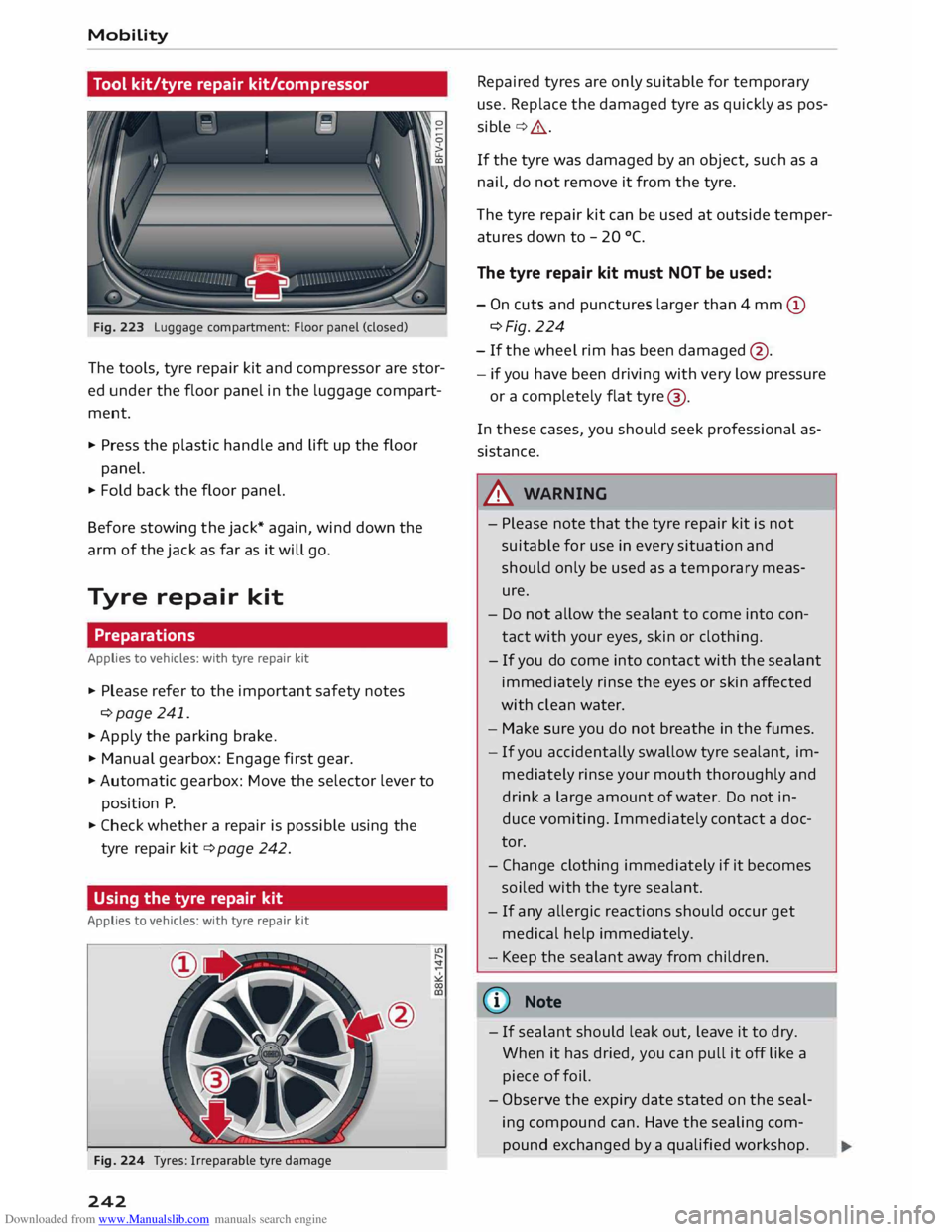
Fig. 223 Luggage compartment: Floor panel (closed)
The tools, tyre repair kit and compressor are stor
ed under the floor panel in the luggage compart
ment.
"' Press the plastic handle and Lift up the floor
panel.
"' Fold back the floor panel.
Before stowing the jack* again, wind down the
arm of the jack as far as it will go.
Tyre repair kit
Preparations
Applies to vehicles: with tyre repair kit
"' Please refer to the important safety notes
¢page 241.
"'Apply the parking brake.
"' Manual gearbox: Engage first gear.
"' Automatic gearbox: Move the selector lever to
position P.
"' Check whether a repair is possible using the
tyre repair kit¢ page 242.
Using the tyre repair kit
Applies to vehicles: with tyre repair kit
Fig. 224 Tyres: Irreparable tyre damage
242 Repaired
tyres are only suitable for temporary
use. Replace the damaged tyre as quickly as pos
sible ¢,&..
If the tyre was damaged by an object, such as a
nail, do not remove it from the tyre.
The tyre repair kit can be used at outside temper
atures down to - 20 °(.
The tyre repair kit must NOT be used:
- On cuts and punctures larger than 4 mm (D
¢Fig. 224
- If the wheel rim has been damaged @.
- if you have been driving with very low pressure
or a completely flat tyre@
.
In these cases, you should seek professional as
sistance.
A WARNING
- Pl ease note that the tyre repair kit is not
suitable for use in every situation and
should only be used as a temporary meas
ure.
- Do not allow the sealant to come into con
tact with your eyes, skin or clothing.
- If you do come into contact with the sealant
immediately rinse the eyes or skin affected
with clean water.
- Make sure you do not breathe in the fumes.
- If you accidentally swallow tyre sealant, im-
mediately rinse your mouth thoroughly and
drink a large amount of water. Do not in
duce vomiting. Immediately contact a doc
tor.
- Change clothing immediately if it becomes
soiled with the tyre sealant.
- If
any allergic reactions should occur get
medical help immediately.
- Keep the sealant away from children.
(©) Note
- If sealant should leak out, leave it to dry.
When it has dried, you can pull it off Like a
piece of foil.
- Observe the expiry date stated on the seal
ing compound can. Have the sealing com
pound exchanged by a qualified workshop.
Page 257 of 284

Downloaded from www.Manualslib.com manuals search engine 0
N
co
....
\D L/'l
N
L/'l
.... ,&.
WARNING
Never attempt to repair a fuse or replace a
blown fuse by fitting a fuse with a higher am
pere rating. This could damage the electrical
system -risk of fire!
CD CAUTION
If a newly replaced fuse blows again after a
short time, the electrical system must be
checked by a qualified workshop as soon as
possible.
@ Note
- Unassigned fuse locations are not shown in
the tables below.
- Some of the items of equipment listed in
the tables below are only fitted on certain
models or are optional extras.
Fuses in vehicle interior
Fig. 246 Interior: Fuse layout
No. Electrical
equipment
F3 ESC
control unit
F4 Central computer (MIB-2)
FS Gateway No.
F6
F7
F8 F9
FlO Fll
F12
F13
F14
FlS
F16
F17
F18
Fl9
F20
F23
F25
F26
F28
F29
F31
F32 F33
F34
F35
F36 F37
F38 F39 Fuses
and bulbs
Electrical equipment
Anti-theft alarm system
Air conditioner console, selector lever (au-
tomatic gearbox), auxiliary heating, relay
coil for rear window heating
Diagnostics, switch for electronic parking
brake, light switch, rain/light sensor, inte-
rior lighting
Steering column switch module
Display
Haldex coupling
MMI system
Control unit for suspension control
Air conditioner blower
Electric steering column lock
MMI system
Instrument cluster
Reversing camera
Control unit for convenience key system
Electric lumbar support adjuster
Exterior lighting (right side), on-board
computer (right side)
Door/s, driver's side (e.g. electric windows)
Seat heating
Media socket for AMI High
On-board computer
On-board computer (left side)
Driver assistance systems
Airbag Electrical socket relay, interior sound, re-
versing light switch, temperature sensor,
oil level sensor
Diagnostics, headlight range control, air
quality sensor, automatic anti-dazzle mir-
rors
Corn ering light (right side)/ LED headlight
(right side)
Cornering light (left side) / LED headlight
(left side)
Engine control unit, ESC control unit
Door(s), passenger's side (e.g. electric win-
dows)
255