2014 AUDI S8 lock
[x] Cancel search: lockPage 229 of 314

Fuel filler flap emergency release
You can open the fuel filler flap by hand if the
power locking system should fail.
Fig . 192 Veh icles w it h select ive catalytic reduct ion :
R ig ht side trim pane l
Fig . 1 93 Right side trim pa ne l in the lu ggage compart
ment: emergency release mechan ism
The emergency release mechanism is located
behind the right side trim pa ne l in the lug
gage compartmen t. In vehicles with se lec tive
catalyt ic red uction *, remove the ve nt gri lle
first:
• Press b oth tabs @
r:::;, fig. 192 and ti lt the
ven t grille downward . You can then remove
t h e g rille upwa rd .
• Loosen the loop
r:::;, fig. 193 from the retainer
and then pull on the loop carefully
r:::;, (D ,
• Press on the left s ide of the fuel filler door
to open
r:::;, page 225, fig . 190.
(D Note
O nl y pull on the loop until you feel resist
ance. You will not hear it release. Other
w ise you cou ld damage t he emergency re
lease mechanism .
Fuel suppl y and filli ng your fuel t ank 22 7
Selective catalytic
reduction
General information
Applies to vehicles: wi th diesel engine
On vehicles with se lective cata lytic reduction,
an urea solution (AdB lue) is injected into the
exhaust system before a n itrogen oxide cata
lytic converter to reduce nitrogen emissions.
The Ad Blue is stored in a separate tank in t he
vehicle. The Ad Blue usage accounts for ap
proximately 0.5% to 1.2% of the d iesel fue l
that is used.
You must refill the Ad Blue or have it refi lled
by your aut horized Audi dea ler or qua lified
workshop as soon as the Ad Blue refill mes
sage appears in the instrument cluster
c;, page 229.
A WARNING
Failure to heed AdBlue refill information in
the instrument clus ter can prevent the ve
hicl e from be ing started and dr iven. If the
vehi cle can not be driven and an emergen cy
ar ises, pe rsonal inju ry c an o ccu r.
- Always have the Ad Blue tank refi lled we ll
befo re the tank runs dry.
(i'} Tips
- Th e instr ument cluster d isplay ind icates
t he distance remain ing that can be d riv
en
r:::;, page 228. I f th e A d Bl ue tank is
c omple tely empty, t he eng ine will not
sta rt ag ain afte r th e ig niti on is swit ched
off.
-Ad Blue is requi red by law t o opera te th is
vehicle.
Page 231 of 314

Filling AdBlue
Applies to vehicles: wit h diesel engine
A special refill bottle must be used to fill the
AdBlue .
Fig. 195 Right rear ve hicle s ide: remov ing the Ad B lu e
cap
Fi g. 196 AdBl ue filler tube: inse rt in g the ref ill bott le
The Ad B lue fi ller tube is located near the die
sel filler tube . Always add 1 gallon (3.8 liters)
of AdBlue (two bottles). This is the m inimum
amount req uired to ensure the system detects
the ref illing and to start the engi ne. The Ad Bl
ue tank capac ity is approximate ly 6 gallons
(23 liters) .
Opening the filler tube and adding
AdBlu e
Requirement: The request to add Ad B lue m ust
appear in the inst rument cluster display.
.. Switch the ignition off .
.. Open the tank cover
¢page 225 .
.. Turn the cap counte rclockw ise with the l ug
wrenc h from the veh icle tool k it to remove it
~fig . 195.
.. Remove the cap from the refill bottle.
.. Position the refill bottle on the filler tube
and turn the bottle clockwise unt il it stops
turning
(D ¢ fig . 196.
Fu el suppl y and filli ng your fuel t ank 229
.. Press ligh tly against the bottom of the bot
tle @ to empty it. Continue pressing the
bottom of the bottle unt il it is empty or un
til f luid stops flowing into the tank.
.. Turn the bottle to the left w ithout pressing
on the bottom .
Clo sing the filler tube
.. Turn the cap clockwise on the filler tube
w ith the lug wrench until you hear it t ighten
completely .
.. Close the tank cover.
After filling
The vehicle must be driven . The system may
take up to two minutes to detect t hat the
AdB lue has been f illed .
.. If the re was no Ad Blue left in the tank and a
range of
O mi (0 km ) was displayed in the
instrument cluster, switch the ignition on
for about 15 seconds before start ing the en
gine.
A WARNING
Ad B lue can irritate the sk in , eyes and res
p ira to ry system .
If there is contact with
the fluid, flush immedia tely with plenty of
wa ter . Co nsu lt a phys ician if ne cessary.
(D Note
- On ly use AdB lue that conforms to the
s tandar d ISO 22241-1. Do not mix any
add itives w ith the AdBlue and do not d i
lute it wi th water.
- Ad Blue is not a diesel add itive . Do not
add it to the diese l tank. If AdBl ue is
m ixed wi th diesel f uel, it can lead to
d amage to the engine an d the AdBl ue
t ank system . The Limited New Vehicle
W arranty does not cove r such damage .
- Ad B lue attacks su rfaces s uch as painted
vehicle components, p las tic a nd carpet .
Remove t he fluid as quickly as possible
w ith a damp cloth and p lenty o f cold wa
ter. If the Ad Bl ue has already crystal-
lized, use warm water and a sponge. ..,_
Page 234 of 314

232 Check ing and filling
- Always disconnect the battery.
- Never smoke or work near heaters or open flames . Fluids in the engine com
partment could start a fire.
- Keep an approved fire extinguisher im
mediately available.
- To avoid electrical shock and persona l in
jury while the engine is running or being started, never touch:
- Ignition cables
- Other components of the high voltage
electronic ignition system.
- If you must perform a check or repa ir
with the engine running:
- Fi rst, fully apply the parking bra ke,
move se lec to r lever to "P" (Park) .
- Always use extreme caution to preven t
clot hing, jewe lry, or long h air from ge t
ting caught in the radiator fan, V -belts
or other moving parts, or from contact ing hot parts . Tie back hair before
start ing, and do not wear cloth ing that
will hang or droop into the eng ine .
- Min imize exposure to emission and
chemica l hazards¢ ,&..
A WARNING
California Propos ition 65 Warning:
- Engine exhaust, some of its constituents,
and certa in veh icle components conta in
or emit chemicals known to the State of
Califor nia to cause cancer and b irth de
fec ts a nd reproduct ive ha rm. In addition ,
certain fluids conta ined in vehicles and
certa in prod ucts of co mponent wear co n
ta in o r emi t chemicals known to the
State o f Ca lifornia to cause can cer and
birth defects or ot her reproductive harm . -
Battery posts, terminals and re lated ac
cessories conta in lead and lead com
pounds, chemicals known to the State of
California to cause cance r and reproduc
tive harms. Wash hands after handling .
(D Note
When adding flu ids, always make sure that
they are poured into the proper conta iner
or f iller opening, otherwise serious dam
age to vehicle systems w ill occur.
® For the sake of the environment
To detect leaks in time, inspect the vehicle
floor pan from underneath regularly. If
you see spots from oil or other ve hicle flu
i ds, have yo ur vehicle inspected by a n au
thori zed Audi dea le r.
Closing the engine hood
.,. Pull the hood down un til the pressure from
t he struts is reduced.
.,. Let the hood
drop down and latch in p lace .
Do not try to push it shut; it may fail to en
gage ¢&_ .
A WARNING
-
A hood that is not completely latched
could fly up and b lock your view while dr iv
ing .
-When you close the engine hood, check it
to make sure the safety catch has p roper
ly engaged. The hood sho uld be flush
with the surrou nding vehicle body pa rts.
- If you notice while driv ing t hat the hood
is not s ecured prope rly, stop at onc e and
close it.
Page 242 of 314

24 0 Ch eck ing and filling
Checking the engine coolant level
The engine coolant level can be checked with
a quick glance .
Fig . 204 Eng ine compartment: cover on the coolant
expa nsion tank
Before you check anything in the engine com
partment,
a lwa ys re ad and h eed a ll WA RN
INGS o .A in Working in the engine compart
ment on page 231 .
Park your vehicle on a level surface.
• Switch
off the ignition .
• Read the engine coolant leve l from the cool
ant expansion tank
o fig. 204, o page 233.
With a cold engine, the coolant level should
be betwee n the "min" and "max" markings.
When the engine is warm, the level may be slightly above the "max" marking .
The location of the coolant expans ion tank
can be seen in the engine compartment illus
tration
o page 233.
To obtain an accurate reading, the engine
must be switched
off.
The expansion tank in your vehicle is equipped
with an e lectric coolant level sensor.
When the coolant level is too low, the warning
light in the Auto-Check System
o page 16 wi ll
illuminate unti l you add coolant and the level
has been restored to normal. Even though
there is an electric coolant level sensor, we
still recommend you check the coolant level
from time to time.
Coolant l oss
Coolant loss may indicate a le ak in the cooling
system. In the event of coolant loss, the cool- ing system shou
ld be inspected immediately
by your authorized Audi dea ler . It is not
enough mere ly to add coo lant .
In a
sea le d system, losses can occur on ly if
the boiling point of the coo lant is exceeded as
a res ult of overheating.
A WARNING
-The cooling system is under pressure and
can get very hot. Red uce the risk of scald
i ng from hot coolant by fo llow ing these
steps.
- Turn
off the engine and allow it to cool
down.
- Protect your face, hands and arms from
escaping flu id and steam by covering the
cap with a large, th ick rag.
- Turn the cap slowly and very carefully in
a counter-clockwise d irect ion while ap
plying light, downward pressure on the
top of the cap.
- To avo id being burned, do not sp ill anti
freeze or coolant on the exhaust system
or hot engine parts. Under certa in cond i
tions, the ethylene glycol in engine cool
ant can catch fire.
0 Note
Do not add any type of radiator leak seal
ant to your veh icle's engine coolant . Add
i ng radiator repa ir fluid may adverse ly af
fect the funct io n and performance of your
cooling system and could result in damage not covered by your New Vehicle Limited
Warranty.
Adding coolant
Be very careful when adding engine coolant .
Before you check anyth ing in the eng ine com
partment,
alw ay s re ad and h eed all WARN
IN GS o .A in Working in the engine compart
ment on page 231.
• Tu rnoff the engi ne.
• Let the eng ine cool down.
Page 243 of 314

~ Place a thick rag over the coolant expansion
tank
¢ page 240, fig . 204 and car efull y
twist the cap counter-clockwise ¢ ,A.
~ Add coolant mixed in the correct ratio
¢ page 239, Coolant.
~ Tw ist the cap on again tightly .
Replacement engine coolant must conform to
exact specifications ¢
page 239, Coolant .
We recommend using on ly coolant additive
G12 ++, G 13 or in an emergency G12 +. Do
not
use a different additive. In an emergency use
pla in water until you can get the correct addi
tive and can restore the correct ratio. This
should be done as soon as possible .
If you have lost a considerable amount of
coolant, then you should add co ld antifree ze
and cold water only when the eng ine is co ld.
A lways use
new engine coolant when ref illing.
D o not fill coolan t above the "M AX " mar k. Ex
cess coolan t will be forced ou t th rough the
p ress ure re li ef va lve in the cap when the en
gine becomes hot .
&_ WARNING
- The coo ling system is under press ure and
can get very hot. Reduce the risk of
sca ld ing from hot coolant by f ollowing
these steps .
-Tu rn off the engine and a llow i tto cool
down.
- P rotec t your f ace, hands an d ar ms from
escaping f lu id and ste am by cover ing
the cap with a large, thick rag.
- Tu rn the ca p slowly and very ca re fully
in a counte r-clockwise d irect ion while
app ly ing light, downwa rd p ress ure on
the top of the cap.
- To avo id being burned, do not sp ill an
tifreeze or coolant on the exhaust sys
tem or hot engine parts . Under certa in
conditions, the ethylene glyco l in en
g ine coolant can catc h fire.
- Antifreeze is poisonous. Always store an
t ifreeze in its or iginal container and well
o ut of the reac h of children .
Checkin g and fillin g 241
-If you dra in the coo lant, it m ust be
caught and safely stored in a pr oper con
tainer clearly marked "poison".
([) Note
-Coo lant poll utes the environment and
co uld cause an engine fi re . Excess cool
ant will be forced out th ro ugh the pres
sure relief valve in the cap when the en
gine becomes hot .
- If, in an eme rgency, only wate r can be
added, the correct ratio between water
and antifreeze ¢
page 239 must be re
stored as soon as poss ible .
@) For the sake of the environment
Drained coola nt should not be reused. A l
ways d ispose of used coolant while observ
i ng all env iro nmental regula tions .
Radiator fan
The radiator fan switches on automatically by
itself .
The rad iator fan is dr iven by the engine via the
V-belt. The viscous clutch regulates the speed
of the fan acco rding to the temperature of the
coolant .
An auxiliary electric radiator fan* sw itches on
and off depending on coolant temperature
and othe r vehicle operat ing cond it io ns.
After you switch the engine off, the aux iliary
fan can continue running for up to 10 m inutes
- even w ith the ignition off . It can even switch
o n aga in later by itself¢
A, if
- the temperature of the engine coo lant rises
due to the heat build- up from the engine in
the engi ne compa rtment, or
- the engine compa rtment heats up because
the vehicle is parked in intense sunlig ht.
&_ WARNING
- To reduce the risk of perso nal inj ury nev-
er touch the radiator fan .
II>-
•
•
Page 244 of 314
242 Checking and filling
-The auxiliary e lectric fan is temperature
controlled and can switch on suddenly
even when the engine is not runn ing.
- The auxiliary radiator fan switches on au
tomatically when the engine coolant
reaches a certain temperature and will
continue to run until the coolant temper
ature drops .
Brake fluid
Checking brake fluid level
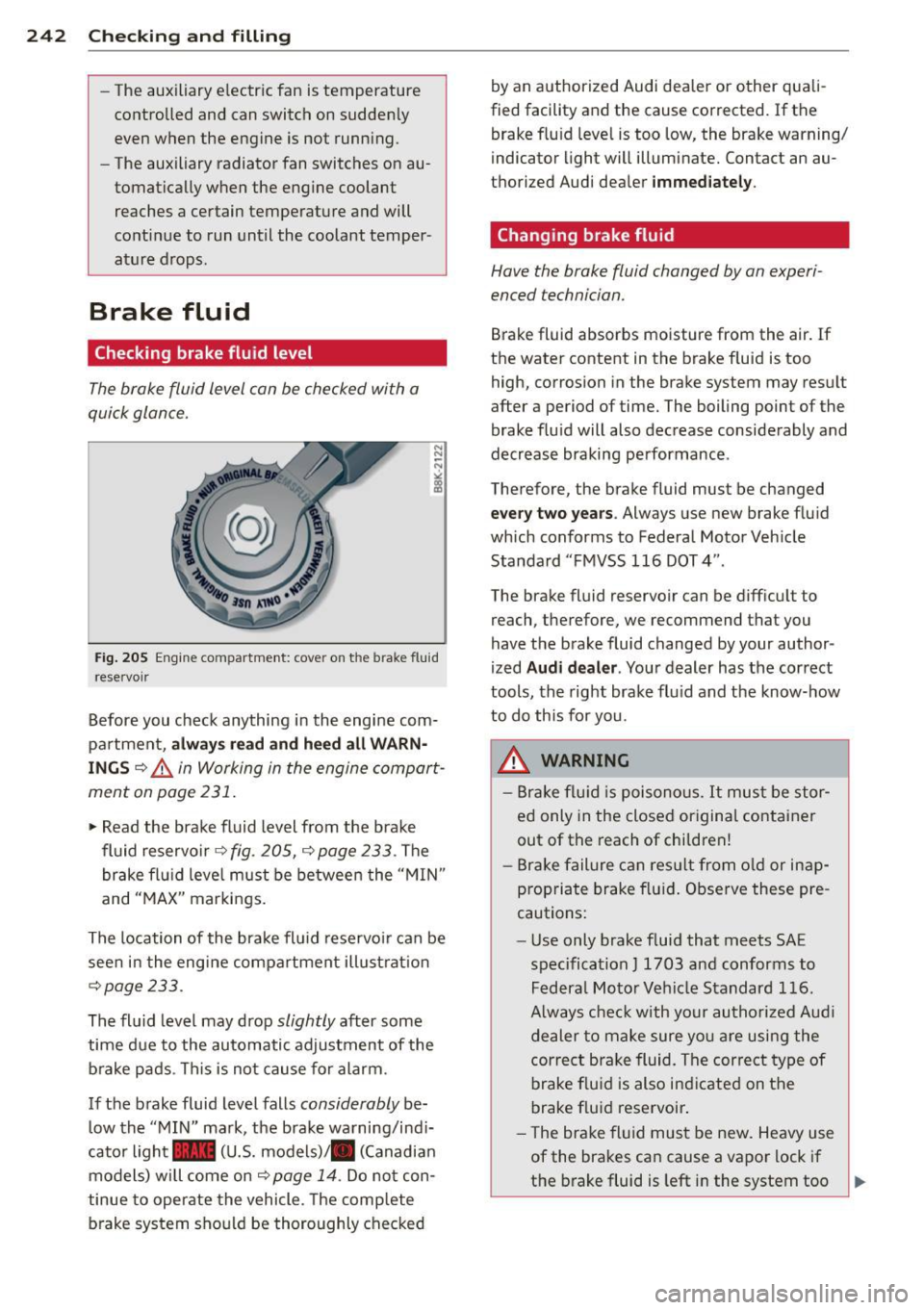
The brake fluid level can be checked with a
quick glance.
Fig . 205 E ng ine co mpartment: cove r on the brake fluid
r eservo ir
Before you check anything in the engine com
partment,
always read and heed all WARN
INGS 9 &_ in Working in the engine compart
m ent on page 231.
.. Read the brake fluid level from the brake
fluid reservoir
9 fig . 205, q page 233. The
brake fluid leve l must be between the "MIN"
and "MAX" markings.
The location of the brake fl uid reservoir can be
seen in the engine compartment illustrat ion
9 page233.
The fluid level may drop slightly after some
time due to the automatic adjustment of the
brake pads. This is not cause for alarm.
If the brake fluid level falls
considerably be
low the "MIN" mark, the brake warning/ind i
cator light
1111 (U.S. models)/ . (Canadian
models) will come on
q page 14. Do not con
tinue to operate the vehicle . T he complete
brake system should be thoroughly checked by an authorized Audi dealer or other quali
fied fac ility and the cause corrected.
If th e
brake flu id level is too low, the brake wa rning/
indicator light will illuminate. Contact an au
thorized Audi dealer
immediately.
Changing brake fluid
Have the brake fluid changed by on experi
enced technician.
Brake fluid absorbs moisture from the air. If
the water content in the brake fluid is too
high, corrosion in the brake system may result
a fter a period of time. The boiling point of the
brake fluid will also decrease considerably and
decrease braking performance .
Therefore, the brake fluid must be changed
every two years. Always use new brake flu id
which conforms to Federal Motor Veh icle
Standard "FMVSS 116 DOT 4" .
The brake fluid reservoir can be difficu lt to
reach, therefore, we recommend that you
have the brake fluid changed by your author
ized
Audi dealer . Your dealer has the correct
tools, the right brake fluid and the know-how
to do this for you .
.&, WARNING
-Brake fluid is poisonous. It must be stor
ed only in the closed origina l container
out of the reach of children!
- Brake failure can result from old or inap
propriate brake fluid. Observe these pre
cautions:
- Use only brake fluid that meets SAE
spec ification
J 1703 and conforms to
Federa l Motor Vehicle Standard 116.
Always check with your authorized Aud i
dealer to make sure you are using the
correct brake fluid. The correct type of
brake fluid is also indicated on the
brake fluid reservoir .
- The brake fluid must be new. Heavy use
of the brakes can cause a vapor lock if
the brake fluid is Left in the system too
lllJ.
Page 257 of 314

of people and the amount of luggage into ac
count when adjusting tire pressure for a trip -
even one that you would not consider to be
"long." See
c> page 256 , Tires and vehicle
load limits
for more important information.
Always use an accurate tire pressure gauge
when checking and adjusting inflation pres
sures . Check all of the tires and be sure not to
forget the spare tire. If the pressure in any tire
is too high when the tire is "cold," let air out
of the tire slowly with the edge of the tire
gauge and keep checking the pressure until
you reach the pressure that is correct for the
load (passengers and luggage) and kind of
driving you plan to do.
If the pressure in any tire is too low, note the
difference between the pressure in the cold
tire and the pressure you need and add the air
that you need to reach the correct pressure for
the vehicle load (passengers and luggage) for
the tires on your vehicle as listed on the on
your vehicle and in this manual and the kind
of driving you plan to do.
Never exceed the maximum inflation pres
sure listed on the tire sidewall for any rea
son.
Remember that the vehicle manufacturer, not
the tire manufacturer, determines the correct
tire pressure for the tires on your vehicle.
It is important to check the tire pressure when
the tires are cold.
- Read the required tire pressure from the tire
pressure label. The tire pressure label is lo
cated on the driver's side 8-pillar.
- Turn the valve stem cap counter-clockwise
to remove it from the tire valve.
- Place the air pressure gauge on the valve .
- The tire pressures should only be checked
and adjusted when the tires are cold . The
slightly raised pressures of warm tires must
not be reduced.
- Adjust the tire pressure to the load you are
carrying.
- Reinstall the valve stem cap on the valve .
Tires and wheels 255
When should I check the tire pressure?
The correct tire pressure is especially impor
tant at high speeds. The pressure should
therefore be checked at least once a month
and always before starting a journey. Do not
forget to check the tire pressure for the spare
wheel
c::;,page 271.
When should I adjust the tire pressures?
Adjust the tire pressure to the load you are
carrying. After changing a wheel
or replacing
wheels you have to adjust the tire pressures on all wheels. In addition, you must then
store the new tire pressures in the tire pres
sure monitoring system*
c::;, page 266 .
A WARNING
Incorrect tire pressures and/or underinfla
tion can lead sudden tire failure, loss of
control, collision, serious personal injury
or even death.
- When the warning symbol
[I] appears in
the instrument cluster, stop and inspect
the tires.
- Incorrect tire pressure and/or underinfla
tion can cause increased tire wear and
can affect the handling of the vehicle and
stopping ability.
- Incorrect tire pressures and/or underin
flation can also lead to sudden tire fail
ure, including a blowout and sudden de
flation, causing loss of vehicle control.
- The driver is responsible for the correct
tire pressures for all tires on the vehicle.
The applicable pressure values are locat
ed on a sticker on the driver's side B-pil
lar.
- Only when all tires on the vehicle are fil led to the correct pressure, the tire pres
sure monitoring* system can work cor rectly .
- The use of incorrect tire pressure values
can lead to accidents or other damage .
Therefore it is essential that the driver
observe the specified tire pressure values
for the tires and the correct pressures for
IIJ,
•
•
Page 264 of 314

26 2 T ire s and wheel s
Driving with different tires reduces vehi
cle handling and can lead to a loss of
co ntrol.
- I f the spare tire is not the same as the
t ires that are mounted on the veh icle -
for example with winter tires - only use
the spare tire for a short period of time
and dr ive with extra care . Refit the nor
ma l road wheel as soon as safely possi
ble.
- Never drive faste r than the maximum
speed for which the tires on your veh icle
are rated because ti res that a re driven
faster than their rated speed can fail
sudden ly .
- Overloading t ires cause heat build- up,
sudden tire failure, including a blowout
and sudden deflation and loss of control.
- T emperature grades app ly to tires that
are properly inflated and not over o r un
derinflated .
- For technical reasons it is not a lways
possible to use wheels from other
vehicles -in some cases not even wheels
from the same vehicle model.
- If you insta ll wheel trim discs on the ve
hicle whee ls, make sure that the air f low
to the brakes is not blocked. Reduced air
flow to the brakes can them to overheat, increasing stopping distances and caus
ing a collision .
- Run flat t ires may on ly be used on
vehicles that were equ ipped w ith them
at the facto ry . The vehicle must have a
chassis des igned for run f lat t ires . Incor
rect use of run flat tires can lead to vehi
cle damage or acc idents. Check with an
au thorized Aud i dealer or ti re specia list
to see if your vehicle can be equipped
with run f lat tires. If run flat tires are
used, they must be installed on all four
wheels . Mix ing tire types is not permit
ted .
(D Note
-For technica l reasons, it is not generally
possib le to use the whee l rims from oth- er veh
icles. This can hold true for wheels
of the same vehicle type.
- If the spare tire is d iffe rent from the
tires that yo u have mounted on your ve
hicle (for example winter tires o r wide
profi le tires), then use the spare tire for a
short period of time only and drive w ith
extra care. Replace the flat tire w ith the
tire matching the others on your vehicle as soon as possible .
- Never drive without the valve stem cap .
T he valves could get damaged .
® For the sake of the environment
Dispose of o ld tires in accordance with the
l ocal requirements.
Uniform tire quality grading
- Tread wear
- Traction AA A B C
- Temperature ABC
Quality grades can be found where applicab le
on the t ire s ide wall between tread shou lder
and maximum section width
c> page 259,
fig. 212 .
For example : Tread wear 200, Traction AA,
Temperature A.
All passenger ca r tires must conform to Feder
al Safety Requirements in addition to these
grades.
Tread wear
T he tread wear grade is a comparative rating
based on the wear rate of the t ire when tested
u nder contro lled conditions o n a specified
government test course .
For example, a tire graded 1S0 would wear
one and o ne ha lf ( 11/2) times as well on the
gover nment course as a t ire g raded 100 .
The relative performance of tires depends upon the actual conditions of their use, how
ever, and may depa rt s ignificantly from the
norm due to va ria tions in d riving hab its, se rv
ice practices and differences in road character-
istics and climate.
ll-