2014 AUDI S4 warning
[x] Cancel search: warningPage 262 of 296

260 What do I do now?
-Check the tire pressure on the spare imme
diately after installation.
- Have the wheel bolt tightening torque
checked with a torque wrench as soon as possible by your authorized Audi dealer or
qualified workshop.
- With steel and alloy wheel rims , the wheel
bolts are correctly tightened at a torque of
90 ft lbs . (120 Nm).
- If you notice that the wheel bolts are cor
roded and difficult to turn while changing
a tire, they should be replaced before you
check the tightening torque .
- Replace the flat tire with a new one and
have it installed on your vehicle as soon as
possible. Remount the wheel cover.
Until then, drive with extra care and at re
duced speeds .
A WARNING
-If you are going to equip y our veh icle
with t ires or rims w hich diffe r from t hose
w hich w ere facto ry ins talled, th en be
s ure to read the in for mati on ~
pag e 242,
N ew tir es a nd replacing tires and
wheel s.
- Always make su re the damaged w heel or
eve n a fla t tire and the ja ck and to ol kit
a re prop erly secure d in the lug gage com
par tment and are not loose in the pas
senger com partment .
- In an a cciden t or sud den m ane uver they
cou ld fly forwar d, inju ring anyone in the
vehicle.
- Always s tore d amage d w hee l, ja ck a nd
tool s secure ly in the lu g gage com part
me nt. Otherw ise, in an acc ident or sud
den maneuver they cou ld fly fo rward,
causing injury to passenge rs in the veh i
cle .
@ Note
Do not use commerc ia lly available t ire
sea lants. Othe rwise, the elect rical compo
ne nts of the tire pressure mon itor ing sys
tem* will no longer wo rk p roperly and the
sensor for th e tire p ressur e monito rin g system
* wi ll h ave to be repla ced by qu ali
fied workshop .
Page 263 of 296

Fuses and bulbs
Fuses
Replacing a fuse
Fuses that have blown will have metal strips
that have burned through.
Fig. 207 Left cockp it: fuse panel cover
The fuses are located at the front left and
r igh t of the cockpit and behi nd the trim on
the right side of the luggage compartment .
.. Turn
off the ignit ion a nd the affected electri
ca l consume rs .
.. Check the following table to see which fuse
belongs to the consumer .
.. Remove the appropriate cover
Q fig. 207 or
Q page 213, fig. 178 .
.. To remove the purple plastic clip if necessa
ry
ll, hold onto it at the small side and pull
it out of the fuse panel¢
page 261,
fig. 208 .
.. Remove the clamp from the rea r side of the
fuse cover ¢
fig. 207 .
.. Remove the fuse using the clamp and re
pla ce the blown fuse w ith an identical new
one.
& WARNING , -
Do not repair f uses and never replace a
blown fuse w ith one that has a higher amp
rating. This can cause damage to the elec
trical system and a fire.
11 You can dispose of the plastic clip after removing it.
Fu se s and bulb s 261
(D Note
If a new fuse burns out again after short ly
have you have insta lled it, have the electri
ca l system checked by your authorized
Audi dealer .
{!) Tips
-The following table does not list fuse lo
cat ions that are not used.
- Some of the equipment items listed are
opt ional or only available on certa in
mode l configurations.
Left cockpit fuse assignment
Fi g. 208 Left cockpit: fuse panel with plastic clip
Fuse panel @ (b lack )
No . Consumer Amps
1 Dynamic steering 5
2
Electronic Stabilization Con-
5 trol (module)
Page 264 of 296

262 Fuses and bulb s
No. Consumer Amps No. Consumer Amps
A/C system pressure sensor, Two-door models: rear left
electromechanical parking window regulator; Four-
brake, Homelink, automatic
11 door models:
rear left door
30
3 dimming interior rear view
5 (window regulator, central
m irror, air quality/outside locking, switch, lighting)
air sensor, Electronic Stab ili-
12 Rain
and light sensor
5
zation Control (button)
5 Sound actuator 5
Fuse panel© (red)
6 Headlight
range control/
5/7,5
head light (corner ing light)
No . Consumer Amps
3 Lumbar support 10
7 Headlight (cornering light) 7,5
4 Dynamic steering
35
Contro l modu les (electro-
5 Interior lighting (Cabriolet)
5
8 mechanical parking brake,
5
shock absorber, quattro
sport), DCDC converter
9 Adaptive cruise contro l 5 6
W
indshield washer system,
35
headlight washer system
7 Vehicle electrical system
20
control module 1
10 Shift gate/clutch
sensor
5
11 Side ass ist 5
8
Vehicle electr ica l system
30
control module 1
12 Headlight range control,
5
park ing system 9 Left rear window regulator
7,5/20
motor (Cabriolet)/sunroof
13 Airbag 5
14 Rear wiper (allroad) 15 10
Vehicle e
lectrica l system
30
control module 1
15 Auxiliary fuse (instrument
10
pane l) 11 Right
rear window regulator
7,5/20
(Cabriolet)/sun shade motor
16 Aux
iliary fuse terminal 15
40
(engine area) 12 Anti-theft
alarm warning
5
system
Fuse panel @ (brown)
No. Consumer Amps
2 Brake light sensor 5
3 Fuel pump 25
4 Clutc h sensor 5
5 Left
seat heating with/with-
15/30
out seat ventilation
6 Electronic
Stabilization Con-
5
trol (electric)
7 Horn 15
Front left door (window reg-
8 ulator, centra I locking, mi r-
30
ror, switch, lighting)
9 Windshield wiper motor 30
10 Electronic Stabi
lizat ion Con-
25
trol (valves)
Page 266 of 296

264 Fuses and bulbs
No. Consumer
5 Electromechanical parking
brake
6 Electronic damping control
7
Electromechanical parking
brake
8 Rear exterior lighting
9 quattro sport
10 Rear exterior lighting
11 Central locking
12 Terminal
30
Fuse panel © (brown)
No. Consumer
1 Luggage compartment lid
contro l module (allroad)
2 12-volt
socket, cigarette
lighter
3 DCDC converter path 1
4 DCDC
converter path 2,
so und amp lifier, radio
6
Right upper cab in heat ing
(Cabr iolet)
7
Electromechanical parking
brake
Right front door (w indow
9 regu lator, central locking,
mirror, switch, lighting)
1 0 Left upper cabin
heating
(Cabr iolet)
T wo -door models : rear right
window regu lator; Four-
11 door models: rear
right door
(window regulator, central
locking, sw itch, lighting)
12 Cell phone prep
Fuse panel © (black)
No. Consumer
1 Right front seat heating
4
MMI
5 Radio
6 Rear view camera
Amps
5
15
30
30
35
30
20 5
Amps
30
20
40
30
30
30
30
30
30
5
Amps
15
7,5
5
5
No . Consumer Amps
7 Rear window heater (all-
30
road)
8 Rear Seat Entertainment s
Bulbs
Replacing bulbs
For your safety, we recommend that you hove
your authorized Audi dealer replace any bulbs
for you.
It is becoming increasingly more and more
difficult to replace vehicle light bulbs since in
many cases, other parts of the car must first
be removed before you are able to get to the
bulb. This applies especially to the light bulbs
in the front of your car which you can only
reach through the engine compartment .
Sheet metal and bulb holders can have sharp
edges that can cause serious cuts, parts must
be correctly taken apart and then properly put
back together to help prevent breakage of
parts and long term damage from water that
can enter housings that have not been p roper
l y resea led.
For your safety, we recommend that you have
you r authorized Aud i dea ler replace any bulbs
for you, since yo ur dealer has the proper tools,
the correct bulbs and the expertise .
Gas discharge lamps (Xenon lights)*:
Due to the high electr ical voltage, have the
bulbs replaced by a qualif ied technician .
Headlights wit h Xenon light are identified by
the high voltage sticker .
_&. WARNING
Changing Xenon lamps witho ut the neces
sa ry equipment can cause serious personal
injury.
- Bulbs are pressurized and can explode
when being changed. Potential risk of in
jury!
-
Page 268 of 296

266 Emergency situations
Emergency situations
General
This chapter is intended for trained emer
gency crews and working per sonnel who
have the necessary tools and equ ipment to
perform these ope rations.
Starting by pushing or
towing
Q;) Note
Vehicle s with an automati c transmission
cannot be started by pushing or towing .
Starting with jumper
cables
If necessary, the engine can be started by
connecting it to the battery of another vehi
cle.
If the engine should fail to start because of a
discha rged or wea k batte ry, the battery can be
connected to the battery o f
another vehicle,
using a
pair of jumper cables to start the en
g ine .
Jumper cables
Use only jumper cab les of sufficiently
large cross section to carry the starter cur rent
safely. Refer to the manufact urer's spec ifica
ti ons.
Use on ly jumper cables with
insulated te rmi
na l clamps wh ic h are d istinctly mar ked :
plus (+) cable in most c ases co lore d red
minu s (-) cable
in most cases colored black .
A WARNING
Batterie s cont ain e lec tricity, a cid, a nd gas.
A ny o f these c an ca use ve ry ser io us or f atal
in ju ry . F ollow the i nstruc tio ns below for
safe ha ndling of your ve hicle's bat tery.
- Alw ay s sh ield yo ur eye s and a vo id le an
ing over the batte ry w henever p ossib le . -
A discharged battery can freeze at tem
pe rat ures just below 32 °F (0 °C). Before
connecting a jumper cable, you must
thaw the fr ozen battery complete ly , ot h
e rwise it cou ld explode.
- Do not allow batte ry acid to contact eyes
or skin . Fl ush any contacted a rea wi th
wate r im media tely.
- Imp roper use of a booster battery to
s tart a vehicle may cause an explosion.
- Vehicle batter ies generate explosive gas
es . Keep sparks, flame and lighted ciga
rettes away from ba tte ries .
- Do not try to jump start a ny ve hicle w ith
a low ac id leve l in the battery .
- The vo ltage of the booster batte ry m ust
a lso have a 12-Vo lt rat ing . The capacity
(A h) of the booster batte ry should not b e
lowe r than that of the discharged bat
tery . U se o f batt erie s of d iffe ren t voltage
or subs tanti ally diffe ren t "Ah" rat ing
may c ause an exp losion and person al in
ju ry .
- N ever ch arge a fr ozen bat te ry. Gas t rap
ped in the ice may ca use an ex plosion .
- N ever ch arge o r use a batt ery th at has
been fro zen. T he battery case may have
be weakened.
- Us e of batt erie s of di ffere nt vo ltag e or
substan tially differen t ca pa city (Ah) rat
i ng may cause an exp losion and injury.
T he capac ity (Ah) of the booster battery
should not be lower than that of the dis
charged batte ry.
- Before you check anything in the engine
compartment, always read and heed a ll
W ARNI NGS¢
page 214.
(D Note
- App lyi ng a hig her voltage booste r bat
tery wi ll cause expens ive damage to sen
sitive e lectronic components, such as
cont ro l units, relays, rad io, etc.
- There must be no electrical contact be twee n the vehicles as otherwise current
co uld already start to f low as soon as t he
posi tive(+) terminals a re con nected . ..,.
Page 269 of 296
@ Tips
The discharged battery must be properly
connected to the vehicle's electrical sys
tem. When jump starting or charg ing the
battery, never connect the negative
ground cable to the battery negat ive post
because the ba ttery manager system must
be ab le to detect the battery's state of
charge. Always connect the negative
g round cab le to the negative ground pos t
of t he battery manager cont ro l unit.
Use of jumper cables
Make sure to connect the jumper coble
clomps in exactly the order described b elow!
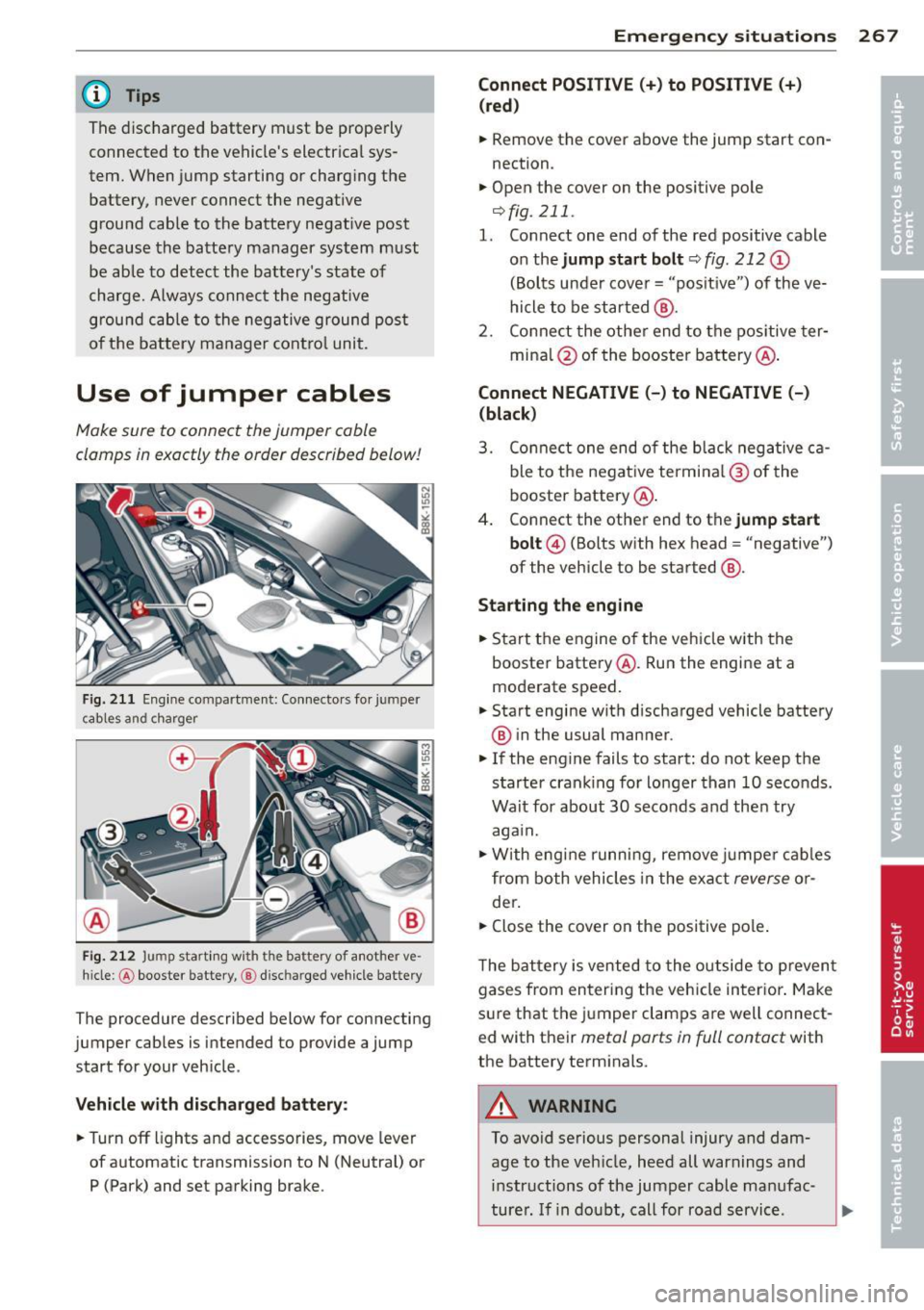
Fi g. 21 1 Eng ine co mpar tment: Co nnecto rs fo r jum per
c ab les a nd c har ge r
F ig. 212 Jump start in g w ith t he ba ttery of a not her ve ·
hi cle :@ booster battery, @ disc harged veh icle battery
The procedure described below for connecting
jumper cables is intended to provide a jump
start for your veh icle .
Vehicle with di scharged battery :
~Turnoff lights and accessories , move lever
of automatic transmission to N (Neutral) or P (Park) and set parking brake .
Emergency situ ation s 267
Connect POSITIVE(+) to POSITIVE(+ )
(red )
~ Remove the cover above the jump start con
nection .
~ Open the cover on the positive pole
¢fig . 211 .
1. Connect one end of the red positive cable
on the
jump sta rt bolt c::;, fig. 212 (D
(Bolts under cove r= "posit ive ") of the ve
hicle to be started @.
2 . Conne ct the othe r end to the pos itive ter -
mina l@ of the booster battery @.
Connect NEGATIVE (-) to NEGATIVE (-)
(black )
3. Co nnect one end o f the b lack neg ative c a
ble to the nega tive te rmi na l@ of the
booster battery @.
4 . Connect the other end to the
jump start
bolt @
(Bolts with hex head = "negative")
of the vehicle to be started @.
Starting the engine
~ Start the engine of the ve hicle with the
booste r batte ry @ . Run the engine at a
moderate speed.
~ Start engine with d ischarged vehicle battery
® in the usual manner .
~ If the engine fails to start: do not keep t he
s tarter cran king for lo nger than 10 seconds .
Wait for about 30 seco nds and the n try
aga in.
~ W ith engi ne runni ng, remove jumpe r cab les
from both vehicles in the exa ct
reverse o r
der .
~ Close the cover on the positive pole .
T he b attery is vented to the o utside to p reven t
gases from en tering the veh icle in ter ior . Ma ke
s ur e that the j umper clamps a re well connect
ed with their
metal ports in full contact with
the batte ry term inals.
A WARNING
To avoid serious personal injury and dam
age to the vehicle, heed all warnings and
in structions of the jumper cable ma nufac-
turer . If i n dou bt, call for road servic e.
Ill>
Page 270 of 296

268 Emergency sit uat ions
-Jumper cables mus t be long enough so
that the vehicles do not touch.
- W hen connecting jumper ca bles, ma ke
sure t hat they cannot get caught in any
moving parts in the eng ine compart
ment.
- Do not bend over the batteries - danger of chemical burns!
- The battery ce ll locking screws must be
tightened securely .
- Before you check anything in the engine
compartment, always read and heed all
WARNINGS
9 page 214.
Improper hook-up of jumper cables can r u
in the generator.
- Always connect POSITIVE( +) to POS I
TIVE(+), and NEGATIVE( -) to NEGATIVE
( - ) ground post of the battery manager
control unit.
- Check that a ll screw plugs on the battery
cells are screwed in firmly. If not, tighten
plugs p rior to connecting clamp on nega
tive battery terminal.
- Please note that the procedure for con nect ing a jumper cable as described
above applies spec ifically to the case of
you r vehicle being jump started. When
you are giving a jump start to another ve hicle, do
not connect the negat ive( -) ca
ble to the negat ive (-) term inal on the
discharged battery@)
9fig. 212. In
stead, securely connect the negative(- )
cable to e ither a solid metal component
that is firm ly bolted to the engine block
or to the engine block itse lf. If the bat
tery that is being charged does not vent
to the outside, escaping battery gas
could ignite and explode!
Emergency towing
with commercial tow
truck
General hints
Your Audi requires special handling for tow
ing.
T he following information is to be used by
commercial tow truck operators who know
how to operate their equipment safely.
- Ne ver tow your Audi , towing will cau se
damage to the engine and tr an smi ssion .
- Ne ver wrap th e safet y chain s or winch ca
ble s around the brak e lines.
- To prevent unne ces sary damage, your Audi
must be tr an sp o rt ed with a flat bed tru ck.
- To load th e vehi cle on to th e flat b ed, use
the towing l oop found in the ve hicle to ols
an d att ach to th e front or rea r anchorage
~page 269 and ~page 269 .
& WARNING
= -
A vehicle being towed is not safe for pas-
sengers. Never allow anyone to ride in a
vehicle being towed, for any reason.
Page 271 of 296
Front towing loop
Do not install the front towing loop until it is
needed.
ou
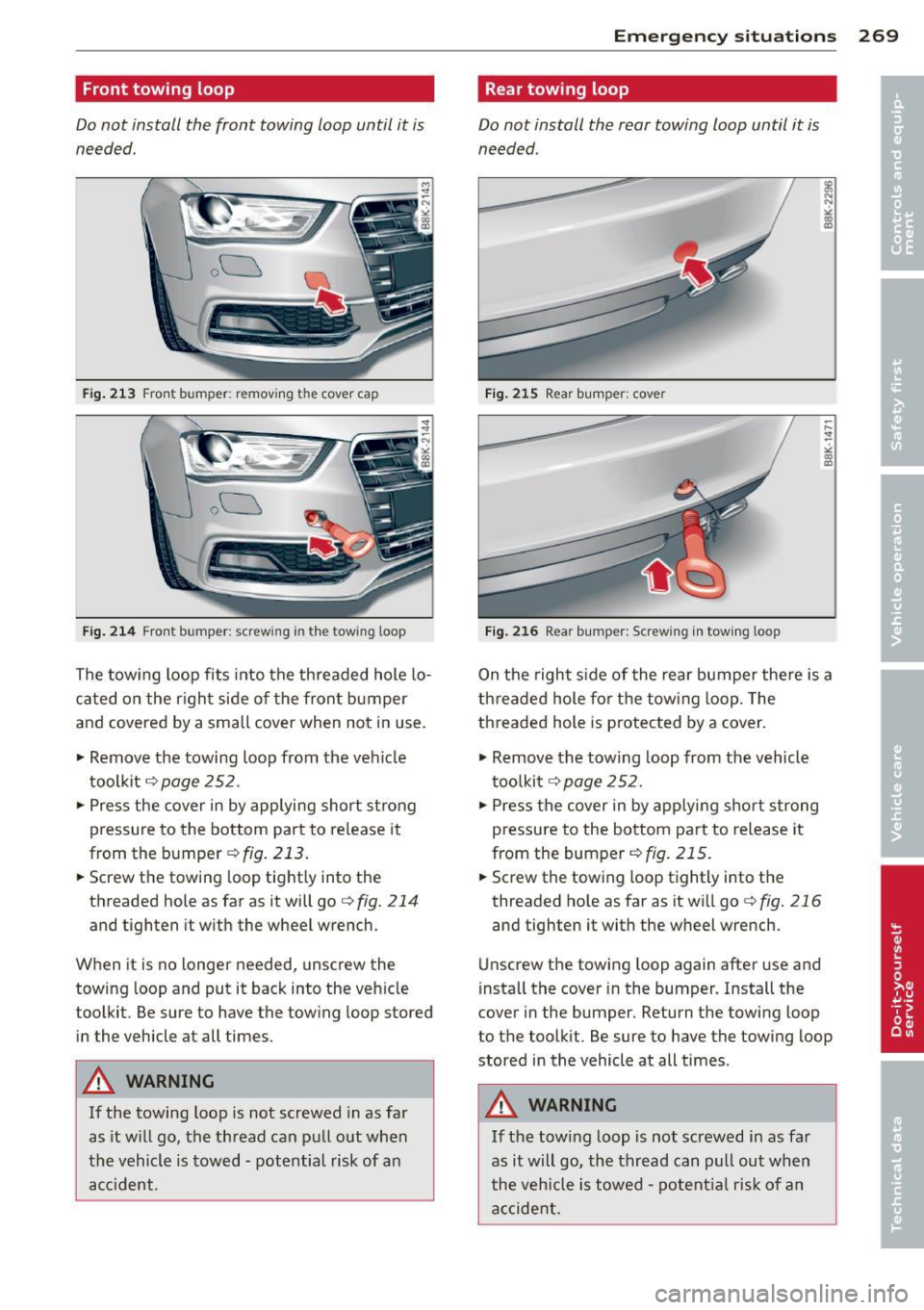
Fig . 2 13 Fr ont bumper : removing t he cover cap
ou
Fi g. 21 4 Front bumper: screwing in the towing loop
The tow ing loop fits into the th readed hole lo
cated on the r igh t side of the fron t bumper
and covered by a small cover when not in use .
"' Remove the towing loop from the vehi cle
toolkit
c:::> page 252 .
"' Press the cover in by applying short strong
pressure to the bottom part to re lease it
from the bumper
c:::> fig. 213 .
"'Screw the towing loop tight ly into the
threaded hole as far as it will go
c:::> fig. 214
and tighten it w ith the wheel wrench .
When it is no longer needed, unscrew the
towing loop and put it back into the veh icle
toolkit. Be sure to have the towing loop stored
in the vehicle at all times.
A WARNING
If the towing loop is not screwed in as far
as it w ill go, the thread can pull o ut when
the vehicle is towed - potential risk of an
accident.
-
Emergenc y situ ation s 269
Rear towing loop
Do not install the rear towing loop until it is
needed .
Fig . 215 Rea r bu mper: cover
Fig. 216 Rea r bumpe r: Screwing in tow ing loop
"' "' N N
"' CD CD
On the right s ide of the rear bumper there is a
th readed hole for the towing loop. The
threaded hole is protected by a cover.
"' Remove the towing loop from the vehicle
too lki t
c:::> page 252.
"' Press the cover in by app lying shor t strong
pressure to the bottom part to release it
from the bumper
c:::>fig. 215.
"' Screw the towing loop tightly in to the
threaded ho le as far as it wi ll go
c:::> fig. 216
and tighten it with the wheel wrench.
Unscrew the towing loop again after use and
install the cover in the bumper. Install the
cover in the bumper. Return the towing loop
to the toolkit. Be sure to have the towing loop
stored in the vehicle at all times .
A WARNING
-
If the towing loop is not screwed in as far
as it will go, the thread can pull out when
the vehicle is towed - potent ia l ris k of an
a ccide nt.