2014 AUDI S4 load capacity
[x] Cancel search: load capacityPage 239 of 296

-Incorrect tire pressures and/or underin
flation can also lead to sudden tire fa il
ure, including a blowout and sudden de
flation, causing loss of vehicle control.
Checking tire pressure
The correct tire pressure for the tires original
ly installed on your vehicle is listed on the tire
pressure label located on driver's side 8-pil lar .
The recommended t ire pressures are on the
tire pressure label and in the table
c:> page 234, Cold tire inflation pressure . This
means that the pressure must be checked and
adjusted when the tire has not been driven for
mo re tha n a couple of m iles (k ilome ters) at
l ow speeds during t he p revious three hours.
A ir in the tires expands when the ti re heats up
as a result of inte rna l friction as it flexes in
use. The tire press ure is higher when the tire
has warmed up than when it is "cold."
It is the i nflat ion p ressu re in a "cold" tire that
counts . Therefore, you shou ld never let air ou t
of a warm tire to match "Cold tire inflation pressure" recommendations
c:> page 234. The
tires would then be under inflated and could
fa il suddenly.
The tire press ure labe l on yo ur Audi lists the
recommended cold t ire inflat ion pressures at
maximum capacity for the new, origina l
equ ipment tires that were on your vehicle at
the time it was manufactured. For the loca
tion of the label
<=> page 234, fig . 189 .
Most tires lose a ir naturally over time. They
can also lose some a ir if you drive
over a pot
hole or hit a curb while parking. It is usually
not possible to see whether the radial t ires
used today are underi nflated just by looking
at them.
Therefore, be sure to check tire pressures at
least o nce a month and always before going
on a long tr ip . Make sure to take the number
of people and the amount of luggage into ac
coun t when adjusting tire pressure for a t rip -
even one that you would not consider to be
Tire s an d wheel s 237
"long." See c:> page 2 38, Tires and vehicle
load limits
for more important information.
A lways use an acc ura te tire pressu re ga uge
when checking and ad justing infla tion pres
s ur es . Check all o f the tires and be sure not to
forget the spare tire. If the pressure in any t ire
is too h igh when the tire is "cold", let a ir o ut
of the t ire s low ly w ith the edge of the tire
gauge and keep checking the pressure until
you reach the pressure that is correct for the load (passengers and luggage) and k ind of
driv ing you plan to do.
If the pressure in any tire is too low, note the
difference between the pressure in the co ld
t ire a nd the pressure you need and add the air
that you need to reach the correct pressure for
t h e ve hicl e load (passenge rs and luggage) for
the tires on you r veh icle as l isted on the on
yo ur vehicle and in this ma nual and the kind
of driving you plan to do.
Never exc eed the maximum inflation pr es
sure li ste d on the tire sidewall for any re a
s o n.
Remember that the vehicl e manufacture r, not
t h e tire manufact urer, de termines t he cor re ct
t ir e p ress ure fo r th e tires on your ve hicl e.
It is important to check the t ire p ressu re whe n
the tires are co ld.
- Read the required tire pressure from the t ire
pressure labe l. The t ire pressure label is lo
cated o n the dr iver's side 8-pillar. The tire
pressure labe l lists the recommended co ld
tire infla tion pressures for t he vehi cle at its
maxim um capacity weigh t and t he tires that
were on your ve hicle a t the time i t was man
ufactured . For recommende d tire pressures
for normal load conditions, p lease see chap
ter
c:> page 2 34.
- Tu rn the va lve stem cap counter -clockwise
to remove it from the tire
va lve .
-Place t he ai r pressure gauge on the va lve.
- The tire pressu res should o nly be checked
and ad justed when the tires are co ld . The
slightly raised pressures of warm tires must
not be red uced.
Ill>-
•
•
Page 241 of 296

not exceeded . Vehicle load includes everybody
and everything in and on the vehicle. These
l oad limits are techn ica lly referred to as the
ve hicle's
Gross Veh icle We ight Rat ing
("GVWR").
The "GVWR" includes the weight of the basic
veh icle, all factory insta lled accessories, a full
tank of fu el, oil, coolant and other fluids plus
maximum load. The maximum load includes
the number of passengers that the vehicle is
i n tended to carry ("seating capacity") with a n
assumed weight of 150 lbs . (68 kg) for each
passenger at a des igna ted sea ting pos ition
and the tota l we ight of any l uggage in the ve
h icle. If you tow a trailer, the weight o f the
trailer hitch and the tong ue weight of the
l oaded trailer must be included as part of the
veh icle load.
The
Gro ss A xle Weight Rating ("GAWR") is
the maximum load that can be applied at each
of the vehicle's two ax les.
The G ross Vehicle We ight Rating and the
Gross Axle Weight Rating are listed on the
safety compliance sticker labe l located on the
driver's side B -pi llar . Your Audi has 5 seating
positions, 2 in the front and 3 in the rear for
tota l seating capacity of 5. Each seating posi
tion has a seat belt¢
page 138, Safety belts.
The fact that there is an upper limit to your
veh icle's Gross Vehicle Weight Rating means
that the tota l weight of whatever is being car
ried in the vehicle (including the weight of a
trailer hitch and the tongue weight of the
loaded trailer) is limited. The more passen
ge rs in the veh icle or passengers who are
h eav ier than the standa rd weights assumed
mean that less weight can be ca rr ied as l ug
gage.
The tire pressure labe l on you r Audi also lists
the maximum combined we ight of all of the
oc cu pants and luggage o r othe r ca rgo that
the vehicle can carry . For the location o f the
l abe l
¢page 234, fig. 189.
Tires an d wheel s 239
A WARNING
Overloading a vehicle can cause loss of ve
h icle contro l, a crash or other accident, se
rious pe rsonal injury, and even death.
- Carrying more we ight than your veh icle
was des igned to carry will prevent the
veh icle from handling properly and in
crease the risk of the loss of vehicle con
trol.
- The brakes on a vehicle that has been
overloaded may not be able to stop the
veh icle w ith in a safe distance.
- Tires on a vehicle that has been overload
ed can fail suddenly, incl uding a blowout
and sudden defla tion, causing loss of
contro l and a crash.
- Always ma ke sure that the total load be
ing transpor ted - incl uding the weight of
a trailer hitch and the tongue weight of a loaded trailer -does not ma ke the vehi
cle heavier than the vehicle's Gross Vehi
cle We ight Rating.
Determining correct load limit
U se th e example below to ca l
culate the total weight of the
pa ssengers and lu ggage or oth
e r thing s that you pl an t o tran s
po rt so that you can make sur e
that your vehicle will not be
o verloaded.
Steps for Determining
Correct Load Limit
1 . Lo cate th e statement "THE
COMBINED WEIGHT OF O C
CUPANTS AND CARGO
SHOULD NE VER E XCE ED XXX
KG OR XXX LBS"on your vehi-
c le 's pla card (tire inflation ..,
•
•
Page 242 of 296

240 Tires and wheels
pressure label) ¢ page 234,
fig. 189.
2. Determine the combined
weight of the driver and pas sengers that will be riding in
your vehicle.
3. Subtract the combined
weight of the driver and pas sengers from
"XXX" kilo
grams or
"XXX" pounds
shown on the sticker
¢ page 234, fig. 189.
4. The resulting figure equals
the available amount of car
go and luggage load capaci
ty. For example, if the
"XXX"
amount equals 1400 lbs.
and there will be five 150
lbs. passengers in your vehi
cle, the amount of available
cargo and luggage load ca
pacity is 650 lbs. (1400-750
(5
X 150) = 650 lbs.)
5. Determine the combined weight of luggage and cargo
being loaded on the vehicle .
That weight may not safely exceed the available cargo
and luggage load capacity
calculated in Step 4.
6. If your vehicle will be towing
a trailer, load from your trail
er will be transferred to your vehicle
. Consult this manual
to determine how this re duces the available cargo
and luggage load capacity of
your vehicle .
... check the tire sidewall
(¢ page 242, fig. 193) to de
termine the designated load rating for a specific tire.
Tire service life
The service life of tires depends on a lot of
different things including proper installation
and balancing, correct tire pressure and driv
ing style.
Fig. 191 T ire tread: tread wear ind icato rs (TWI)
____ Jj
Fig. 192 Rotating tires for more even wear
Tread Wear Indicator (TWI)
The original tires on you r vehicle have
1/16 inch (1.6 mm) high "wear indicators"
cf> fig. 191 running across the tread. Depend-
ing on the make, there will be six to eight of
them evenly placed around the tire. Marks on
the tire sidewall (for example "TWI" or other ..,.
Page 275 of 296
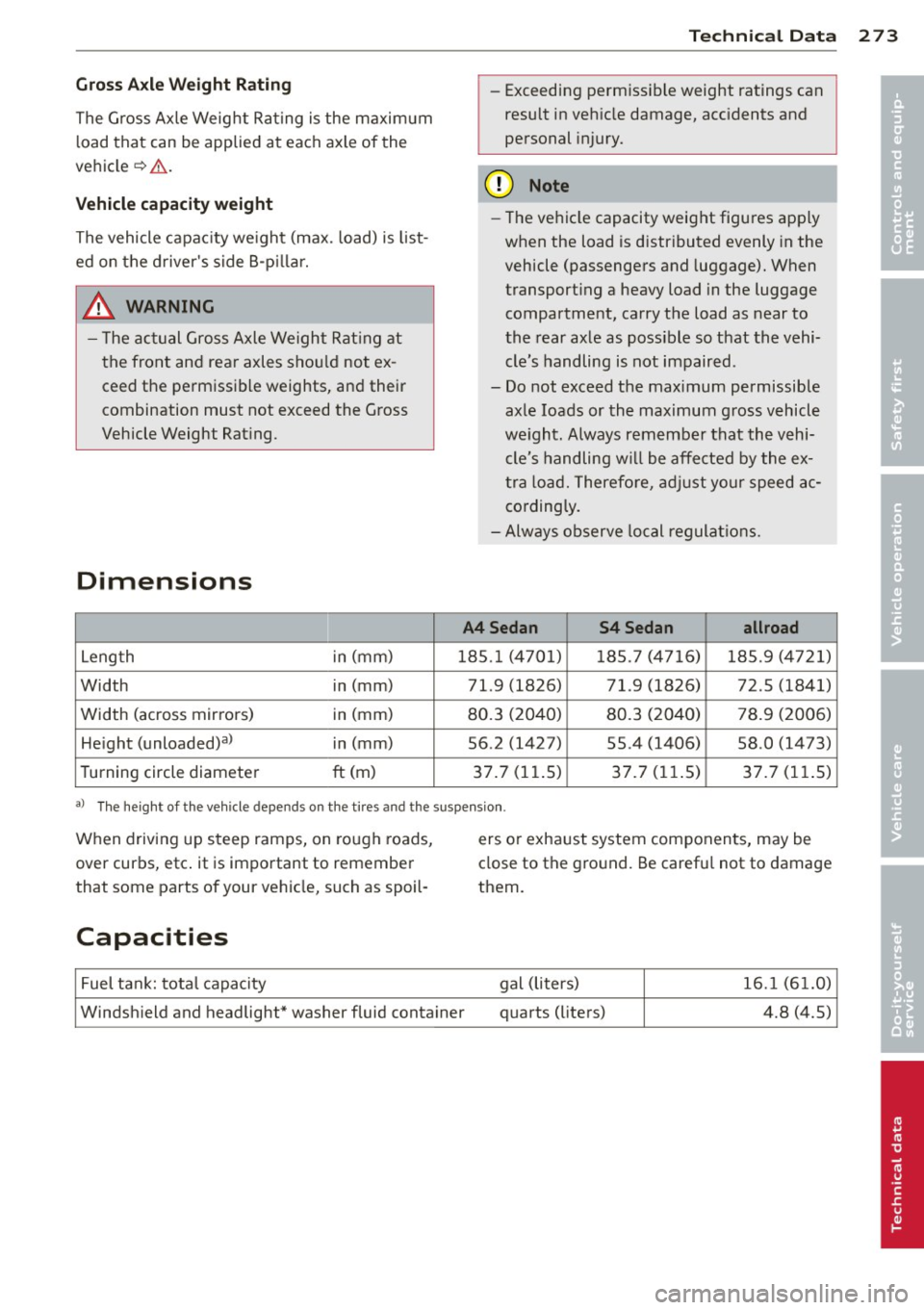
Technical Dat a 273
Gros s Axle We ight Rating
The G ross Axle Weight Rating is the maxim um
l oad that can be applied at each axle of the
vehicle
c::> &. .
Vehicle capacity weight
The vehicle capac ity we ight (max. load) is list
ed on the d river 's side 8-p illar.
_& WARNING
- T he ac tual Gross Axle Weight Rat ing at
t he front and rea r axles sho uld not ex
ceed the perm issible weights, a nd their
combination must not exceed the G ross
Vehicle Weight Rat ing.
Dimensions
Leng th in (mm)
Width in (mm)
Width (across mir rors) in (mm)
He ight (unloaded)a) in (mm)
T urning circle diamete r
ft (m)
-
-Exceeding perm iss ible weight ratings can
result in veh icle damage, acc idents and
pe rsonal injury.
([) Note
-Th e ve hicl e capacity weig ht figu res apply
when the load is d istr ibuted evenly in the
vehicle (passengers and luggage). When
transport ing a heavy load in the luggage
compartment , carry the load as near to
t he rear ax le as poss ible so that the vehi
cle's handling is not impaired.
- Do not exceed t he maximum permissible
ax le loads or the maximum g ross vehicl e
we ight. A lways remember that the v ehi
cl e's handling w ill be affe cted by the ex
t ra lo ad. Therefo re, adju st yo ur speed ac
c o rding ly.
- Always o bserve loc al regulat io ns.
A4Sedan
S4Sedan allroad
1
85. 1 (4701) 185.7 ( 47 16 ) 1 85.9 (47 21)
71.9 (1826) 71.9 (1826) 72 .5 (1841)
80.3 (2 040) 80.3 (2 040) 78.9 (2 006)
56 .2 (1427) 55 .4 (1406) 58 .0 (1473)
37.7 (1 1.5) 37. 7 (11. 5) 37. 7 (11. 5)
aJ The heig ht of t he ve hicle depends on th e t ires and the suspensio n.
When driving up s teep ramps, on ro ugh roads,
over cur bs, etc . it is impo rtant to remembe r
that some parts of your ve hicle, such as spoil -
Capacities
Fuel ta nk: tota l capacity
Windsh ield and headlight* washer fluid container ers o
r exha ust system componen ts, may be
close to the ground. Be carefu l not to damage
them.
gal (liters) 16. 1 (6 1.0)
quarts (lite rs) 4.8 (4.5)
•
•
Page 287 of 296

_______________________________ ___:I~n~d~e:.::x 285
Fuel
Additives ... ................ ... ... 209
Blended gasoline ............ ... .. . 209
Consumption . . . . . . . . . . . . . . . . . . . . . . 25
Filler neck .. ............. .... .. ... 211
Fuel gauge . ................ ... ... . 12
Gasoline ... ... .. .. ...... .. .. .. .. . 209
Gasoline additives ........... .... .. 211
L ow fuel level symbol . . . . . . . . . . . . . . . 21
Octane rating ............ .... .. ... 209
Recommendation ............ ... .. . 209
Refuelling . ................. ... ... 212
Reserve .... ................ ... .... 12
T ank capacity . ........... .. .. .. ... 273
Tank system ............. .... .. .... 21
Unlocking the fuel filler flap by hand . . 213
F uel economy messages (efficiency pro-
gram) .......................... .... 29
Fuel filler flap
Un locking the fuel filler flap by hand . . 213
Fuses Assignment . . . . . . . . . . . . . . . . . 261, 263
R l . ep acing .................. .... .. 261
G
Garage door opener (Homelink) .. .. .. . 124
Garment hooks . . . . . . . . . . . . . . . . . . . . . . 66
Gas discharge lamps ........ .. .. .. .. . 264
Gauges Engine coolant tempera ture .. .. .. .. .. 10
Fuel gauge ................. .... ... 12
Tachometer . . . . . . . . . . . . . . . . . . . . . . . 11
Gear recommendation . . . . . . . . . . . . . . . . 28
G h.ft . d'
ears
I in 1cator ......... .. .. .. .. .. 27
Gearshift lever 6-speed manual transmission . .. . ... .. 91
General illustration Instruments and controls . . . . . . . . . . . . . 8
Generator Warning/indicator lights ......... .. .. 17
Glossary of tire and loading terminology 231
Glove compartment . . . . . . . . . . . . . . . . . . 65
Valet parking ............ .... .. .... 46
GPS controlled clock .. .... .. .. .. .. .. .. 12
Gross Vehicle Weight Rating (GVWR) ... 272
Ground clearance .................. . 199
H
Headlights
Cleaning ... ..... .. ............... 205
Cleaning system . . . . . . . . . . . . . . . . . . . . 53
Defective . . . . . . . . . . . . . . . . . . . . . . . . . 21
Headlight range control ............ . 22
Left hand drive, right hand drive .. .. .. . 49
Travel mode . . . . . . . . . . . . . . . . . . . . . . . 49
Headlight washer reservoir ......... .. 228
Head restraints .. .. .......... ....... 132
Adjusting . . . . . . . . . . . . . . . . . . . . 61, 132
Removing/installing .............. .. 61
Heated exterior mirrors . . . . . . . . . . . . . . . . . . . . SO
rear window . .. .. .... ........... .. . 78
seats ..... .. .. .. .... ............. . 78
windshield washer spray nozzles . . . . . . 53
Heating ......... ... ..... ........... 76
Heavy clothing and saf ety belts ....... . 141
High beam .. .. .. .. .. . ... .. ..... .... . 48
High voltage warning label .. ....... .. 272
Hill descent control .................. 95
Homelink (remote control) ......... .. 124
Hood Opening .. .. .. .. .... ............. 214
Release lever . . . . . . . . . . . . . . . . . . . . . 214
Hooks ............................. 72
Horn .. .... .. .... ..... ... ... ... ... .. 8
How are child restraint system anchors re-
la ted to child safety ........... .. .... 181
How many airbags does my vehicle have? 153
How often should I check my tire pres-
sures? 238
How safe ty bel t pre ten sioners work .. .. 144
Hydroplaning ..... .. ............... 240
I
Ignit ion
switching on/off .. ...... .. .. ... .... . 80
Ignition key Emergency unlocking .......... .... .. 35
Ignition lock .. .. .. ...... .. ... ...... . 80
Indic ato r light . .. ........... ...... . 18
Mal func tion . . . . . . . . . . . . . . . . . . . . . . . 22
Immobilizer . . . . . . . . . . . . . . . . . . . . . . . . 12
•
•
Page 291 of 296

Index 289 ____________________________ ...:.:..:.=.:::.::.:
Remote control key ............... .. .. 33
Personalizing ................ .. .... 33
unlocking/locking ............ .. .. .. 35
Remote rear lid release ............... 39
Repair manuals ..................... 275
Repairs
Airbag system .............. ... ...
159
Replacement key ................ .... 33
Replacing
Windshield wiper blades .............
56
Replacing bulbs .............. ... ... 264
Replacing tires and wheels ....... .. ... 242
Replacing wiper blades ............... 55
Reporting Safety Defects ....... ... .. . 136
Reset button .... .. .. ... ... .. .. .. .. .. 12
Retractor . . . . . . . . . . . . . . . . . . . . . . . . . . 141
Reversible floor . . . . . . . . . . . . . . . . . . . . . . 7 4
Reversible mat ................ .. ....
73
Right hand drive .............. ... .... 49
Rims
Cleaning . ............... ...... .. .
205
Roof rack . . . . . . . . . . . . . . . . . . . . . . . . . . . 67
Roof load . . . . . . . . . . . . . . . . . . . . . . . . . 68
Roof weight . . . . . . . . . . . . . . . . . . . . . . . 68
s
SAFE ..... ......................... 12
Safe driving habits ............ ... .. . 128
Safety belt position ................. 142
Safety belt height adjustment .. .. .. . 144
Safety belts worn by pregnant women . 143
Safety belt pretensioner . . . . . . . . . . . . . . 144
Service and disposal . . . . . . . . . . . . . . . 145
Safety belts . . . . . . . . . . . . . . . . . . . . . . . . 141
Cleaning . .. .. ........... .. .. .. ... 206
Danger to passengers who do not wear a
safety belt . .. .. ............ ... .. .
139
Fastening ........................ 141
Height adjustment . . . . . . . . . . . . . . . . . 144
Improperly worn .................. 144
Not worn .. ............. .... .. ... 139
Safety belt position . . . . . . . . . . . . . . . . 142
Safety instructions ................. 141
Securing child safety seats .......... 177
Special considerations for pregnant
women ..........................
143
Unfasten ing ..... ................. 143
Warning/indicator light ........... .. 138
w . 1· h arning 1g t .. .. .. ................ 16
Why YOU MUST wear them .......... 138
Worn properly . . . . . . . . . . . . . . . . . . . . 140
Safety belt warning light ........... .. 138
Safety compliance sticker ............ 272
Safety equipment ...... ............. 128
Safety features for occupant restraint and
protection ... ..... .................
128
Safety guidelines
Seats .............................
58
Safety instructions
Engine compartment ...............
214
for side curtain airbags ............. 166
for using child safety seats ........ .. 170
for using safety belts ............... 141
Monitoring the Advanced Airbag Sys-
tem .............................
158
Seat adjustment
Head restraints .............. .... .
132
Seat belts
refer to Safety belts ... ............. 138
Seat covers
Cleaning ... ..... .. . ..............
207
Seat heating . . . . . . . . . . . . . . . . . . . . . . . . 78
Seating capacity ... .. ........... .... 138
Seating position
Driver ...........................
129
Front passenger .... .............. . 130
How to adjust the front seats ....... . 130
Incorrect seat position . ............. 132
Occupants . .. .. .. ... ............ .. 129
Rear passengers .. ............. .... 131
Seat memory . . . . . . . . . . . . . . . . . . . . . . . 62
Seats
Ad '
t· JUS mg . . . . . . . . . . . . . . . . . . . . . 59, 60
D . , rivers seat . . . . . . . . . . . . . . . . . . . . . . . 58
Folding ..... .. .. ... ............ .. . 69
Front passenger's seat . . . . . . . . . . . . . . . 59
Head restraints .... .............. .. 61
Number of seats ... .............. . 138
Safety guidelines . .................. 58
Seat ventilation . . . . . . . . . . . . . . . . . . . . . 78
Securing attachments ................ 73
Selective unlock feature ............... 37
•
•