2014 AUDI RS7 SPORTBACK lights
[x] Cancel search: lightsPage 226 of 292
224 Check ing and filling
Have the battery checked when you take your
vehicle in for service. You are well advised to replace a battery that is older than 5 years .
W ith certa in types o f airbag deployment, the
battery is disconnected from the vehicle elec
trica l system for safety reasons¢
& in Re
pair, core and disposal of the airbags on
page 158.
Disconn ecting the battery terminal s
Some vehicle functions (power w indow regu
l ators, for example) are lost if the battery ter
minals are disconnected . These functions have
to be re learned after the battery terminals are
connected again. To prevent this, the battery
should only be disconnected from the vehicle
e lectrical system when absolutely necessary
for repairs .
Vehicles not driven for l ong period s
If you do not drive your vehicle over a period
of several days or weeks, electrical compo
nents are gradually cut back or switched off.
This reduces energy consumption and main
tains starting capab il ity over a longer period
¢
page 195. Some of the convenience func
tions may not operate, s uch as the inte rior
lights or power seat adjus tment. The conven
ience f unctions will be available again when
you switch on the ignition and start the en gine.
Winter operation
D uring the winter months, ba tte ry capaci ty
tends to decrease as tempe rat ures d rop . This
is because more powe r is also consumed while
starting , and the headlights, rear window de
fogger, etc., are used more often.
Avoid unnecessary power consumption, par
ticular ly in c ity traffic or when t raveling on ly
short distances. Let you r authorized Audi
dea ler check the capacity of the vehicle bat
tery before winter sets in
¢ page 226. A we ll
charged battery w ill not only prevent starting
prob lems when the weather is cold , but w ill
also last longer .
(D Tips
If your vehicle is left standing for seve ral
weeks at extremely low temperatures, the
vehicle battery sho uld be removed and
stored where it w ill not freeze . This will
prevent it from be ing damaged and having
to be replaced .
Working on the battery
Be especially careful when working on or near
the battery.
The battery is located in the luggage compart
ment under the floor. Before you check any
t hi ng in the luggage compartment,
read and
heed all WARNINGS
¢ ,& .
Always heed the safety warnings , when work
ing on the vehicle battery or the vehicle e lec
trical system to prevent inju ry.
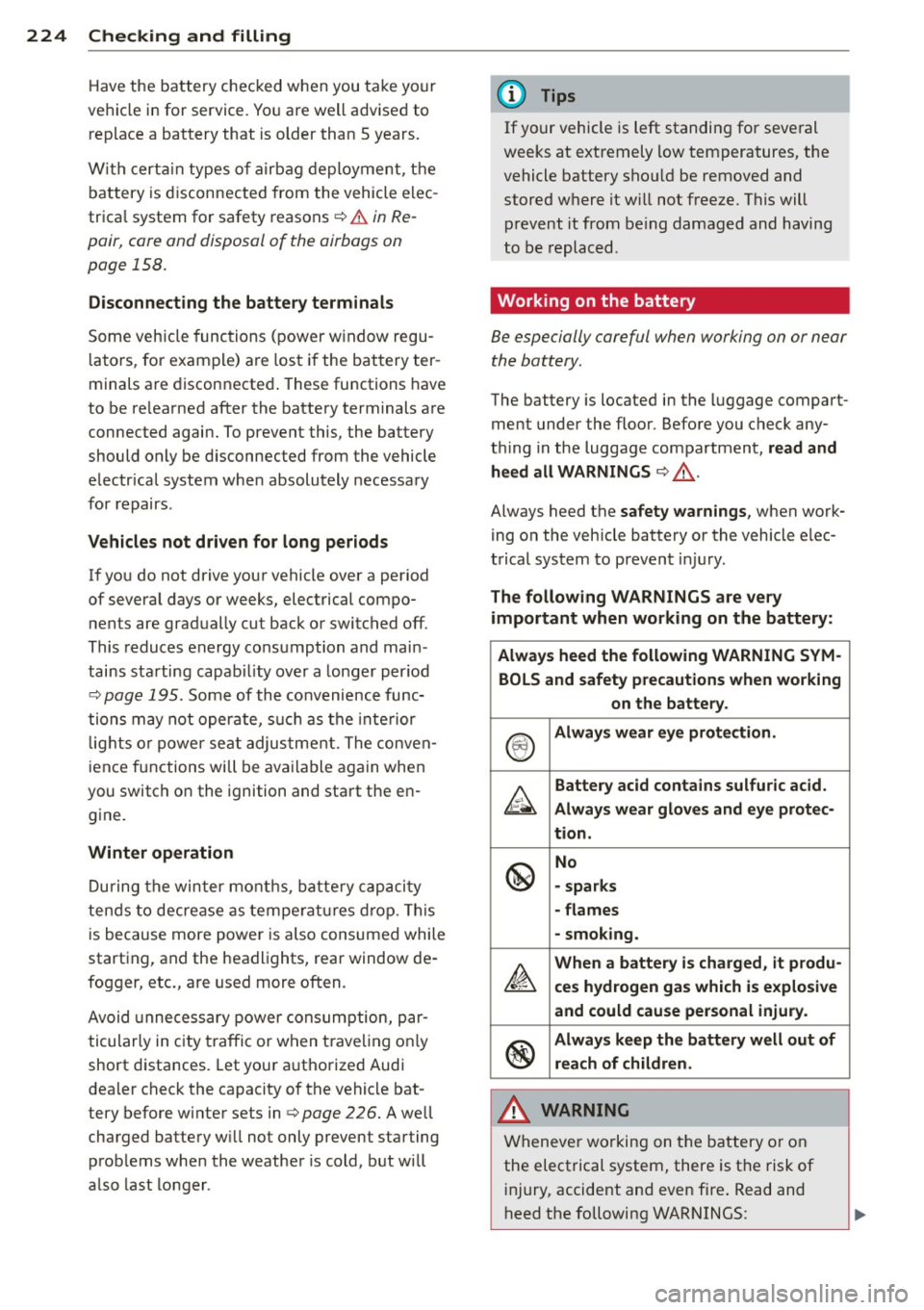
The following WARNINGS are very
important when working on the battery :
Al ways heed the follo wing WARNING SYM -
BOLS and safety precautions when working
on the battery .
®
Always wear eye prote cti on.
&
Battery acid contains sulfuric acid.
Always wear glove s and eye protec-
tion.
@
No
- spa rks
- flames
- smoking.
£
When a battery i s charged, it produ-
ce s hydrogen gas which is e xplosi ve
and could cau se personal injury.
@
Alwa ys k eep the battery well out of
rea ch of children .
_&. WARNING ~
Whenever working on t he battery o r on
the electrical system, there is the risk of
i njury, accident and even fire . Read and
heed the following WARNINGS:
-
Page 227 of 292
-Always wear eye protection. Do not let
battery acid or any lead particles get on
your skin or clothing. Shield your eyes .
Explosive gases can cause blindness or
other injury.
- Battery acid contains sulfuric acid . Sulfu
ric acid can cause blindness and severe
burns.
- Always wear gloves and eye protection.
Do not tilt the battery because acid
could leak out of the ventilation open
ings.
- If you get battery acid in your eyes or
on your skin, immediately rinse with
cold water for several minutes and get
medical attention .
- If you should ingest any battery acid,
seek medical attention immediately.
- Do not expose the battery to an open
flame, electric sparks or an open light.
- Do not smoke.
- Do not interchange the positive and neg -
ative cables .
= When working on the battery, be sure
not to short-circuit the terminals with
tools or other metal objects. This would cause the battery to heat up very quickly,
which could lead to damage or explosion and personal injury.
- When a battery is charged, it produces
hydrogen gas which is explosive and
could cause personal injury .
- Always keep the battery well out of the
reach of children.
- Before work is done on the electrical sys
tem, disconnect the negative ground ca ble .
- Before performing any work on the elec
trical system, switch off the engine and
ignition as well as any electrical equip
ment. The negative cable on the battery
must be disconnected . If you are just go
ing to replace a light bulb, then it is
enough to switch off the lights.
- Before disconnecting the battery, switch
off the anti-theft alarm system! Other
wise you will set off the alarm.
Checking and filling 225
-When disconnecting the battery, first
disconnect the negative cable and then
the positive cable.
- Before reconnecting the battery, make
sure all electrical consumers are switch
ed off. Reconnect the positive cable first
and then the negative cable . Never inter
change the cables -this could start a fire!
- Never charge a frozen or a thawed-out
battery . It could explode! If a battery has
frozen , then it must be replaced . A dis
charged battery can freeze over at 32 °F
(0 °C) .
-Make sure the vent hose is always attach
ed to the opening on the side of the bat
tery .
- Never use batteries which are damaged.
There is the danger of an explosion! Al
ways replace a damaged battery.
&_ WARNING
California Proposition 65 Warning:
- Battery posts, terminals and related ac
cessories contain lead and lead com
pounds, chemicals known to the State of
California to cause cancer and reproduc
tive problems. Wash hands after han dling.
(D Note
- Do not disconnect the vehicle battery
when the ignition is on or when the en gine is running, otherwise, you will dam
age electronic components in the e lectri
cal system.
- If your vehicle is going to stand for a
long period of time without being driven,
protect the battery from "freezing", oth
erwise it will be damaged and will then
have to be replaced.
- When opening the doors, the windows
lower approximately 10 mm automati
cally . This function is not available when
the battery is disconnected, which
means there is a risk that the door sea l
or the window could be damaged.
•
•
Page 250 of 292
![AUDI RS7 SPORTBACK 2014 Owners Manual 248 Tires and wheels
If the [fJ] indicator light turns on, the pressure
in at least one tire is too low or new sensors
were not adapted:
[f!l indicator lights turns on after t](/manual-img/6/57649/w960_57649-249.png "AUDI RS7 SPORTBACK 2014 Owners Manual 248 Tires and wheels
If the [fJ] indicator light turns on, the pressure
in at least one tire is too low or new sensors
were not adapted:
[f!l indicator lights turns on after t")
248 Tires and wheels
If the [fJ] indicator light turns on, the pressure
in at least one tire is too low or new sensors
were not adapted:
[f!l indicator lights turns on after turning
the ignition on
The tire pressure is too low compared to the
specified pressure.
.,. Check and store the tire pressure(s) the next
time it is possible¢
page 248.
[f!l indicator light turns on while driving
Wheels with new sensors were not adapted or
the tire pressure has reached a critical level
compared to the spec ified pressure.
.,. Avoid unnecessary steering and braking ma
neuvers .
.,. Adapt your driving style to the situation .
.,. Stop as soon as possible and check the
ti re(s).
.,. If it is possible to continue driving, see an
authorized Audi dealer or a qualified work
shop immediately and have your tire(s) re
paired or replaced.
A WARNING
Read and follow the important informa
tion and notes
~page 246.
Storing new tire pressures
-
Correctly stored tire pressure specifications
are necessary for reliable tire pressure moni
toring.
.,. Check the tire pressures in all wheels.
.,. If necessary, correct the tire pressure ac
cording to the specifications on the sticker
on the side of the driver's door . Only correct
the pressure in tires whose temperature is
approximately the same as the ambient
temperature. If the temperature of the tire
is higher than ambient temperature, the tire
pressure must be increased approximately
0.2 bar above the value on the sticker.
.,. Switch on the ignition.
.,. Select :
I CARI function button > Car systems
> Tire pressure monitoring > Store tire pressures.
After storing,
the tire pressure
monitoring system measures the current
tire pressures and stores them as the new
specified pressures.
,. If the changed tire pressures are not dis
played in the Infotainment system, drive the
veh icle for approx imately 10 minutes so
that the sensor signal from the wheels is re
ceived aga in .
During this adaptation phase,--,--is displayed
for the pressure and temperature and the tire
pressure monitoring system is only partially
available.
It only provides a warning if one or
more tire pressures is be low the min imum
permitted spec ified pressure . If this is the
case, the
[fJ] indicator light appears with a
message.
A WARNING
Read and follow the important informa
tion and notes¢
page 246.
Malfunctions
Fig. 202 Display : indicator light with a message
-
If the tire pressure monitoring system is not
available,
the m indicator light appears in
the driver information system. The
[fJ] indica
tor light also blinks for approximately one mi
nutes each time the ignition is switched on.
The tire pressure monitoring system cannot be selected in the Infotainment system. The
malfunction could be caused by the following
examples:
- If the message appears at the end of the
adaptation phase, the system cannot detect
the wheels installed on the vehicle. This may
resu lt from one or more wheels being ..,.
Page 265 of 292
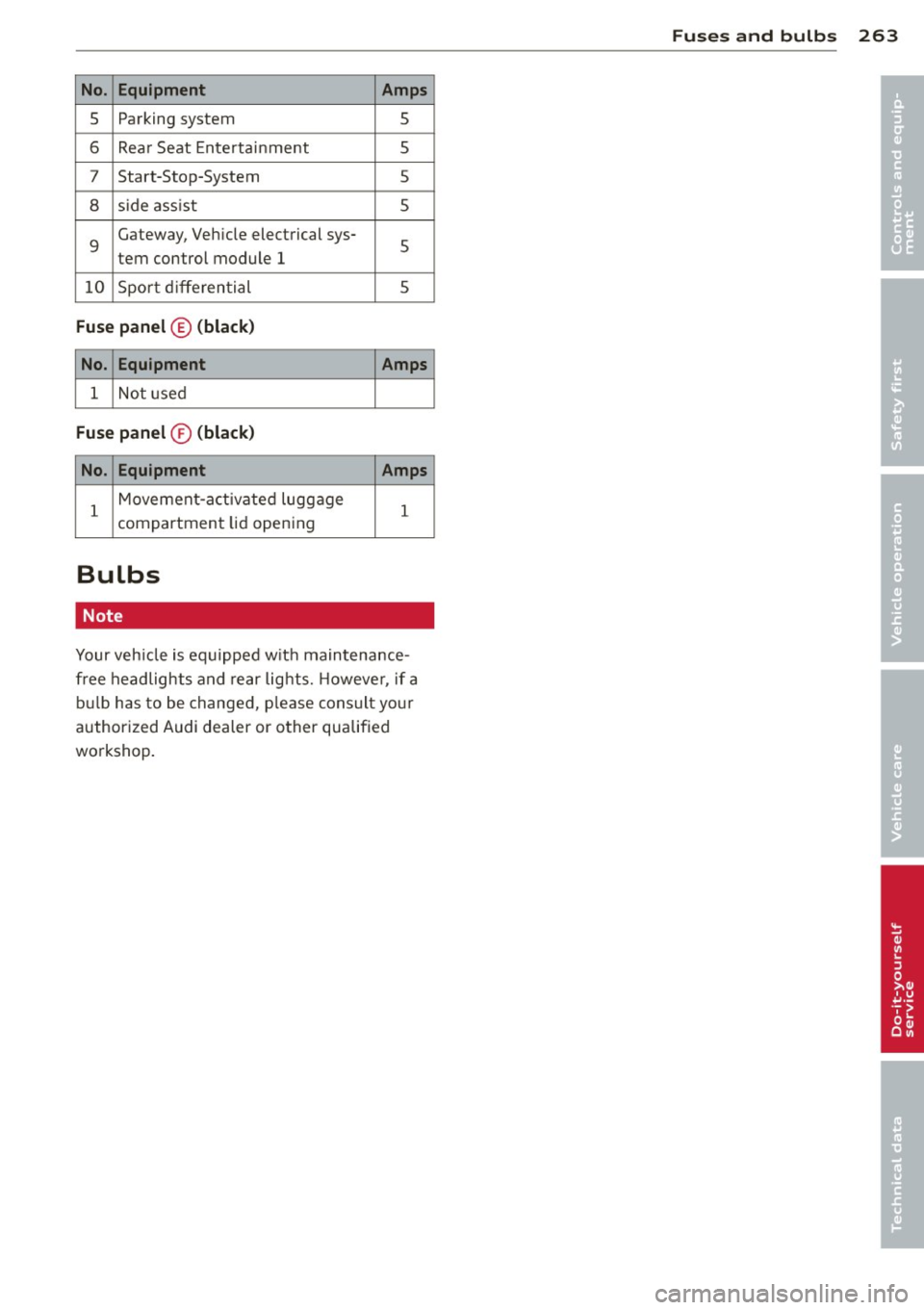
No. Equipment Amps
5 Parking system 5
6 Rear Seat Entertainment 5
7 Start-Stop-System 5
8 side ass ist 5
9
Gateway, Vehicle electrical sys-
5 tern control module 1
10 Sport d ifferen tial
5
Fu se p anel © (black )
No. Equipment Amps
1 Not used
Fu se p anel ® (black )
No. Equipment Amps
1 Movement-activated luggage
1
compartment lid opening
Bulbs
Note
Your veh icle is equipped with maintenance
free headlights and rear lights. Howeve r, if a
bu lb has to be changed, p lease consult yo ur
authorized Audi dealer or other qualified
workshop.
Fu ses and bulb s 263
•
•
Page 267 of 292
@ Tips
The disc harged battery must be properly
connected to the vehicle's electrical sys
tem. When jump starting or charg ing the
battery, never connect the negative
ground cable to the batte ry negat ive post
because the ba tte ry manager system must
be ab le to detect the battery's state of
charge. Always connect the negative
g round cab le to the negative ground pos t
of t he battery manager cont ro l unit.
Use of jumper cables
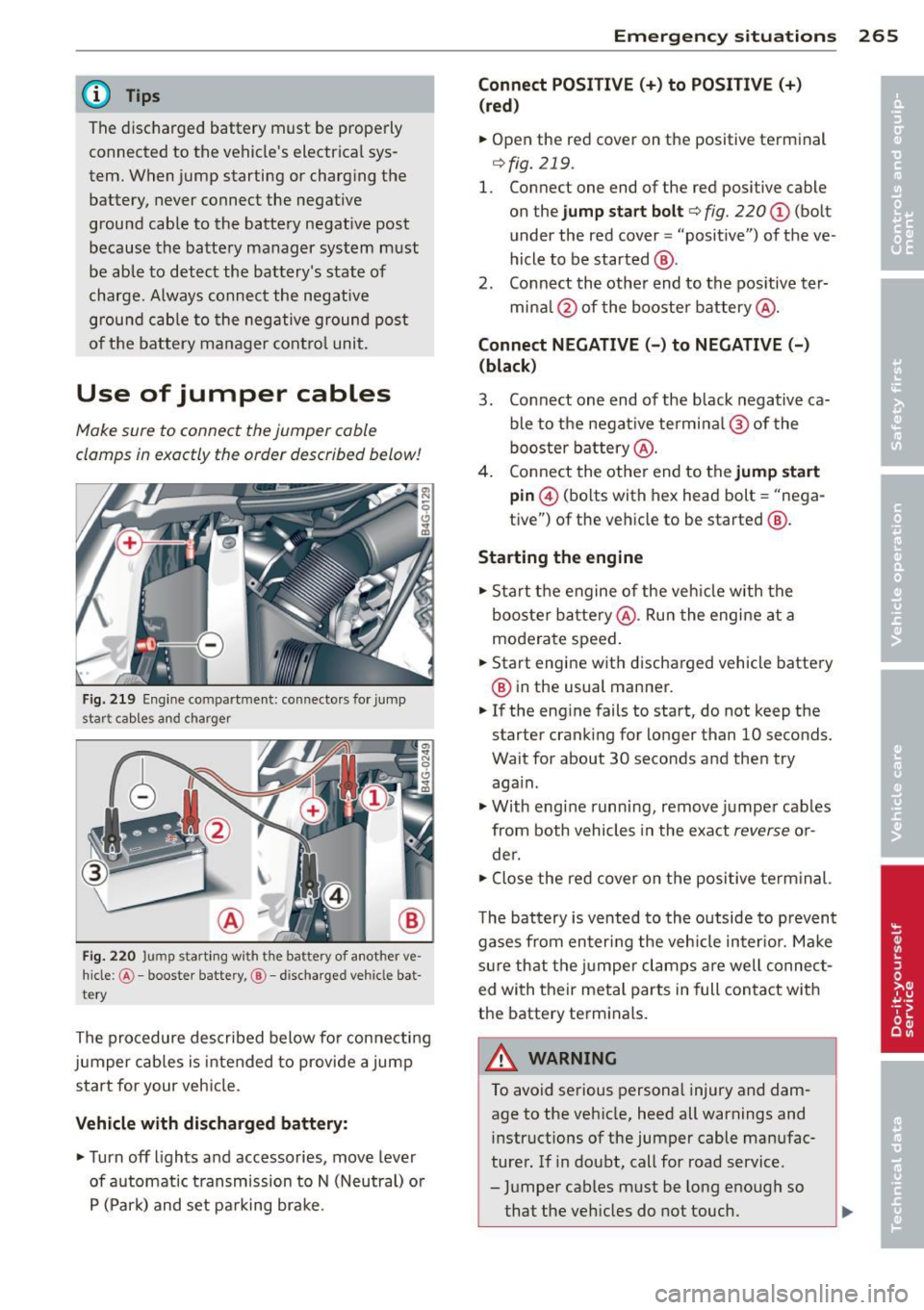
Make sure to connect the jumper coble
clomps in exactly the order described b elow!
Fi g. 21 9 Eng ine co mpar tment: connecto rs for jum p
s tar t cab les and ch arg er
F ig. 220 Jump start in g w ith t he ba ttery of a not her ve ·
hi cle :
@-booster battery, ®-disc harged ve hicle bat
te ry
The procedure des cribed below fo r connecti ng
jumper cables is intended to provide a jump
start for your veh icle.
Vehicle with discharged battery :
• Turnoff lights and accessories, move lever
of automatic t ransmission to N (Neu tral) o r
P ( Par k) and set pa rking brake .
Emergenc y situ ation s 265
Connect POSI TIVE(+) to POSITIVE(+)
(red )
• Open the red cov er on the posit ive te rminal
¢ fig. 219 .
1. Connect one end of the red positive cable
on the jump sta rt bolt
¢ fig. 220 (D (bolt
under the red cover = "positive") of the ve
hicle to be started @.
2 . Connect th e othe r end to the pos itive ter-
mi na l@ of the booster battery @.
Connect NEGATIVE( -) to NEGATIVE(-)
(black )
3. Connect one end of the black negative ca ble to the negat ive termi na l@ of the
booster b attery @.
4. Connect the othe r end to the jump start
pin @ (bo lts w ith hex head bolt = "nega
tive") of the vehicle to be started @.
Starting the engine • Sta rt the e ngine of the veh icle w ith the
booste r ba tte ry @ . Ru n the engi ne at a
modera te speed.
• Start engine w it h discha rged vehicle battery
@ in the usual manner.
• If the eng ine fails to start, do not keep the
starter c ranking for longer than 10 seconds.
Wait for about 30 seco nds a nd the n try
aga in .
• With eng ine runni ng,
remove ju mpe r cab les
from both vehicles in the exact
reverse o r
de r.
• Close the re d
cover on the positive te rm inal.
T he battery is v ented to th e outside to p rev ent
gases from en ter ing the veh icle in ter io r. Ma ke
s ur e th at the jumper clamps are well connec t
ed with their meta l parts in full con ta ct w ith
the battery term inals.
,8. WARNING
To avoid se rious personal injury and dam
age to the veh icle, heed all warnings and
instructions of the jumper cable man ufac
ture r. If in doubt, call for road service .
- Ju mpe r cables m ust be long enough so
that the veh icles d o not touch.
-
Page 279 of 292
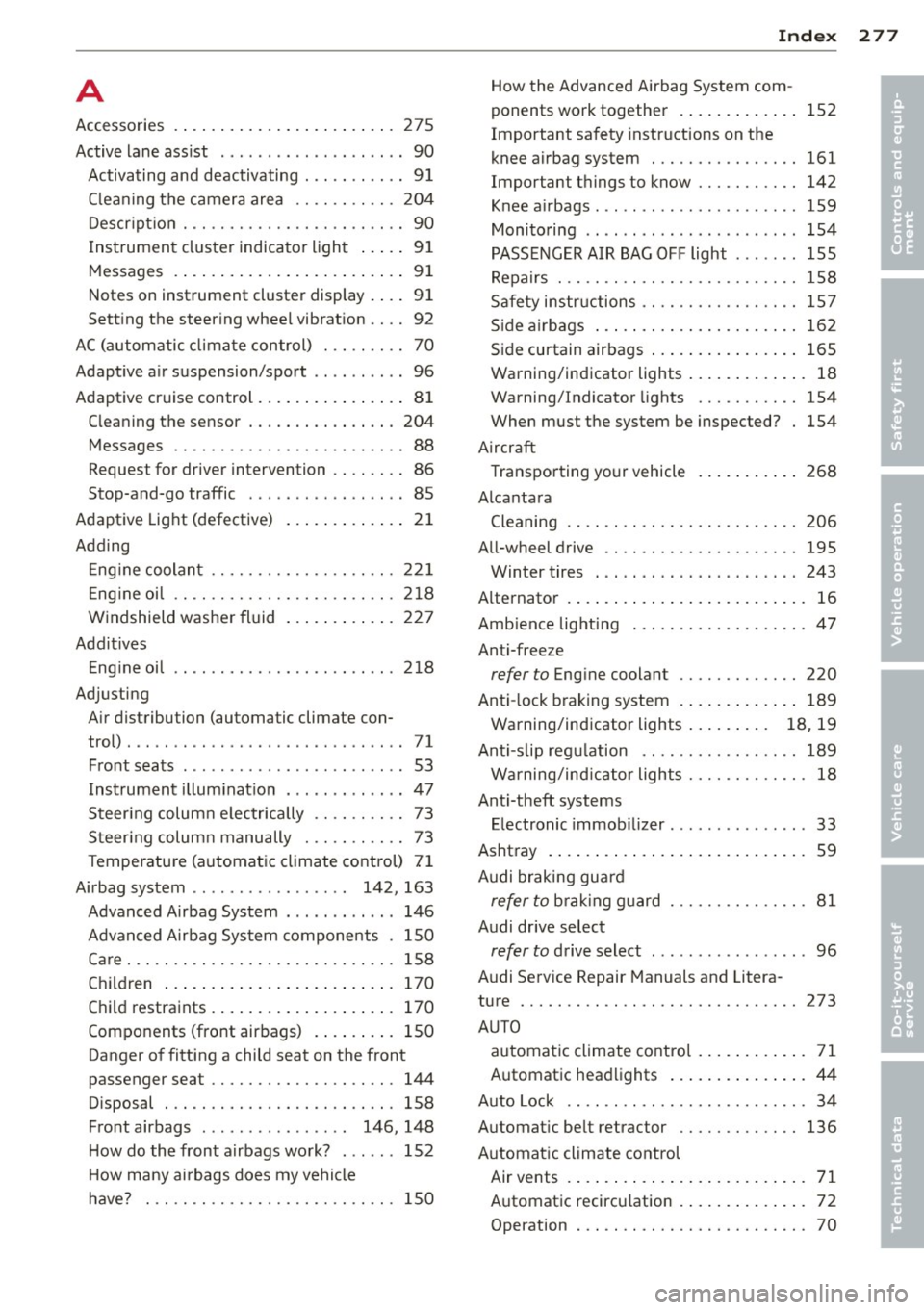
A
Accessories . . . . . . . . . . . . . . . . . . . . . . . . 2 7 5
Active lane assist . . . . . . . . . . . . . . . . . . . . 90
Activating and deactivating . .. .. .. .. .. 91
C leaning the camera area .. .. .. .. .. . 204
Description .............. .... .. .... 90
Instrument cluster indicator light . . . . . 91
Messages .. ................ ... .... 91
Notes on instrument cluster display . . . . 91
Setting the steering wheel vibration .. .. 92
AC (automatic climate control) . .. .. .. .. 70
Adaptive air suspension/sport .. .. ... ... 96
Adaptive cruise control ......... ... .... 81
Cleaning the sensor .......... ..... . 204
Messages .. ............. .... .. .... 88
Request for driver intervention . . . . . . . . 86
Stop-and-go traffic . . . . . . . . . . . . . . . . . 85
Adaptive Light (defective) ............. 21
Adding Engine coolant ........... .. .. .. .. . 221
Engine oil .. ............. .... .. ... 218
Windshield washer fluid ............ 227
Additives Engine oil .. ....... ...... .... .. .. . 218
Adjusting Air distribution (automatic climate con-
trol) ..... ... ...... ....... ...... ... 71
Front seats . . . . . . . . . . . . . . . . . . . . . . . . 53
Instrument illumination ... .. .. .. .. .. 47
Steering column e lectrically .. .. .. .. .. 73
Steering column manually . .. .. .. .. .. 73
Temperature (automatic climate control) 71
Airbag system . . . . . . . . . . . . . . . . . 142, 163
Advanced Airbag System . . . . . . . . . . . . 146
Advanced Airbag System components . 150
Care . .. .. .. .... ............. .. .. . 158
Children ... ................ ... ... 170
Child restraints .............. ... ... 170
Components (front airbags) . ... .. .. . 150
Danger of fitting a child seat on the front
passenger seat . . . . . . . . . . . . . . . . . . . . 144
Disposal . .. ............. .... .. .. . 158
Front airbags . . . . . . . . . . . . . . . . 146, 148
How do the front airbags work? . ..... 152
H ow many airbags does my vehicle
have? ... .. .... ............. .. .. . 150
Index 277
How the Advanced Airbag System com-
ponents work together ............ . 152
Important safety instructions on the
knee airbag system ................ 161
Important things to know ......... .. 142
Knee airbags . .. .. .. ............... 159
Monitoring .. .. .. .. . .. .... ........ 154
PASSENGER AIR BAG OFF light ....... 155
Repairs . . . . . . . . . . . . . . . . . . . . . . . . . . 158
Safety instructions .... ......... .. .. 157
Side airbags ... .. .. ............... 162
Side curtain airbags ............... . 165
Warning/indicator lights ............ . 18
Warning/Indicator lights ....... .. .. 154
When must the system be inspected? 154
Aircraft Transporting your vehicle
Alcantara 268
Cleaning .. .. .. .. .... ........... .. 206
All-wheel drive .. .. .. ............... 195
Winter tires . .. .. .... ... .... .... .. 243
Alternator ... ..... .. ................ 16
Ambience lighting ... ... ..... ... .... . 47
Anti-freeze
refer to Engine coolant ............. 220
Anti-lock braking system ............ . 189
Warning/indicator lights . . . . . . . . . 18, 19
Anti-s lip regu lation .... ......... .. .. 189
Warning/indicator lights ........ .. .. . 18
Anti-theft systems Electronic immobilizer ............. .. 33
Ashtray ..... ... .... ................ 59
Audi braking guard
refer to brak ing guard .......... .... . 81
Audi drive select
refer to drive select ... .. ...... .... .. 96
Audi Serv ice Repair Manuals and Litera-
ture ......... .. .. ................. 273
AUTO automatic climate control .......... .. 71
Automatic headlights ............... 44
Auto Lock . . . . . . . . . . . . . . . . . . . . . . . . . . 34
Automatic belt retractor ......... .. .. 136
Automatic climate control
Air vents .. .. .... .. ................ 71
Automatic recirculation ............ .. 72
Operation . . . . . . . . . . . . . . . . . . . . . . . . . 70
•
•
Page 280 of 292

278 Index
Setup . . . . . . . . . . . . . . . . . . . . . . . . . . . . 72
synchronizing ............. ... .... .. 71
Automatic Shift Lock (ASL) .......... . 105
Automatic transmission . . . . . . . . . . . . . . 104
Automatic Shift Lock (ASL) . .. .. .. .. . 105
Driving .... .. ........ .... ... .. .. . 106
Emergency mode ........... .. .. ... 108
E mergency release ........ .. .. .. .. . 109
Kick -down ............... .... .... . 108
Manual shift program ......... .. .. . 108
Selector lever ............. ... .... . 104
Automatic wipers . .. ........ ... .. .. .. 48
Auto Safety Hotline . . . . . . . . . . . . . . . . . 131
Average consumption ....... .. .. .. .. . . 24
Average speed . . . . . . . . . . . . . . . . . . . . . . . 24
Avoid damaging the vehicle ........ .. . 199
B
Bag hooks . . . . . . . . . . . . . . . . . . . . . . . . . . 67
Battery ... .. .. .. ............ ... .. . 223
Charging ... .. .. .. .......... ... .. . 226
I mportant warnings ...... .. .. .. .. . 224
Jump starting .. ........ .. .. .. .. .. . 264
L ocat ion ..... ........... ........ . 224
l ow ... .... ................ ..... . 195
Rep lacing the battery ...... ... .. .. . 227
State of charge ............ ... .. .. . 195
Winter operation ......... .... .... . 223
Working on the battery .... .. .. .. .. . 224
Before driving . . . . . . . . . . . . . . . . . . . . . . 123
Blended gasoline .... ...... .. .. .. .. . 208
Blower (automatic climate control) . . . . . . 71
Boost display . . . . . . . . . . . . . . . . . . . . . . . . 28
Booster seats ... .... ...... .. .. .. .. . 177
Boost pressure indicator .......... .. .. 28
Brake fluid Changing the brake fl uid ... .... .. .. . 223
Check ing the brake fluid level . .. .. .. . 222
What is the correct brake fluid leve l? .. 222
What should I do if the brake fluid warn-
ing light comes on? ........ .... ... . 222
Brake system Anti-lock braking system ..... .. ...... 19
Brake assist system ........ ... .. .. . 189
Brake booster ............. ... .... . 193
Brake fluid ............... ... .... . 222 Brake fluid specifications for refill and re
placement
. . . . . . . . . . . . . . . . . . . . . . . 223
Brake light defective . . . . . . . . . . . . . . . . 21
Brake pads ...... ............. .... 198
Electromechanical parking brake . .... . 77
Fluid reservoir . .. ................ . 222
How does moisture or road salt affect the
brakes? ....... .. .. ........ ... ... . 193
Warning/ind icator lights ...... .. .. .. . 14
Worn b rake pads symbo l ........ .. .. . 20
braking guard
Settings . . . . . . . . . . . . . . . . . . . . . . . . . . 88
Braking guard ..... ............. ... .. 81
Messages . .. .. .. .. ........... .... . 88
Break-in per iod .... ............. .... 198
Brake pads .... .. ................ . 198
Tires .... ..... .. .. .............. . 198
Bu lbs .. .. .. .. .. .. .. .. ...... ... .. .. 263
C
California Proposition 65 Warn ing .... . 214
Battery specific .. ..... ......... ... 225
Capacities .. .... .. ................. 271
Engine oil ....... ............. .... 215
Carbon parts Cleaning . . . . . . . . . . . . . . . . . . . . 205, 206
Car carrier Transporting your vehicle ....... .. .. 268
Care ... .. .. .. .. .. ............. .. .. 203
Cargo area . ..... .. ............. ... . 129
Cargo net . . . . . . . . . . . . . . . . . . . . . . . . . . . 66
Catalytic converter .............. .. .. 199
Center armrest Cockpit . . . . . . . . . . . . . . . . . . . . . . . . . . . 56
Central locking .. .. .......... ...... .. 34
Emergency locking ... ....... ...... .. 38
Certification ..................... .. 276
Changi ng a wheel .. ... .......... .. .. 254
Changing engine oil .......... ...... . 219
Checking Engine coolant level ............ .... 220
Tire pressure ... .. ... .......... .. .. 234
Page 281 of 292
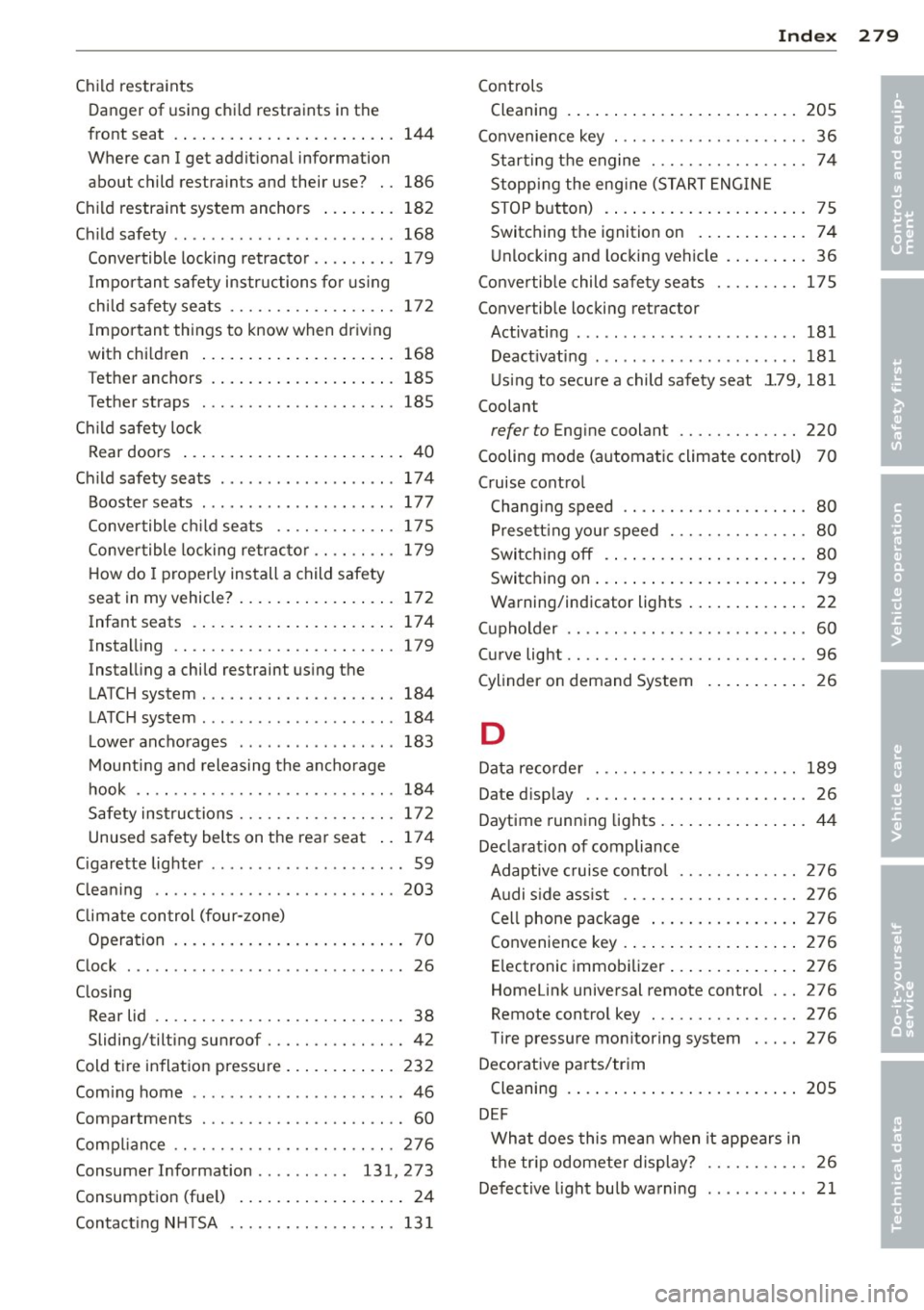
Child restraints
Dang er of using chi ld rest raints in th e
front seat . . . . . . . . . . . . . . . . . . . . . . . . 144
Where can I get addit ional information
about child restra ints and their use? . . 186
Ch ild restra int system anchors ... .. .. . 182
Ch ild safety .. ................ ... ... 168
Convertible locking retracto r . . . . . . . . . 179
I mportant safety instr uctions fo r using
ch ild safety seats ......... .. .. .. .. . 172
I mportant things to know when dr iv ing
with chi ld ren .... ..... ... .. .. .. ... 168
T ether anchors . . . . . . . . . . . . . . . . . . . . 185
Tether straps ............ .... .. .. . 185
C hild safety loc k
Rear doors ..... .. .... ... .. .. .. .... 4 0
Ch ild safety seats . . . . . . . . . . . . . . . . . . . 17 4
B ooste r seats . .. .. .... ... .. .. .. .. . 177
Conver tible c hild seats .... .. .. .. .. . 175
Conve rtible locking re tra cto r .. .. .. .. . 179
H ow do I properly ins tall a child safety
seat in my vehicle? ..... ... .. .. .. .. . 172
Infant seats . . . . . . . . . . . . . . . . . . . . . . 17 4
Instal ling .. ............. .... .. ... 179
Instal ling a child restraint us ing the
LATC H system ... .... ... .. .. .. .. .. . 184
LA TC H system ............... ... ... 184
L ower ancho rages ......... ... ... .. 183
M ount ing and releas ing the ancho rage
hook .. .. .. .. ............. .. .. ... 184
Safety ins truc tions ........ .. .. .. .. . 172
Unused safety belts on the rear seat .. 17 4
Cigarette lig hter . . . . . . . . . . . . . . . . . . . . . 59
C leaning ... . ............. .... .. .. . 203
Climate con trol (four-zone)
Operation . . . . . . . . . . . . . . . . . . . . . . . . . 70
Clock ..... ... ...... ............. ... 26
C losing
Rear lid . . . . . . . . . . . . . . . . . . . . . . . . . . . 38
Sliding/tilting su nroof ..... .. .. .. .. .. 42
Cold ti re inflat ion pressure ... .. .. .. .. . 23 2
Com ing home ..... .. ...... .. .. .. .. .. 4 6
Compartments . ........... .. .. .. .... 60
Com plian ce .. ............. .... .. .. . 276
Consume r Info rmation . . . . . . . . . . 131, 273
Consumption (fue l) . . . . . . . . . . . . . . . . . . 24
Contact ing N HTSA ......... .. .. .. .. . 13 1
Inde x 279
Controls
Cleaning . ... .. .... . ... ...... ... .. 205
Convenie nce key . . . . . . . . . . . . . . . . . . . . . 36
Star ting the engine ............ .. .. . 74
Stopping the eng ine (STAR T ENGIN E
STOP b utton) .. .... . ... ...... ... .. . 7S
Switching the ignition on .... ... .. .. . 74
U nlocking and loc king vehicle . ... .. .. . 36
Conve rtib le child sa fe ty seats ..... .. .. 17S
Convertib le locking retractor
Activati ng .... ... .. ..... .......... 181
Deact ivati ng .. ... .. ..... .......... 181
U sing to secure a child safety seat l.79, 181
Coolant
refer to Eng ine coolant ......... .. .. 220
Cooling mode (automatic climate control) 70
Cruise cont ro l
Changi ng speed .. ................. . 80
P rese tt ing your speed .......... .. .. . 80
S wi tching off .. .. .. . .. ... .... ... .. . 80
Switching on . . . . . . . . . . . . . . . . . . . . . . . 79
Warning/indicator lights ..... ... .. .. . 22
( upholder .. .. .. .. .... ........... .. . 60
Curve light .. .. .. .. .. ............... . 96
Cylinder on demand System ... ... .. .. . 26
D
Data recorde r . . . . . . . . . . . . . . . . . . . . . . 189
Date d isp lay .. .. .. .. . .. .. ..... ... .. . 26
Daytime running lights . ... .... ... .. .. . 44
Decla rat io n of compliance
Adaptive c ruise cont ro l ......... .. .. 276
A udi s ide ass ist ...... ......... .. .. 276
C e ll phone package ... ...... ... .. .. 276
Co nvenience key .... . .. ..... ... .. .. 276
E lectronic immobi lizer .. ..... ... .. .. 276
Homelink universal remote control . .. 276
Remote contro l key ............ .. .. 276
Tire pressure mo nitor ing system . .. .. 276
Decorative pa rts/trim
Cleaning . ... .... .. . .. .. ..... ... .. 205
D EF
Wh at does this mea n when it appears in
t h e tr ip odomete r display? ...... .. .. . 26
Defec tive light bu lb warni ng ......... .. 21
•
•