2014 AUDI A5 CABRIOLET roof
[x] Cancel search: roofPage 170 of 286

168 Child Safet y
Convertible child safety seats
Properly used convertible child safety seats
can help protect toddlers and children over
age one who weigh between
20 and 40 lbs. (9
and 18 kg) in a crash.
Fig . 160 Sche matic overv iew : ins tallat ion of t he at
t a chments appl icable to a LATCH seat
Fig. 161 Sche matic overview: in sta llat ion of t he sea t
us ing t he veh icle's safety be lt system
.. When using the vehicle safety be lt to insta ll
a chi ld safety seat, you must f irst activate
the convertible locking feature on the safety
belt to prevent the child safety seat from
moving
c::> page 171 or insta ll the seat using
the LATCH attachments .
.. Push the child safety seat down with your
full weight to get the safety belt really t ight
so that the seat cannot move forward or s ideways more than one inch (2.5 cm)
c::> page 171.
.. Secure unused safety be lts on the rear seat
~ page 166.
A toddler or child is usually too large for an in
fant restraint if i t is more than one year old
and weighs more than 20 lbs . (9 kg).
Toddle rs and ch ildren who are o lder than one
year up to about 4 years o ld and weigh more
than 20 lbs. (9 kg) up to 40 lbs. (18 kg) must always be proper
ly restrained in a child safety
seat certified for the ir size and weight
~ fig. 160 and r:!) fig . 161 .
The airbag on the passenger side makes the
front seat a potentia lly dangerous place for a
c h ild to ride. The front seat is not the safest
place for a child in a forward-facing child safe
ty seat. It is a very dangerous place for an in
fant or a larger ch ild in a rearward-facing seat.
A WARNING c=
Not using a child safety seat, us ing the
wrong child safety seat or imprope rly in
stalling a ch ild restra int increases the risk
of ser ious personal in jury and death in a
collis ion or o ther emerge ncy sit uat ion.
- Ch ild ren on the front seat of any ca r,
even with Advan ced Airbags, can be seri
ously injured or even k illed when an air
bag inflates. A chi ld in a rearwa rd -facing
child safety seat installed on the front passenger seat will be serio usly injured
and can be killed if the front airbag in
flates -even with an Advanced Airbag
System .
-
-The inflating airbag will h it the ch ild
safety seat or infant carrier with great
force and will smash the child safety seat
and child aga inst the back rest, center
armrest, doo r or roof .
-Always install rearward-facing ch ild safe
ty seats on the rea r seat .
- If you must install a rearward fac ing
child safety seat on the front passenger
seat because of exceptiona l circumstan
ces and the
PA SSENGER AIR BAG OFF
light does not come o n and stay on, im
mediately insta ll the rearward-facing
child safety seat in a rear seating posi
tion and have the airbag system inspect
ed by your authorized A udi dealer.
- The rear side of the child safety seat
should be pos itioned as close as possib le
to the backrest on the vehicle seat.
- Always read and heed all WARNINGS
whenever using a child restrained in ave-
h icle is being used
c::> page 132, Safety ll>-
Page 173 of 286

-If the PA SS ENGER AIR BAG O FF light
does not come o n an d stay on, perform
the checks described
c:> page 150, Moni
toring the Advanced Airbag System .
-Take the child restraint off the front pas
senger seat and install it properly at one
of the rear seat positions if the
PAS SEN
GER AIR BAG OFF
light does not stay on
whenever the ignition is switched on.
- Always read and heed all WARNINGS
whenever using a child rest rained in ave
hicle is being used
c:> page 132, Safety
belts,
c:> page 140, Airbag system and
c:> page 161, Important things to know.
Installing a child safety
seat
Securing a child safety seat using a
safety belt
Safety belts for the rear seats and the front
pas senger's seat can be locked with the con
vertible locking retractor to properly secure
child saf ety seat s.
The safety belts eme rgency lock ing re tracto rs
for the re ar seats safety belts and for the
front passenger 's seat sa fety belt have a con
ve rtible locking retractor for child restraints.
The safety belt must be locked so that belt
webbing cannot unreel. The retractor can be
activated to lock the safety belt and prevent
t he safety belt webbing from loosening up
during normal driving . A child safety seat can
only be properly installed when the safety belt
i s locked so tha t the child and ch ild safety
seat will stay in place.
Always remember: Even though your veh icle is
equ ipped w it h an Advanced A irbag system, all
chi ld ren , espec ia lly those 12 yea rs and yo ung
e r, should always ride in the back seat proper
l y rest rained for thei r age and weig ht.
~ WARNING
Improperly insta lled child sa fety seats in
crease the risk of ser ious personal inju ry
and death in a collision.
Child Sa fet y 1 71
-Always ma ke sure that the safety be lt re
tractor is locked when insta lling a child
safety seat. An unlocked safety belt re
tracto r cannot hold the child safety seat
in place dur ing no rma l dr iving o r in a
crash .
- Always buckle the child safety seat firmly
in place even if a ch ild is not sitt ing in it .
A loose child safety seat can fly around
du ring a s udden stop or in a collision.
- If t he backrest is not securely latched,
the child and the child res traint will be
thrown fo rward togethe r with the bac k
rest and wi ll stri ke par ts of the ve hicle
interior. The child can be seriously i n
jured or killed .
- Never install rearwa rd -fac in g ch ild safety
seats or infant ca rrie rs on the front pas
senger seat . A child will be serio usly in
jured and can be killed when the passen
ger airbag inflates .
- The inflating airbag will h it the ch ild
safety seat or infant carrier with great
force and will smas h the child safety seat
and child against the backrest, center
armrest, doo r or roof .
- Always install rearward-facing chi ld safe
ty seats or infant carriers on the rea r
seat.
- Forward-facing child safety seats or in
fant carriers installed on the front pas
senger's seat may interfer e with the de
ployment of t he a irbag and cause serious
in jur y to the child.
- I t is safer to install a forwa rd-facing
child safety seat on t he rear seat.
- Always read a nd heed a ll WAR NIN GS
wheneve r us ing a chi ld restrained in ave
hicle is being used
c:> p age 161. Special
prec autions apply when instal ling a child
safety seat on the fron t passenger seat
c:> page 141, Child restraints on the front
seat -some important things to know.
A WARNING
A lways take specia l precautions if you
must install a forward or rearward-facing •
•
Page 174 of 286

172 Child Safety
child restraint on the front passenger's
seat in exceptional situations:
- Whenever a forward or rearward-facing
child restraint is installed on the front
passenger seat, the
PASSENGER AIR
BAG OFF
light must come on and stay on
whenever the ignition is switched on .
- If the
PASSENGER AIR BAG OFF light
does not come on and stay on, perform
the checks described<::)
page 150, Moni
toring the Advanced Airbag System .
- Take the child restraint off the front pas
senger seat and install it properly at one
of the rear seat positions if the
PASS EN·
GER AIR BAG OFF
light does not stay on
whenever the ignition is switched on.
- Improper installation of child restraints
can reduce their effectiveness or even
prevent them from providing any protec
tion.
- An improperly installed child restraint
can interfere with the airbag as it de
ploys and seriously injure or even kill the
child.
- Always carefully follow the manufactur
er's instructions provided with the child
safety seat or carrier.
- Never place additional items on the seat
that can increase the total weight regis
tered by the weight-sensing mat and can
cause injury in a crash .
.&_ WARNING
Forward-facing child restraints:
- Always make sure the forward-facing
seat has been designed and certified by
its manufacturer for use on a front seat
with a passenger front and side airbag.
- Never put the forward-facing child re
straint up, against or very near the in
strument panel.
- Always move the passenger seat into its
rearmost position in the seat's fore and
aft adjustment range, as far away from
the airbag as possible before installing
the forward-facing child restraint. The backrest must be adjusted to an upright
position.
- Make sure that the
PASSENGER AIR BAG
OFF
light comes on and stays on all the
time whenever the ignition is switched
on.
.&_ WARNING
-Rearward-facing child restraints:
- A child in a rearward-facing child safety
seat installed on the front passenger
seat will be seriously injured and can be killed if the front airbag inflates - even
with an Advanced Airbag System .
- The inflating airbag will hit the child
safety seat or infant carrier with great
force and will smash the child safety seat
and child against the backrest, center
armrest, door or roof.
-Always be especially careful if you must
install a rearward facing child safety seat
on the front passenger seat in exception
al circumstances.
-A tight tether strap on a rearward-facing
child restraint attached to the front pas
senger seat can put too much pressure
on the weight-mat in the seat and regis
ter a heavier weight in the Advanced Air bag System. The heavier weight regis
tered can make the system work as
though an adult were on the seat and de
ploy the Advanced Airbag when it must
be suppressed causing serious or even
fatal injury to the child.
- Make sure that the
PASSENGER AIR BAG
OFF
light comes on and stays on all the
time whenever the ignition is switched
on.
- If the PASSENGER AIR BAG OFF light
does not come on and stay on, immedi
ately install the rearward-facing child
safety seat in a rear seating position and
have the airbag system inspected by your
authorized Audi dealer.
Page 190 of 286

188 Driving and en vironm ent
8_ WARNING
After driving through water, mud, slush,
etc ., the brakes may be slow to take effect
because of wet brake rotors and pads . Dry
the brakes first by braking carefully to re
store the full braking effect.
(D Note
Vehicle components such as the engine,
transmiss ion, suspension or electrical sys
tem can be severely damaged by driving
through wate r.
@ Tips
- Check the depth of the water before dr iv
i ng through it .
- Do not stop the veh icle, dr ive in reverse
or switc h the engine off when driving
t hr ough water .
- Keep in mind that oncoming vehicles
may c reate waves that raise the water
l evel and make it too deep fo r you r vehi
cle to dr ive through safely.
-
- Avoid dr iving thro ugh salt water because
i t can ca use corrosion.
Catalytic converter
It is very important that your emission con
trol system (catalytic conv ert er) is function
ing properly to ensure that your vehicle is run
ning in on env ironm entally sound manner.
,,. Always use lead-free gaso line Q page 201,
Fuel supply .
,,. Never run the tank down a ll th e way to emp
ty.
,,. Never put too much moto r oil in your engine
Q page 211 , ~ Adding engine oil .
,,. Never try to push -or tow -start your ve hicle .
T he cata lytic converter is an eff ic ient "clean
up" device built in to the exhaust system of
the vehicle . The catalytic converter burns
many of the polluta nts in the exhaust gas be
fore they are released into the atmosphe re . The exclus
ive use of unleaded f uel is critica lly
important for the life of the catalytic conv ert
er and p roper funct ion ing of the eng ine .
A WARNING
=
-The temperature of the exhaust system
is high, both when driving and after stop
p ing the eng ine .
- Never touch the exhaust tail pipes once
they have become hot. This could result
in burns.
- Do not park or operate the vehicle i n
areas where the hot exhaust system may
come in co ntact with dry grass, brush,
fue l spill or other material wh ich can
cause a fire .
- Do not app ly additional undercoating or
r u stp roofing on or nea r the exhaust
manifold, exhaust pipes, cataly tic con
ver ter or he at s hields. Dur ing driv ing, the
substance used fo r undercoating could
overheat and cause a fire.
CI) Note
- Be aware tha t just o ne tank filling with
leaded fu el w ill alre ady ser io usly de
grade the performance of the cata lytic
converter .
- Do not exceed the cor rect engine oil level
Q poge 211.
-Do not drive until the fuel t ank becomes
comple tely empty . The engine cou ld mis
fire . Unburned fuel could also get into
the exhaust system and th is co uld cause
the catalytic converter to overheat.
- Do not turn off the ignition while the ve
hicle is mov ing.
- Do not contin ue to ope rate your veh icle
under these conditions, as otherwise fuel
can reach the catalyt ic converter. Th is
co uld result in overheating of the con
verter, requir ing its replacement.
- To assure efficient operation of the Emis -
sion Control System: .,..
Page 212 of 286

210 Check ing and filling
temperatures stay below freezing point for
long periods.
Detergent addit ives in the o il w il l make fresh
oil look dark after the eng ine has been run
ning for a short time . This is norma l and is not
a reason to change the oi l more often than
recommended.
D am age or m alfunc tions du e to lack of
m ainten ance
It is essential that you change your oil at the
recommended in tervals using only engine o il
that complies with Audi oi l standard
VW 502 00. Your Limited New Vehicle War
ranty does not cover damage or malfunctions
due to fail ure to fo llow recommended mainte
nance and use requ irements as set forth in
the Audi Owner's Manual and Warranty
&
Maintenance book let . Your dealer will have to
deny warranty coverage unless you present to
the dea ler proof in the form of Service or Re
pa ir Orders that all scheduled ma intenance
was performed in a t imely manner.
Eng ine oil consumption
The engine in your vehicle depends on an ade
quate amount of oil to lubricate and cool all
of its moving parts.
In order to provide effective lubrication and
cool ing of internal engine components, a ll in
ternal combustion eng ines consume a certa in
amount of oil. O il consumption varies from
engine to engine and may change significantly
over the life of the engine. Typica lly, engines
with a specif ied break-in period (see
¢
page 187) consume more oil during the
break-in period than they consume after oil
consumption has stabilized.
Under norma l conditions, the rate of oil con
sumption depends on the quality and viscosity
of the oil, the RPM (revolutions per minute) at
which the engine is operated, the ambient
temperature and road condit ions . Further fac
tors are the amount of oil d ilution from water
condensat ion or fuel residue and the ox ida
tion level of the oi l. As any engine is subject to wear as mi
leage builds up, the oil consump
tion may increase over time until replacement
of worn components may become necessary.
With a ll these variab les coming into play, no
standard rate of oil consumption can be es
tablished or specified. There is no alternative
to regu lar and frequent check ing of the o il lev
el, see
Note .
If the yellow engine oil leve l warning symbo l
Ill in the instrument cl uster lights up, you
shou ld check the oil leve l as soon as possib le
¢
page 211. Top off the oil at your earliest
convenience ¢
page 211.
A WARNING '"---
Before you check anythi ng in the engine
compartment, always read and heed all
WARNINGS¢
A in Working in the engine
compartment on page 206.
(D Note
Driving w ith an insufficient o il level is like
ly to cause severe damage to the engine .
(D Tips
-The oil pressu re warn ing display. is
not an indic ator of the oil l evel. Do not
r e ly on it . Instea d, check the oil level in
y our engin e at r egular in ter val s, pref
erably ea ch time y ou r efu el, and alwa ys
befor e go ing on a long trip.
- If you have the impression you r engine
cons umes excessive amoun ts of o il, we
recommend that you consu lt an author
ized Aud i dea le r to have the cause of
your concern properly diagnosed. Keep in m ind that the accurate measu rement of
oil consumption requ ires great care and
may take some time. An authorized Aud i
dea ler has instructions about how to
measu re oil consumption accurately.
-
Page 253 of 286
Fuses and bulb s 251
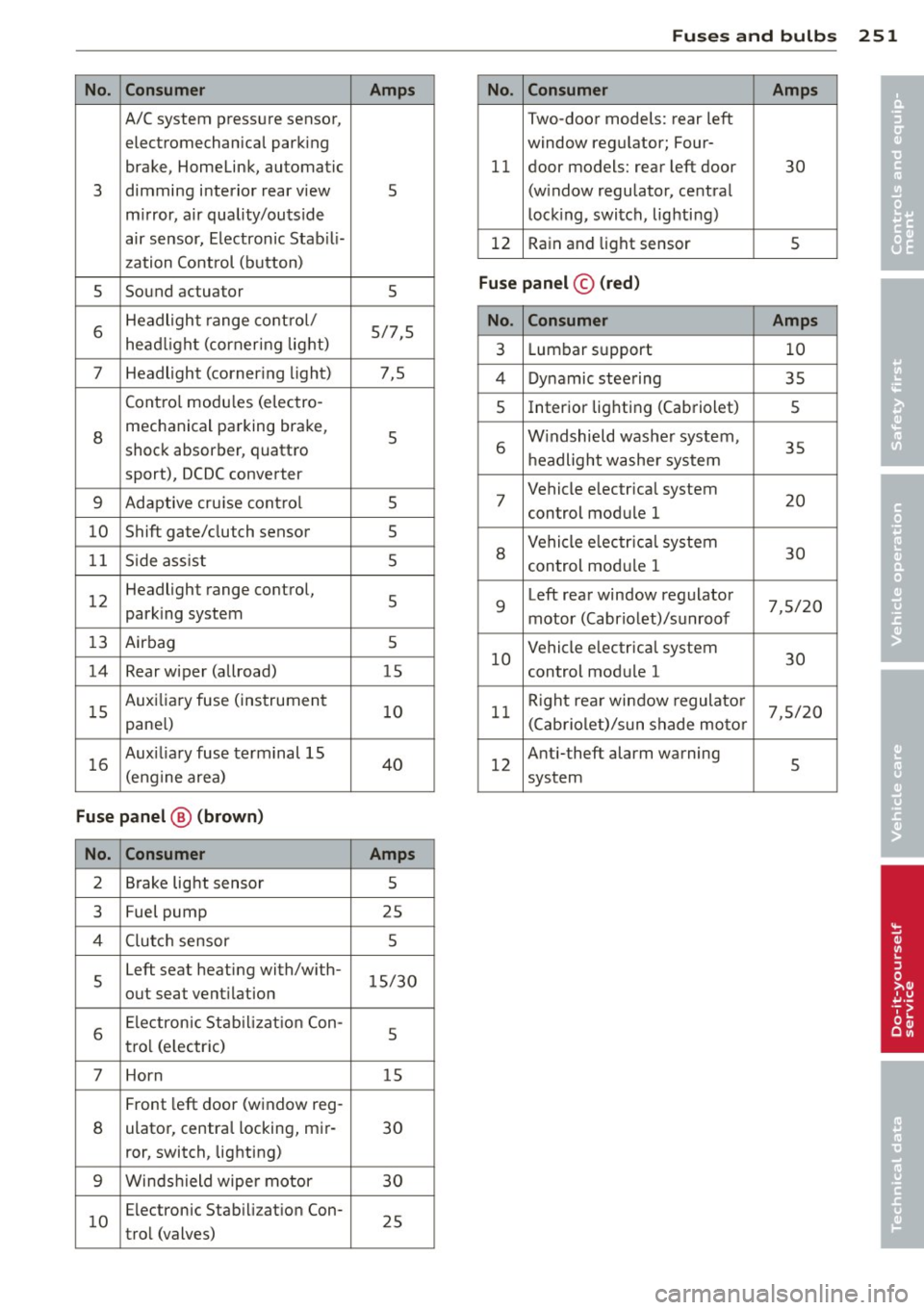
No. Con sumer Amps No. Consumer Amps
•
A/C system pressure sensor, Two-door models: rear left
• electromechanical parking window regulator; Four-
brake, Homelink, automatic 11 door models:
rear left door
30
3 dimming interior rear view
5 (window regulator, central
m irror, air quality/outside locking, switch, lighting)
air sensor, Electronic Stab ili-
12 Rain and light sensor
5
zation Control (button)
5 Sound
actuator
5
Fuse panel© (r e d )
6 Headlight
range cont rol/
5/7,5
head light (cornering light)
No. Consumer Amps
3 Lumbar support 10
7 Headlight (corner
ing light) 7,5
4 Dynamic steering 35
Contro l modu les (e lectro-
s Inter ior lighting (Cabriolet)
5
8 mechanical parking brake,
5
shock absorber, quattro
sport), DCDC converter
9 Adaptive cru ise contro l 5 6
W
indshield washer system,
35
h eadlight washe r system
7 Vehicle electrical
system
20
control module 1
10 Shift gate/clutch
sensor
5
1 1 Side ass ist 5
8
Vehicle electr ica l system
30
control module 1
1 2 Headlight range
control,
5
park ing system 9 Left rear window regulator
7,5/20
motor (Cabriolet)/sunroof
13 Airbag 5
14 Rear wiper (allroad) 15 10 Vehicle e
lectrical system
30
control module 1
1 5 Auxi
liary fuse (instrument
10
pane l) 11 R
ight rea r window regulato r
7,5/20
(Cabriolet)/sun shade motor
16 Aux
iliary fuse terminal 15
40
(engine area) 12 Anti-theft
alarm warning
5
system
Fuse p anel @ (brown )
No. Con sumer Amps
2 Brake light sensor 5
3 Fuel
pump
25
4 Clutc h sensor 5
5 Left
seat heating with/w ith-
15/30
out seat vent ilation
6 Electronic Stab
il iz at ion Con-
5
tro l (e lectric)
7 Horn 15
Front left door (window reg-
8 ulator, centra
l locking, mir-
30
ror, switch, lighting)
9 Winds hield wipe r motor 30
1 0 Electronic
Stabilizat ion Con-
25
trol (valves)
Page 267 of 286

complexity of today's automobi les, have
steadi ly reduced the scope of maintenance
and repairs which can be carried out by vehicle
owners.
Also, safe ty and e nvir onm en tal con
cerns place very strict limits on the nature of
repairs and adjustments to engine and trans
miss io n pa rts which an owner can perform .
Maintenance, adjustments and repairs usua lly
require special tools, testing devices and oth
er equipment avai lab le to specially trained
workshop personnel in order to assure prope r
performance, reliab ility and safety of the vehi
cle and its many systems .
Improper ma intenance, adjustments and re
pa irs can impair the operation and reliability
of your vehicle and even void your vehicle war ranty. The refo re, p roof of servic ing in accord
ance w ith the maintenance sched ule may be a
condition for upholding a poss ible war ranty
claim made within the warranty period.
Above all, operational safety can be adversely
affected, crea ting unnecessary risks for you
and your passengers.
If in doubt about any servicing, have it done
by your authorized Audi dealer or any properly
equ ipped and qua lified workshop. We st rong
l y urge you to g ive your authorized Audi dea ler
the opportunity to perform all scheduled
maintenance and necessary repairs . Your dea l
er has the facilities, original parts and trained
specialists to keep your veh icle running prop
erly.
Performing limit ed m aintenance you rself
The following pages describe a limited num
ber of procedures which can be performed on
your vehicle with ordinary too ls, should the
need arise and trained personnel be unavaila
ble. Before performing any of these proce
dures, always thoroughly read all of the appli
cable text and carefully follow the instruc
tions given. Always rigorously obse rve the
WARNINGS provided.
B efore you check anything in th e engine
compartment, a lways re ad and heed all
Con sumer In formation 265
WARNINGS ¢ & and ¢ & in Working in the
engine comportment on page 206 .
A WARNING
-Ser ious personal injury may occur as a re
sult of improperly performed mainte
nance, adjustments or repa irs.
-Always be extremely careful when work
ing on the vehicle. Always follow com
mon ly accepted safety practices and gen
eral common sense. Never r isk personal
lnJUry.
- Do not attempt any of the ma intenance,
checks or repairs descr ibed on the fol
lowing pages if you are not fully fam iliar
wit h these or othe r pro cedures with re
spect to t he veh icle, or are uncerta in how
to p roceed .
- Do not do any work without the proper
too ls and equipment. Have the necessary
work done by your authorized A udi deal
er or any properly equipped and qualified
wo rkshop.
- The engine compartment o f any motor
veh icle is a potentially hazardous area.
Never reach into the area around or
touch the radiator fan. It is temperature
contro lled and can switch on suddenly -
even when the engine is off and the igni
tion key has been removed. The rad iator
fan switches on automat ica lly when the
coo lant reaches a certai n temperatu re
and will cont inue to run until the coo lan t
tempera ture drops .
- Always remove the ign itio n key befo re
anyone gets under the vehicle.
- Always support your veh icle with safety
s tands i f it is necessary to work under
neath the vehicle. The jack s upplied with
the vehicle is not adequate for this pur
pose and cou ld collapse causing serio us
personal injury.
- If you must work underneath the vehicle
with the wheels on the ground, a lways
make sure the vehicle is on leve l ground,
that the wheels are a lways securely
blocked a nd that the engine cannot be
started.
•
•