Page 180 of 280

DIESEL VERSIONSThousands of miles21 42 63 84 105
Thousands of kilometres 35 70 105 140 175
Months24 48 72 96 120
Check tyre conditions/wear and adjust pressure, if required●●●●●
Check operation of lighting system (headlamps, direction indicators, hazard warning lights,
passenger compartment, luggage compartment, instrument panel warning lights, etc.)●●●●●
Check operation of windscreen washer/wiper system●●●●●
Check the position/wear of the windscreen/rear window wiper blades●●●●●
Check condition and wear of front disc brake pads and operation of pad wear indicator●●●●●
Check rear disc brake pad condition and wear●●●●●
Condition and status visual check: bodywork exterior, underbody protection, pipes and hoses
(exhaust - fuel system - brakes), rubber elements (boots - sleeves - bushes etc.)●●●●●
Check cleanliness of bonnet and boot locks, as well as cleanliness and lubrication of linkages●●●●●
Check and, if necessary, top up fluid levels (engine cooling, hydraulic brakes/clutch, screen washer,
battery, etc.)●●●●●
Check handbrake lever travel and adjust, if required●●●●●
Check exhaust fumes/emissions●●●●●
Visually inspect conditions of the accessory drive belts●●
Check engine management system operation (through the diagnosis socket)●●●●●
Check battery charge status and possibly recharge●●●●●
Replace accessory drive belts●
176GETTING TO KNOW
YOUR CAR
SAFETY
STARTING AND
DRIVING
IN AN EMERGENCYSERVICING AND
MAINTENANCE
TECHNICAL
SPECIFICATIONS
INDEX
Page 182 of 280

PERIODIC CHECKSEvery 1,000 km or before long journeys, check and restore the
following if necessary:
❒engine coolant, brake fluid and windscreen washer fluid level;
❒tyre inflation pressure and condition;
❒operation of lighting system (headlamps, direction indicators,
hazard warning lights, etc.);
❒operation of window washer/wiper system and positioning/wear of
windscreen/rear window wiper blades
Check and top up, if required, the engine oil level every 3,000 km.
HEAVY-DUTY USE OF THE CARIf you use the car mainly under one of the following conditions:
❒towing a trailer or caravan;
❒dusty roads;
❒short, repeated journeys (less than 7-8 km) at sub-zero outside
temperatures;
❒engine often idling or driving long distances at low speeds or long
periods of idleness;
the following checks must be performed more frequently than indicated
in the Scheduled Servicing Plan:
❒check front disc brake pad conditions and wear;
❒check cleanliness of bonnet and boot locks, cleanliness and
lubrication of linkage;
❒visually inspect conditions of: engine, gearbox, transmission, pipes
and hoses (exhaust - fuel system - brakes) and rubber elements
(boots - sleeves - bushes - etc.);
❒check battery charge and battery fluid level (electrolyte);
❒visually inspect condition of the accessory drive belts;
❒check and, if necessary, change engine oil and replace oil filter;
❒check and, if necessary, replace pollen filter;
❒check and, if necessary, replace air cleaner.
178GETTING TO KNOW
YOUR CAR
SAFETY
STARTING AND
DRIVING
IN AN EMERGENCYSERVICING AND
MAINTENANCE
TECHNICAL
SPECIFICATIONS
INDEX
Page 195 of 280

Replacing the wiper bladesProceed as follows:
❒raise the wiper arm, press tab A fig. 165 of the attachment spring
and remove the blade from the arm;
❒fit the new blade by inserting the tab into the special slot in the arm.
Make sure that it is properly locked into place;
❒lower the windscreen wiper arm on the windscreen.
Do not operate the windscreen wiper with the blades lifted
from the windscreen.
Lifting the wiper bladesWhen the wiper blades have to be lifted from the windscreen (i.e. in
the event of snow), proceed as follows:
❒turn the ignition key to the MAR position;❒operate the lever to the right of the steering wheel to activate a
windscreen wiper stroke (see paragraph "Window washing" in
chapter "Getting to know your car");
❒turn the ignition key to the STOP position when the driver's side
wiper blade reaches the windscreen side pillar and lift the
windscreen wiper to the rest position;
❒bring the wiper blades back into contact with the windscreen before
activating the windscreen wiper.
Replacing the rear window wiper
bladeProceed as follows:
❒raise cover A fig. 166, undo nut B and remove arm C;
❒correctly position the new arm, fully tighten nut B then lower cover
A.
fig. 165
A0J0054
fig. 166
A0J0057
191GETTING TO KNOW
YOUR CAR
SAFETY
STARTING AND
DRIVING
IN AN EMERGENCYSERVICING AND
MAINTENANCETECHNICAL
SPECIFICATIONS
INDEX
Page 201 of 280
CHASSIS MARKINGThis is printed on the passenger compartment floor, near the front right
seat.
Slide flap A fig. 171 to access.
The marking includes:
❒vehicle type (ZAR 955000);
❒chassis serial number.BODYWORK PAINT IDENTIFICATION
PLATEThis is fitted to the inside of the tailgate and bears the following data
fig. 172:
APaint manufacturer.
BColour name.
CFiat colour code.
DRespray and touch up code.
ENGINE MARKINGThis is stamped on the cylinder block and gives the model and the
chassis serial number.
fig. 171
A0J0140
fig. 172
A0J0138
197GETTING TO KNOW
YOUR CAR
SAFETY
STARTING AND
DRIVING
IN AN EMERGENCY
SERVICING AND
MAINTENANCETECHNICAL
SPECIFICATIONSINDEX
Page 225 of 280
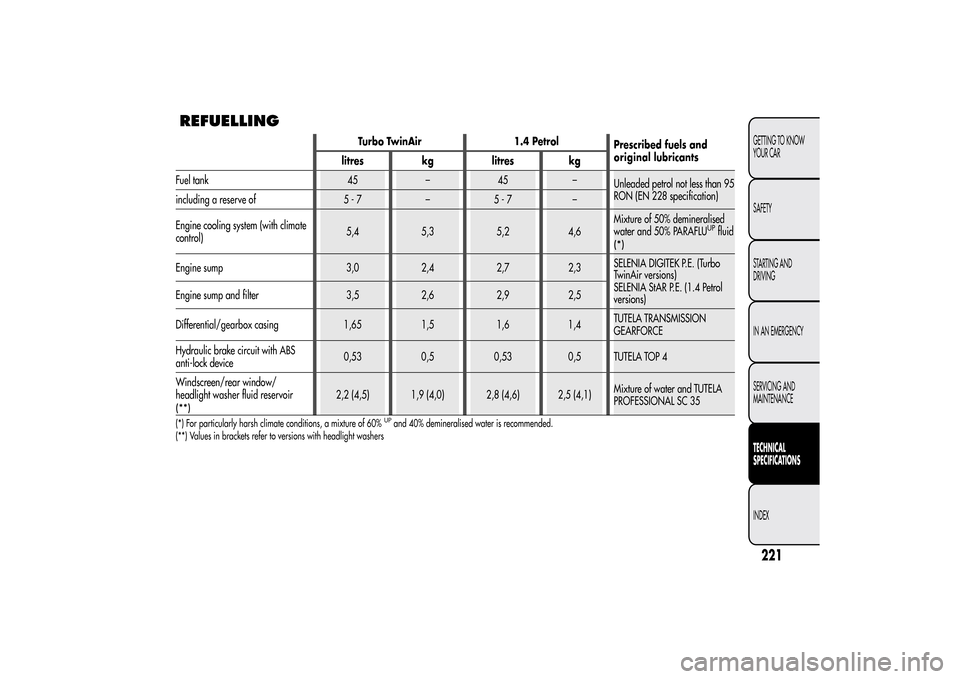
REFUELLING
221GETTING TO KNOW
YOUR CAR
SAFETY
STARTING AND
DRIVING
IN AN EMERGENCY
SERVICING AND
MAINTENANCETECHNICAL
SPECIFICATIONSINDEX
Turbo TwinAir 1.4 Petrol
Prescribed fuels and
litres kg litres kg
Fuel tank 45 – 45 –
Unleaded petrol not less than 95
RON (EN 228 specification)
including a reserve of 5 - 7 – 5 - 7 –
Engine cooling system (with climate
control)5,4 5,3 5,2 4,6Mixture of 50% demineralised
water and 50% PARAFLU
UPfluid
(*)
Engine sump 3,0 2,4 2,7 2,3SELENIA DIGITEK P.E. (Turbo
TwinAir versions)
SELENIA StAR P.E. (1.4 Petrol
versions) Engine sump and filter 3,5 2,6 2,9 2,5
Differential/gearbox casing 1,65 1,5 1,6 1,4TUTELA TRANSMISSION
GEARFORCE
Hydraulic brake circuit with ABS
anti-lock device0,53 0,5 0,53 0,5 TUTELA TOP 4
Windscreen/rear window/
headlight washer fluid reservoir(**)
2,2 (4,5) 1,9 (4,0) 2,8 (4,6) 2,5 (4,1)Mixture of water and TUTELA
PROFESSIONAL SC 35
(*) For particularly harsh climate conditions, a mixture of 60%
UPand 40% demineralised water is recommended.
(**) Values in brackets refer to versions with headlight washers
originallubricants
Page 226 of 280
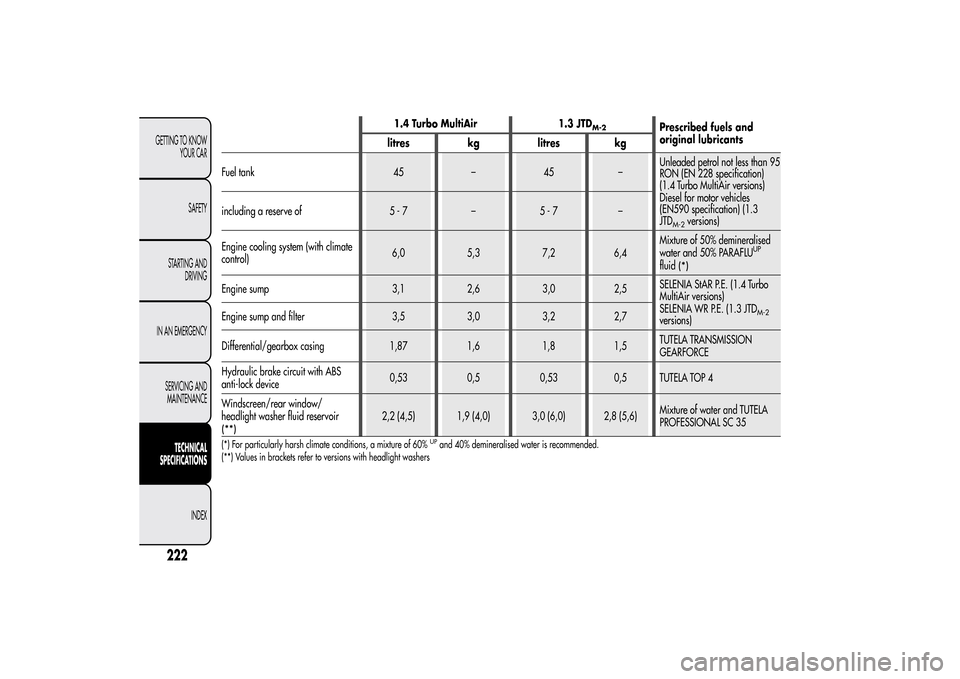
1.4 Turbo MultiAir 1.3 JTD
M-2
Prescribed fuels and
original lubricants
litres kg litres kg
Fuel tank 45 – 45 –Unleaded petrol not less than 95
RON (EN 228 specification)
(1.4 Turbo MultiAir versions)
Diesel for motor vehicles
(EN590 specification) (1.3
JTD
M-2
versions) including a reserve of 5 - 7 – 5 - 7 –
Engine cooling system (with climate
control)6,0 5,3 7,2 6,4Mixture of 50% demineralised
water and 50% PARAFLU
UP
fluid
(*)
Engine sump 3,1 2,6 3,0 2,5SELENIA StAR P.E. (1.4 Turbo
MultiAir versions)
SELENIA WR P.E. (1.3 JTD
M-2
versions) Engine sump and filter 3,5 3,0 3,2 2,7
Differential/gearbox casing 1,87 1,6 1,8 1,5TUTELA TRANSMISSION
GEARFORCE
Hydraulic brake circuit with ABS
anti-lock device0,53 0,5 0,53 0,5 TUTELA TOP 4
Windscreen/rear window/
headlight washer fluid reservoir
(**)
2,2 (4,5) 1,9 (4,0) 3,0 (6,0) 2,8 (5,6)Mixture of water and TUTELA
PROFESSIONAL SC 35
(*) For particularly harsh climate conditions, a mixture of 60%
UPand 40% demineralised water is recommended.
(**) Values in brackets refer to versions with headlight washers
222GETTING TO KNOW
YOUR CAR
SAFETY
STARTING AND
DRIVING
IN AN EMERGENCY
SERVICING AND
MAINTENANCE
TECHNICAL
SPECIFICATIONS
INDEX
Page 227 of 280
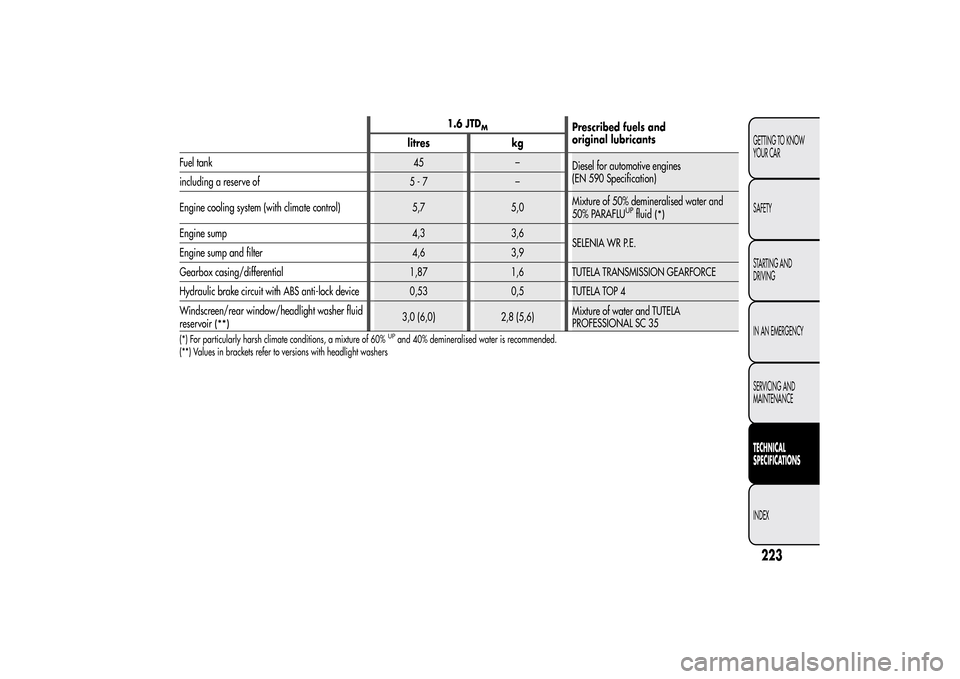
1.6 JTD
M
Prescribed fuels and
original lubricants
litres kg
Fuel tank 45 –
Diesel for automotive engines
(EN 590 Specification)
including a reserve of 5 - 7 –
Engine cooling system (with climate control) 5,7 5,0Mixture of 50% demineralised water and
50% PARAFLU
UPfluid
(*)
Engine sump 4,3 3,6
SELENIA WR P.E.
Engine sump and filter 4,6 3,9
Gearbox casing/differential 1,87 1,6 TUTELA TRANSMISSION GEARFORCE
Hydraulic brake circuit with ABS anti-lock device 0,53 0,5 TUTELA TOP 4
Windscreen/rear window/headlight washer fluid
reservoir
(**)
3,0 (6,0) 2,8 (5,6)Mixture of water and TUTELA
PROFESSIONAL SC 35
(*) For particularly harsh climate conditions, a mixture of 60%
UPand 40% demineralised water is recommended.
(**) Values in brackets refer to versions with headlight washers
223GETTING TO KNOW
YOUR CAR
SAFETY
STARTING AND
DRIVING
IN AN EMERGENCY
SERVICING AND
MAINTENANCETECHNICAL
SPECIFICATIONSINDEX
Page 235 of 280
DASHBOARDThe presence and position of controls, instruments and gauges may vary according to different versions.1. Air vent for side windows – 2. Adjustable air vent – 3. Passenger front air bag – 4. Sound system (for versions/markets, where provided) – 5.
Adjustable air vents – 6. Hazard warning lights, door lock/unlock button – 7. Exterior lighting control lever – 8. Instrument panel – 9. Windscreen
wiper/rearscreen wiper/trip computer control lever – 10. Control panel – 11. Fuse box access flap – 12. Ignition device – 13. Driver front air bag –
14. Driver front knee air bag (for versions/markets, where provided) – 15. Cruise Control (for versions/markets, where provided) – 16. “Alfa DNA”
system – 17. Gear lever – 18. Heating/ventilation/climate control system controls – 19. Glove compartment
fig. 1
A0J0393
231
RIGHT HAND DRIVE VERSIONS