2014 Alfa Romeo MiTo warning light
[x] Cancel search: warning lightPage 96 of 280
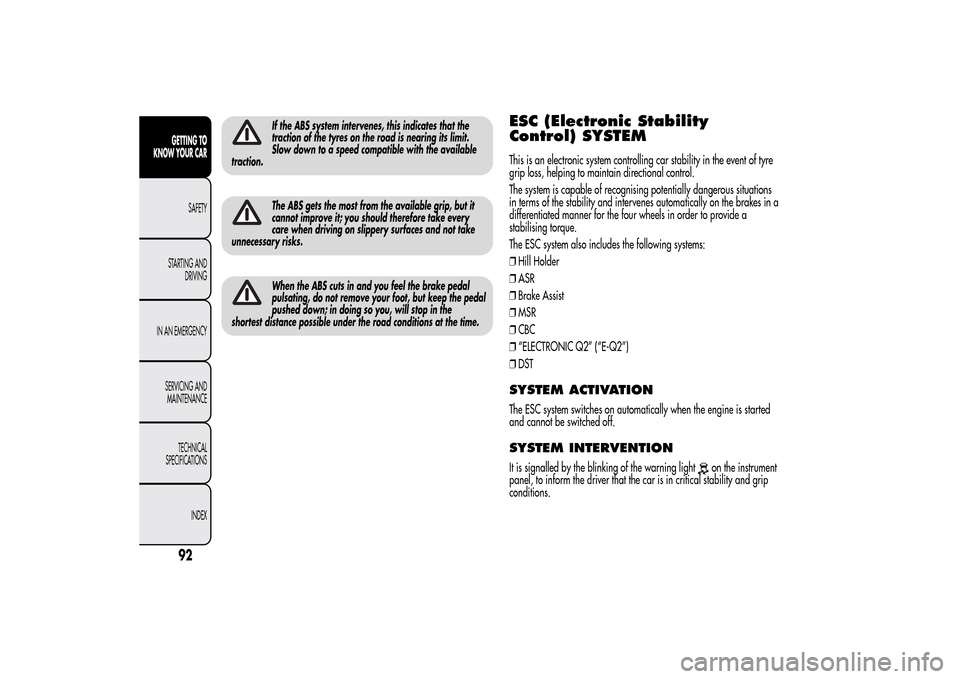
If the ABS system intervenes, this indicates that the
traction of the tyres on the road is nearing its limit.
Slow down to a speed compatible with the available
traction.The ABS gets the most from the available grip, but it
cannot improve it; you should therefore take every
care when driving on slippery surfaces and not take
unnecessary risks.When the ABS cuts in and you feel the brake pedal
pulsating, do not remove your foot, but keep the pedal
pushed down; in doing so you, will stop in the
shortest distance possible under the road conditions at the time.
ESC (Electronic Stability
Control) SYSTEMThis is an electronic system controlling car stability in the event of tyre
grip loss, helping to maintain directional control.
The system is capable of recognising potentially dangerous situations
in terms of the stability and intervenes automatically on the brakes in a
differentiated manner for the four wheels in order to provide a
stabilising torque.
The ESC system also includes the following systems:
❒Hill Holder
❒ASR
❒Brake Assist
❒MSR
❒CBC
❒“ELECTRONIC Q2” (“E-Q2”)
❒DSTSYSTEM ACTIVATIONThe ESC system switches on automatically when the engine is started
and cannot be switched off.SYSTEM INTERVENTIONIt is signalled by the blinking of the warning light
on the instrument
panel, to inform the driver that the car is in critical stability and grip
conditions.
92GETTING TO
KNOW YOUR CAR
SAFETY
STARTING AND
DRIVING
IN AN EMERGENCY
SERVICING AND
MAINTENANCE
TECHNICAL
SPECIFICATIONS
INDEX
Page 103 of 280

Restarting the engine
Press the clutch pedal to restart the engine.SYSTEM MANUAL ACTIVATION/
DEACTIVATIONTo activate/deactivate manually the system, press the
fig. 81 button
on the trim next to the steering wheel.
Start&Stop system activation
A message and a symbol will be displayed when the Start&Stop
system is activated.
Turning the Start&Stop off
❒Versions with multifunction display:a message is displayed when the
Start&Stop system is deactivated.
❒Versions with reconfigurable multifunction display:the
symbol is
displayed + a message when the Start&Stop system is deactivated.When the system is deactivated, the
warning light on the instrument
panel switches on. For versions/markets where provided, a message
and symbol are also displayed in the event of system activation/
deactivation.
ENGINE STOPPING FAILURE
CONDITIONSWhen the system is operating, due to comfort, emission control and
safety reasons, the engine does not stop in some conditions, among
which:
❒engine still cold;
❒especially cold outside temperature;
❒battery not sufficiently charged;
❒particulate filter regeneration (DPF) in progress (diesel engines only);
❒driver's door not shut;
❒driver's seat belt not fastened;
❒reverse gear engaged (for example, for parking manoeuvres);
❒for versions equipped with dual zone automatic climate control (for
versions/markets, where provided), if an adequate level of thermal
comfort has not been reached or with MAX-DEF function activation;
❒during the first period of use, to initialise the system.
If the climate comfort is to be favoured, the Start&Stop
system can be deactivated, for a continuous operation of
the climate control system.
fig. 81
A0J0307
99GETTING TO
KNOW YOUR CARSAFETY
STARTING AND
DRIVING
IN AN EMERGENCY
SERVICING AND
MAINTENANCE
TECHNICAL
SPECIFICATIONS
INDEX
Page 104 of 280

ENGINE RESTARTING CONDITIONSDue to comfort, emission control and safety reasons, the engine can
restart automatically without any action by the driver, under special
conditions, such as:
❒battery not sufficiently charged;
❒reduced braking system vacuum (e.g. if the brake pedal is pressed
repeatedly);
❒car moving (e.g. when driving on roads with a gradient);
❒engine stopping by Start&Stop system for over 3 minutes;
❒for versions equipped with dual zone automatic climate control
system (for versions/markets, where provided), if an adequate level
of thermal comfort has not been reached or MAX-DEF function
activation.
With gear engaged, automatic engine restarting is possible only by
fully depressing the clutch pedal. The driver is informed by the
displaying of a message on the display and - for versions/markets,
where provided - by the flashing of the symbol
.
Notes
If the clutch is not pressed, about 3 minutes after the engine stops, the
engine can be restarted only using the ignition key.
In cases when the engine stops and this is not desired, due for example
to the clutch pedal being released sharply with a gear engaged, if the
Start&Stop system is activated, the engine can be restarted by fully
depressing the clutch pedal or by placing the gear lever in neutral.
SAFETY FUNCTIONSWhen the engine is stopped by the Start&Stop system, if the driver
releases his/her seat belt and opens the driver's or passenger's door,
the engine can be restarted only using the ignition key.
The driver is informed by a buzzer and by the flashing of the symbol
on the display; on some versions, a message is displayed as well.
"ENERGY SAVING" FUNCTION(for versions/markets, where provided)
If, following automatic engine restarting, the driver does not carry out
any action on the car for over 3 minutes, the Start&Stop system stops
the engine once and for all, to prevent fuel consumption. In these
cases, the engine can be restarted only using the ignition key.
NOTE In any case, it is possible to keep the engine running by
deactivating the Start&Stop system.IRREGULAR OPERATIONIn the event of malfunction, the Start&Stop system is deactivated.
The driver is informed of the fault by the
warning light switching
on in the instrument panel and, for versions/markets where provided,
a message and symbol on the display.
In this case, contact Alfa Romeo Authorized Services.
100GETTING TO
KNOW YOUR CAR
SAFETY
STARTING AND
DRIVING
IN AN EMERGENCY
SERVICING AND
MAINTENANCE
TECHNICAL
SPECIFICATIONS
INDEX
Page 116 of 280

The regeneration procedure is controlled automatically by the engine
management control unit according to the filter conditions and vehicle
use conditions.
During the regeneration there may be a limited increase in the engine
idle speed, fan activation, a limited increase in fumes and high
temperatures at the exhaust.
These are not faults; they do not impair normal car performance or
damage the environment. If the dedicated message is displayed, see
contents of "Warning lights and messages" paragraph.
The catalytic converter and particulate filter (DPF) reach
very high temperatures during operation. Therefore
do not park the car on flammable materials (grass, dry
leaves, pine needles, etc.): fire hazard.
112GETTING TO
KNOW YOUR CAR
SAFETY
STARTING AND
DRIVING
IN AN EMERGENCY
SERVICING AND
MAINTENANCE
TECHNICAL
SPECIFICATIONS
INDEX
Page 118 of 280
IMPORTANT When putting the rear seat back in its normal position,
make sure that the seat belts are positioned so that they are ready
to use.
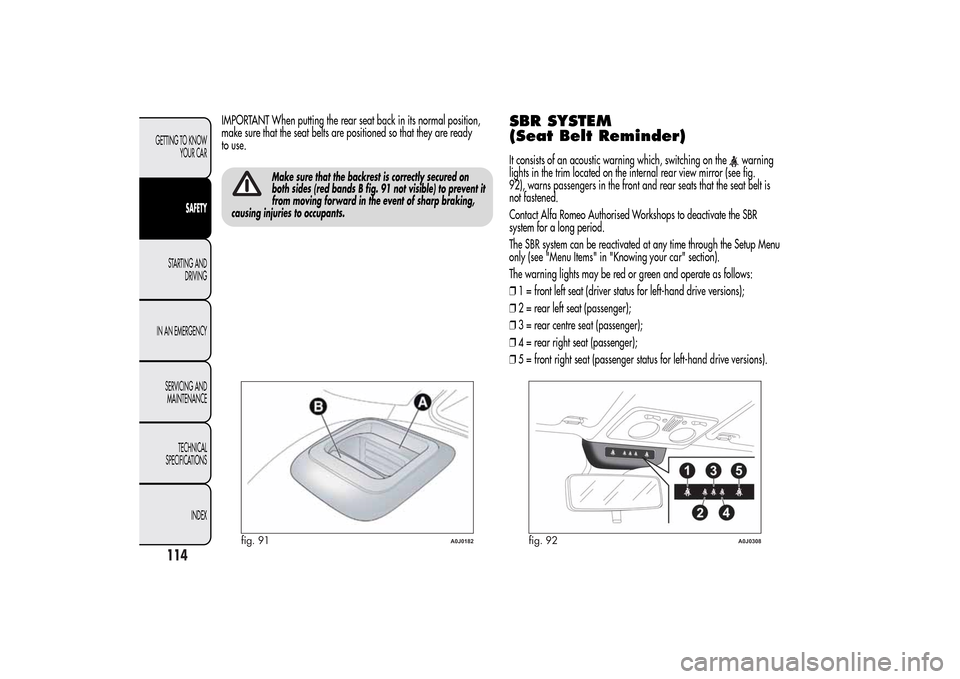
Make sure that the backrest is correctly secured on
both sides (red bands B fig. 91 not visible) to prevent it
from moving forward in the event of sharp braking,
causing injuries to occupants.
SBR SYSTEM
(Seat Belt Reminder)It consists of an acoustic warning which, switching on the
warning
lights in the trim located on the internal rear view mirror (see fig.
92), warns passengers in the front and rear seats that the seat belt is
not fastened.
Contact Alfa Romeo Authorised Workshops to deactivate the SBR
system for a long period.
The SBR system can be reactivated at any time through the Setup Menu
only (see "Menu Items" in "Knowing your car" section).
The warning lights may be red or green and operate as follows:
❒1 = front left seat (driver status for left-hand drive versions);
❒2 = rear left seat (passenger);
❒3 = rear centre seat (passenger);
❒4 = rear right seat (passenger);
❒5 = front right seat (passenger status for left-hand drive versions).
fig. 91
A0J0182
fig. 92
A0J0308
114GETTING TO KNOW
YOUR CAR
SAFETY
STARTING AND
DRIVING
IN AN EMERGENCY
SERVICING AND
MAINTENANCE
TECHNICAL
SPECIFICATIONS
INDEX
Page 119 of 280
NOTE On versions equipped with sports front seats, the passenger side
seat belt fastened indication (warning light 1 for RHD versions or
warning light 5 for LHD versions) will never be displayed.FRONT SEATS (warning light no. 1 =
driver and no. 5 = passenger)Driver
If the driver is the only occupant and their seat belt is not fastened,
when 20 km/h is exceeded or when travelling at a speed between 10
and 20 km/h for longer than 5 seconds, an acoustic signal cycle
will be started for the front seats (continuous acoustic signal for
6 seconds followed by a 90 second beep). The warning light will flash.
The warning lights will stay on constantly at the end of the cycle until
the engine is stopped. The acoustic signal will be interrupted
immediately when the driver’s seat belt is fastened and the warning
light will turn green.
The reminder cycle (acoustic and visual) will be repeated as described
above and the red warning light will flash if the seat belt is unfastened
again while travelling.
Passenger
A similar situation applies to the front passenger, with the difference
that the warning light turns green and the indication is also interrupted
when the passenger leaves the car.
If both front seat belts are unfastened a few seconds apart while the
car is travelling, the acoustic signal will refer to the most recent event
and the two warning lights will proceed with the visual indication
independently.
REAR SEATS (warning light no. 2, no.
3 and no. 4)For the rear seats, the reminder cycle is only activated when any seat
belt is unfastened (flashing red).
In this condition, the warning light for the seat belt which has been
unfastened will flash (red) for approximately 30 seconds. An acoustic
signal is also emitted.
The visual indication (flashing red) will start and stop independently for
each warning light if several seat belts are unfastened. The warning
light will become green when the relevant seat belt is fastened again.
The rear seat warning lights will switch off, regardless of the state
of the belt (red or green) approximately 30 seconds after the last
signal.
IMPORTANT
The warning lights are all off if all seat belts (front and rear) are
already fastened when the ignition key is turned to MAR.
All warning lights switch on when at least one belt changes from
fastened to unfastened or vice versa.
115GETTING TO KNOW
YOUR CARSAFETYSTARTING AND
DRIVING
IN AN EMERGENCY
SERVICING AND
MAINTENANCE
TECHNICAL
SPECIFICATIONS
INDEX
Page 123 of 280

In Europe the characteristics of children restraint systems are ruled by
the regulation ECE-R44, dividing them into five weight groups:Group Weight groups
Group0 upto10kg
Group 0+ up to 13 kg
Group 1 9-18 kg
Group 2 15-25 kg
Group 3 22-36 kgAll restraint devices must bear the type-approval data along with the
control mark on a label firmly secured to the child seat which must
never be removed.
Lineaccessori Alfa Romeo includes child seats for each weight group.
These devices are recommended having been specifically tested for
Alfa Romeo cars.
When an active passenger airbag is fitted, DO NOT
install child seats to be fitted facing backwards on the
front seat. Deployment of the airbag in an accident
could cause fatal injuries to the baby regardless of the severity of
the collision. It is advisable to always carry children in a child
seat on the rear seat, which is the most protected position in the
event of a collision.Should it be absolutely necessary to carry a child on the
passenger side front seat in a child seat facing backwards,
the passenger front and side airbags (pelvis/chest
protection front and side bags) must be deactivated
through the Setup menu. Deactivation should be verified by
checking that the
warning light is on, in the trim above the internal
rearview mirror. Slide the passenger seat back as far as possible to
avoid contact between the child seat and the dashboard.
119GETTING TO KNOW
YOUR CARSAFETYSTARTING AND
DRIVING
IN AN EMERGENCY
SERVICING AND
MAINTENANCE
TECHNICAL
SPECIFICATIONS
INDEX
Page 130 of 280

Fit the child seat according to the instructions, which
must be included.
Main recommendations to carry children safely
❒Install the child seats on the rear seat, which is the most protected
position in the event of an accident.
❒Keep children in rear facing seats for as long as possible, until 2
years old.
❒Should a rear facing child seat be installed on the rear seats, it is
advisable to position it as far forward as the position of the front
seat allows.
❒If the passenger's front airbag is deactivated always check the
permanent switching on of the dedicated warning light on the
instrument panel to make sure that it has actually been deactivated.
❒Carefully follow the instructions supplied with the child seat itself.
Keep the instructions in the car along with the other documents
and this handbook. Do not use second-hand child seats without
instructions.
❒Only one child is to be strapped into each restraint system; never
carry two children simultaneously.
❒Always check that the seat belts do not interfere with the child's
throat.
❒Always check that the seat belt is well fastened by pulling on it.❒While travelling, do not let the child sit incorrectly or unfasten the
belts.
❒Never allow a child to put the belt's diagonal section under an arm
or behind their back.
❒Never carry children on your lap, even newborns. No-one can
restrain a child in the event of an accident.
❒In the event of an accident, replace the child seat with a new one.
126GETTING TO KNOW
YOUR CAR
SAFETY
STARTING AND
DRIVING
IN AN EMERGENCY
SERVICING AND
MAINTENANCE
TECHNICAL
SPECIFICATIONS
INDEX