2014 Alfa Romeo MiTo roof
[x] Cancel search: roofPage 83 of 280

INITIALISATION PROCEDUREAfter the battery has been disconnected or a fuse has blown, the
operation of the sun roof must be initialised again.
Proceed as follows:
❒press button B fig. 54 until the roof is completely closed. Release the
button;
❒press B button and keep it pressed for at least 10 seconds and/or
until the glass panel clicks forwards. Release the button at this point;
❒within 5 seconds of the previous operation, press button B and hold
it down: the front glass panel will complete a full opening and
closing cycle. Only release the button at the end of this cycle.
MAINTENANCE/EMERGENCYIn the event of emergency or maintenance, the roof can be moved
manually when there is no power supply (opening/closing of the front
glass panel) by carrying out the following operations:
❒remove the protective cap A fig. 56 located on the internal lining,
between the two sun blinds;
❒take the Allen key B supplied, which is located in the on-board
documentation container or in the tool container in the luggage
compartment;
❒introduce the key into housing C and turn it clockwise to open the
roof or anticlockwise to close the roof.
fig. 56
A0J0328
79GETTING TO
KNOW YOUR CARSAFETY
STARTING AND
DRIVING
IN AN EMERGENCY
SERVICING AND
MAINTENANCE
TECHNICAL
SPECIFICATIONS
INDEX
Page 93 of 280
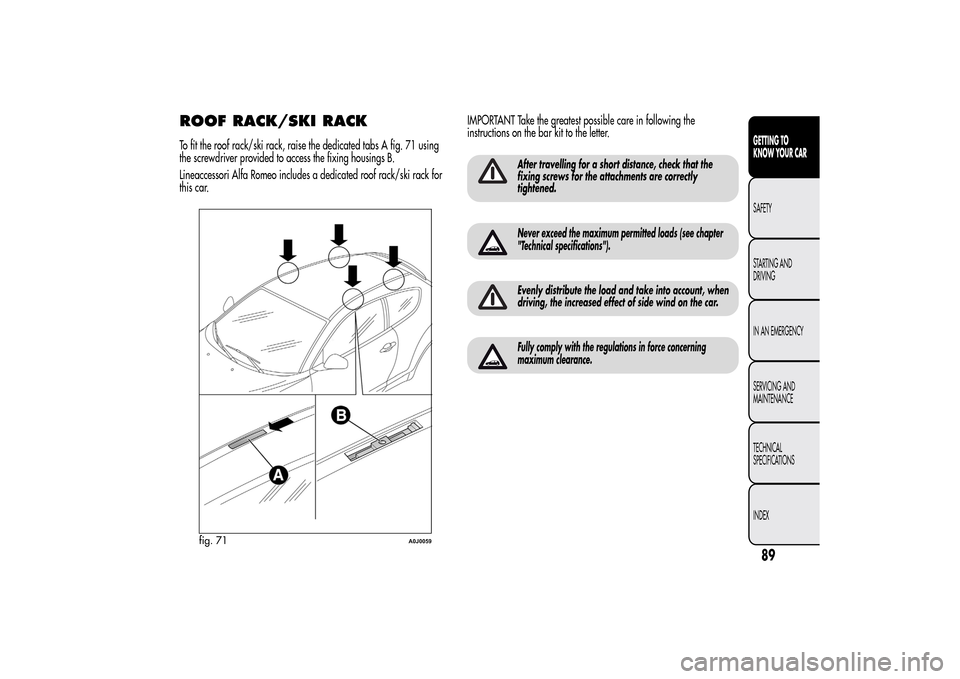
ROOF RACK/SKI RACKTo fit the roof rack/ski rack, raise the dedicated tabs A fig. 71 using
the screwdriver provided to access the fixing housings B.
Lineaccessori Alfa Romeo includes a dedicated roof rack/ski rack for
this car.IMPORTANT Take the greatest possible care in following the
instructions on the bar kit to the letter.
After travelling for a short distance, check that the
fixing screws for the attachments are correctly
tightened.Never exceed the maximum permitted loads (see chapter
"Technical specifications").Evenly distribute the load and take into account, when
driving, the increased effect of side wind on the car.Fully comply with the regulations in force concerning
maximum clearance.
fig. 71
A0J0059
89GETTING TO
KNOW YOUR CARSAFETY
STARTING AND
DRIVING
IN AN EMERGENCY
SERVICING AND
MAINTENANCE
TECHNICAL
SPECIFICATIONS
INDEX
Page 131 of 280

FRONT AIRBAGSThe car is equipped with multi-stage front airbags (“Smart bags”) for
the driver and passenger and knee bags for the driver.“SMART BAG” SYSTEM (MULTISTAGE
FRONT AIRBAGS)The front airbags (driver's and passenger's) and the driver's knee bag
have been designed to protect the occupants in the event of head-on
crashes of medium-high severity, by placing cushions between the
occupant and the steering wheel or dashboard.
Therefore non-deployment in other types of impacts (side impacts, rear
shunts, roll-overs, etc.) does not indicate a system malfunction.
The airbags do not replace, but rather complement, the use of seat
belts, which should always be worn. In the event of an impact,
someone not wearing a seat belt could move forward and come into
contact with a bag which is still in the opening phase. The protection
offered by the bag is compromised in these circumstances.
Front airbags may not activate in the following situations:
❒frontal impacts against highly deformable objects not involving the
front surface of the car (e.g. wing collision against guard rail);
❒car wedging under other vehicles or protective barriers (e.g. trucks
or guard rails).
Failure to activate in the conditions described above is due to the fact
that they may not provide any additional protection compared with
seat belts, so their activation would be inappropriate.
In these cases, non-deployment does not indicate a system malfunction.
Do not apply stickers or other objects on the steering
wheel, on the dashboard in the passenger side airbag
area, on side upholstery on the roof or on the seats.
Never put objects (e.g. mobile phones) on the passenger's side
dashboard since they could interfere with correct inflation of the
airbag and also cause serious injury to the passengers.
FRONT DRIVER SIDE AIRBAGThis consists of an instantly inflating bag contained in a special
compartment in the centre of the steering wheel fig. 103.
Always drive with your hands on the steering wheel
rim so that the airbag can inflate freely if necessary.
Do not drive with your body bent forward. Keep the
back of your seat upright and lean back into it.
fig. 103
A0J0047
127GETTING TO KNOW
YOUR CARSAFETYSTARTING AND
DRIVING
IN AN EMERGENCY
SERVICING AND
MAINTENANCE
TECHNICAL
SPECIFICATIONS
INDEX
Page 134 of 280

FRONT SIDE AIRBAGS (SIDE BAGS)These comprise two types of bags located in the front seat backrests
fig. 107 which protect the pelvic, chest and shoulder area of the
occupants in the event of a side impact of medium-high severity.SIDE AIRBAGS FOR HEAD PROTECTION
(WINDOW BAGS)This comprises two "curtain" bags housed behind the roof side linings
and covered by special trims fig. 108.
It is designed to protect the head of front and rear occupants in the
event of a side collision, thanks to the wide cushion inflation surface.
The deployment of side bags in the event of side impacts of low
severity is not required.
The airbags are not deployed in the event of low-severity impacts (for
which the retaining action of the seat belts is sufficient). It is therefore
always necessary to wear seat belts.In the event of a side impact, the system provides optimum protection if
the passenger assumes the correct position on the seat, thus allowing
correct window bag deployment.
Do not hook rigid objects to the coat hooks or to the
support handles.Do not rest your head, arms or elbows on the door,
windows or the area in which the window bag is
located to avoid possible injury during inflation.Never lean your head, arms or elbows out of the
window.
fig. 107
A0J0103
fig. 108
A0J0051
130GETTING TO KNOW
YOUR CAR
SAFETY
STARTING AND
DRIVING
IN AN EMERGENCY
SERVICING AND
MAINTENANCE
TECHNICAL
SPECIFICATIONS
INDEX
Page 142 of 280

SAVING FUELHere are some suggestions which can help you to save fuel and lower
harmful emissions.GENERAL CONSIDERATIONSCar maintenance
Have checks and adjustments carried out in accordance with the
“Scheduled Servicing Plan” (see chapter “Maintenance and care”).
Ty r e s
Check the tyre pressure at least once every 4 weeks: if the pressure is
too low, consumption levels increase as resistance to rolling is higher.
Unnecessary loads
Do not travel with an overloaded boot. The weight of the car and its
arrangement greatly affect fuel consumption and stability.
Roof rack/ski rack
Remove the roof rack or the ski rack from the roof after use. These
accessories lower aerodynamic penetration and adversely affect
consumption levels. It is better to use a trailer to transport particularly
bulky objects.
Electrical devices
Only use electrical devices for the time needed. The heated rear
window, additional headlights, windscreen wipers and heater fan
require a considerable amount of energy; increasing the current uptake
increases fuel consumption (by up to +25% in an urban cycle).Climate control system
Using the climate control system will increase consumption: use the air
vents when the external temperature allows it.
Devices for aerodynamic control
The use of non-certified devices for aerodynamic control may adversely
affect air drag and fuel consumption.
DRIVING STYLEStarting
Do not warm up the engine at low or high revs when the vehicle is
stationary; this causes the engine to warm up more slowly, thereby
increasing fuel consumption and emissions. It is therefore advisable to
move off immediately, slowly, avoiding high speeds: in this way the
engine will warm up more quickly.
Unnecessary actions
Avoid revving up when at traffic lights or before switching off the
engine. The latter action, like double-declutching, is unnecessary and
causes increased fuel consumption and pollution.
Gear selection
Use a higher gear when traffic and road conditions allow it. Using a
low gear for faster acceleration will increase consumption. In the same
way improper use of a high gear increases consumption, emissions
and engine wear.
138GETTING TO KNOW
YOUR CAR
SAFETYSTARTING AND
DRIVINGIN AN EMERGENCY
SERVICING AND
MAINTENANCE
TECHNICAL
SPECIFICATIONS
INDEX
Page 159 of 280

Bulbs Type Power Re. Figure
Front side lights/Daytime running lights W21/5W 5/21W A
Rear side lights LED – –
Dipped headlights H7 55W D
Main beam headlights H7 55W D
Front direction indicators 24W module 24W B
Rear direction indicators P21W 21W B
Side direction indicators WY5W 5W A
Brake light LED – –
3rd brake light LED – –
Number plate light W5W 5W A
Fog lights H1 55W E
Rear fog lights P21W 21W B
Reversing lights P21W 21W B
Front roof light C10W 10W C
Luggage compartment roof light W5W 5W A
Glove compartment light C5W 5W C
Puddle light W5W 5W A
155GETTING TO KNOW
YOUR CAR
SAFETY
STARTING AND
DRIVINGIN AN
EMERGENCYSERVICING AND
MAINTENANCE
TECHNICAL
SPECIFICATIONS
INDEX
Page 164 of 280

REPLACING INTERIOR BULBSFRONT ROOF LIGHTTo change the bulb, proceed as follows:
❒remove the roof light A fig. 141 working at the points indicated by
the arrows;
❒open the flap B fig. 142 and replace the bulbs C releasing them
from the side contacts. Make sure that the new bulbs are correctly
secured between the contacts;
❒reclose the flap B fig. 142 and fix the roof light A fig. 141 in its
housing making sure that it is locked.LUGGAGE COMPARTMENT ROOF
LIGHTTo change the bulb, proceed as follows:
❒open the luggage compartment and extract the roof light A fig. 143
working in the point shown by the arrow;❒open the protection B fig. 144 and replace the bulb;
❒re-close the protection B on the lens;
❒refit the roof light A fig. 143 by inserting it in its correct position
firstly on one side and then pressing on the other until it clicks into
place.
fig. 141
A0J0120
fig. 142
A0J0121
fig. 143
A0J0119
160GETTING TO KNOW
YOUR CAR
SAFETY
STARTING AND
DRIVING
IN AN
EMERGENCY
SERVICING AND
MAINTENANCE
TECHNICAL
SPECIFICATIONS
INDEX
Page 165 of 280

GLOVE COMPARTMENT LIGHTTo change the bulb, proceed as follows:
❒open the glove compartment and extract the light A fig. 145;
❒replace bulb B, releasing it from the side contacts and making sure
the new bulb is correctly fastened between the contacts.
COURTESY LIGHT(for versions/markets, where provided)
To change the bulb, proceed as follows:
❒lower the sun visor and remove courtesy light A fig. 146, applying
leverage at the point indicated by the arrow;
❒remove protection B, releasing it from tabs C, then replace bulb D
fig. 147 by pulling it outwards and releasing it from the side
contacts;
❒insert the new bulb, making sure that it is positioned correctly and is
secured between the contacts;
❒refit protection B fig. 146, inserting it correctly between tabs C;
❒refit the roof light, inserting it first from side E fig. 147, then press on
the other side until you hear tab F click into place.
fig. 144
A0J0118
fig. 145
A0J0122
fig. 146
A0J0123
161GETTING TO KNOW
YOUR CAR
SAFETY
STARTING AND
DRIVINGIN AN
EMERGENCYSERVICING AND
MAINTENANCE
TECHNICAL
SPECIFICATIONS
INDEX