2014 Alfa Romeo MiTo air condition
[x] Cancel search: air conditionPage 100 of 280
Steering wheel tuning:functions aimed at comfort in normal
conditions of use.
DST:braking standard control coordinated with ABS/ESC. Standard
control over lateral acceleration. Oversteer compensation: a slight
pulse on the steering wheel encourages the driver to carry out the most
appropriate manoeuvre.
Engine:standard response.ENGAGEMENT/DISENGAGEMENT OF
“Dynamic” MODEEngagement
Move the lever A fig. 74 upwards (next to the letter “d”) and hold in
this position for 0.5 seconds until the corresponding LED lights up
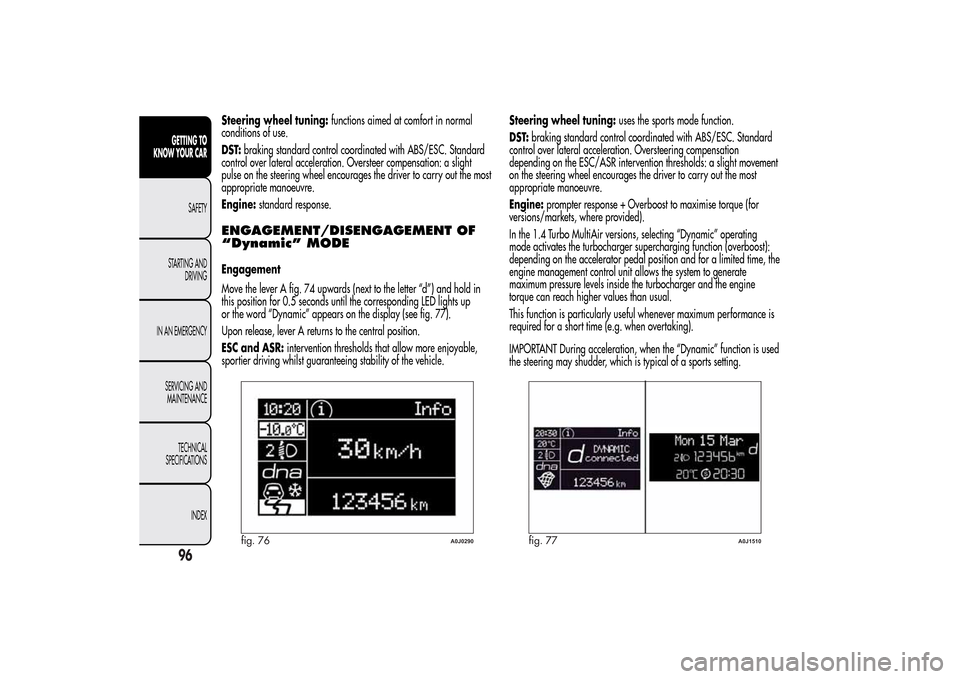
or the word “Dynamic” appears on the display (see fig. 77).
Upon release, lever A returns to the central position.
ESC and ASR:intervention thresholds that allow more enjoyable,
sportier driving whilst guaranteeing stability of the vehicle.Steering wheel tuning:uses the sports mode function.
DST:braking standard control coordinated with ABS/ESC. Standard
control over lateral acceleration. Oversteering compensation
depending on the ESC/ASR intervention thresholds: a slight movement
on the steering wheel encourages the driver to carry out the most
appropriate manoeuvre.
Engine:prompter response + Overboost to maximise torque (for
versions/markets, where provided).
In the 1.4 Turbo MultiAir versions, selecting “Dynamic” operating
mode activates the turbocharger supercharging function (overboost):
depending on the accelerator pedal position and for a limited time, the
engine management control unit allows the system to generate
maximum pressure levels inside the turbocharger and the engine
torque can reach higher values than usual.
This function is particularly useful whenever maximum performance is
required for a short time (e.g. when overtaking).
IMPORTANT During acceleration, when the “Dynamic” function is used
the steering may shudder, which is typical of a sports setting.
fig. 76
A0J0290
fig. 77
A0J1510
96GETTING TO
KNOW YOUR CAR
SAFETY
STARTING AND
DRIVING
IN AN EMERGENCY
SERVICING AND
MAINTENANCE
TECHNICAL
SPECIFICATIONS
INDEX
Page 116 of 280

The regeneration procedure is controlled automatically by the engine
management control unit according to the filter conditions and vehicle
use conditions.
During the regeneration there may be a limited increase in the engine
idle speed, fan activation, a limited increase in fumes and high
temperatures at the exhaust.
These are not faults; they do not impair normal car performance or
damage the environment. If the dedicated message is displayed, see
contents of "Warning lights and messages" paragraph.
The catalytic converter and particulate filter (DPF) reach
very high temperatures during operation. Therefore
do not park the car on flammable materials (grass, dry
leaves, pine needles, etc.): fire hazard.
112GETTING TO
KNOW YOUR CAR
SAFETY
STARTING AND
DRIVING
IN AN EMERGENCY
SERVICING AND
MAINTENANCE
TECHNICAL
SPECIFICATIONS
INDEX
Page 131 of 280

FRONT AIRBAGSThe car is equipped with multi-stage front airbags (“Smart bags”) for
the driver and passenger and knee bags for the driver.“SMART BAG” SYSTEM (MULTISTAGE
FRONT AIRBAGS)The front airbags (driver's and passenger's) and the driver's knee bag
have been designed to protect the occupants in the event of head-on
crashes of medium-high severity, by placing cushions between the
occupant and the steering wheel or dashboard.
Therefore non-deployment in other types of impacts (side impacts, rear
shunts, roll-overs, etc.) does not indicate a system malfunction.
The airbags do not replace, but rather complement, the use of seat
belts, which should always be worn. In the event of an impact,
someone not wearing a seat belt could move forward and come into
contact with a bag which is still in the opening phase. The protection
offered by the bag is compromised in these circumstances.
Front airbags may not activate in the following situations:
❒frontal impacts against highly deformable objects not involving the
front surface of the car (e.g. wing collision against guard rail);
❒car wedging under other vehicles or protective barriers (e.g. trucks
or guard rails).
Failure to activate in the conditions described above is due to the fact
that they may not provide any additional protection compared with
seat belts, so their activation would be inappropriate.
In these cases, non-deployment does not indicate a system malfunction.
Do not apply stickers or other objects on the steering
wheel, on the dashboard in the passenger side airbag
area, on side upholstery on the roof or on the seats.
Never put objects (e.g. mobile phones) on the passenger's side
dashboard since they could interfere with correct inflation of the
airbag and also cause serious injury to the passengers.
FRONT DRIVER SIDE AIRBAGThis consists of an instantly inflating bag contained in a special
compartment in the centre of the steering wheel fig. 103.
Always drive with your hands on the steering wheel
rim so that the airbag can inflate freely if necessary.
Do not drive with your body bent forward. Keep the
back of your seat upright and lean back into it.
fig. 103
A0J0047
127GETTING TO KNOW
YOUR CARSAFETYSTARTING AND
DRIVING
IN AN EMERGENCY
SERVICING AND
MAINTENANCE
TECHNICAL
SPECIFICATIONS
INDEX
Page 142 of 280

SAVING FUELHere are some suggestions which can help you to save fuel and lower
harmful emissions.GENERAL CONSIDERATIONSCar maintenance
Have checks and adjustments carried out in accordance with the
“Scheduled Servicing Plan” (see chapter “Maintenance and care”).
Ty r e s
Check the tyre pressure at least once every 4 weeks: if the pressure is
too low, consumption levels increase as resistance to rolling is higher.
Unnecessary loads
Do not travel with an overloaded boot. The weight of the car and its
arrangement greatly affect fuel consumption and stability.
Roof rack/ski rack
Remove the roof rack or the ski rack from the roof after use. These
accessories lower aerodynamic penetration and adversely affect
consumption levels. It is better to use a trailer to transport particularly
bulky objects.
Electrical devices
Only use electrical devices for the time needed. The heated rear
window, additional headlights, windscreen wipers and heater fan
require a considerable amount of energy; increasing the current uptake
increases fuel consumption (by up to +25% in an urban cycle).Climate control system
Using the climate control system will increase consumption: use the air
vents when the external temperature allows it.
Devices for aerodynamic control
The use of non-certified devices for aerodynamic control may adversely
affect air drag and fuel consumption.
DRIVING STYLEStarting
Do not warm up the engine at low or high revs when the vehicle is
stationary; this causes the engine to warm up more slowly, thereby
increasing fuel consumption and emissions. It is therefore advisable to
move off immediately, slowly, avoiding high speeds: in this way the
engine will warm up more quickly.
Unnecessary actions
Avoid revving up when at traffic lights or before switching off the
engine. The latter action, like double-declutching, is unnecessary and
causes increased fuel consumption and pollution.
Gear selection
Use a higher gear when traffic and road conditions allow it. Using a
low gear for faster acceleration will increase consumption. In the same
way improper use of a high gear increases consumption, emissions
and engine wear.
138GETTING TO KNOW
YOUR CAR
SAFETYSTARTING AND
DRIVINGIN AN EMERGENCY
SERVICING AND
MAINTENANCE
TECHNICAL
SPECIFICATIONS
INDEX
Page 167 of 280

REPLACING FUSESGENERAL INFORMATIONFuses protect the electrical system: they intervene (blow) in the event of
a failure or improper intervention on the system.
When a device does not work, check the condition of its protective
fuse: the conductor element A fig. 149 must be intact.
If it is not, replace the blown fuse with another with the same
amperage (same colour).
B = undamaged fuse.
C = fuse with damaged filament.
Contact Alfa Romeo Authorized Services should the
fuse blow again.Never replace a fuse with metal wires or anything else.
Never replace a fuse with another with a higher amp
rating; DANGER OF FIRE.If a general protection fuse (MAXI-FUSE, MEGA-FUSE,
MIDI-FUSE) blows, contact Alfa Romeo Authorized
Services.Remove the key from the ignition switch and switch off
all loads before replacing a fuse.Contact Alfa Romeo Authorized Services if a safety
system (air bags, brakes), engine system (engine,
gearbox) or steering system general protection fuse
blows.
fig. 149
A0J0048
163GETTING TO KNOW
YOUR CAR
SAFETY
STARTING AND
DRIVINGIN AN
EMERGENCYSERVICING AND
MAINTENANCE
TECHNICAL
SPECIFICATIONS
INDEX
Page 171 of 280

ENGINE COMPARTMENT FUSE BOXfig. 151DEVICE PROTECTEDFUSE AMPS
StarterF03 20
Passenger compartment electric fan F08 40
Additional heater (Turbo TwinAir 105 HP and 1.3 JTD
M-2
85 HP versions) F09 5
Two-tone hornsF10 15
Main beam headlightsF14 15
Additional heater (PTC 1)F15 30
Air conditioning compressorF19 7,5
Heated rear windscreen, defrosting system F20 30
Electric fuel pump in tankF21 15
Fog lightsF30 15
Additional heater (PTC2)F81 60
Additional heater (PTC1)F82 40
Additional heater (PTC2)F82 50
FreeF83 –
HI-FI sound system (control units, Bassbox speaker) mechanical gearbox setup F84 20
Power socket on tunnelF85 15
Electric door mirror demisters, demisters on windscreen jets, relay switch coil for heated
windscreenF87 7,5
167GETTING TO KNOW
YOUR CAR
SAFETY
STARTING AND
DRIVINGIN AN
EMERGENCYSERVICING AND
MAINTENANCE
TECHNICAL
SPECIFICATIONS
INDEX
Page 177 of 280

SERVICING AND MAINTENANCE
SCHEDULED SERVICINGCorrect servicing is essential in guaranteeing a long life for the car
under the best conditions.
That’s why Alfa Romeo has prepared a series of checks and service
operations to be carried out every 30,000 kilometres (petrol versions)
or every 35,000 kilometres (diesel versions).
Check the items on the Scheduled Servicing Plan (e.g. periodically
check level of liquids, tyre pressure, etc.) before 30,000/35,000 km
and between these services deadlines.
Scheduled Servicing is carried out at Alfa Romeo Authorized Services
according to a set time schedule. If, during each operation, in addition
to the ones scheduled, the need arises for further replacements or
repairs, these may be carried out only with the explicit agreement of
the Customer. If your car is used frequently for towing, the interval
between one service operation and the next should be reduced.WARNING
At 2,000 km from the next service operation the display will show a
message.
The Scheduled Services intervals are set out by the Manufacturer.
Failure to comply with the schedule may invalidate the warranty.
It is advisable to inform Alfa Romeo Authorized Services of any small
faults without waiting for the next scheduled service.
173GETTING TO KNOW
YOUR CAR
SAFETY
STARTING AND
DRIVING
IN AN EMERGENCYSERVICING AND
MAINTENANCETECHNICAL
SPECIFICATIONS
INDEX
Page 178 of 280

SCHEDULED SERVICING PLANPETROL VERSIONSThousands of miles18 36 54 72 90 108
Thousands of kilometres 30 60 90 120 150 180
Months24 48 72 96 120 144
Check tyre conditions/wear and adjust pressure, if required●●●●●●
Check operation of lighting system (headlamps, direction indicators, hazard warning lights,
passenger compartment, luggage compartment, instrument panel warning lights, etc.)●●●●●●
Check operation of windscreen washer/wiper system●●●●●●
Check the position/wear of the windscreen/rear window wiper blades●●●●●●
Check condition and wear of front disc brake pads and operation of pad wear indicator●●●●●●
Check rear disc brake pad condition and wear●●●●●●
Condition and status visual check: bodywork exterior, underbody protection, pipes and hoses
(exhaust - fuel system - brakes), rubber elements (boots - sleeves - bushes etc.)●●●●●●
Check cleanliness of bonnet and boot locks, as well as cleanliness and lubrication of linkages●●●●●●
Check and, if necessary, top up fluid levels (engine cooling, hydraulic brakes/clutch, screen washer,
battery, etc.)●●●●●●
Check handbrake lever travel and adjust, if required●●●●●●
Check of condition of timing drive belt (excluding TwinAir Turbo versions)●●
Visually inspect conditions of the accessory drive belt(s)●●
Check tension of accessory drive belts and adjust if necessary (versions with heater) (1.4 Petrol 8V
78 HP versions)●●
Check tappet clearance and adjust, if necessary (1.4 Petrol 8V 78 HP versions)●●●
174GETTING TO KNOW
YOUR CAR
SAFETY
STARTING AND
DRIVING
IN AN EMERGENCYSERVICING AND
MAINTENANCE
TECHNICAL
SPECIFICATIONS
INDEX