2014 Alfa Romeo MiTo ABS
[x] Cancel search: ABSPage 95 of 280
ADJUSTING THE HEADLIGHTS ABROADThe dipped headlights are aligned to comply with the regulations of
the country of purchase. When travelling in countries with opposite
driving direction, to avoid dazzling the drivers on the other side of the
road, you need to cover areas of the headlight according to the
Highway code of the country you are travelling in.
ABS SYSTEMThe car is fitted with an ABS braking system, which prevents the wheels
from locking when braking, makes the most of road grip and gives
the best control when performing emergency braking under difficult
road conditions.
The EBD system (Electronic Braking Force Distribution) completes the
system allowing the brake force to be distributed between the front and
rear wheels.
IMPORTANT To obtain the maximum efficiency of the braking system,
a bedding-in period of about 500 km is needed: during this period
it is better to avoid sharp, repeated and prolonged braking.SYSTEM INTERVENTIONIt can be detected because the brake pedal pulsates slightly and the
system gets noisier: it means that the car speed should be altered
to suit the type of road surface.MECHANICAL BRAKE ASSIST
(emergency braking assistance)(for versions/markets, where provided)
This system, which cannot be deactivated, recognises emergency
braking conditions (according to the brake pedal operation speed) and
provides an additional hydraulic braking pressure to support that
provided by the driver. This allows faster and more powerful operation
of the braking system.
IMPORTANT When the Mechanical Brake Assist intervenes, noises may
be heard from the system. This is normal. In any case, while braking
keep the brake pedal firmly depressed.
91GETTING TO
KNOW YOUR CARSAFETY
STARTING AND
DRIVING
IN AN EMERGENCY
SERVICING AND
MAINTENANCE
TECHNICAL
SPECIFICATIONS
INDEX
Page 96 of 280
If the ABS system intervenes, this indicates that the
traction of the tyres on the road is nearing its limit.
Slow down to a speed compatible with the available
traction.The ABS gets the most from the available grip, but it
cannot improve it; you should therefore take every
care when driving on slippery surfaces and not take
unnecessary risks.When the ABS cuts in and you feel the brake pedal
pulsating, do not remove your foot, but keep the pedal
pushed down; in doing so you, will stop in the
shortest distance possible under the road conditions at the time.
ESC (Electronic Stability
Control) SYSTEMThis is an electronic system controlling car stability in the event of tyre
grip loss, helping to maintain directional control.
The system is capable of recognising potentially dangerous situations
in terms of the stability and intervenes automatically on the brakes in a
differentiated manner for the four wheels in order to provide a
stabilising torque.
The ESC system also includes the following systems:
❒Hill Holder
❒ASR
❒Brake Assist
❒MSR
❒CBC
❒“ELECTRONIC Q2” (“E-Q2”)
❒DSTSYSTEM ACTIVATIONThe ESC system switches on automatically when the engine is started
and cannot be switched off.SYSTEM INTERVENTIONIt is signalled by the blinking of the warning light
on the instrument
panel, to inform the driver that the car is in critical stability and grip
conditions.
92GETTING TO
KNOW YOUR CAR
SAFETY
STARTING AND
DRIVING
IN AN EMERGENCY
SERVICING AND
MAINTENANCE
TECHNICAL
SPECIFICATIONS
INDEX
Page 98 of 280
BRAKE ASSIST(assistance during emergency braking)
The system, which cannot be turned off, recognises emergency braking
(on the basis of the brake pedal operating speed) and speeding up
the response of the braking system. The Brake Assist device is
deactivated if there is a ESC system failure.MSR SYSTEM(Motor Schleppmoment Regelung)
This system is an integral part of the ABS, that intervenes, if there is a
sudden downshifting, restoring torque to the engine, thereby
preventing excessive drive at the drive wheels which, especially in poor
grip conditions, could lead to a loss in stability of the car.CBC (Cornering Brake Control)
SYSTEMThis function improves the distribution of the braking pressure at the
four wheels (to fully exploit the grip available on the ground) when
braking on bends if the ABS intervenes. This improves stopping
distances and above all vehicle stability when cornering.
“ELECTRONIC Q2” SYSTEM (“E-Q2”)The “Electronic Q2” system uses the braking system to create an effect
similar to a limited slip differential.
The front braking system, when accelerating around a curve, acts on
the inside wheel to increase the drive to the outside wheel (increased
load), dynamically and continuously distributing the torque between
the front drive wheels according to driving and road conditions.
The system, combined with MacPherson front suspension, allows
particularly effective and sports driving to be achieved.DST SYSTEM
(Dynamic Steering Torque)This function integrates Dual Pinion active steering into the operation of
ESC. For particular manoeuvres, the ESC system controls the steering
to actuate a steering torque and assist the driver in the best possible
way.
The system operates the brakes and steering in a coordinated manner
to increase the suspension and safety level of the car as a whole.
The steering provides additional torque on the steering wheel.
94GETTING TO
KNOW YOUR CAR
SAFETY
STARTING AND
DRIVING
IN AN EMERGENCY
SERVICING AND
MAINTENANCE
TECHNICAL
SPECIFICATIONS
INDEX
Page 100 of 280
Steering wheel tuning:functions aimed at comfort in normal
conditions of use.
DST:braking standard control coordinated with ABS/ESC. Standard
control over lateral acceleration. Oversteer compensation: a slight
pulse on the steering wheel encourages the driver to carry out the most
appropriate manoeuvre.
Engine:standard response.ENGAGEMENT/DISENGAGEMENT OF
“Dynamic” MODEEngagement
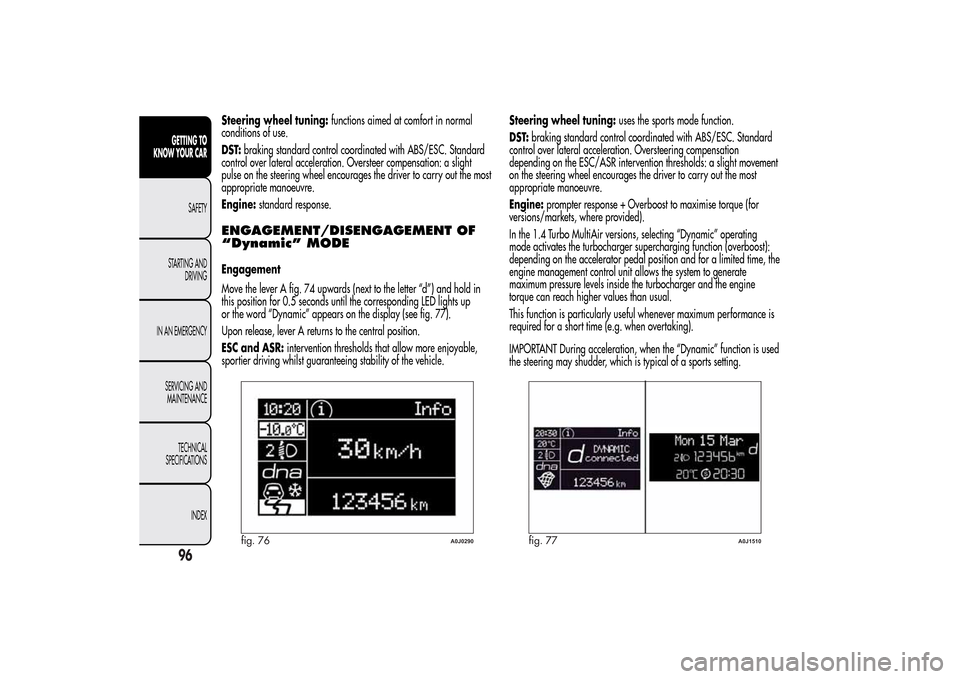
Move the lever A fig. 74 upwards (next to the letter “d”) and hold in
this position for 0.5 seconds until the corresponding LED lights up
or the word “Dynamic” appears on the display (see fig. 77).
Upon release, lever A returns to the central position.
ESC and ASR:intervention thresholds that allow more enjoyable,
sportier driving whilst guaranteeing stability of the vehicle.Steering wheel tuning:uses the sports mode function.
DST:braking standard control coordinated with ABS/ESC. Standard
control over lateral acceleration. Oversteering compensation
depending on the ESC/ASR intervention thresholds: a slight movement
on the steering wheel encourages the driver to carry out the most
appropriate manoeuvre.
Engine:prompter response + Overboost to maximise torque (for
versions/markets, where provided).
In the 1.4 Turbo MultiAir versions, selecting “Dynamic” operating
mode activates the turbocharger supercharging function (overboost):
depending on the accelerator pedal position and for a limited time, the
engine management control unit allows the system to generate
maximum pressure levels inside the turbocharger and the engine
torque can reach higher values than usual.
This function is particularly useful whenever maximum performance is
required for a short time (e.g. when overtaking).
IMPORTANT During acceleration, when the “Dynamic” function is used
the steering may shudder, which is typical of a sports setting.
fig. 76
A0J0290
fig. 77
A0J1510
96GETTING TO
KNOW YOUR CAR
SAFETY
STARTING AND
DRIVING
IN AN EMERGENCY
SERVICING AND
MAINTENANCE
TECHNICAL
SPECIFICATIONS
INDEX
Page 101 of 280
Disengagement
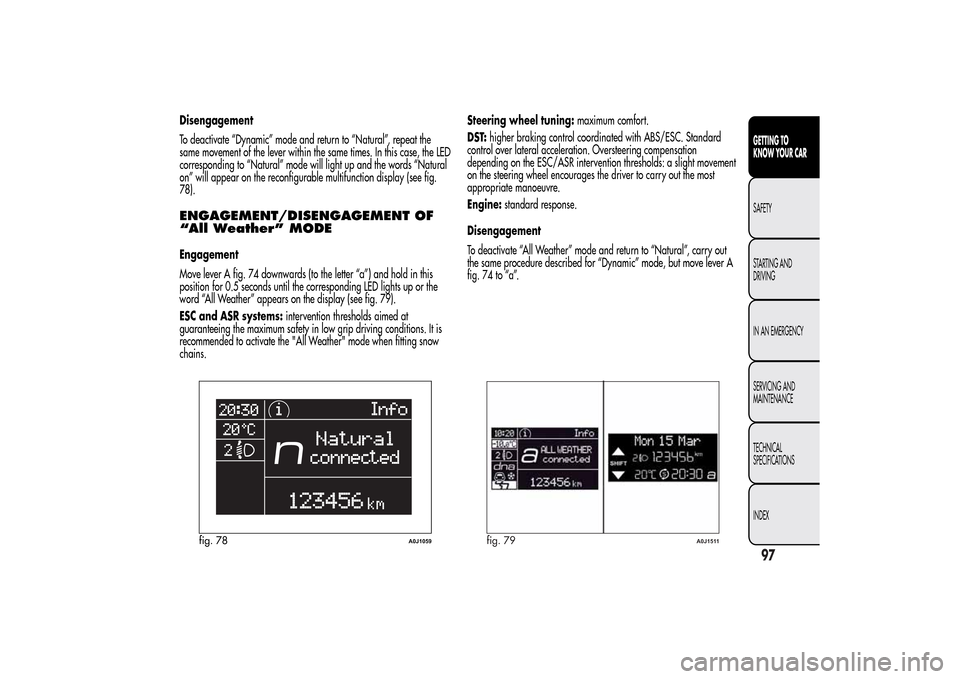
To deactivate “Dynamic” mode and return to “Natural”, repeat the
same movement of the lever within the same times. In this case, the LED
corresponding to “Natural” mode will light up and the words “Natural
on” will appear on the reconfigurable multifunction display (see fig.
78).ENGAGEMENT/DISENGAGEMENT OF
“All Weather” MODEEngagement
Move lever A fig. 74 downwards (to the letter “a”) and hold in this
position for 0.5 seconds until the corresponding LED lights up or the
word “All Weather” appears on the display (see fig. 79).
ESC and ASR systems:intervention thresholds aimed at
guaranteeing the maximum safety in low grip driving conditions. It is
recommended to activate the "All Weather" mode when fitting snow
chains.Steering wheel tuning:maximum comfort.
DST:higher braking control coordinated with ABS/ESC. Standard
control over lateral acceleration. Oversteering compensation
depending on the ESC/ASR intervention thresholds: a slight movement
on the steering wheel encourages the driver to carry out the most
appropriate manoeuvre.
Engine:standard response.
Disengagement
To deactivate “All Weather” mode and return to “Natural”, carry out
the same procedure described for “Dynamic” mode, but move lever A
fig. 74 to “a”.
fig. 78
A0J1059
fig. 79
A0J1511
97GETTING TO
KNOW YOUR CARSAFETY
STARTING AND
DRIVING
IN AN EMERGENCY
SERVICING AND
MAINTENANCE
TECHNICAL
SPECIFICATIONS
INDEX
Page 106 of 280

DYNAMIC SUSPENSION (active
shock absorber system)(for versions/markets, where provided)
This system interacts with the “Alfa DNA” system (see paragraph “Alfa
DNA”).
The “Alfa DNA” system lever allows you to choose three different
driving settings depending on the route type and on the road surface:
❒d = Dynamic (sports driving mode);
❒n = Natural (mode for driving in normal conditions);
❒a = All Weather (mode for driving in poor grip conditions, such as
rain and snow).
In “Natural” and “All Weather” operating mode, the active shock
absorbers adjust the car suspension to suit the route type and
the driving stresses, thus considerably improving driving comfort in
particular on rough terrain.The "Dynamic" operating mode produces a sports driving setting
characterised by more responsive acceleration and greater effort on
the steering wheel to give a sporty feeling. The shock absorber
damping action is also adjusted and divided, to guarantee higher
precision and reactivity of the car, while maintaining a good comfort
level.
The car is more precise when entering bends and quicker in changing
direction.
fig. 84
A0J0341
102GETTING TO
KNOW YOUR CAR
SAFETY
STARTING AND
DRIVING
IN AN EMERGENCY
SERVICING AND
MAINTENANCE
TECHNICAL
SPECIFICATIONS
INDEX
Page 107 of 280

EOBD SYSTEM (European On
Board Diagnosis)(for versions/markets, where provided)
The aim of the EOBD system (European On Board Diagnosis) is to:
❒monitor the system efficiency;
❒indicate an increase in emissions;
❒indicate the need to replace damaged components.
The car also has a diagnostic connector that can be interfaced with
appropriate tools, which makes it possible to read the error codes
stored in the electronic control units together with a series of specific
parameters for engine operation and diagnosis. This check can also be
carried out by the traffic police.
IMPORTANT After eliminating a fault, to check the system completely,
Alfa Romeo Authorised Services are obliged to run tests and, if
necessary, road tests which may also call for a long journey.
ELECTRIC POWER STEERINGThis only operates with the key turned to MAR-ON and the engine
started. Power steering allows the force required at the steering wheel
to be adapted to driving conditions.
The different power assistance modes can be selected via the "d,n,a"
positions of the “Alfa DNA System” lever (see “Alfa DNA System”
paragraph).
It is absolutely forbidden to carry out any after-market
operation involving steering system or steering column
modifications (e.g.: installation of anti-theft device)
that could badly affect performance and safety, invalidate the
warranty and also result in non-compliance of the car with
type-approval requirements.Before performing any maintenance operations,
always turn off the engine and remove the key from
the ignition to lock the steering column, especially
when the car’s wheels are not touching the ground.
103GETTING TO
KNOW YOUR CARSAFETY
STARTING AND
DRIVING
IN AN EMERGENCY
SERVICING AND
MAINTENANCE
TECHNICAL
SPECIFICATIONS
INDEX
Page 111 of 280

❒sensor performance can also be influenced by the position of the
sensors. For example by a change in the ride setting (caused by
the wear of the shock absorbers, suspension), overloading the
vehicle and carrying out specific tuning operations that require the
vehicle to be lowered;
❒The detection of obstacles at the top part of the car may not be
guaranteed because the system detects obstacles that could cause an
impact with the car in the bottom part.
TPMS (Tyre Pressure
Monitoring System)(for versions/markets, where provided)
The car may be fitted with a tyre pressure monitoring system (TPMS),
which informs the driver of the tyre inflation status via the "Check
tyre pressure" and "Low tyre pressure" messages on the display.
This system comprises a radio frequency transmitter fitted to each
wheel (on the wheel rim inside the tyre), which is able to send
information on the tyre inflation pressure of each wheel to the control
unit.IMPORTANT INFORMATION ABOUT
THE TPMSThe fault indications are not stored and will therefore not be displayed
after the engine has been switched off and then on again.
If the fault conditions persist, the control unit will send the relative
indications to the instrument panel only after the car has been in
motion for a short time.
The presence of the TPMS does not permit the driver to
neglect regular checks of the tyre pressure, including
for the spare wheel.Tyre pressure must be checked with tyres rested and
cold. Should it become necessary for whatever reason
to check pressure with warm tyres, do not reduce
pressure even though it is higher than the prescribed value, but
repeat the check when tyres are cold.
107GETTING TO
KNOW YOUR CARSAFETY
STARTING AND
DRIVING
IN AN EMERGENCY
SERVICING AND
MAINTENANCE
TECHNICAL
SPECIFICATIONS
INDEX