2014.5 Citroen C4 DAG belt
[x] Cancel search: beltPage 120 of 340
77
118
C4-2_en_Chap07_securite-enfants_ed01-2014
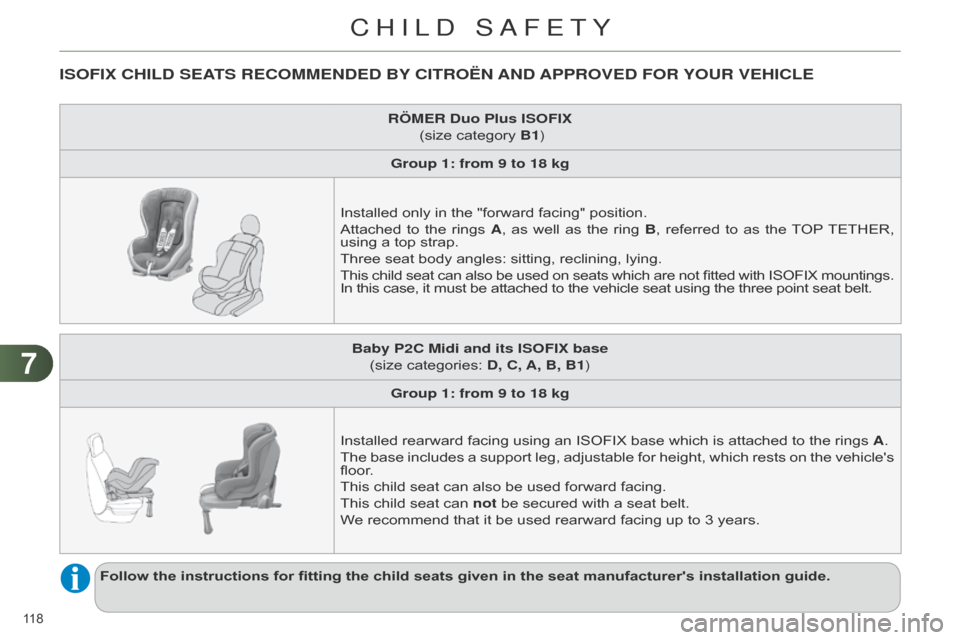
ISOFIX CHILD SEATS RECOMMENDED BY CITROËN AND APPROVED FOR YOUR VEHICLE
RÖMER Duo Plus ISOFIX
(size category B1)
Group 1: from 9 to 18 kg
Installed
only in the "forward facing" position.
Attached
to
the
rings
A
,
as
well
as
the
ring
B
,
referred
to
as
the
T
OP
TETHER,
using
a top strap.
Three
seat body angles: sitting, reclining, lying.
This
child
seat
can
also
be
used
on
seats
which
are
not
fitted
with
ISOFIX
mountings. In
this
case, it must be attached to the vehicle seat using the three point seat belt.
Follow the instructions for fitting the child seats given in the seat manufacturer's installation guide. Baby P2C Midi and its ISOFIX base
(size
categories: D, C, A, B, B1)
Group 1: from 9 to 18 kg
Installed
rearward facing using an ISOFIX base which is attached to the rings A.
The
base
includes
a
support
leg,
adjustable
for
height,
which
rests
on
the
vehicle's
floor
.
This
child seat can also be used forward facing.
This
child seat can not be secured with a seat belt.
We
recommend that it be used rearward facing up to 3 years.
CHILD SAFETY
Page 122 of 340

77
120
C4-2_en_Chap07_securite-enfants_ed01-2014
For optimum installation of the "for -
ward-facing" child seat, ensure that
the
back
of
the
child
seat
is
as
close
as
possible
to
the
backrest
of
the
ve
-
hicle's
seat, in contact if possible.
You
mst
remove
the
head
restraint
before
installin
g
a
child
seat
with
backrest
to a passenger seat.
Ensure
that
the
head
restraint
is
stored
or
attached
securely
to
pre
-
vent
it
from
being
thrown
around
the
vehicle
in
the
event
of
sharp
brak
-
ing.
Refit
the
head
restraint
when
the
child
seat is removed.
ADVICE ON CHILD SEATS
Installing a booster seat
Children at the frontThe incorrect installation of a child seat
in a vehicle compromises the
child's
protection
in
the
event
of
an
accident.
Ensure that there is no seat belt or
seat
belt
buckle
under
the
child
seat,
as
this could destabilise it.
Remember
to
fasten
the
seat
belts
or
the
child
seat
harnesses
keeping
the
slack
relative
to
the
child's
body
to
a
minimum,
even for short journeys.
When
installin
g
a
child
seat
using
the
seat belt, ensure that the seat belt is
tightened
correctly
on
the
child
seat
and
that
it
secures
the
child
seat
firm
-
ly
on
the
seat
of
your
vehicle.
If
your
passenger
seat
is
adjustable,
move
it
forwards
if necessary. The
legislation
on
carrying
children
on the
front
passenger
seat
is
specific
to each
country
.
Refer
to
the
legislation in
force in your country.
Deactivate
the
passenger
airbag
when
a
"rearward-facing"
child
seat
is
installed on the front seat.
Otherwise,
the
child
would
risk
being
seriously
injured
or
kille
d
if
the
airbag
were
to inflate.The
chest
part
of
the
seat
belt
must
be
positioned
on
the
child's
shoulder
without
touching the neck.
Ensure that the lap part of the seat
belt
passes
correctly
over
the
child's
thighs.
CITROËN
recommends
the
use
of
a
booster
seat
which
has
a
back,
fit
-
ted
with
a
seat
belt
guide
at
shoulder
level.
As
a safety precaution, do not leave:
-
a
child
or
children
alone
and
un
-
supervised
in a vehicle,
-
a
child
or
an
animal
in
a
vehicle
which
is
exposed
to
the
sun,
with
the
windows closed,
-
the
keys
within
reach
of
children
inside
the vehicle.
At
rear
seating
positions,
always
leave
sufficient
space
between
the
front
seat and:
-
a
"rearward facing" child seat,
-
the
child's
feet
for
a
child
seat
fit
-
ted
"forward facing".
To
do
this,
move
the
front
seat
for
-
wards
and,
if
necessary
,
move
its
backrest
into the upright position. To
prevent
accidental
opening
of
the
doors
and
rear
windows,
use
the
"Child
lock".
Take
care
not
to
open
the
rear
win
-
dows
by more than one third.
To
protect
young
children
from
the
rays
of
the
sun,
fit
side
blinds
on
the
rear
windows.
CHILD SAFETY
Page 128 of 340

88
126
C4-2_en_Chap08_securite_ed01-2014
Seat belt not fastened / unfastened
warning lamp in the instrument panelWhen
the
ignition
is
switched
on, this
warning
lamp
comes
on
in the
instrument
panel
if
the
driver and/or
the
front
passenger
has not
fastened their seat belt.1.
Driver's
seat
belt
not
fastened
/
un
-
fastened warning lamp.
2.
Front
passenger's
seat
belt
not
fas
-
tened / unfastened warning lamp.
Seat belt not fastened / unfastened
warning lamps display
F
T
o
lower
the
attachment
point,
squeeze
the
control
A
and
slide
it
downwards.
F
T
o
raise
the
attachment
point,
slide
the control
A upwards.
Height adjustment
SEAT BELTS
Front seat belts
The front
seat belts are fitted with a pre -
tensioning and force limiting system.
This
system
improves
safety
in
the
front
seats
in
the
event
of
a
front
or
side
im
-
pact.
Depending
on
the
severity
of
the
impact,
the
pretensioning
system
in
-
stantly
tightens
the
seat
belts
against
the
body of the occupants.
The
pretensioning
seat
belts
are
active
when
the ignition is on.
The
force
limiter
reduces
the
pressure
of
the seat belt on the chest of the oc-
cupant,
so improving their protection.
Fastening
F
Pull
the
strap,
then
insert
the
tongue
in
the buckle.
F
Check
that
the
seat
belt
is
fastened
correctly
by pulling the strap.
Unfastening
F
Press
the red button on the buckle.
F
Guide
the seat belt as it reels in. The
corresponding
warning
lamp
1
or
2
comes
on
in
red
on
the
seat
belt
and
passenger's
front
airbag
warning
lamps
display
,
accompanied
by
an
audible
signal
and
a
message
in
the
screen,
if
the
seat
belt
is
not
fastened
or
is
unfastened.
From
approximately
12
mph
(20
km/h)
this
warning
lamp
flashes
for
two
minutes accompanied
by
an
audible
signal
of
in
-
creasing
volume.
Once
these
two
minutes have
elapsed,
this
warning
lamp
remains on
until
the
driver
and/or
the
front
passen
-
ger
fastens their seat belt.
SAFETY
Page 129 of 340

88
127
C4-2_en_Chap08_securite_ed01-2014
Rear seat belts
The rear seats are each fitted with a three-point
seat belt, with force limiter
and,
for
the
outer
seats,
an
ef
fort
limiter
.
Fastening
F
Pull
the
strap,
then
insert
the
tongue
in
the buckle.
F
Check
that
the
seat
belt
is
fastened
correctly
by pulling the strap.
Unfastening
F
Press
the red button on the buckle.
F
Guide
the seat belt as it reels in.
F
o n the outer seat belts, raise the
bar
to
the
top
of
the
backrest
to
prevent
the
tongue
from
knocking
against
the side trim. This
warning lamp comes on in
the
instrument
panel
when
one
or
more
rear
passengers
unfas
-
ten
their seat belt.
Seat belt unfastened warning lamp
in the instrument panel
3.
Right
hand
rear
seat
belt
warning
lamp.
4.
Centre
rear seat belt warning lamp.
5.
Left
hand
rear
seat
belt
warning
lamp.
Seat belt unfastened warning lamps
display
When
the
ignition
is
switched
on,
with
the
engine
running
or
when
the
ve
-
hicle
is
moving
at
less
than
12
mph
(20
km/h),
the
corresponding
warning
lamps
3
, 4
and
5
come
on
in
red
for
ap
-
proximately
30
seconds,
if
the
seat
belt
is
not fastened.
When
the
vehicle
is
moving
at
more
than 12
mph
(20
km/h),
the
corresponding warning
lamps
3, 4 and
5 come
on
in
red, accompanied
by
an
audible
signal
and
a message
in
the
screen,
if
a
rear
passen
-
ger
has unfastened their seat belt.
From
approximately
12
mph
(20
km/h),
this
warning
lamp
flashes
for
two
minutes accompanied
by
an
audible
signal
of
in
-
creasing
volume.
Once
these
two
minutes have
elapsed,
this
warning
lamp
remains on
until
the
one
or
more
rear
passengers fasten
their seat belt.
SAFETY
Page 130 of 340

88
128
C4-2_en_Chap08_securite_ed01-2014
The driver must ensure that passen -
gers use the seat belts correctly and
that
they
are
all
restrained
securely
before
setting off.
Wherever
you
are
seated
in
the
ve
-
hicle, always fasten your seat belt,
even
for short journeys.
Do
not
interchange
the
seat
belt
buckles
as
they
will
not
fulfil
their
role
fully
.
The
seat
belts
are
fitted
with
an
inertia
reel
permitting
automatic
adjustment
of
the
length
of
the
strap
to
your
size.
The
seat
belt
is
stowed
automatically
when
not in use.
Before
and
after
use,
ensure
that
the
seat
belt is reeled in correctly.
The
lower
part
of
the
strap
must
be
positioned
as
low
as
possible
on
the
pelvis.
The
upper
part
must
be
positioned
in
the
hollow of the shoulder.
The
inertia
reels
are
fitted
with
an
auto
-
matic
locking
device
which
comes
into operation in the event of a collision,
emergency
braking
or
if
the
vehicle rolls
over
.
Y
ou
can
release
the
device by
pulling
the
strap
firmly
and
then
re
-
leasing
it so that it reels in slightly.In
order to be ef fective, a seat belt must:
-
be
tightened
as
close
to
the
body
as possible,
-
be
pulled
in
front
of
you
with
a
smooth
movement,
checking
that
it
does not twist,
-
be
used
to
restrain
only
one
person,
-
not
bear
any
trace
of
cuts
or
fraying,
-
not
be
converted
or
modified
to
avoid
affecting its performance.
In
accordance
with
current
safety
regulations,
for
all
repairs
on
your
vehicle's
seat
belts,
go
to
a
qualified
workshop
with
the
skills
and
equip
-
ment
needed,
which
a
CITROËN
dealer
is able to provide.
Have
your
seat
belts
checked
regu
-
larly
by
a
CITROËN
dealer
or
a
qualified
workshop,
particularly
if
the
straps
show signs of damage.
Clean the seat belt straps with soapy
water
or
a
textile
cleaning
product,
sold
by CITROËN dealers.
After
folding
or
moving
a
seat
or
rear
bench seat, ensure that the seat belt
is
positioned and reeled in correctly.Recommendations for children
Use
a
suitable
child
seat
if
the
pas
-
senger
is
less
than
12
years
old
or
shorter
than one and a half metres.
Never
use
the
same
seat
belt
to
se
-
cure
more than one person.
Never
allow
a
child
to
travel
on
your
lap.
For
more
information,
refer
to
the
"Child
seats" section.
In the event of an impact
Depending on the nature and se-
riousness of the impact, the pre-
tensioning
device
may
be
deployed
before
and
independently
of
the
airbags.
Deployment
of
the
preten
-
sioners
is
accompanied
by
a
slight
discharge
of
harmless
smoke
and
a
noise,
due
to
the
activation
of
the
pyrotechnic
cartridge
incorporated
in
the
system.
In
all
cases,
the
airbag
warning
lamp
comes
on.
Following
an
impact,
have
the
seat
belts
system
checked,
and
if
neces
-
sary
replaced,
by
a
CITROËN
dealer
or
a qualified workshop.
SAFETY
Page 131 of 340

88
129
C4-2_en_Chap08_securite_ed01-2014
AIRBAGS
System designed to contribute towards improving
the safety of the occupants
(with
the
exception
of
the
rear
centre
passenger)
in
the
event
of
violent
colli-
sions.
The
airbags
supplement
the
ac
-
tion
of
the
force-limiting
seat
belts
(with
the
exception
of
the
centre
rear
pas
-
senger).
If
a
collision
occurs,
the
electronic
de
-
tectors
record
and
analyse
the
front
and
side
impacts
sustained
in
the
im
-
pact
detection zones:
-
in
the
case
of
a
serious
impact,
the
airbags
are
deployed
instantly
and
contribute
towards
better
protection
of the occupants of the vehicle (with
the
exception
of
the
rear
centre
pas
-
senger);
immediately
after
the
im
-
pact,
the
airbags
deflate
rapidly
so
that
they
do
not
hinder
visibility
or
the
exit of the occupants,
-
in
the
case
of
a
minor
or
rear
impact
or
in
certain
roll-over
conditions,
the
airbags
may
not
be
deployed;
the
seat
belt
alone
contributes
towards
ensuring
your
protection
in
these
situations.
The airbags do not operate when
the ignition is switched off.
A. Front impact zone.
B.
Side
impact zone.
Impact detection zones
Deployment
of
one
or
more
of
the
airbags
is
accompanied
by
a
slight
emission
of
smoke
and
a
noise,
due
to
the
activation
of
the
pyrotechnic
cartridge
incor
-
porated
in the system.
This
smoke
is
not
harmful,
but
sensitive
individuals
may
experi
-
ence
slight irritation.
The
noise
of
detonation
related
to
the
deployment
of
one
or
more
airbags
may
result
in
a
slight
loss
of
hearing
for
a
short
time.
Front airbags
System which protects the driver and front
passenger in the event of a seri -
ous
front
impact
in
order
to
limit
the
risk
of
injury to the head and thorax.
The
driver's
airbag
is
fitted
in
the
centre
of
the
steering
wheel;
the
front
passen
-
ger's
airbag
is
fitted
in
the
dashboard
above
the glove box.
Deployment
The
airbags
are
deployed,
except
the passenger's
front
airbag
if
it
is
deactivat
-
ed,
in
the
event
of
a
serious
front
impact to
all
or
part
of
the
front
impact
zone
A, in
the
longitudinal
centreline
of
the
vehicle on
a
horizontal
plane
and
directed
from the
front to the rear of the vehicle.
The
front
airbag
inflates
between
the
tho
-
rax
and
head
of
the
front
occupant
of
the vehicle
and
the
steering
wheel,
driver's side,
and
the
dashboard,
passenger's side
to cushion their forward movement.
This
equipment
will
only
deploy
once.
If
a
second
impact
occurs
(during
the
same
or
a
subse
-
quent
accident),
the
airbag
will
not
be
deployed
again.
SAFETY
Page 132 of 340

88
130
C4-2_en_Chap08_securite_ed01-2014
Deactivation
Only
the
passenger's
front
airbag
can
be
deactivated:
F
insert
the
key
in
the
passenger
air
-
bag
deactivation switch,
F
turn it to the
"OFF" position,
F
then,
remove
the
key
keeping
the
switch
in the new position.
According
to
version,
this
warn
-
ing
lamp
comes
on
in
the
in
-
strument
panel
and/or
in
the
seat
belt
and
passenger's
front
airbag
warning
lamps
display
when
the
ignition
is
on
and
until
the
airbag
is
re
-
activated. To assure the safety of your
child,
the
passenger's
front
air
-
bag
must
be
deactivated
when
you
install
a
"rear
facing"
child
seat
on
the
front
passenger
seat.
Otherwise,
the
child
would
risk
being
seriously
injured
or
kille
d
if
the
airbag were deployed.
Reactivation
When
you
remove
the
child
seat,
turn
the switch to the
"ON" position to re-
activate
the
airbag
and
so
assure
the
safety
of
your
front
passenger
in
the
event
of an impact.
With
the
ignition
on,
this
warn
-
ing
lamp
comes
on
in
the
seat
belt
and
passenger's
front
air
-
bag
warning
lamps
display
for
approximately
one
minute,
if
the
pas
-
senger's
front airbag is activated.Operating fault
If
this
warning
lamp
comes
on
in
the
instrument
panel,
con
-
tact
a
CITROËN
dealer
or
a
qualified
workshop
to
have
the
system
checked.
The
airbags
may
no
longer
be
deployed
in
the
event
of
a
se
-
rious
impact.
SAFETY
Page 134 of 340

88
132
C4-2_en_Chap08_securite_ed01-2014
For the airbags to be fully
effective, observe the
following safety rules:
Sit in a normal upright position.
Wear
a
correctly
adjusted
seat
belt.
Do
not
leave
anything
between
the
occupants
and
the
airbags
(a
child,
pet,
object...).
This
could
hamper
the
operation
of
the
air
-
bags
or injure the occupants.
After
an
accident
or
if
the
ve
-
hicle
has
been
stolen
or
broken
into,
have
the
airbag
systems
checked.
All
work
on
the
airbag
sys
-
tem
must
be
carried
out
by
a
CITROËN
dealer
or
a
qualified
workshop.
Even if all of the precautions
mentioned
are
observed,
a
risk
of
injury
or
of
minor
burns
to
the
head,
chest
or
arms
when
an
air
-
bag
is
deployed
cannot
be
ruled
out.
The
bag
inflates
almost
in
-
stantly
(within
a
few
millis
econds)
then
deflates
within
the
same
time
discharging
the
hot
gas
via
openings
provided
for
this
pur
-
pose. Front airbags
Do
not
drive
holding
the
steering
wheel
by
its
spokes
or
resting
your
hands
on
the
centre part of the wheel.
Passengers
must not place their feet on the dashboard.
Do
not
smoke
as
deployment
of
the
airbags
can
cause
burns
or
the
risk
of
injury
from
a cigarette or pipe.
Never
remove or pierce the steering wheel or hit it violently.
Do
not
fit
or
attach
anything
to
the
steering
wheel
or
dashboard,
this
could
cause
injuries
with deployment of the airbags.
Lateral airbags
Use
only
approved
covers
on
the
seats,
compatible
with
the
deployment
the
lat
-
eral
airbags.
For
information
on
the
range
of
seat
covers
suitable
for
your
vehicle,
you
can contact a CITROËN dealer.
Refer
to the "Accessories" section.
Do
not
fix
or
attach
anything
to
the
seat
backs
(clothing...).
This
could
cause
injury
to the chest or arms if the lateral airbag is deployed.
Do
not
sit
with
the
upper
part
of
the
body
any
nearer
to
the
door
than
necessary
.
Curtain airbags
Do
not
fix
or
attach
anything
to
the
roof.
This
could
cause
injury
to
the
head
if
the
curtain
airbag is deployed.
If
fitted
on
your
vehicle,
do
not
remove
the
grab
handles
installed
on
the
roof,
they
play
a part in securing the curtain airbags.
SAFETY