2013 VOLVO XC90 tow
[x] Cancel search: towPage 86 of 310

02 Instruments and controls
Mirrors
02
84* Option/accessory, for more information, see Introduction.
Rearview mirror
G026660
To reduce glare from the headlights of follow-
ing vehicles, use the control to switch between
the normal and night-driving positions.
Normal position
Night position, reduces glare from follow-
ing headlights
Autodim function*The autodim function reacts to headlights from
following traffic and automatically reduces
glare.
NOTE
This function is automatically switched off
when the gear selector is placed in the
Reverse position.
Rearview mirror with compass*
G026965
The upper left-hand corner of the rearview mir-
ror has an integrated display that shows the
compass direction toward which the car is
pointing. Eight different directions can be dis-
played:
N, NE, E, SE, S, SW, W and NW. The
display shows your car's orientation with
respect to true north.
If the compass is activated, it will be displayed
automatically when the ignition is in postilion IIor when the engine is running. The compass
can be switched off or on by pressing the inset
button on the rear side of the mirror (see the
inset illustration). This can be done with
straightened paperclip or similar object. The
button is recessed approximately 1 in. (2.5 cm)
in the mirror.
G026409
Magnetic zonesThe earth is divided into 15 magnetic zones.
The compass is initially set for the zone to
which the car was delivered, and should
always be adjusted if the car is driven to a new
magnetic zone. To do so:
1.
Switch the ignition to position II.
Page 98 of 310

03 Climate
Air distribution
03
96
G027044
Air distributionThe incoming air is distributed through the ven-
tilation points in the passenger compartment
shown above.
G027043
Air vents in the dashOpen
Closed
Horizontal air flow
Vertical air flow
Direct the outer air vents toward the side win-
dows to defrost.
0
G027064
Air vents in the door pillarsOpen
Closed
Horizontal air flow
Vertical air flow
Direct the outer air vents toward the side win-
dows to defrost.
Page 135 of 310

05 Locks and alarm
Alarm
05
* Option/accessory, for more information, see Introduction.133
The alarm is automatically armed whenever
you lock your vehicle.
When armed, the alarm continuously monitors
a number of points on the vehicle. The follow-
ing conditions will set off the alarm:
•The hood is forced open.
•The tailgate is forced open.
•A door is forced open.
•The ignition switch is tampered with.
•If there is movement in the passenger com-
partment (if the vehicle is equipped with
the optional movement sensor).
•The vehicle is lifted or towed (if the vehicle
is equipped with the optional inclination
sensor).
•The battery is disconnected (while the
alarm is armed).
•The siren is disconnected when the alarm
is disarmed.
Arming the alarm1.
Press the LOCK button on the remote key.
2. Lock the vehicle using the key blade in the
driver's door or press the central lock but-
ton on the driver's door with the door open.
One long flash of the turn signals will confirm
that the alarm is armed.
Movement sensor*In addition to triggering the alarm if there is
movement in the passenger compartment,
currents of air may also affect the movement
sensor. This means that locking the vehicle
with the windows or the moonroof open, or
using an accessory portable passenger com-
partment heater, could trigger the alarm.
To help avoid this, close the windows and
moonroof before locking the vehicle. If a pas-
senger compartment heater is used when the
vehicle is locked, direct airflow from the heat-
er's vent(s) so that it isn't directed upward in
the passenger compartment.
Disarming the alarmPress the UNLOCK button on the remote key
or unlock the doors with the key blade.
Turning off (stopping) the alarmIf the alarm is sounding, it can be stopped by
pressing the UNLOCK button on the remote
key or by unlocking the driver's door with the
key blade.
Visual alarm signalThe visual alarm signal is given by flashing all
turn signals and turning on the interior lighting
for approximately 5 minutes.
Audible alarm signalAn audible alarm signal is given by a battery
powered siren. One alarm cycle lasts for
25 seconds.
"Panic" buttonIn an emergency situation, this feature can be
used to attract attention.
Activate the "panic" button by pressing the red
button on the remote key ( see page 127 for
illustration) for at least 3 seconds or by press-
ing this button twice within 3 seconds. The turn
signals will flash, and the vehicle's horn will
sound.
The function can be turned off by pressing any
of the buttons on the remote key or will stop
automatically after 25 seconds. When a button
is pressed, there is a 5 second delay before the
panic alarm is deactivated.
NOTE
This button will NOT unlock the vehicle.
LED alarm status signalsThe status of the alarm system is indicated by
the red LED at the top of the dash:
•LED off – the alarm is not armed
•LED flashes once per second – the alarm
is armed
Page 138 of 310

136* Option/accessory, for more information, see Introduction.
General information............................................................................... 138
Fuel requirements................................................................................. 139
Refueling............................................................................................... 141
Starting the vehicle............................................................................... 143
Ignition switch and steering wheel lock................................................ 145
Economical driving................................................................................ 146
Difficult driving conditions..................................................................... 147
Automatic transmission........................................................................ 148
Jump starting........................................................................................ 151
All Wheel Drive*..................................................................................... 152
Brake system........................................................................................ 153
Parking brake........................................................................................ 156
Stability system..................................................................................... 157
Front/rear park assist*........................................................................... 159
Towing.................................................................................................. 161
Towing a trailer...................................................................................... 163
Detachable trailer hitch......................................................................... 166
Load carriers (accessory)...................................................................... 167
Cold weather precautions..................................................................... 168
Before a long distance trip.................................................................... 169
Blind Spot Information System*............................................................ 170
Page 141 of 310

06 Starting and driving
Fuel requirements
06
139 Octane rating
Minimum octane
G028920
Typical pump octane label
Volvo recommends premium for best perform-
ance, but using 87 octane1 or above will not
affect engine reliability.
Demanding drivingIn demanding driving conditions, such as oper-
ating the vehicle in hot weather, towing a trailer,
or driving for extended periods at higher alti-
tudes than normal, it may be advisable to
switch to higher octane fuel (91 or higher) or to
change gasoline brands to fully utilize your
engine's capacity, and for the smoothest pos-
sible operation.
NOTE
When switching to higher octane fuel or
changing gasoline brands, it may be neces-
sary to fill the tank more than once before a
difference in engine operation is noticeable.
Fuel FormulationsDo not use gasoline that contains lead as a
knock inhibitor, and do not use lead additives.
Besides damaging the exhaust emission con-
trol systems on your vehicle, lead has been
strongly linked to certain forms of cancer.
Many fuels contain benzene as a solvent.
Unburned benzene has been strongly linked to
certain forms of cancer. If you live in an area
where you must fill your own gas tank, take
precautions. These may include:
•standing upwind away from the filler nozzle
while refueling
•refueling only at gas stations with vapor
recovery systems that fully seal the mouth
of the filler neck during refueling
•wearing neoprene gloves while handling a
fuel filler nozzle.
Use of AdditivesWith the exception of gas line antifreeze during
winter months, do not add solvents, thicken-ers, or other store-bought additives to your
vehicle's fuel, cooling, or lubricating systems.
Overuse may damage your engine, and some
of these additives contain organically volatile
chemicals. Do not needlessly expose yourself
to these chemicals.
WARNING
Carbon monoxide is a poisonous, colorless,
and odorless gas. It is present in all exhaust
gases. If you ever smell exhaust fumes
inside the vehicle, make sure the passenger
compartment is ventilated, and immediately
return the vehicle to a trained and qualified
Volvo service technician for correction.
WARNING
Driving with the tailgate open: Driving with
the tailgate open could lead to poisonous
exhaust gases entering the passenger com-
partment.
•If the tailgate must be kept open for any
reason, proceed as follows:
•Close the windows
•Set the ventilation system control to air
flow to floor, windshield and side win-
dows and blower control to its highest
setting.
1AKI (ANTI KNOCK INDEX) is an average of the Research Octane Number (RON) and the Motor Octane Number (MON), MON+RON/2.
Page 149 of 310

06 Starting and driving
Difficult driving conditions
06
147 Driving on rough/unpaved surfaces
The Volvo XC90 is designed primarily for on-
road driving, and it has excellent handling cha-
racteristics on very rough or unpaved roads.
When driving on poorly maintained or unpaved
roads, please keep the following in mind:
•Reduce speed on rough surfaces to mini-
mize possible damage to the vehicle's
underbody.
•When driving on soft surfaces such as dry
sand or snow, try to avoid stopping if at all
possible.
WARNING
•Avoid driving diagonally across steep
inclines as this could increase the risk of
a roll-over. Try to drive straight up or
down the slope.
•If the road is very steep, avoid turning
the vehicle around to help avoid the risk
of rolling over. Back the vehicle up or
down the incline instead.
NOTE
Avoid driving on steep inclines if the fuel
tank is nearly empty. If the flow of fuel to the
engine is interrupted due to the vehicle's
angle of inclination, this could result in dam-
age to the three-way catalytic converter. We
recommend keeping the fuel tank at least
half full when driving on steep inclines.
Driving through water
The vehicle can be driven through water up to
a depth of approximately 16 inches (40 cm), at
a maximum speed of 6 mph (10 km/h).
Take particular care when driving through flow-
ing water.
Clean the electrical connections for trailer wir-
ing after driving in mud or water.
When driving through water, maintain low
speed and do not stop in the water.
WARNING
After driving through water, press lightly on
the brake pedal to ensure that the brakes
are functioning normally. Water or mud can
make the brake linings slippery, resulting in
delayed braking effect.
CAUTION
•Engine damage will occur if water is
drawn into the air cleaner.
•If the vehicle is driven through water
deeper than 18 in (48 cm), water may
enter the differential and the transmis-
sion. This reduces the oil's lubricating
capacity and may shorten the service
life of these components.
•Do not allow the vehicle to stand in
water up to the door sills longer than
absolutely necessary. This could result
in electrical malfunctions.
•If the engine has been stopped while the
car is in water, do not attempt to restart
the engine. Have the car towed out of
the water.
Page 151 of 310
06 Starting and driving
Automatic transmission
06
149
KickdownAutomatic shift to a lower gear (kickdown) is
achieved by depressing the accelerator pedal
fully and briskly. An upshift will occur when
approaching the top speed for a particular gear
or by releasing the accelerator pedal slightly.
Kickdown can be used for maximum acceler-
ation or when passing at highway speeds.
NOTE
The gear selector must be in the D (Drive)
position for kickdown to function.
Manual shifting – Geartronic
You can move the gear selector freely between
the MAN (Manual) and D (Drive) positions to
select forward gears while driving. Gears 3, 4,
5, and 6 have a "lock-up" function which
reduces engine speed and helps save fuel.
NOTE
Reverse, Neutral, and Park cannot be
selected in Geartronic mode.
•A "lock-up" feature1 reduces engine speed
and help saves fuel.The currently selected gear will be displayed in
the instrument panel (see page 58).
•To access the MAN shifting position from
D, move the gear selector to the left to
MAN.
•To return to the D positions from MAN,
move the gear selector to the right.
While driving
If you select the MAN position while driving, the
gear that was being used in the D position will
also initially be selected in MAN position.
•Move the gear selector forward (toward
"+") to shift to a higher gear or rearward
(toward "– ") to shift to a lower gear.
•If you hold the gear selector toward "–", the
transmission will downshift one gear and
will utilize the braking power of the engine.
If the current speed is too high for using a
lower gear, the downshift will not occur
until the speed has decreased enough to
allow the lower gear to be used.
•If you slow down to a very low speed, the
transmission will automatically shift down.
•When starting in the MAN position, 3rd
gear is the highest gear that may be
selected.
W – Winter/Wet driving mode –
enhanced vehicle traction
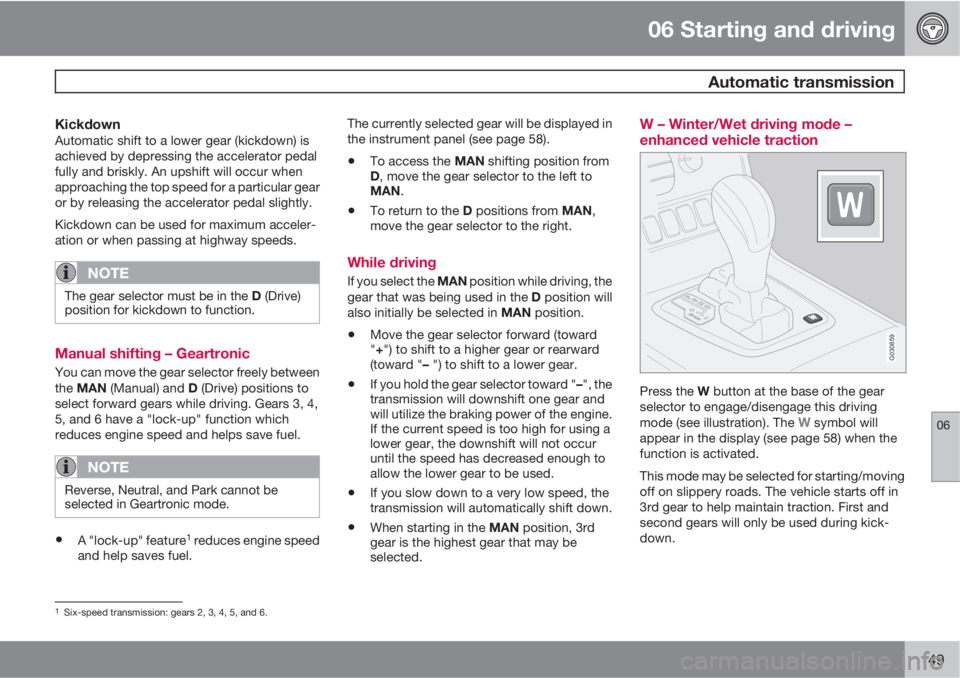
G030859
Press the W button at the base of the gear
selector to engage/disengage this driving
mode (see illustration). The
W symbol will
appear in the display (see page 58) when the
function is activated.
This mode may be selected for starting/moving
off on slippery roads. The vehicle starts off in
3rd gear to help maintain traction. First and
second gears will only be used during kick-
down.
1Six-speed transmission: gears 2, 3, 4, 5, and 6.
Page 155 of 310

06 Starting and driving
Brake system
06
* Option/accessory, for more information, see Introduction.153 BRAKE Brake circuit malfunction
The brake system is a hydraulic system con-
sisting of two master cylinders and two sepa-
rate brake circuits. If a problem should occur in
one of these circuits, it is still possible to stop
the vehicle with the other brake circuit.
If the brake pedal must be depressed farther
than normal and requires greater foot pressure,
the stopping distance will be longer.
A warning light in the instrument panel will light
up to warn the driver that a fault has occurred.
If this light comes on while driving or braking,
stop immediately and check the brake fluid
level in the reservoir.
NOTE
Press the brake pedal hard and maintain
pressure on the pedal – do not pump the
brakes.
WARNING
If the fluid level is below the MIN mark in the
reservoir or if a BRAKE FAILURE STOP
SAFELY message is displayed in the text
window: DO NOT DRIVE. Have the vehicle
towed to a trained and qualified Volvo serv-
ice technician and have the brake system
inspected.
NOTE
When the vehicle is at a standstill and the
engine is idling, e.g. at a traffic light and the
brake pedal is depressed, the pedal may go
down slightly. This is a normal function of
the power-assisted brake system.
Brake pad inspectionOn vehicles equipped with a jack*, the condi-
tion of the brake pads can be checked by rais-
ing the vehicle (see page 195 for information
about using the jack and removing a wheel)
and performing a visual inspection of the brake
pads.
WARNING
•If the vehicle has been driven immedi-
ately prior to a brake pad inspection, the
wheel hub, brake components, etc., will
be very hot. Allow time for these com-
ponents to cool before carrying out the
inspection.
•Apply the parking brake and put the
gear selector in the Park (P) position.
•Block the wheels standing on the
ground, use rigid wooden blocks or
large stones.
WARNING
•Use the jack intended for the vehicle
when changing a tire. For any other job,
use stands to support the vehicle.
•The jack should be kept well-greased
and clean, and should not be damaged.
•Be sure the jack is on a firm, level, non-
slippery surface.
•No objects should be placed between
the base of jack and the ground, or
between the jack and the attachment
bar on the vehicle.
•The jack must correctly engage the jack
attachment.
•Never allow any part of your body to be
extended under a vehicle supported by
a jack.
Power brakes function only when the
engine is running
The power brakes utilize vacuum pressure
which is only created when the engine is run-
ning. Never let the vehicle roll to a stop with the
engine switched off.
If the power brakes are not working, consider-
ably higher pressure will be required on the
brake pedal to compensate for the lack of
power assistance. This can happen for exam-
ple when towing your vehicle or if the engine is