2013 VOLVO V60 overheating
[x] Cancel search: overheatingPage 319 of 422
08 Wheels and tyres
Tyre pressure
08
317
Tyre pressure
G021830
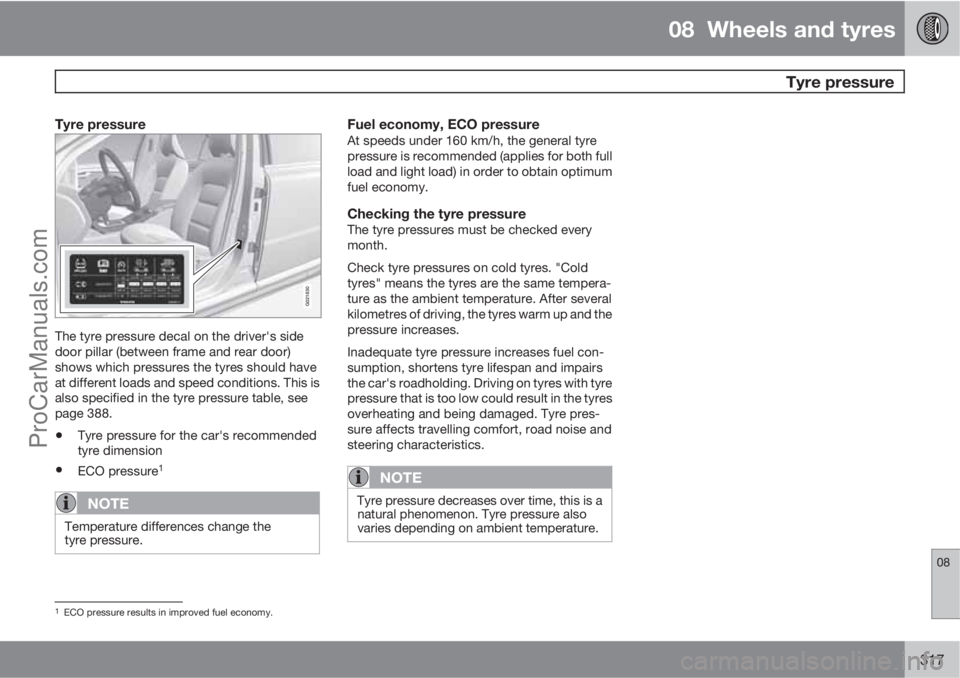
The tyre pressure decal on the driver's side
door pillar (between frame and rear door)
shows which pressures the tyres should have
at different loads and speed conditions. This is
also specified in the tyre pressure table, see
page 388.
•Tyre pressure for the car's recommended
tyre dimension
•ECO pressure1
NOTE
Temperature differences change the
tyre pressure.
Fuel economy, ECO pressureAt speeds under 160 km/h, the general tyre
pressure is recommended (applies for both full
load and light load) in order to obtain optimum
fuel economy.
Checking the tyre pressureThe tyre pressures must be checked every
month.
Check tyre pressures on cold tyres. "Cold
tyres" means the tyres are the same tempera-
ture as the ambient temperature. After several
kilometres of driving, the tyres warm up and the
pressure increases.
Inadequate tyre pressure increases fuel con-
sumption, shortens tyre lifespan and impairs
the car's roadholding. Driving on tyres with tyre
pressure that is too low could result in the tyres
overheating and being damaged. Tyre pres-
sure affects travelling comfort, road noise and
steering characteristics.
NOTE
Tyre pressure decreases over time, this is a
natural phenomenon. Tyre pressure also
varies depending on ambient temperature.
1ECO pressure results in improved fuel economy.
ProCarManuals.com
Page 325 of 422

08 Wheels and tyres
Emergency puncture repair (TMK)
08
323
NOTE
If the compressor is connected to one of the
two 12 V sockets, in the tunnel console, no
other current consumer must be connected
to the other one.
WARNING
Do not leave children in the car without
supervision when the engine is running.
8.
Flick the switch to position I.
WARNING
Never stand next to the tyre when the com-
pressor is running. If cracks or unevenness
arise then the compressor must be
switched off immediately. The journey
should not be continued. Contacting an
authorised tyre centre is recommended.
NOTE
When the compressor starts, the pressure
can increase up to 6 bar but the pressure
drops after approximately 30 seconds.
9. Inflate the tyre for 7 minutes.
IMPORTANT
Risk of overheating. The compressor must
not run for more than 10 minutes.
10. Switch off the compressor to check the
pressure on the pressure gauge. Minimum
pressure is 1.8 bar and maximum 3.5 bar.
(Release air with the pressure reducing
valve if the tyre pressure is too high.)
WARNING
If the pressure is below 1.8 bar then the hole
in the tyre is too big. The journey should not
be continued. Contacting an authorised tyre
centre is recommended.
11. Switch off the compressor and unplug the
cable from the 12 V socket.
12. Detach the hose from the tyre valve and fit
the valve cap.
13. As soon as possible, drive approximately
3 km at a maximum speed of 80 km/h so
that the sealing fluid can seal the tyre.
Rechecking the repair and pressure1. Reconnect the equipment.2. Read the tyre pressure on the pressure
gauge.
•If it is below 1.3 bar then the tyre is
insufficiently sealed. The journey should
not be continued. Contact a tyre centre.
•If the tyre pressure is higher than 1.3
bar, the tyre must be inflated to the pres-
sure specified in accordance with the
tyre pressure table, see page 388 (1
bar=100 kPa). Release air using the
pressure reducing valve if the tyre pres-
sure is too high.
WARNING
Do not unscrew the bottle, it is equipped
with a reverse catch to prevent leakage.
3. Make sure the compressor is switched off.
Detach the air hose and cable. Refit the
dust cap.
NOTE
The sealing fluid bottle and the hose must
be replaced after use. Volvo recommends
that this replacement is performed by an
authorised Volvo workshop.
ProCarManuals.com
Page 326 of 422

08 Wheels and tyres
Emergency puncture repair (TMK)
08
324
WARNING
Check the tyre pressure regularly.
Volvo recommends that you drive to the near-
est authorised Volvo workshop for the replace-
ment/repair of the damaged tyre. Advise the
workshop that the tyre contains sealing fluid.
WARNING
You should not drive faster than 80 km/h
after the emergency tyre repair kit has been
used. Volvo recommends that you visit an
authorised Volvo workshop for inspection of
the sealed tyre (maximum driving distance
is 200 km). The staff there can determine
whether or not the tyre can be repaired or if
it needs to be replaced.
Inflating the tyres
The car's original tyres can be inflated by the
compressor.
1. The compressor must be switched off.
Make sure that the switch is in position 0
and locate the cable and air hose.
2. Unscrew the wheel's dust cap and screw
in the air hose valve connection to the bot-
tom of the thread on the tyre's air valve.
WARNING
Inhaling car exhaust fumes can result in
danger to life. Never leave the engine run-
ning in sealed areas or areas that lack suf-
ficient ventilation.
WARNING
Do not leave children in the car without
supervision when the engine is running.
3. Connect the cable to one of the car's 12 V
sockets and start the car.
4. Start the compressor by flicking the switch
to position I.
IMPORTANT
Risk of overheating. The compressor must
not run for more than 10 minutes.
5. Inflate the tyre to the pressure specified in
accordance with the tyre pressure table,
see page 388. (Release air using the pres-
sure reducing valve if the tyre pressure is
too high.)
6. Switch off the compressor. Detach the air
hose and cable.
7. Refit the dust cap.
Replacing the sealing fluid canister
Replace the bottle when the expiration date
has passed. Treat the old bottle as environ-
mentally hazardous waste.
WARNING
The bottle contains 1.2-Ethanol and natural
rubber-latex.
Harmful if ingested. Could result in allergic
reaction in the event of skin contact.
Avoid contact with the skin and eyes.
Store out of the reach of children.
ProCarManuals.com
Page 413 of 422

11 Alphabetical Index
11
411
ECO pressure.......................................... 317
Eco Start/Stop DRIVe.............................. 127
Electrical socket......................................229
cargo area........................................... 293
front seat............................................. 229
Electric parking brake.............................. 137
low battery voltage.............................137
releasing automatically....................... 138
releasing manually.............................. 138
Emergency equipment
warning triangle.................................. 318
Emergency puncture repair..................... 321
Emissions of carbon dioxide................... 291
Engine
overheating......................................... 298
starting................................................ 113
Engine block heater................................. 118
fuel-driven........................................... 220
Engine compartment
coolant................................................ 332
oil........................................................ 329
overview.............................................. 329
power steering fluid............................ 334
Engine drag control ................................146Engine oil.........................................329, 378
adverse driving conditions.................. 378
capacities........................................... 378
filter..................................................... 329
oil grade.............................................. 378
Engine specifications............................... 376
Environmental labelling, FSC, owner's
manual.......................................................12
Error messages
Adaptive Cruise Control..................... 162
Driver Alert Control............................. 183
Lane Departure Warning..................... 186
see Messages and symbols.......139, 162
Error messages in BLIS........................... 196
Error messages in Distance Alert............ 167
ERS - Remote Start................................. 114
ETC, electronic temperature control ....... 214
Expectant mothers, seatbelt...................... 17
External dimensions................................372
F
Fan........................................................... 215
Fault tracing for the camera sensor. 170, 178First aid equipment.................................. 318
First aid kit .............................................. 318
Flexifuel.................................................... 118
adaptation........................................... 119
Fluids, capacities..................................... 381
Fluids and oils.......................................... 381
Fog lamps
rear........................................................ 91
Foot brake............................................... 135
FOUR-C – Active chassis........................226
FSC, environmental labelling..................... 12
Fuel.......................................................... 288
fuel consumption................................ 384
fuel economy...................................... 317
fuel filter.............................................. 290
Fuse box.................................................. 350
glovebox............................................. 355
Fuses.......................................................350
box in cargo area................................ 358
changing............................................. 350
cold zone............................................ 359
general................................................ 350
relay/fuse box in engine compartment 351
Start/Stop........................................... 359
ProCarManuals.com
Page 416 of 422

11 Alphabetical Index
11
414
Manual gearbox....................................... 121
GSI - Gear selector assistance........... 121
towing and recovery........................... 304
Manual gear positions (Geartronic).......... 123
Max. roof load ......................................... 373
Media, Bluetooth
Ÿ ................................... 259
media player ........................................... 252
Memory function in seats.......................... 81
Menu navigation, Infotainment ............... 238
Menus/functions...................................... 204
Menus and messages.............................. 200
Menu system MY CAR............................202
Messages and symbols
Adaptive Cruise Control..................... 162
Collision Warning with Auto
Brake..........................................171, 179
Distance Alert..................................... 167
Driver Alert Control............................. 183
Lane Departure Warning..................... 186
Messages in BLIS.................................... 196
Messages in the combined instrument
panel........................................................200
Messages in the information display....... 147Meters
fuel gauge............................................. 72
speedometer......................................... 72
tachometer........................................... 72
Microphone.............................................. 262
Misting..................................................... 217
attending to the windows...................210
condensation in headlamps............... 361
remove with the air vents................... 219
timer function...................................... 217
Mobile phone
connect............................................... 263
handsfree............................................ 262
register phone..................................... 263
voice control....................................... 271
Mood lighting............................................. 93
MY CAR................................................... 202
O
Oil, see also Engine oil............................. 378
Oil level low.............................................. 329
Overheating............................................. 298
Owner's manual, environmental labelling. . 12
P
PACOS....................................................... 22
PACOS, switch.......................................... 22
Paintwork
colour code......................................... 365
damage and touch-up........................ 365
Panel lighting............................................. 86
Panic function............................................ 46
Park assist camera.................................. 191
Parking assistance................................... 188
parking assistance sensors................ 190
Parking brake........................................... 137
Parking heater.......................................... 220
battery and fuel................................... 220
parking on a hill..................................220
time setting......................................... 222
Passenger compartment.........................227
Passenger compartment filter................. 210
Passenger compartment heater
fuel-driven........................................... 220
PCC – Personal Car Communicator
functions............................................... 45
range............................................... 46, 47
Pedestrian protection..............................173
ProCarManuals.com