2013 VOLVO S80 trunk
[x] Cancel search: trunkPage 266 of 372

07 During your trip
Driving recommendations
07
264
General information
Economical driving conserves natural
resources
Better driving economy may be obtained by
thinking ahead, avoiding rapid starts and stops
and adjusting the speed of your vehicle to
immediate traffic conditions.
Observe the following rules:
•Bring the engine to normal operating tem-
perature as soon as possible by driving
with a light foot on the accelerator pedal for
the first few minutes of operation. A cold
engine uses more fuel and is subject to
increased wear.
•Whenever possible, avoid using the vehicle
for driving short distances. This does not
allow the engine to reach normal operating
temperature.
•Drive carefully and avoid rapid acceleration
and hard braking.
•Use the transmission's Drive (D) position
as often as possible and avoid using kick-
down.
•Do not exceed posted speed limits.
•Avoid carrying unnecessary items (extra
load) in the vehicle.
•Maintain correct tire pressure. Check tire
pressure regularly (when tires are cold).
•Remove snow tires when threat of snow or
ice has ended.
•Note that roof racks, ski racks, etc,
increase air resistance and also fuel con-
sumption.
•At highway driving speeds, fuel consump-
tion will be lower with the air conditioning
on and the windows closed than with the
air conditioning off and the windows open.
•Using the onboard trip computer's fuel
consumption modes can help you learn
how to drive more economically.
Other factors that decrease gas mileage
are:
•Dirty air cleaner
•Dirty engine oil and clogged oil filter
•Dragging brakes
•Incorrect front end alignment
Some of the above mentioned items and others
are checked at the standard maintenance
intervals.
WARNING
Driving with the trunk open: Driving with
the trunk open could lead to poisonous
exhaust gases entering the passenger com-
partment. If the trunk must be kept open for
any reason, proceed as follows:
•Close the windows
•Set the ventilation system control to air
flow to floor, windshield and side win-
dows and the blower control to its high-
est setting.
Weight distribution affects handlingAt the specified curb weight your vehicle has a
tendency to understeer, which means that the
steering wheel has to be turned more than
might seem appropriate for the curvature of a
bend. This ensures good stability and reduces
the risk of rear wheel skid. Remember that
these properties can alter with the vehicle load.
The heavier the load in the trunk, the less the
tendency to understeer.
Handling, roadholdingVehicle load, tire design and inflation pressure
all affect vehicle handling. Therefore, check
that the tires are inflated to the recommended
pressure according to the vehicle load. See the
"Tire pressure" section. Loads should be dis-
tributed so that capacity weight or maximum
permissible axle loads are not exceeded.
Page 271 of 372
07 During your trip
Refueling
07
269
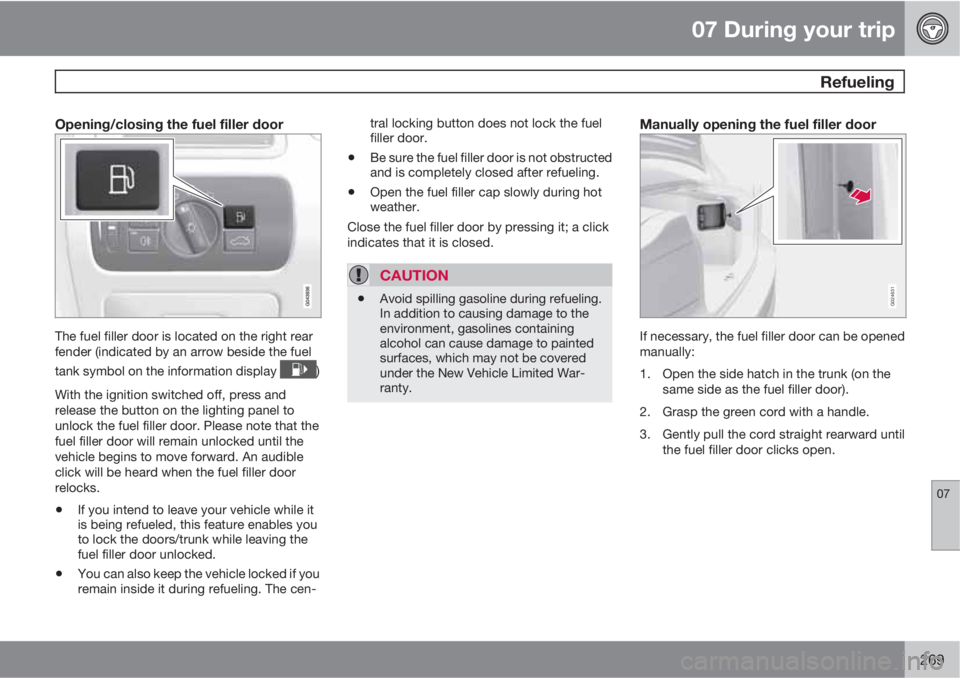
Opening/closing the fuel filler door
The fuel filler door is located on the right rear
fender (indicated by an arrow beside the fuel
tank symbol on the information display
)
With the ignition switched off, press and
release the button on the lighting panel to
unlock the fuel filler door. Please note that the
fuel filler door will remain unlocked until the
vehicle begins to move forward. An audible
click will be heard when the fuel filler door
relocks.
•If you intend to leave your vehicle while it
is being refueled, this feature enables you
to lock the doors/trunk while leaving the
fuel filler door unlocked.
•You can also keep the vehicle locked if you
remain inside it during refueling. The cen-tral locking button does not lock the fuel
filler door.
•Be sure the fuel filler door is not obstructed
and is completely closed after refueling.
•Open the fuel filler cap slowly during hot
weather.
Close the fuel filler door by pressing it; a click
indicates that it is closed.
CAUTION
•Avoid spilling gasoline during refueling.
In addition to causing damage to the
environment, gasolines containing
alcohol can cause damage to painted
surfaces, which may not be covered
under the New Vehicle Limited War-
ranty.
Manually opening the fuel filler door
G024631
If necessary, the fuel filler door can be opened
manually:
1. Open the side hatch in the trunk (on the
same side as the fuel filler door).
2. Grasp the green cord with a handle.
3. Gently pull the cord straight rearward until
the fuel filler door clicks open.
Page 274 of 372

07 During your trip
Loading
07
272* Option/accessory, for more information, see Introduction.
Introduction
The load carrying capacity of your vehicle is
determined by factors such as the number of
passengers, the amount of cargo, the weight
of any accessories that may be installed, etc.
To increase loading space, the rear seat back-
rests can be folded down, see page 87.
When loading the trunk, keep the following in
mind:
The trunk lid can be unlocked an pop-
ped open slightly via the button
located on the lighting panel, see page 65.
•Load objects in the trunk against the back-
rest whenever possible.
•Unstable loads can be secured to the load
anchoring eyelets with straps or web lash-
ings to help keep them from shifting.
•Stop the engine and apply the parking
brake when loading or unloading long
objects. The gear selector can be knocked
out of position by long loads, which could
set the vehicle in motion.
WARNING
•Stop the engine, put the gear selector in
P, and apply the parking brake when
loading or unloading long objects.
•The vehicle's driving characteristics
may change depending on the weight
and distribution of the load.
•A 44-pound (20 kg) object produces a
force of 2,200 pounds (1,000 kg) in a
head-on collision at 30 mph (50 km/h).
•The rear seat should not be loaded to a
level higher than 2 in. (5 cm) below the
upper edge of the rear side windows.
Objects placed higher than this level
could impede the function of the Volvo
Inflatable Curtain.
Folding down the rear seat backrests
The rear seat backrests can be folded down for
additional loading space, see page 88.
Load anchoring eyelets
G021462
The load anchoring eyelets on both sides of the
vehicle are used to fasten straps, etc., to help
anchor items in the trunk.
Page 275 of 372

07 During your trip
Loading
07
* Option/accessory, for more information, see Introduction.273
WARNING
•Cover sharp edges on long loads to help
prevent injury to occupants. Secure the
load to help prevent shifting during sud-
den stops.
•Always secure large and heavy objects
with a seat belt or cargo retaining
straps.
•Always secure the load to help prevent
it from moving in the event of sudden
stops.
•Switch off the engine, apply the parking
brake and put the gear selector in P
when loading and unloading the vehicle.
Grocery bag holder*
G021463
Grocery bag holder under the floor of the trunk
The grocery bag holder holds shopping bags
in place.
1. Open the hatch in the floor of the trunk.
2. Secure the shopping bags with the strap.
Ski hatch
There is a hatch in the right section of the rear
seat backrest that can be opened for transpor-
tation.
Fold the right backrest forward.
Release the hatch in the rear seat backrest
by sliding the catch up while folding the
hatch forward.
Return the backrest to the upright position
with the hatch open.
Use the seat belt to prevent the load from mov-
ing.
Page 280 of 372

07 During your trip
Emergency towing
07
278
Towing eyelet
G021500
Attaching the towing eyelet
Attaching the towing eyeletThe towing eyelet is located under the floor
of the trunk, with the spare tire. This eyelet
must be screwed into the positions provi-
ded on the right sides of either the front or
rear bumper (see illustration).
There are two different types of covers over
the openings for the towing eyelet and they
have to be opened differently.
•If the cover has a notch, insert a coin,
etc., into the notch and pry open the
edge of the cover. Open the cover com-
pletely and remove it.
•If the cover has a mark along one edge
or in a corner, press the mark while pry-
ing out the opposite side/corner using a
coin, etc. Open the cover and remove it.
Screw the towing eyelet in place, first by hand
and then using the tire iron until it is securely in
place.
After the vehicle has been towed, the eyelet
should be removed and returned to its storage
location.
Press the cover for the attachment point back
into position.
NOTE
On certain models equipped with a trailer
hitch, the towing eyelet cannot be screwed
into the hole in the rear bumper. The towing
rope should be attached to the trailer hitch
instead. For this reason, the detachable
section of the trailer hitch should be safely
stowed in the vehicle at all times.
Page 300 of 372

08 Wheels and tires
Tire Sealing System
08
298* Option/accessory, for more information, see Introduction.
Location
IntroductionCertain models are equipped with a tire sealing
system* that enables you to temporarily seal a
hole in the tread surface and re-inflate a flat tire,
or to adjust a tire’s inflation pressure.
The system consists of an air compressor, a
container for the sealing compound, wiring to
connect the system to the vehicle’s electrical
system via one of the 12-volt sockets, and a
hose used to connect the system to the tire’s
inflation valve.
NOTE
The tire sealing system's compressor has
been tested and approved by Volvo.
The 12-volt sockets are located in the front
tunnel console and on the rear side of the cen-
ter console in the rear seat, see page 205.
Accessing the tire sealing systemThe tire sealing system is stowed under the
floor of the trunk. To access it:
1. Lift the floor hatch in the cargo area.
2. Lift out the tire sealing system.
NOTE
•The tire sealing system is only intended
to seal holes on the tire’s tread area, not
the sidewall.
•Tires with large holes or tears cannot be
repaired with the tire sealing system.
•After use, stow the tire sealing system
properly to help prevent rattling.
WARNING
•After using the tire sealing system, the
vehicle should not be driven farther than
approximately 120 miles (200 km).
•Have the tire inspected by a trained and
qualified Volvo service technician as
soon as possible to determine if it can
be permanently repaired or must be
replaced.
•The vehicle should not be driven faster
than 50 mph (80 km/h) while using a tire
that has been temporarily repaired with
the tire sealing system.
•After using the tire sealing system, drive
carefully and avoid abrupt steering
maneuvers and sudden stops.
Page 306 of 372
08 Wheels and tires
Changing a wheel
08
304* Option/accessory, for more information, see Introduction.
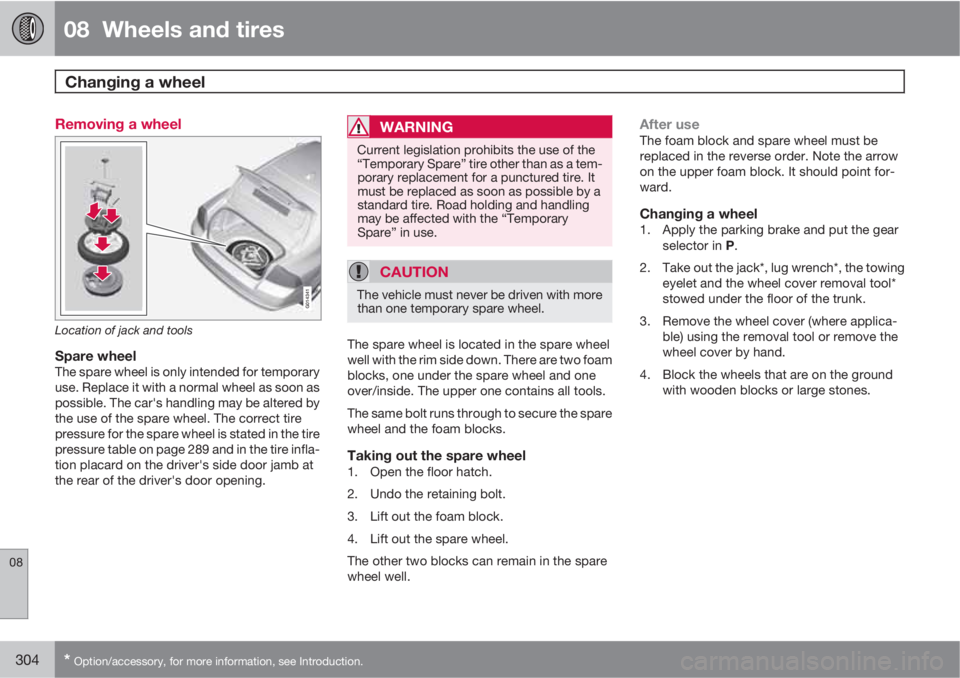
Removing a wheel
G014341
Location of jack and tools
Spare wheelThe spare wheel is only intended for temporary
use. Replace it with a normal wheel as soon as
possible. The car's handling may be altered by
the use of the spare wheel. The correct tire
pressure for the spare wheel is stated in the tire
pressure table on page 289 and in the tire infla-
tion placard on the driver's side door jamb at
the rear of the driver's door opening.
WARNING
Current legislation prohibits the use of the
“Temporary Spare” tire other than as a tem-
porary replacement for a punctured tire. It
must be replaced as soon as possible by a
standard tire. Road holding and handling
may be affected with the “Temporary
Spare” in use.
CAUTION
The vehicle must never be driven with more
than one temporary spare wheel.
The spare wheel is located in the spare wheel
well with the rim side down. There are two foam
blocks, one under the spare wheel and one
over/inside. The upper one contains all tools.
The same bolt runs through to secure the spare
wheel and the foam blocks.
Taking out the spare wheel1. Open the floor hatch.
2. Undo the retaining bolt.
3. Lift out the foam block.
4. Lift out the spare wheel.
The other two blocks can remain in the spare
wheel well.
After useThe foam block and spare wheel must be
replaced in the reverse order. Note the arrow
on the upper foam block. It should point for-
ward.
Changing a wheel1. Apply the parking brake and put the gear
selector in P.
2. Take out the jack*, lug wrench*, the towing
eyelet and the wheel cover removal tool*
stowed under the floor of the trunk.
3. Remove the wheel cover (where applica-
ble) using the removal tool or remove the
wheel cover by hand.
4. Block the wheels that are on the ground
with wooden blocks or large stones.
Page 326 of 372

09 Maintenance and specifications
Replacing bulbs 09
324
Front fog lights
G021753
1. Remove the cover by pressing in the clips
and pulling straight out.
2. Unscrew the fog light housing screw and
pull it out.3. Turn the bulb counterclockwise and
remove it.
4. Install a new bulb by turning clockwise.
5. Press the bulb into the holder. (The profile
of the bulb holder corresponds to the pro-
file of the foot of the bulb.)
6.
Reinstall the bulb holder. The TOP mark on
the bulb holder must always be upward.
7. Put the cover back into place.
Taillight housing
G021755
Taillight lens, right side
Parking lights (LED)
Turn signals
Side marker lights (LED)
Brake lights
Rear fog lights (driver's side only)
Backup light
G021754
The bulbs in the taillight cluster are replaced
from inside the trunk (not the LED functions).
NOTE
Before starting to replace a bulb, see
page 320.
1. Remove the covers in the left/right panel to
access the bulbs. The bulbs are located in
separate bulb holders.
2. Press the catches together and pull out the
bulb holder.