Section width
The linear distance between the exteriors of the sidewalls of an inflated tire, excluding elevations due
to labeling decoration, or protective bands.
Sidewall
The portion of a tire between the bead and the tread.
Sidewall separation
The parting of the rubber compound from the cord material in the sidewall.
Speed rating (letter code)
A standardized letter code indicating the maximum speed at which a tire is designed to be driven for
extended periods of time. The ratings range from 93 mph or km/h (“P”) to mph or ( km/h) “Y”.
The speed rating letter code, where applicable, is molded on the tire sidewall 297, Speed rating
code letter. You may not find this information on all tires because it is not required by law.
Tire Pressure Monitoring System
A system that detects when at least one of a vehicle's tires is underinflated and illuminates a low tire-
pressure warning light.
Tread
The portion of a tire that normally touches the road.
Tread rib
A tread section running circumferentially around a tire.
Tread separation
Tire failure caused by the tread pulling away from the tire carcass.
Tread wear indicators (TWI)
Raised areas within the main tread grooves that show, visually, when tires are worn and near the end
of their useful life, Tread depth and tread wear indicators.
Uniform Tire Quality Grading (UTQG)
A tire information system developed by the U.S. National Highway Traffic Safety Administration
(NHTSA) that is designed to help buyers compare tires. UTQG is not a safety rating, nor is it a
guarantee that a tire will last for a certain number of miles or perform a certain way. It gives tire buyers
more information to compare with factors such as price, brand loyalty and dealer recommendations.
Under UTQG, tires are graded by the tire manufacturers in 3 areas: tread wear, traction and
temperature resistance. UTQG information is molded into the tire sidewalls.
U.S. DOT Tire Identification Number (TIN)
A tire's serial number. It begins with the letters “DOT” (“Department of Transportation”) and indicates
that the tire meets all federal standards. The next 2 numbers or letters indicate the plant where the tire
was manufactured. The last 4 numbers represent the week and year of manufacture.
For example, the numbers 1 mean that the tire was produced in the 18th week of 1. Any other
numbers are marketing codes used by the tire manufacturer. This information is used to help identify
affected consumers if a tire defect requires a recall.
Vehicle capacity weight
The total rated cargo, luggage and passenger load. Passenger load is lbs (68 kilograms) times the
vehicle's total seating capacity (as listed on the label inside the driver door).
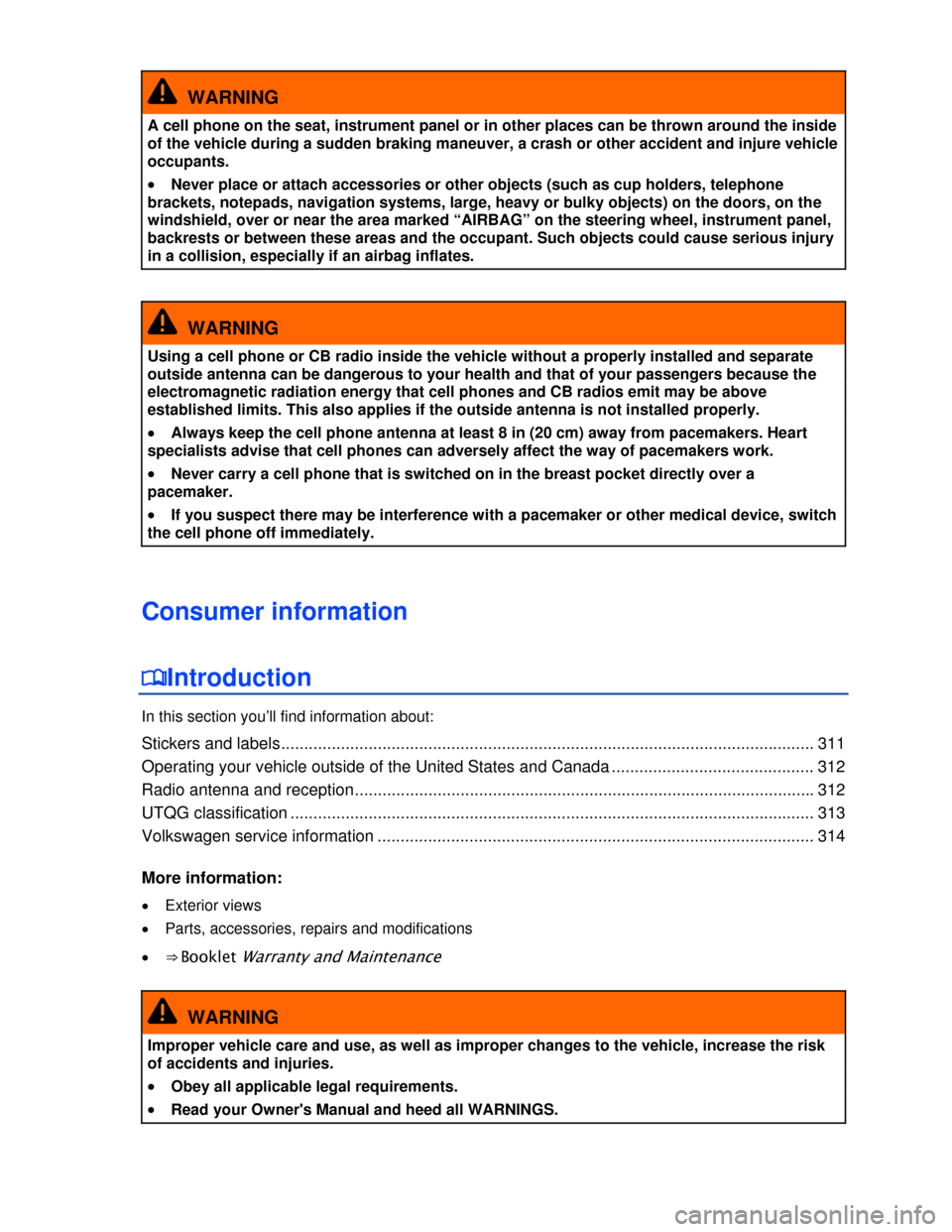
WARNING
A cell phone on the seat, instrument panel or in other places can be thrown around the inside
of the vehicle during a sudden braking maneuver, a crash or other accident and injure vehicle
occupants.
x Never place or attach accessories or other objects (such as cup holders, telephone
brackets, notepads, navigation systems, large, heavy or bulky objects) on the doors, on the
windshield, over or near the area marked “AIRBAG” on the steering wheel, instrument panel,
backrests or between these areas and the occupant. Such objects could cause serious injury
in a collision, especially if an airbag inflates.
WARNING
Using a cell phone or CB radio inside the vehicle without a properly installed and separate
outside antenna can be dangerous to your health and that of your passengers because the
electromagnetic radiation energy that cell phones and CB radios emit may be above
established limits. This also applies if the outside antenna is not installed properly.
x Always keep the cell phone antenna at least 8 in (20 cm) away from pacemakers. Heart
specialists advise that cell phones can adversely affect the way of pacemakers work.
x Never carry a cell phone that is switched on in the breast pocket directly over a
pacemaker.
x If you suspect there may be interference with a pacemaker or other medical device, switch
the cell phone off immediately.
Consumer information