2013 VOLKSWAGEN PASSAT CC tire
[x] Cancel search: tirePage 279 of 353

Under- or over-inflation significantly shortens the service life of your tires and affects the handling of
the vehicle ⇒ . The correct tire pressure is very important, particularly when the vehicle is driven at
higher speeds. Incorrect tire pressure causes increased wear and even sudden tire failure and
blowouts.
Therefore, tire pressure should be checked at least once a month and always before long trips.
The specified tire inflation pressure applies to a cold tire. When tires are warm, the pressure will be
higher than when the tires are cold.
Do not reduce the tire pressure on warm tires to match the required cold tire inflation pressure. The
tire inflation pressure would then be too low and could cause sudden tire failure and blowout.
Checking tire inflation pressure
Always check the tire pressure only on “cold” tires when the vehicle has not been driven more than a
couple of miles (kilometers) at low speed within the last 3 hours.
x Check tire inflation pressure regularly and on cold tires. Check all the tires, including the compact
spare, if any. In colder climates tire pressure should be checked more often, but only when the tires
are cold. Always use an accurate tire pressure gauge.
x Adjust the tire pressure for heavy loads accordingly.
x After adjusting the tire inflation pressures, make sure to screw the valve caps back on; replace
missing valve caps immediately. Please read and heed the information on resetting the Tire Pressure
Monitoring System, if necessary
x Remember that the vehicle manufacturer, not the tire manufacturer, determines the correct tire
pressure for the tires on your vehicle. Never exceed the maximum inflation pressure listed on the tire
sidewall for any reason.
Inflate a spare wheel to the pressure specified for the vehicle's road wheels on the tire pressure label;
inflate a compact spare wheel to the pressure specified for the compact spare on the tire pressure
label or on a separate label for the compact spare, if there is one.
WARNING
Incorrect tire pressure can cause a sudden tire failure or blowout, loss of control, collision,
serious personal injury, and even death.
x Always inflate tires to the recommended and correct cold tire pressure before driving off.
x Low tire pressure can cause tires to get too hot, resulting in tread separation, sudden loss
of pressure, and blowouts. Tires with excessively low pressure flex (bend) more, which can
cause the tire to overheat and fail suddenly without warning.
x Excessive speed and/or overloading can cause heat build-up, sudden tire failure including
a blowout and sudden deflation and loss of control.
x If the tire pressure is too low or too high, the tires will wear prematurely and the vehicle
will not handle well.
x Regularly check tire inflation pressure, at least once a month, and also especially before a
long trip.
x Check the pressure in all 4 tires when the tires are still cold. Never reduce air pressure in
warm tires to match cold tire inflation pressure.
NOTICE
x Make sure not to jam the tire pressure gauge into the valve stem. Otherwise, you can
damage the tire valves.
x Driving without valve caps, with the wrong valve caps, or with valve caps that are not
properly screwed on can damage the tire valves. To help prevent damage, always use valve
Page 280 of 353

stem caps like those originally installed at the factory. The caps must be screwed on tightly. Do
not use metal valve caps or “comfort” valve stem caps.
Underinflation increases fuel consumption.
There may be differences between the pressure readings from a tire pressure gauge and the
pressures registered by the Tire Pressure Monitoring System. The electronic Tire Pressure Monitoring
System is more accurate
When the TPMS warns that the pressure in at least one tire is too low, check the tire pressure in
all 4 tires with an accurate tire pressure gauge. Low tire pressure usually cannot be spotted by looking
at the tire. This is especially true for low-profile tires. When checking the tire pressures, refer to 218,
Tire Pressure Monitoring System (TPMS).
Applicable only in the United States
Tire inflation pressure in cold tires
Page 281 of 353

Engine Tire dimensions Tire pressure
bar psi kPa
The Tire Pressure Monitoring System is configured at the factory with the correct tire inflation
pressure applicable for the vehicle model, engine and factory-installed tires. The tire inflation
pressure is listed on the tire inflation pressure label on the driver door jamb 274. The tire inflation
pressures for the road tires are listed on this label. The inflation pressure for the compact spare is as
specified on the tire pressure label or on a separate label for the compact spare, if there is one. In
the event of a discrepancy between the above figures and the tire pressures listed on the tire
inflation pressure label, the pressures listed on the label are the ones you should use. The listed
pressure applies to all road tires. If different tires are installed that do not have the same cold tire
inflation pressure as the tires originally installed on your vehicle, the Tire Pressure Monitoring
System cannot properly monitor tire inflation pressures unless the TPMS is reset to the new tire
pressures 229. Authorized Volkswagen dealers and authorized Volkswagen Service Facilities have
the necessary special tools and can reset the TPMS for the new tires on your vehicle.
Applicable only in Canada
Tire inflation pressure in cold tires
Page 282 of 353
Engine Tire dimensions Tire pressure
bar psi kPa
The Tire Pressure Monitoring System is configured at the factory with the correct tire inflation
pressure applicable for the vehicle model, engine and factory-installed tires. The tire inflation
pressure is listed on the tire inflation pressure label on the driver door jamb 274. The tire inflation
pressures for the road tires are listed on this label. The inflation pressure for the compact spare is as
specified on the tire pressure label or on a separate label for the compact spare, if there is one. In
the event of a discrepancy between the above figures and the tire pressures listed on the tire
inflation pressure label, the pressures listed on the label are the ones you should use. The listed
pressure applies to all road tires. The Tire Pressure Monitoring System must be recalibrated
whenever you change or adjust the cold tire inflation pressure or remove and remount or change any
wheel or tire on the vehicle, even if the reinstalled or replacement wheels and tires are identical to
those that were removed and even if the tire pressure does not change
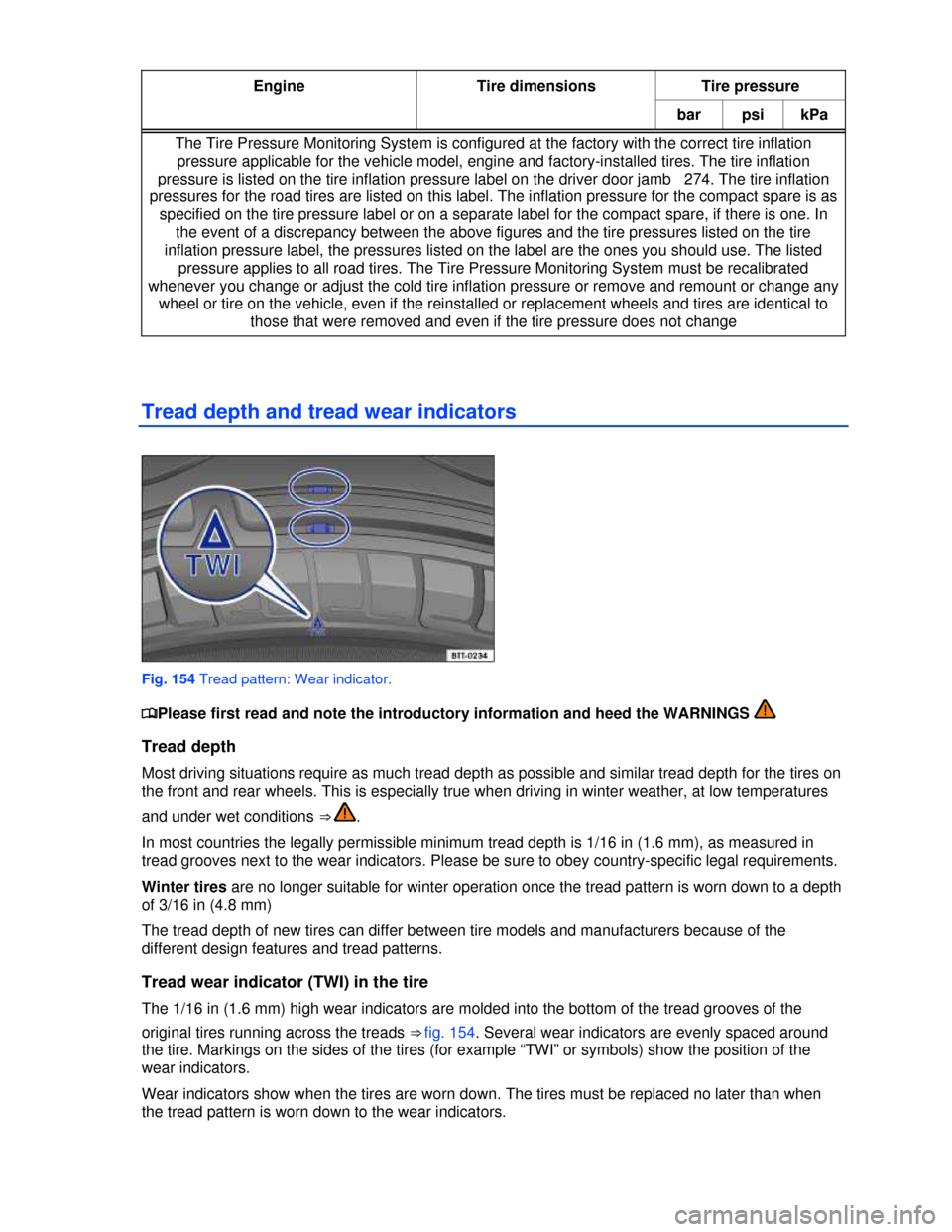
Tread depth and tread wear indicators
Fig. 154 Tread pattern: Wear indicator.
Page 283 of 353

WARNING
Worn tires are dangerous and can cause loss of vehicle control including serious personal
injuries.
x Never drive a vehicle when the tread on any tire is worn down to the wear indicators,
replace them sooner.
x Worn tires do not grip the road properly, especially on wet roads, increasing your risk of
“hydroplaning” and loss of control.
x Worn tires reduce the ability of your vehicle to handle well in normal and difficult driving
situations and increase braking distances and the risk of skidding.
Tire wear and damage
Page 284 of 353

WARNING
Unusual vibrations or pulling to one side can indicate tire damage.
x Reduce speed immediately and stop when it is safe to do so.
x Check tires and wheel rims for damage.
x Never drive with a damaged tire or rim. Get expert assistance instead.
x If no external damage is visible, slowly and carefully drive to the nearest authorized
Volkswagen dealer, authorized Volkswagen Service Facility, or other qualified workshop and
have the vehicle checked.
Spare wheel or compact spare wheel
Fig. 155 In the luggage compartment: Handwheel holding spare wheel in place.
Fig. 156 In the luggage compartment: Compact spare wheel.
Page 285 of 353

x If necessary, return the vehicle tool kit to its location in the luggage compartment.
x Unhook the floor covering and fold it back down onto the floor of the luggage compartment.
x Close the luggage compartment lid.
If the spare wheel is different from the road wheels
If the spare is different from the road wheels, a compact spare wheel, for example, or if the road
wheels are winter tires, the spare wheel must be used only in the event of a flat tire, only for a brief
time, and only when driving with extra caution ⇒ .
Replace it with a tire matching the others on your vehicle as soon as possible.
Please heed the following:
x Do not drive faster than 50 mph (80 km/h)!
x Avoid full-throttle acceleration, hard braking and fast cornering!
x Do not use snow chains on the compact spare wheel
x After installing the spare wheel or compact spare wheel, check the tire pressure as soon as
possible
Check the tire inflation pressure of the spare or compact spare whenever you check the tire pressure
of the road wheels, at least once a month. Inflate a spare wheel to the cold tire pressure specified for
the vehicle's road wheels on the tire pressure label; inflate a compact spare wheel to the cold tire
pressure specified for the compact spare on the tire pressure label or on a separate label for the
compact spare, if there is one.
WARNING
Improper use of a spare wheel or a compact spare wheel can cause loss of vehicle control, a
crash or other accident, and serious personal injury.
x Never use a spare wheel or compact spare wheel if it is damaged or worn down to the
wear indicators.
x In some vehicles, the spare wheel or compact spare wheel is smaller than the original tire.
A smaller compact spare wheel is identified with a sticker and the words “50 mph” or
“80 km/h”. This is the maximum permissible speed when driving with this tire.
x Never drive faster than 50 mph (80 km/h) with a compact spare wheel. Avoid full-throttle
acceleration, heavy braking, and fast cornering!
x Never drive more than 125 miles (200 km) if a compact spare wheel is installed on the front
axle (drive axle).
x Replace the compact spare with a normal wheel and tire as soon as possible. Compact
spare tires are designed for brief use only.
x Regularly check the U.S. DOT Tire Identification Number (TIN) to determine the age of the
compact spare wheel Tires age even if they are not being used and can fail suddenly,
especially at higher speeds.
x Tires that are more than 6 years old can only be used in an emergency and then with
special care and at lower speeds.
x The compact spare wheel must always be secured with the wheel bolts provided by the
factory.
x Never drive using more than one compact spare wheel.
x After installing the compact spare wheel, the tire pressure must be checked as soon as
possible
x Snow chains cannot be used on the compact spare wheel. If you must use snow chains
and have a compact spare wheel mounted, move the compact spare wheel to the rear axle if a
front tire has to be replaced. The tire taken off the rear axle can then be used to replace the
flat front tire. Be sure you do not change the tire's direction of rotation. Install the snow
chains on the full-sized road tire.
Page 286 of 353

NOTICE
When the spare wheel or compact spare is being used, the TPMS indicator light may start
flashing after about 10 minutes.
If possible, attach the spare wheel, compact spare wheel, or the wheel you took off the vehicle
securely in the luggage compartment.
Tire labeling
Fig. 157 International tire labeling.