Page 485 of 556

5
When trouble arises
485
5-2. Steps to take in an emergency
Start the hybrid system and check for the multi-information
display.
If the message does not disappear:
Stop the hybrid system and c ontact your Toyota dealer.
If the message is not displayed: Have the vehicle inspected at the nearest Toyota dealer.
CAUTION
■To prevent an accident or injury when inspecting under the hood of
your vehicle
●If steam is seen coming from under the hood, do not open the hood until
the steam has subsided. The engine compartment may be very hot, caus-
ing serious injuries such as burns.
● Check that on the multi-information display and the “READY” indi-
cator are off.
● On hybrid vehicles, the gasoline engine may automatically start, or the
cooling fan may suddenly operate even if the gasoline engine stops. Do
not touch or approach rotating parts such as the fan, which may lead to fin-
gers or clothing (especially a tie, a scarf or a muffler) getting caught,
resulting in serious injury.
● Do not loosen the radiator cap while the hybrid system and radiator are
hot.
Serious injuries, such as burns, may result from hot coolant and steam
released under pressure.
STEP6
Page 486 of 556
486 5-2. Steps to take in an emergency
NOTICE
■When adding engine/power control unit coolant
Wait until the hybrid system has cooled down before adding engine/power
control unit coolant.
When adding coolant, do so slowly. Adding cool coolant to a hot hybrid sys-
tem too quickly can cause damage to the hybrid system.
■ To prevent damage to the cooling system
Observe the following precautions:
●Avoid contaminating the coolant with foreign matter (such as sand or dust
etc.).
● When using coolant additives, use genuine Toyota products or equivalent.
Page 488 of 556
488
5-2. Steps to take in an emergency
If your vehicle has to be stopped in an emergency
Only in an emergency, such as if it becomes impossible to stop the
vehicle in the normal way, stop the vehicle using the following pro-
cedure:
Steadily step on the brake pedal with both feet and firmly
depress it.
Do not pump the brake pedal repeatedly as this will increase the
effort required to slow the vehicle.
Shift the shift lever to N.
If the shift lever is shifted to N After slowing down, stop the vehi cle in a safe place by the
road.
Stop the hybrid system.
If the shift lever cannot be shifted to N Keep depressing the brake pedal with both feet to reduce
vehicle speed as much as possible.
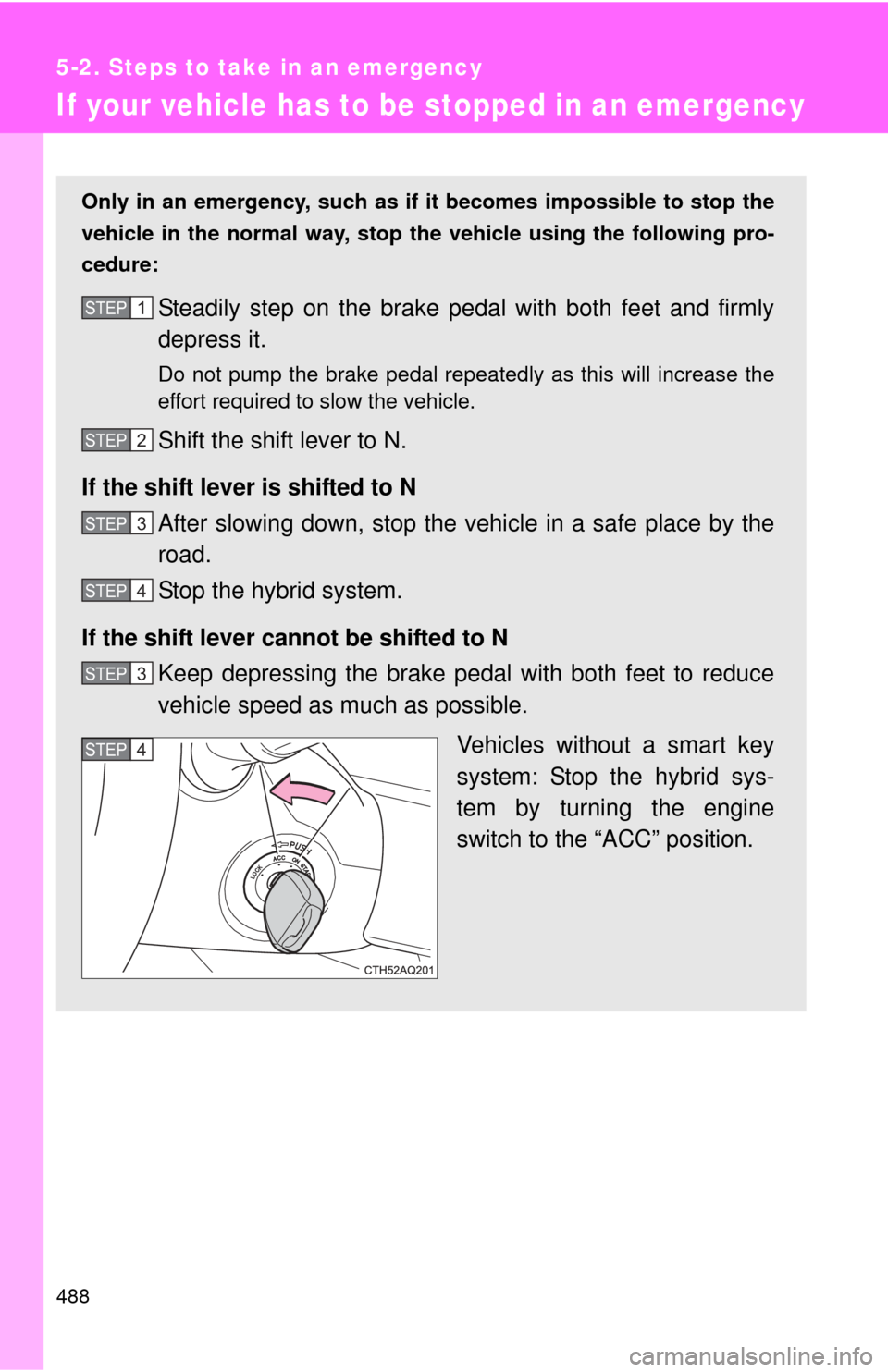
Vehicles without a smart key
system: Stop the hybrid sys-
tem by turning the engine
switch to the “ACC” position.
STEP1
STEP2
STEP3
STEP4
STEP3
STEP4
Page 494 of 556
494 6-1. Specifications
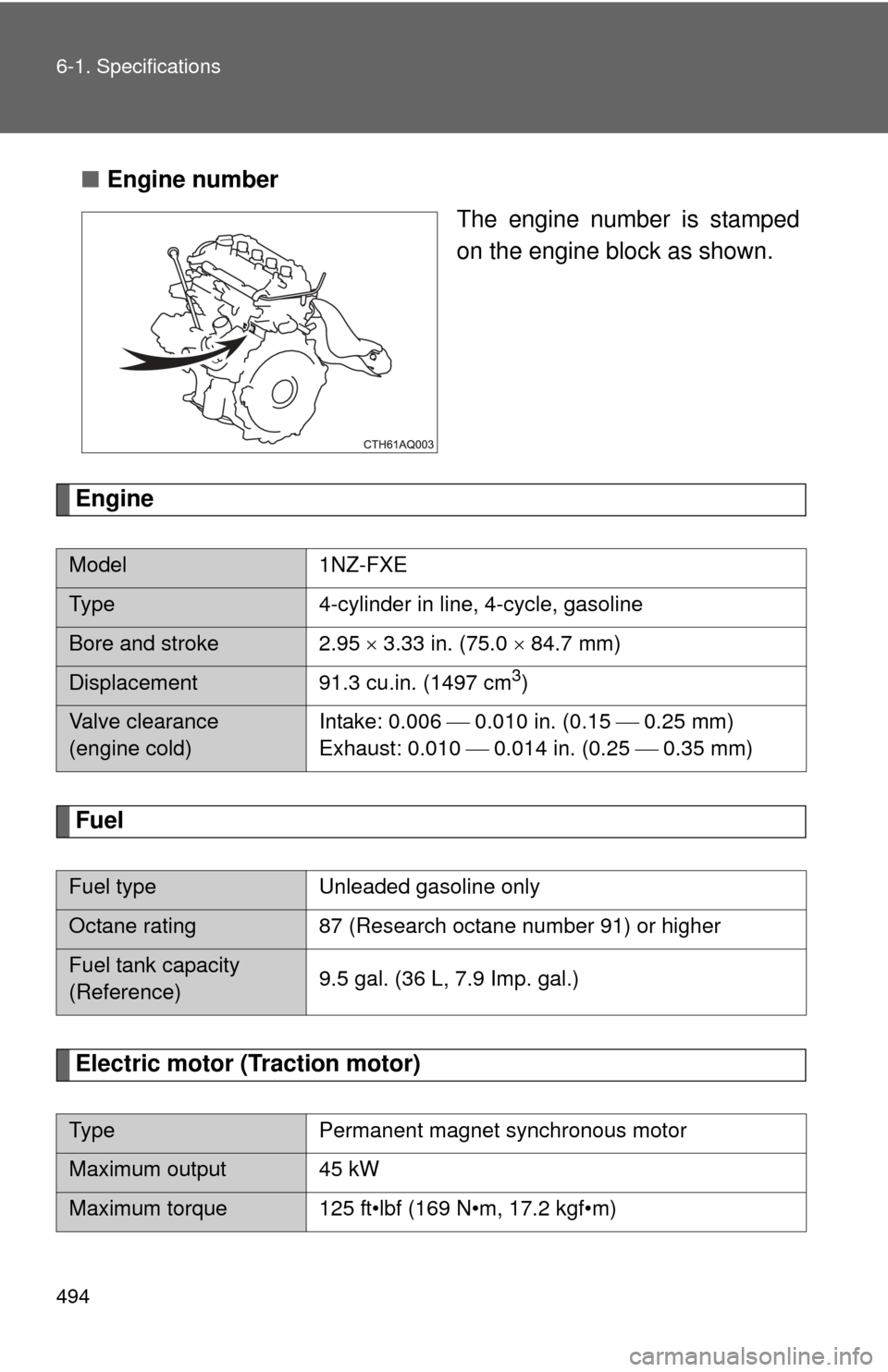
■Engine number
The engine number is stamped
on the engine block as shown.
Engine
Fuel
Electric motor (Traction motor)
Model1NZ-FXE
Type 4-cylinder in line, 4-cycle, gasoline
Bore and stroke 2.95 3.33 in. (75.0 84.7 mm)
Displacement 91.3 cu.in. (1497 cm3)
Valve clearance
(engine cold) Intake: 0.006 0.010 in. (0.15 0.25 mm)
Exhaust: 0.010 0.014 in. (0.25 0.35 mm)
Fuel type Unleaded gasoline only
Octane rating 87 (Research octane number 91) or higher
Fuel tank capacity
(Reference) 9.5 gal. (36 L, 7.9 Imp. gal.)
Type
Permanent magnet synchronous motor
Maximum output 45 kW
Maximum torque 125 ft•lbf (169 N•m, 17.2 kgf•m)
Page 495 of 556
495
6-1. Specifications
6
Vehicle specifications
Hybrid battery (Traction battery)
Lubrication system
*: The engine oil capacity is a reference quantity to be used when changing the
engine oil. Warm up the engine and turn off the hybrid system, wait more
than 5 minutes, and check the oil level on the dipstick.
■Engine oil selection
“Toyota Genuine Motor Oil” is used in your Toyota vehicle. Use
Toyota approved “Toyota Genuine Motor Oil” or equivalent to satisfy
the following grade and viscosity.
Oil grade: ILSAC GF-5 multigrade engine oil
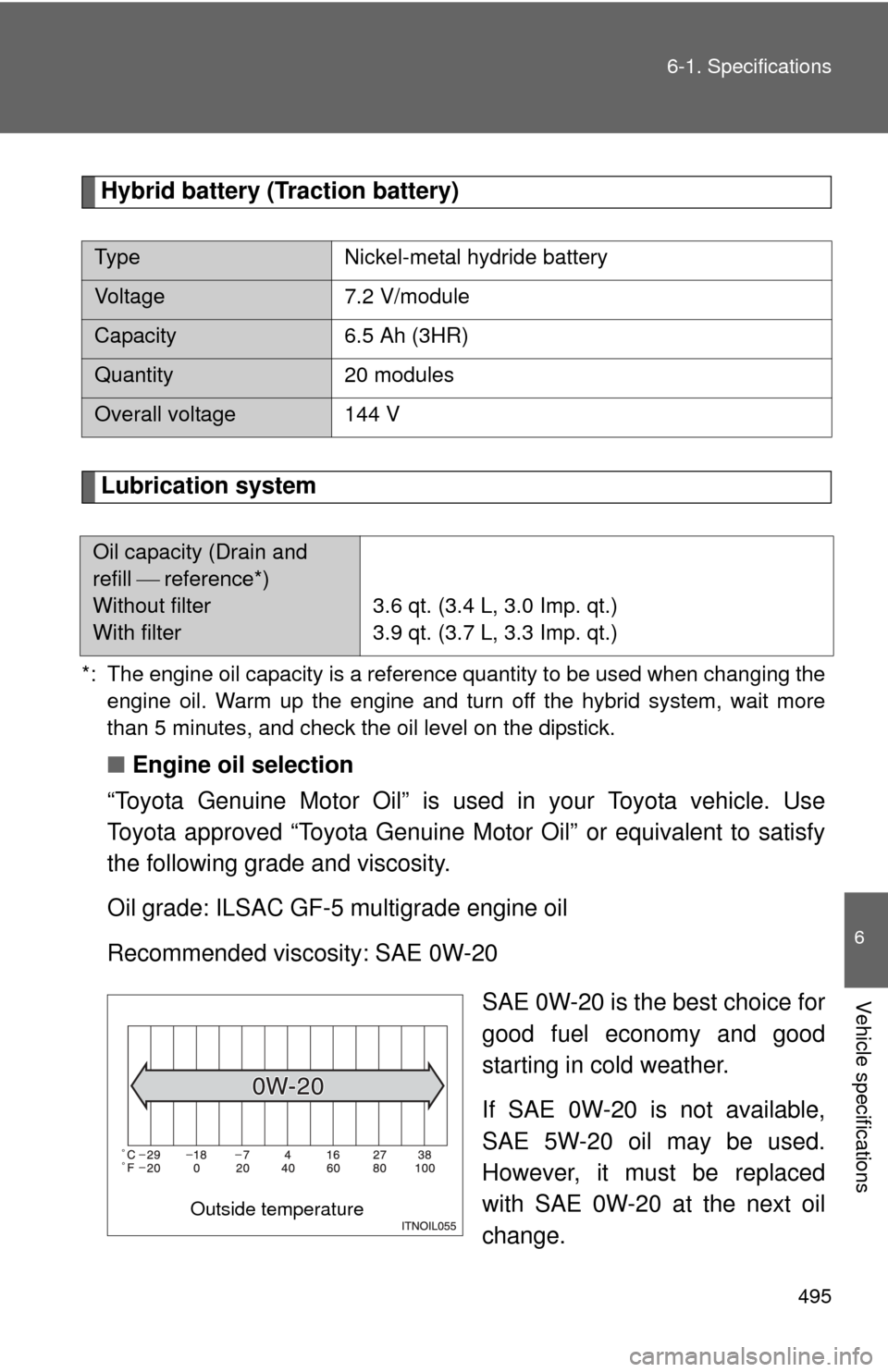
Recommended viscosity: SAE 0W-20
SAE 0W-20 is the best choice for
good fuel economy and good
starting in cold weather.
If SAE 0W-20 is not available,
SAE 5W-20 oil may be used.
However, it must be replaced
with SAE 0W-20 at the next oil
change.
TypeNickel-metal hydride battery
Voltage7.2 V/module
Capacity6.5 Ah (3HR)
Quantity 20 modules
Overall voltage 144 V
Oil capacity (Drain and
refill reference*)
Without filter
With filter 3.6 qt. (3.4 L, 3.0 Imp. qt.)
3.9 qt. (3.7 L, 3.3 Imp. qt.)
Outside temperature
Page 496 of 556

496 6-1. Specifications
Oil viscosity (0W-20 is explained here as an example):
• The 0W in 0W-20 indicates the characteristic of the oil which allowscold startability. Oils with a lower value before the W allow for easier
starting of the engine in cold weather.
• The 20 in 0W-20 indicates the viscosity characteristic of the oil when the oil is at high temperature. An oil with a higher viscosity (one with a
higher value) may be better suited if the vehicle is operated at high
speeds, or under extreme load conditions.
How to read oil container label:
The ILSAC (International Lubricant Standardization and Approval
Committee) Certification Mark is added to some oil containers to help
you select the oil you should use.
Cooling system
Capacity Gasoline engine
Power control unit 5.6 qt. (5.3 L, 4.7 Imp. qt.)
1.7 qt. (1.6 L, 1.4 Imp. qt.)
Coolant type Use either of the following:
• “Toyota Super Long Life Coolant”
• A similar high-quality ethylene glycol-based non-silicate, non-amine, non-nitrite,
and non-borate coolant with long-life
hybrid organic acid technology
Do not use plain water alone.
Page 502 of 556
502
6-1. Specifications
Fuel infor mation
■Fuel tank opening fo r unleaded gasoline
To help prevent incorrect fueling, your vehicle has a fuel tank opening that
only accommodates the special nozzle on unleaded fuel pumps.
■ Gasoline quality
In very few cases, driveability problems may be caused by the brand of gas-
oline you are using. If driveability problems persist, try changing the brand of
gasoline. If this does not correct the problem, consult your Toyota dealer.
■ Gasoline quality standards
●Automotive manufacturers in the U.S.A., Europe and Japan have devel-
oped a specification for fuel quality called the World-Wide Fuel Charter
(WWFC), which is expected to be applied worldwide.
● The WWFC consists of four categories that are based on required emis-
sion levels. In the U.S., category 4 has been adopted.
● The WWFC improves air quality by lowering emissions in vehicle fleets,
and improves customer satisfaction through better performance.
■ Recommendation of the use of gaso line containing detergent additives
● Toyota recommends the use of gasoline that contains detergent additives
to avoid the build-up of engine deposits.
● All gasoline sold in the U.S.A. contains minimum detergent additives to
clean and/or keep clean intake systems, per EPA’s lowest additives con-
centration program.
● Toyota strongly recommends the use of Top Tier Detergent Gasoline. For
more information on Top Tier Detergent Gasoline and a list of marketers,
please go to the official website www.toptiergas.com.
You must only use unleaded gasoline in your vehicle.
Select octane rating 87 (Research Octane Number 91) or higher. Use
of unleaded gasoline with an octane rating lower than 87 may result
in engine knocking. Persistent kno cking can lead to engine damage.
At minimum, the gasoline you use should meet the specifications
of ASTM D4814 in the U.S.A. and CGSB3.5-M93 in Canada.
Page 504 of 556

504 6-1. Specifications
■If your engine knocks
●Consult your Toyota dealer.
● You may occasionally notice light knocking for a short time while acceler-
ating or driving uphill. This is normal and there is no need for concern.
NOTICE
■Notice on fuel quality
●Do not use improper fuels. If improper fuels are used, the engine will be
damaged.
● Do not use leaded gasoline.
Leaded gasoline can cause damage to your vehicle’s three-way catalytic
converters causing the emission control system to malfunction.
● Do not use gasohol other than the type previously stated.
Other gasohol may cause fuel system damage or vehicle performance
problems.
● Using unleaded gasoline with an octane number or rating lower than the
level previously stated will cause persistent heavy knocking.
At worst, this will lead to engine damage.
■ Fuel-related poor driveability
If poor driveability is encountered after using a different type of fuel (poor hot
starting, vaporization, engine knocking, etc.), discontinue the use of that type
of fuel.
■ When refueling with gasohol
Take care not to spill gasohol. It can damage your vehicle's paint.