Page 143 of 500
143
2-3. Operating the lights and wipers
2
When driving
Windshield wipers and washer
Wiper can be operated manually.
Ty p e A
Intermittent wind-
shield wiper opera-
tion
Low speed wind-
shield wiper opera-
tion
High speed wind-
shield wiper opera-
tion
Temporary operation
Increases the intermittent
windshield wiper frequency*
Decreases the intermittent
windshield wiper frequency*
*:If equipped
Page 144 of 500
144 2-3. Operating the lights and wipers
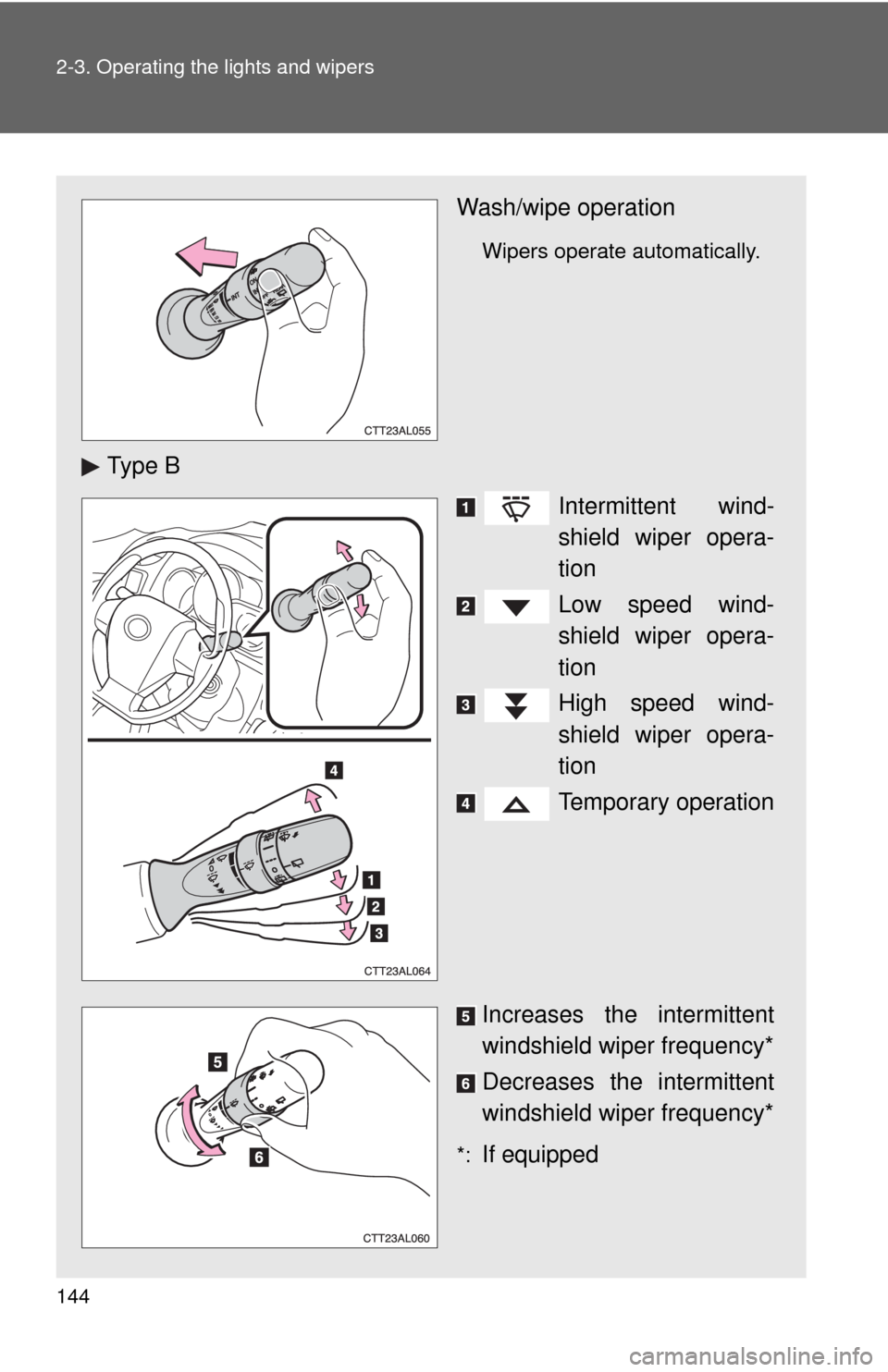
Wash/wipe operation
Wipers operate automatically.
Ty p e B
Intermittent wind-
shield wiper opera-
tion
Low speed wind-
shield wiper opera-
tion
High speed wind-
shield wiper opera-
tion
Temporary operation
Increases the intermittent
windshield wiper frequency*
Decreases the intermittent
windshield wiper frequency*
*:If equipped
Page 145 of 500
145 2-3. Operating the lights and wipers
2
When driving
■The windshield wipers and washers can be operated when
The engine switch is in the “ON” position.
■If no windshield washer fluid sprays
Check that the washer nozzles are not blocked and if there is washer fluid in
the windshield washer fluid reservoir.
NOTICE
■When the windshield is dry
Do not use the wipers, as they may damage the windshield.
■When there is no washer fluid spray from the nozzle
Damage to the washer fluid pump may be caused if the lever is pulled
toward you and held continually.
■When a nozzle becomes blocked
Do not try to clear it with a pin or other object. The nozzle will be damaged.
Wash/wipe operation
Wipers operate automatically.
Page 146 of 500
146
2-3. Operating the lights and wipers
Rear window wiper and washer
: If equipped
Ty p e A
Intermittent window
wiper operation
Normal window
wiper operation
Washer/wiper dual
operation
Wiper operates automatically.
Washer/wiper dual
operation
Wiper operates automatically.
Page 147 of 500
147 2-3. Operating the lights and wipers
2
When driving
■The rear window wiper and washer can be operated when
The engine switch is in “ON”.
NOTICE
■When the rear window is dry
Do not use the wipers, as they may damage the rear window.
■When there is no washer fluid spray from the nozzle
Damage to the washer fluid pump may be caused if the lever is pulled
toward you and held continually.
■When a nozzle becomes blocked
Do not try to clear it with a pin or other object. The nozzle will be damaged.
Ty p e B
Intermittent window
wiper operation
Normal window
wiper operation
Washer/wiper dual
operation
Wiper operates automatically.
Washer/wiper dual
operation
Wiper operates automatically.
Page 151 of 500

151 2-4. Using other driving systems
2
When driving
■Automatic cruise control cancelation
Cruise control will stop maintaining the vehicle speed in any of the following
situations.
●Actual vehicle speed falls more than approximately 10 mph (16 km/h)
below the preset vehicle speed.
At this time, the memorized set speed is not retained.
●Actual vehicle speed is below approximately 25 mph (40 km/h).
●VSC is activated.
■If the cruise control indicator light flashes
Press the “ON-OFF” button once to deactivate the system, and then press
the button again to reactivate the system.
If the cruise control speed cannot be set or if the cruise control cancels
immediately after being activated, there may be a malfunction in the cruise
control system. Have the vehicle inspected by your Toyota dealer.
CAUTION
■To avoid operating the cruise control by mistake
Switch the cruise control off using the “ON-OFF” button when not in use.
■Situations unsuitable for cruise control
Do not use cruise control in any of the following situations.
Doing so may result in loss of control and could cause an accident resulting
in death or serious injury.
●In heavy traffic
●On roads with sharp bends
●On winding roads
●On slippery roads, such as those covered with rain, ice or snow
●On steep hills
Vehicle speed may exceed the set speed when driving down a steep hill.
●When your vehicle is towing a trailer or during emergency towing
Page 153 of 500
153 2-4. Using other driving systems
2
When driving
When VSC and TRAC are operating
If the vehicle is in danger of slip-
ping or the front wheels (2WD),
or 4 wheels (AWD) spin, the indi-
cator flashes to indicate that
VSC/TRAC have been engaged.
To disable TRAC and/or VSC
If the vehicle gets stuck in fresh snow or mud, TRAC and VSC may
reduce power from the engine to the wheels. You may need to turn
the system off to enable you to rock the vehicle in order to free it.
■Turning off TRAC
Quickly push and release the
switch to turn off TRAC.
The “TRAC OFF” indicator light
should come on.
Push the switch again to turn the
system back on.
Page 154 of 500

154 2-4. Using other driving systems
■Turning off TRAC and VSC
Push and hold the switch while
the vehicle is stopped to turn off
TRAC and VSC.
The “TRAC OFF” indicator light
and VSC off indicator light should
come on.
Push the switch again to turn the
system back on.
■When the “TRAC OFF” indicator light comes on even if the VSC off
switch has not been pressed
TRAC cannot be operated. Contact your Toyota dealer.
■Automatic reactivation of TRAC and VSC
Turning the engine switch OFF after turning off the TRAC and VSC systems
will automatically re-enable them.
■Automatic TRAC reactivation
If only the TRAC system is turned off, the TRAC system will turn on when
vehicle speed increases.
■Automatic TRAC and VSC reactivation
If the TRAC and VSC systems are turned off, the systems will not turn on
even when vehicle speed increases.
■Sounds and vibrations caused by ABS, brake assist, VSC and TRAC
●A sound may be heard from the engine compartment when the engine is
started or just after the vehicle begins to move. This sound does not indi-
cate that a malfunction has occurred in any of these systems.
●Any of the following conditions may occur when the above systems are
operating. None of these indicates that a malfunction has occurred.
• Vibrations may be felt through the vehicle body and steering.
• A motor sound may be heard after the vehicle comes to a stop.
• The brake pedal may pulsate slightly after ABS is activated.
• The brake pedal may move down slightly after ABS is activated.