Page 328 of 500

328 4-3. Do-it-yourself maintenance
CAUTION
The engine compartment contains many mechanisms and fluids that may
move suddenly, become hot, or become electrically energized. To avoid death
or serious injury observe the following precautions.
■When working on the engine compartment
●Keep hands, clothing, and tools away from the moving fan and engine
drive belt.
●Be careful not to touch the engine, radiator, exhaust manifold, etc. right
after driving as they may be hot. Oil and other fluids may also be hot.
●Do not leave anything that may burn easily, such as paper or rags, in the
engine compartment.
●Do not smoke, cause sparks or expose an open flame to fuel or the bat-
tery. Fuel and battery fumes are flammable.
●Be extremely cautious when working on the battery. It contains poisonous
and corrosive sulfuric acid.
●Take care because brake fluid can harm your hands or eyes and damage
painted surfaces.
If fluid gets on your hands or in your eyes, flush the affected area with
clean water immediately.
If you still experience discomfort, see a doctor.
■When working near the electric cooling fans or radiator grille
Be sure the engine switch is OFF. With the engine switch in the “ON” posi-
tion, the electric cooling fans may automatically start to run if the air condi-
tioning is on and/or the coolant temperature is high. (P. 342)
■Safety glasses
Wear safety glasses to prevent flying or falling material, fluid spray, etc. from
getting in the eyes.
Page 335 of 500
335
4-3. Do-it-yourself maintenance
4
Maintenance and care
Engine compar tment
1.8 L 4-cylinder (2ZR-FE) engine
Engine oil filler cap
(P. 339)
Engine oil level dipstick
(P. 337)
Brake fluid reservoir
(P. 343)
Fuse box (P. 369)Battery (P. 345)
Radiator (P. 342)
Electric cooling fan
Condenser (P. 342)
Engine coolant reservoir
(P. 341)
Washer fluid tank (P. 347)
Page 336 of 500
336 4-3. Do-it-yourself maintenance
2.4 L 4-cylinder (2AZ-FE) engine
Engine coolant reservoir
(P. 341)
Engine oil filler cap
(P. 339)
Engine oil level dipstick
(P. 337)
Brake fluid reservoir
(P. 343)Fuse box (P. 369)
Battery (P. 345)
Radiator (P. 342)
Electric cooling fans
Condenser (P. 342)
Washer fluid tank (P. 347)
Page 337 of 500
337 4-3. Do-it-yourself maintenance
4
Maintenance and care
Engine oil
With the engine at operating temperature and turned off, check the oil
level on the dipstick.
■Checking the engine oil
Park the vehicle on level ground. After warming up the engine
and turning it off, wait more than 5 minutes for the oil to drain
back into the bottom of the engine.
Hold a rag under the end and
pull the dipstick out.
Wipe the dipstick clean.
1.8 L 4-cylinder (2ZR-FE) engine with flat dipstick and 2.4 L 4-cyl-
inder (2AZ-FE) engine
Reinsert the dipstick fully.
1.8 L 4-cylinder (2ZR-FE) engine with non-flat dipstick
Reinsert the non-flat dipstick fully
with its protruding areas ( in
the illustration) pointing towards
the engine.
Holding a rag under the end, pull the dipstick out and check
the oil level.
Wipe the dipstick and reinsert it fully.
STEP1
STEP2
STEP3
STEP4
STEP4
STEP5
STEP6
Page 339 of 500

339 4-3. Do-it-yourself maintenance
4
Maintenance and care
■Adding engine oil
If the oil level is below or near
the low level mark, add engine
oil of the same type as already in
the engine.
Make sure to check the oil type and prepare the items needed before
adding oil.
Remove the oil filler cap.
Add engine oil slowly, checking the dipstick.
Install the filler cap, turning it clockwise.
Engine oil selectionP. 443
Oil quantity
(Low Full)1.8 L 4-cylinder (2ZR-FE) engine
1.6 qt. (1.5 L, 1.3 Imp. qt.)
2.4 L 4-cylinder (2AZ-FE) engine
1.1 qt. (1.0 L, 0.9 Imp. qt.)
Items Clean funnel
■Engine oil consumption
A certain amount of engine oil will be consumed while driving. In the follow-
ing situations, oil consumption may increase, and engine oil may need to be
refilled in between oil maintenance intervals.
●When the engine is new, for example directly after purchasing the vehicle
or after replacing the engine
●If low quality oil or oil of an inappropriate viscosity is used
●2.4L 4-cylinder (2AZ-FE) engine: When driving at high engine speeds or
with a heavy load, when towing, or when driving while accelerating or
decelerating frequently
STEP1
STEP2
STEP3
Page 340 of 500

340 4-3. Do-it-yourself maintenance
●1.8L 4-cylinder (2ZR-FE) engine: When driving at high engine speeds or
with a heavy load, or when driving while accelerating or decelerating fre-
quently
●When leaving the engine idling for a long time, or when driving frequently
through heavy traffic
CAUTION
■Used engine oil
●Used engine oil contains potentially harmful contaminants which may
cause skin disorders such as inflammation or skin cancer, so care should
be taken to avoid prolonged and repeated contact. To remove used engine
oil from your skin, wash thoroughly with soap and water.
●Dispose of used oil and filters only in a safe and acceptable manner. Do
not dispose of used oil and filters in household trash, in sewers or onto the
ground. Call your Toyota dealer, service station or auto parts store for
information concerning recycling or disposal.
●Do not leave used engine oil within the reach of children.
NOTICE
■To prevent serious engine damage
Check the oil level on a regular basis.
■When replacing the engine oil
●Be careful not to spill engine oil on the vehicle components.
●Avoid overfilling, as the engine could be damaged.
●Check the oil level on the dipstick every time you refill the vehicle.
●Be sure the engine oil filler cap is properly tightened.
Page 363 of 500

363 4-3. Do-it-yourself maintenance
4
Maintenance and care
■When replacing wheels
The wheels of your Toyota, except for the compact spare tire, are
equipped with tire pressure warning valves and transmitters that allow
the tire pressure warning system to provide advanced warning in the
event of a loss in tire inflation pressure. Whenever wheels are replaced,
the tire pressure warning valves and transmitters must be installed.
(P. 350)
CAUTION
■When replacing wheels
●Do not use wheels that are a different size from those recommended in
the Owner’s Manual, as this may result in loss of handling control.
●Never use an inner tube in a leaking wheel which is designed for a
tubeless tire. Doing so may result in an accident, causing serious
injury or death.
■When installing the wheel nuts
●Never use oil or grease on the wheel bolts or wheel nuts.
Oil and grease may cause the wheel nuts to be excessively tightened,
leading to bolt or disc wheel damage. In addition, the oil or grease can
cause the wheel nuts to loosen and the wheel may fall off, causing an
accident and resulting in death or serious injury. Remove any oil or
grease from the wheel bolts or wheel nuts.
●Be sure to install the wheel nuts with
the tapered end facing inward. Install-
ing the nuts with the tapered end fac-
ing outward can cause wheel to
break and eventually cause a wheel
to come off while driving, which could
lead to an accident resulting in death
or serious injury.
Tapered
portion
Page 398 of 500
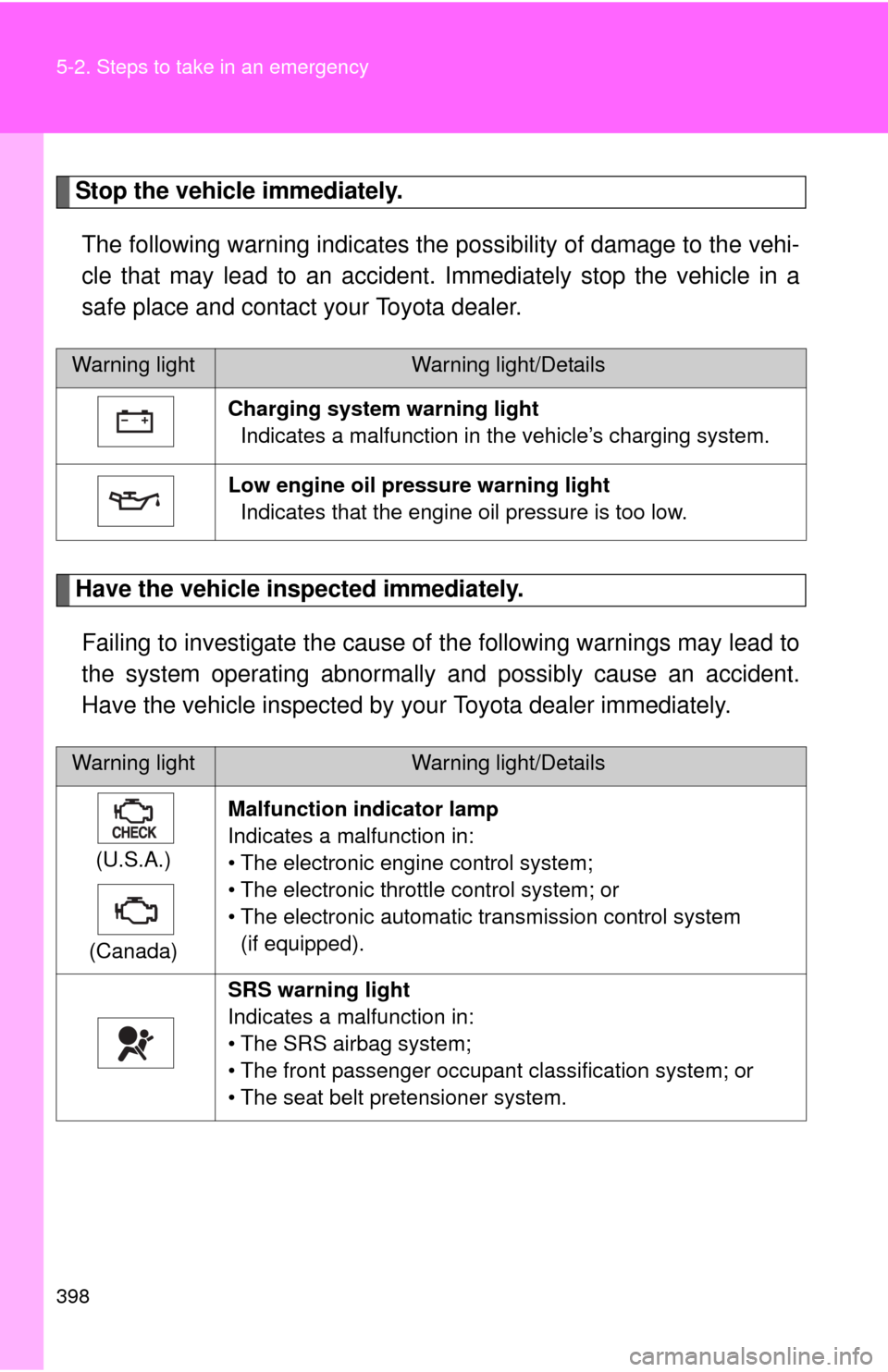
398 5-2. Steps to take in an emergency
Stop the vehicle immediately.
The following warning indicates the possibility of damage to the vehi-
cle that may lead to an accident. Immediately stop the vehicle in a
safe place and contact your Toyota dealer.
Have the vehicle inspected immediately.
Failing to investigate the cause of the following warnings may lead to
the system operating abnormally and possibly cause an accident.
Have the vehicle inspected by your Toyota dealer immediately.
Warning lightWarning light/Details
Charging system warning light
Indicates a malfunction in the vehicle’s charging system.
Low engine oil pressure warning light
Indicates that the engine oil pressure is too low.
Warning lightWarning light/Details
(U.S.A.)
(Canada)Malfunction indicator lamp
Indicates a malfunction in:
• The electronic engine control system;
• The electronic throttle control system; or
• The electronic automatic transmission control system
(if equipped).
SRS warning light
Indicates a malfunction in:
• The SRS airbag system;
• The front passenger occupant classification system; or
• The seat belt pretensioner system.


