Page 117 of 720
117 1-7. Safety information
1
Before driving
LC200_OM_OM60F57U_(U)
■SRS airbag deployment conditions (SRS front airbags)
●The SRS front airbag will deploy in the event of an impact that exceeds
the set threshold level (the level of force corresponding to an approxi-
mately 12 - 18 mph [20 - 30 km/h] frontal collision with a fixed wall that
does not move or deform).
However, this threshold velocity will be considerably higher in the following
situations:
• If the vehicle strikes an object, such as a parked vehicle or sign pole,
which can move or deform on impact
• If the vehicle is involved in an underride collision, such as a collision in
which the front of the vehicle “underrides”, or goes under, the bed of a
truck
●Depending on the type of collision, it is possible that only the seat belt
pretensioners will activate.
●The SRS front airbags for the front passenger will not activate if there is
not passenger sitting in the front passenger seat. However, the front air-
bags for the front passenger may deploy if luggage is put in the seat,
even if the seat is unoccupied.
■SRS airbag deployment conditions (SRS side airbags and SRS curtain
shield airbags)
●The SRS side airbags and SRS curtain shield airbags will deploy in the
event of an impact that exceeds the set threshold level (the level of force
corresponding to the impact force produced by an approximately 3300 lb.
[1500 kg] vehicle colliding with the vehicle cabin from a direction perpen-
dicular to the vehicle orientation at an approximate speed of 12 - 18 mph
[20 - 30 km/h]).
●The SRS curtain shield airbags will deploy in the event of vehicle rollover.
Page 118 of 720
118 1-7. Safety information
LC200_OM_OM60F57U_(U)
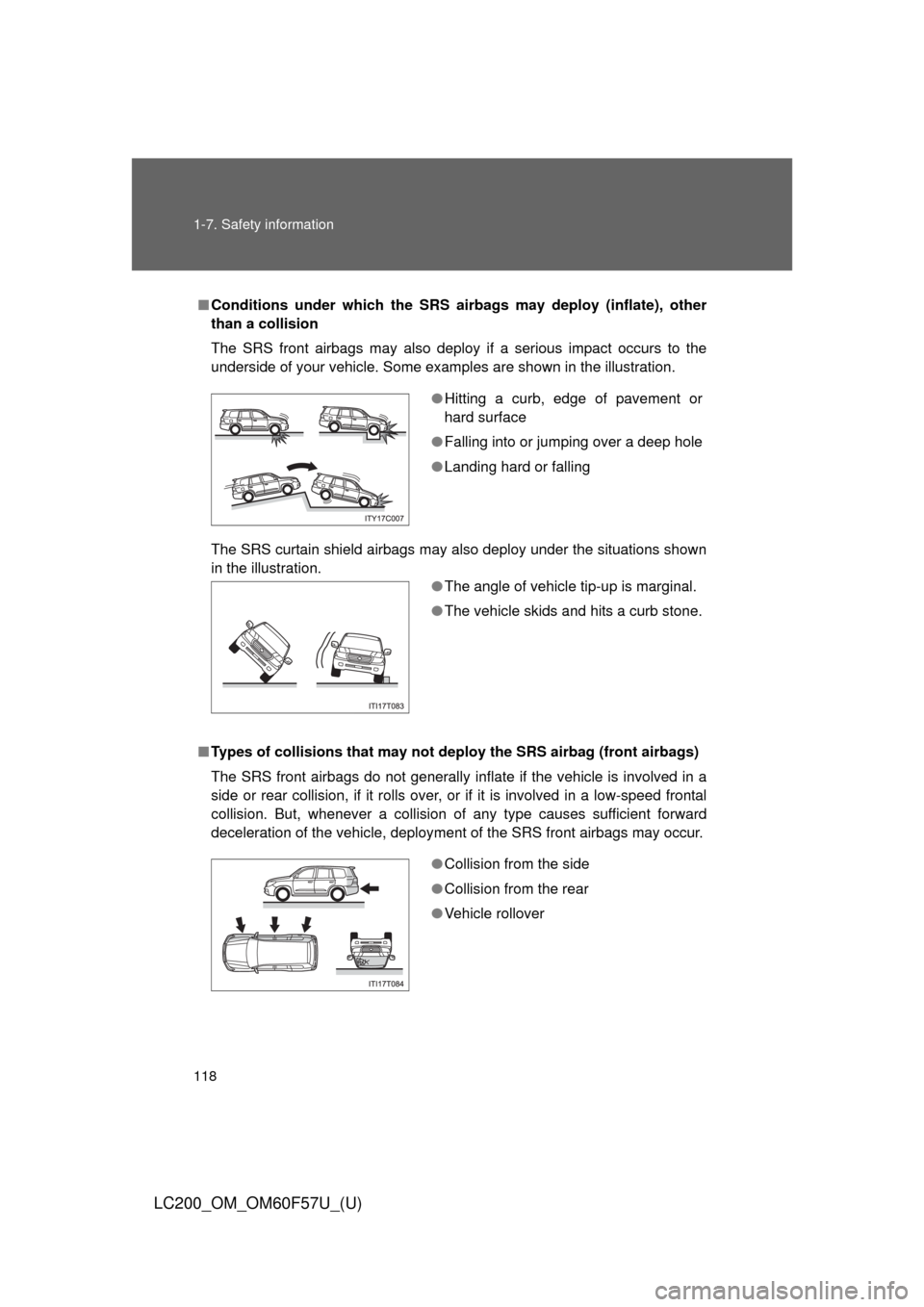
■Conditions under which the SRS airbags may deploy (inflate), other
than a collision
The SRS front airbags may also deploy if a serious impact occurs to the
underside of your vehicle. Some examples are shown in the illustration.
The SRS curtain shield airbags may also deploy under the situations shown
in the illustration.
■Types of collisions that may not deploy the SRS airbag (front airbags)
The SRS front airbags do not generally inflate if the vehicle is involved in a
side or rear collision, if it rolls over, or if it is involved in a low-speed frontal
collision. But, whenever a collision of any type causes sufficient forward
deceleration of the vehicle, deployment of the SRS front airbags may occur.
●Hitting a curb, edge of pavement or
hard surface
●Falling into or jumping over a deep hole
●Landing hard or falling
●The angle of vehicle tip-up is marginal.
●The vehicle skids and hits a curb stone.
●Collision from the side
●Collision from the rear
●Vehicle rollover
Page 128 of 720
128 1-7. Safety information
LC200_OM_OM60F57U_(U)
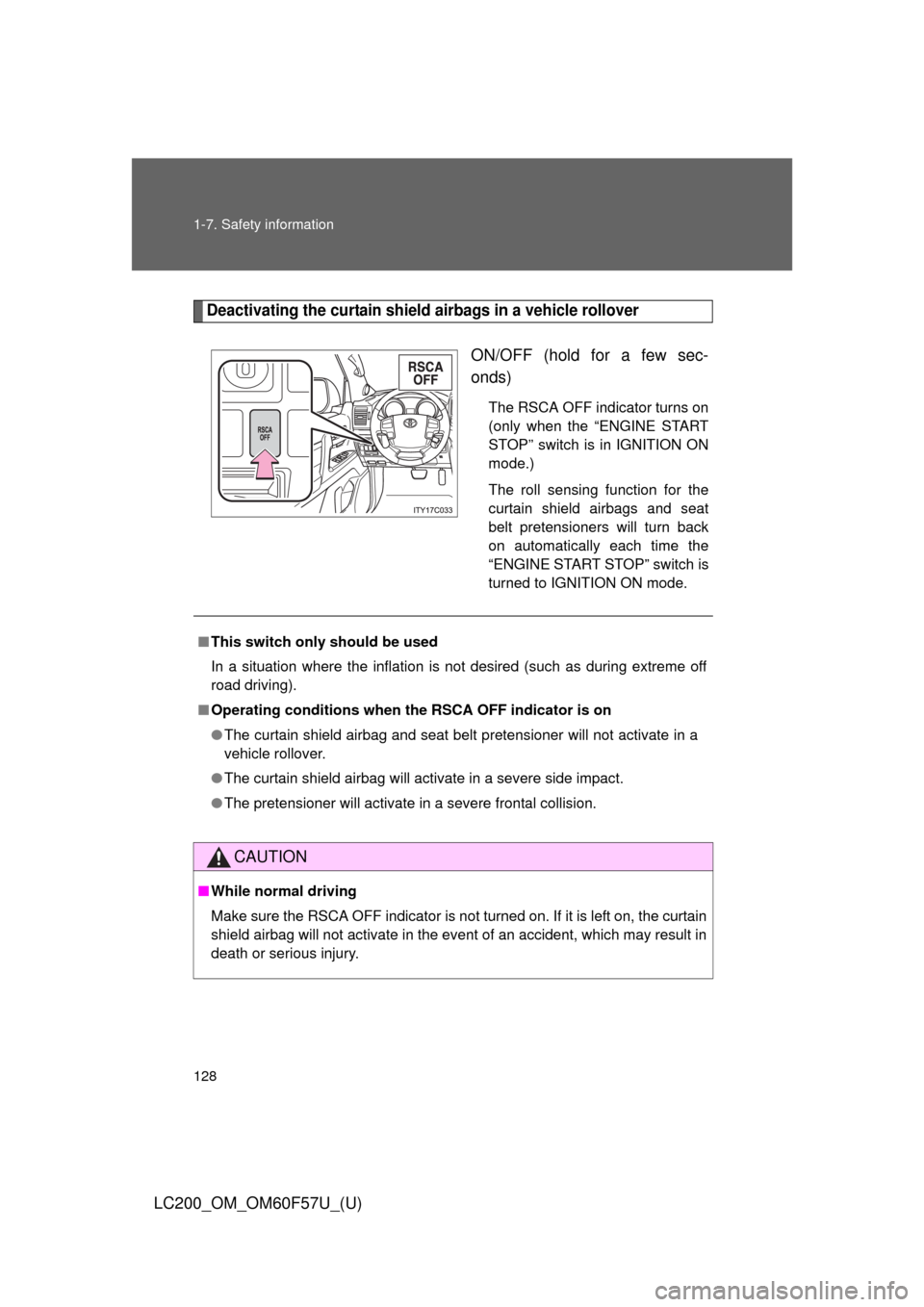
Deactivating the curtain shield airbags in a vehicle rollover
ON/OFF (hold for a few sec-
onds)
The RSCA OFF indicator turns on
(only when the “ENGINE START
STOP” switch is in IGNITION ON
mode.)
The roll sensing function for the
curtain shield airbags and seat
belt pretensioners will turn back
on automatically each time the
“ENGINE START STOP” switch is
turned to IGNITION ON mode.
■This switch only should be used
In a situation where the inflation is not desired (such as during extreme off
road driving).
■Operating conditions when the RSCA OFF indicator is on
●The curtain shield airbag and seat belt pretensioner will not activate in a
vehicle rollover.
●The curtain shield airbag will activate in a severe side impact.
●The pretensioner will activate in a severe frontal collision.
CAUTION
■While normal driving
Make sure the RSCA OFF indicator is not turned on. If it is left on, the curtain
shield airbag will not activate in the event of an accident, which may result in
death or serious injury.
Page 129 of 720
129
1
1-7. Safety information
Before driving
LC200_OM_OM60F57U_(U)
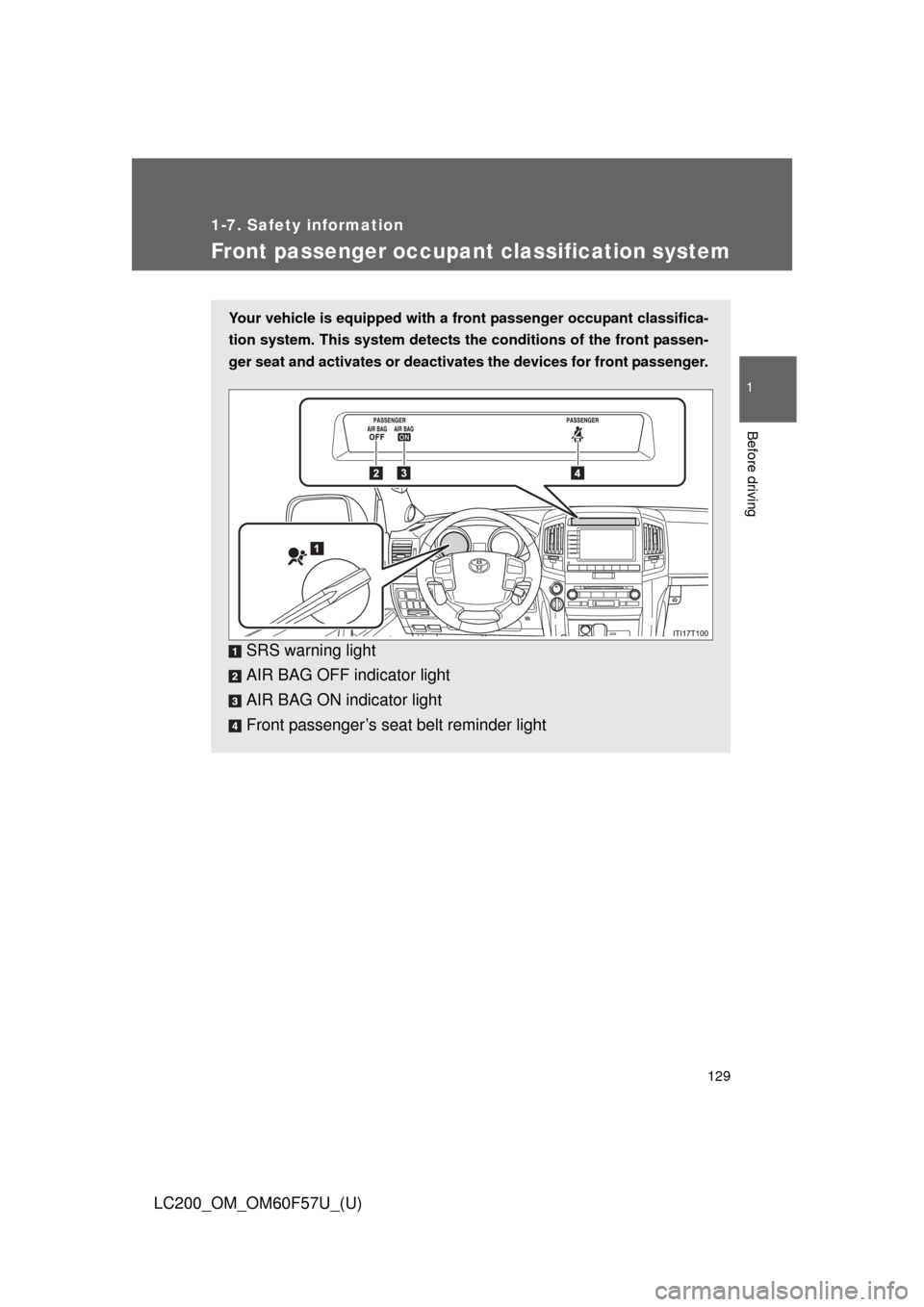
Front passenger occupant classification system
Your vehicle is equipped with a front passenger occupant classifica-
tion system. This system detects the conditions of the front passen-
ger seat and activates or deactivates the devices for front passenger.
SRS warning light
AIR BAG OFF indicator light
AIR BAG ON indicator light
Front passenger’s seat belt reminder light
Page 130 of 720
130 1-7. Safety information
LC200_OM_OM60F57U_(U)
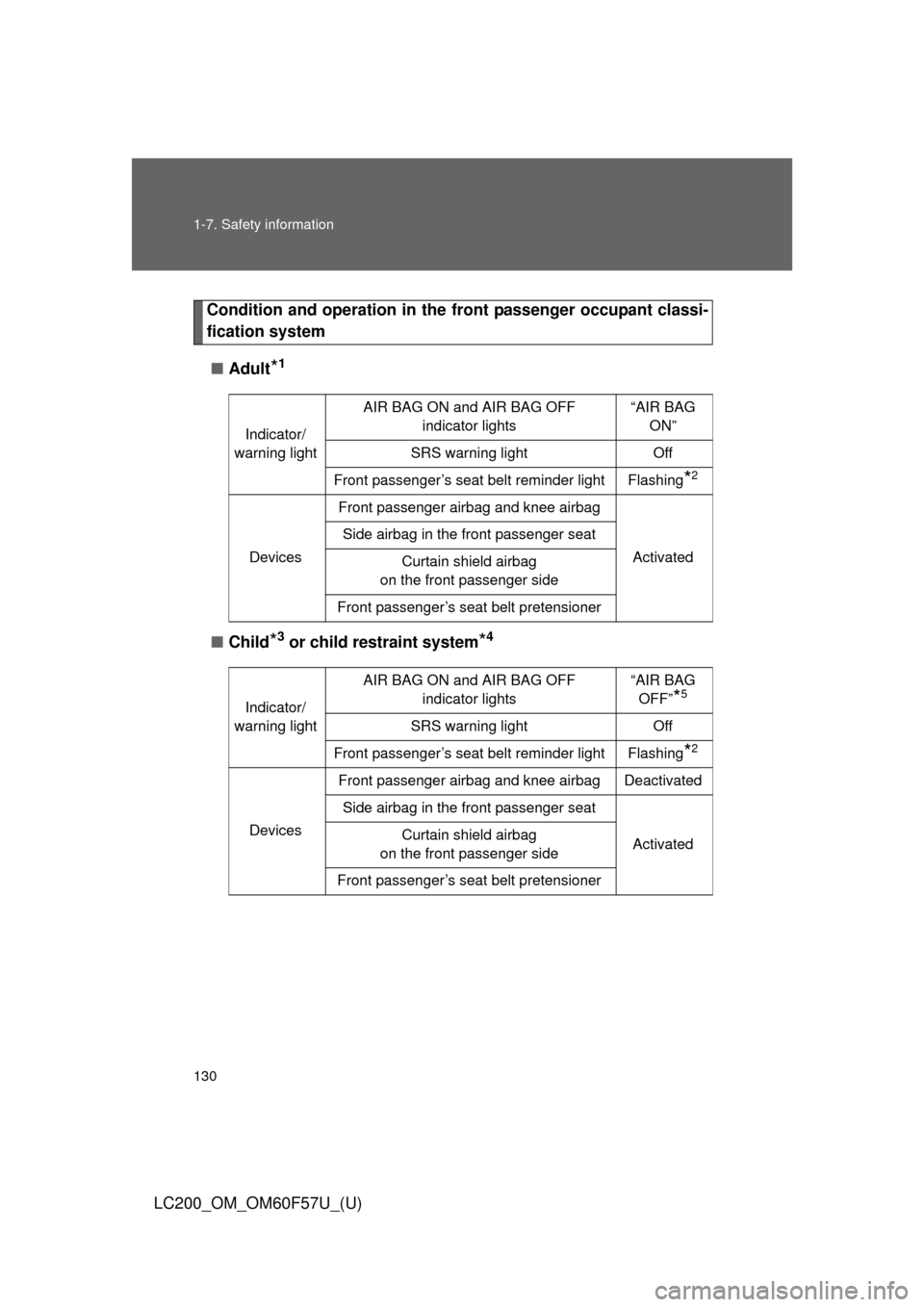
Condition and operation in the front passenger occupant classi-
fication system
■Adult
*1
■Child*3 or child restraint system*4
Indicator/
warning lightAIR BAG ON and AIR BAG OFF
indicator lights“AIR BAG
ON”
SRS warning light Off
Front passenger’s seat belt reminder light Flashing
*2
DevicesFront passenger airbag and knee airbag
Activated Side airbag in the front passenger seat
Curtain shield airbag
on the front passenger side
Front passenger’s seat belt pretensioner
Indicator/
warning lightAIR BAG ON and AIR BAG OFF
indicator lights“AIR BAG
OFF”*5
SRS warning light Off
Front passenger’s seat belt reminder light Flashing
*2
DevicesFront passenger airbag and knee airbag Deactivated
Side airbag in the front passenger seat
Activated Curtain shield airbag
on the front passenger side
Front passenger’s seat belt pretensioner
Page 237 of 720
237 2-4. Using other driving systems
2
When driving
LC200_OM_OM60F57U_(U)
■Sensor detection information
●The sensor’s detection areas are limited to the areas around the vehi-
cle’s front corner and rear bumpers.
●Certain vehicle conditions and the surrounding environment may affect
the ability of the sensor to correctly detect obstacles. Particular instances
where this may occur are listed below.
• There is dirt, snow or ice on the sensor. (Wiping the sensors will
resolve this problem.)
• The sensor is frozen. (Thawing the area will resolve this problem.)
In especially cold weather, if a sensor is frozen the screen may show
an abnormal display, or obstacles may not be detected.
• The sensor is covered in any way.
• The vehicle is leaning considerably to one side.
• On an extremely bumpy road, on an incline, on gravel, or on grass
• The vicinity of the vehicle is noisy due to vehicle horns, motorcycle
engines, air brakes of large vehicles, or other loud noises producing
ultrasonic waves.
• There is another vehicle equipped with parking assist sensors in the
vicinity.
• The sensor is coated with a sheet of spray or heavy rain.
• The vehicle is equipped with a fender pole or wireless antenna.
• Towing eyelets are installed.
• The bumper or sensor receives a strong impact.
• The vehicle is approaching a tall or curved curb.
• In harsh sunlight or intense cold weather
• The area directly under the bumpers is not detected.
• If obstacles draw too close to the sensor.
• A non-genuine Toyota suspension (lowered suspension etc.) is
installed.
• People may not be detected if they are wearing certain types of cloth-
ing.
In addition to the examples above, there are instances in which, because
of their shape, signs and other objects may be judged by the sensor to be
closer than they are.
Page 238 of 720
238 2-4. Using other driving systems
LC200_OM_OM60F57U_(U)
●The shape of the obstacle may prevent the sensor from detecting it. Pay
particular attention to the following obstacles:
• Wires, fences, ropes, etc.
• Cotton, snow and other materials that absorb sound waves
• Sharply-angled objects
• Low obstacles
• Tall obstacles with upper sections projecting outwards in the direction
of your vehicle
●The following situations may occur during use.
• Depending on the shape of the obstacle and other factors, the detec-
tion distance may shorten, or detection may be impossible.
• Obstacles may not be detected if they are too close to the sensor
• There will be a short delay between obstacle detection and display.
Even at slow speeds, there is a possibility that the obstacle will come
within the sensor’s detection areas before the display is shown and the
warning beep sounds.
• Thin posts or objects lower than the sensor may not be detected for
collision when approached, even if they have been detected once.
• It might be difficult to hear beeps due to the volume of audio system or
air flow noise of air conditioning system.
■If a message is displayed on the multi-information display
P. 617
Page 311 of 720
311 2-5. Driving information
2
When driving
LC200_OM_OM60F57U_(U)
■Before driving the vehicle
Perform the following according to the driving conditions.
●Do not try to forcibly open a window or move a wiper that is
frozen. Pour warm water over the frozen area to melt the ice.
Wipe away the water immediately to prevent it from freezing.
●To ensure proper operation of the climate control system fan,
remove any snow that has accumulated on the air inlet vents
in front of the windshield.
●Check for and remove any excess ice or snow that may have
accumulated on the exterior lights, vehicle’s roof, chassis,
around the tires or on the brakes.
●Remove any snow or mud from the bottom of your shoes
before getting in the vehicle.
■When driving the vehicle
Accelerate the vehicle slowly, keep a safe distance between you
and the vehicle ahead, and drive at a reduced speed suitable to
road conditions.
■When parking the vehicle
Park the vehicle and move the shift lever to “P” without setting
the parking brake. The parking brake may freeze up, preventing
it from being released. If necessary, block the wheels to prevent
inadvertent sliding or creeping.