2013 TOYOTA AURIS TOURING SPORTS inflation pressure
[x] Cancel search: inflation pressurePage 5 of 616
5
1
8 7
6
5
4
3
2
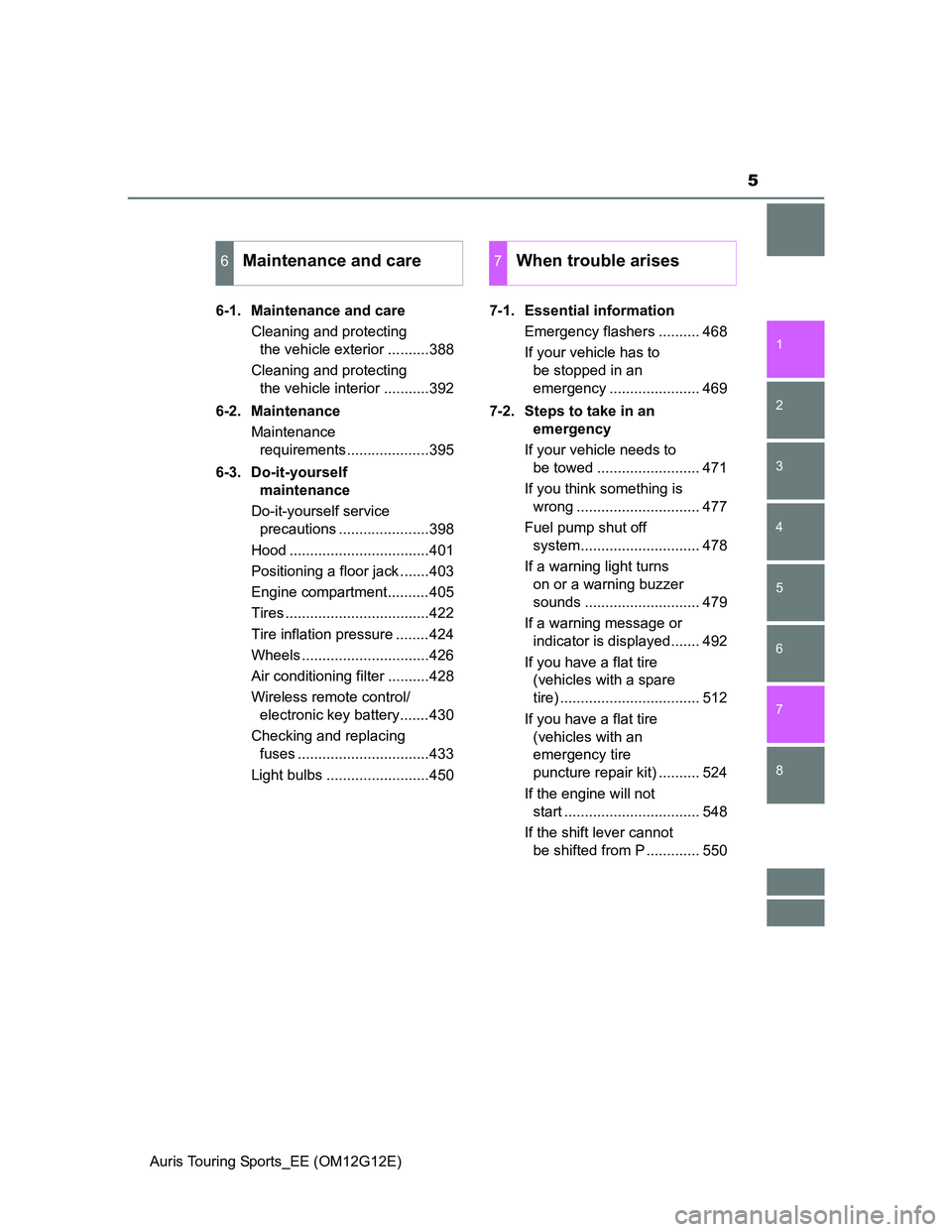
Auris Touring Sports_EE (OM12G12E)6-1. Maintenance and care
Cleaning and protecting
the vehicle exterior ..........388
Cleaning and protecting
the vehicle interior ...........392
6-2. Maintenance
Maintenance
requirements....................395
6-3. Do-it-yourself
maintenance
Do-it-yourself service
precautions ......................398
Hood ..................................401
Positioning a floor jack .......403
Engine compartment..........405
Tires ...................................422
Tire inflation pressure ........424
Wheels ...............................426
Air conditioning filter ..........428
Wireless remote control/
electronic key battery.......430
Checking and replacing
fuses ................................433
Light bulbs .........................4507-1. Essential information
Emergency flashers .......... 468
If your vehicle has to
be stopped in an
emergency ...................... 469
7-2. Steps to take in an
emergency
If your vehicle needs to
be towed ......................... 471
If you think something is
wrong .............................. 477
Fuel pump shut off
system............................. 478
If a warning light turns
on or a warning buzzer
sounds ............................ 479
If a warning message or
indicator is displayed....... 492
If you have a flat tire
(vehicles with a spare
tire) .................................. 512
If you have a flat tire
(vehicles with an
emergency tire
puncture repair kit) .......... 524
If the engine will not
start ................................. 548
If the shift lever cannot
be shifted from P ............. 550
6Maintenance and care7When trouble arises
Page 15 of 616
15Pictorial index
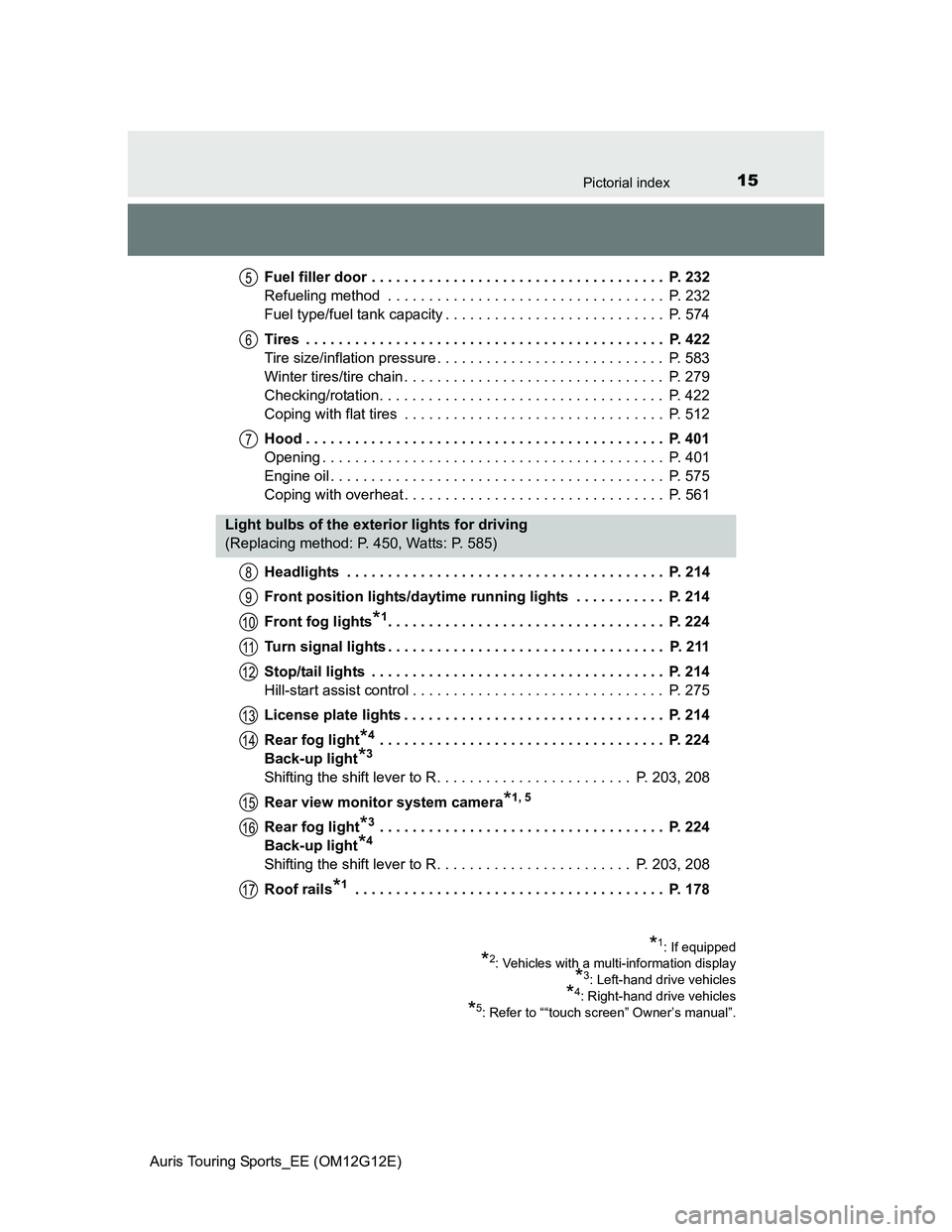
Auris Touring Sports_EE (OM12G12E)Fuel filler door . . . . . . . . . . . . . . . . . . . . . . . . . . . . . . . . . . . . P. 232
Refueling method . . . . . . . . . . . . . . . . . . . . . . . . . . . . . . . . . . P. 232
Fuel type/fuel tank capacity . . . . . . . . . . . . . . . . . . . . . . . . . . . P. 574
Tires . . . . . . . . . . . . . . . . . . . . . . . . . . . . . . . . . . . . . . . . . . . . P. 422
Tire size/inflation pressure . . . . . . . . . . . . . . . . . . . . . . . . . . . . P. 583
Winter tires/tire chain . . . . . . . . . . . . . . . . . . . . . . . . . . . . . . . . P. 279
Checking/rotation. . . . . . . . . . . . . . . . . . . . . . . . . . . . . . . . . . . P. 422
Coping with flat tires . . . . . . . . . . . . . . . . . . . . . . . . . . . . . . . . P. 512
Hood . . . . . . . . . . . . . . . . . . . . . . . . . . . . . . . . . . . . . . . . . . . . P. 401
Opening . . . . . . . . . . . . . . . . . . . . . . . . . . . . . . . . . . . . . . . . . . P. 401
Engine oil . . . . . . . . . . . . . . . . . . . . . . . . . . . . . . . . . . . . . . . . . P. 575
Coping with overheat . . . . . . . . . . . . . . . . . . . . . . . . . . . . . . . . P. 561
Headlights . . . . . . . . . . . . . . . . . . . . . . . . . . . . . . . . . . . . . . . P. 214
Front position lights/daytime running lights . . . . . . . . . . . P. 214
Front fog lights
*1. . . . . . . . . . . . . . . . . . . . . . . . . . . . . . . . . . P. 224
Turn signal lights . . . . . . . . . . . . . . . . . . . . . . . . . . . . . . . . . . P. 211
Stop/tail lights . . . . . . . . . . . . . . . . . . . . . . . . . . . . . . . . . . . . P. 214
Hill-start assist control . . . . . . . . . . . . . . . . . . . . . . . . . . . . . . . P. 275
License plate lights . . . . . . . . . . . . . . . . . . . . . . . . . . . . . . . . P. 214
Rear fog light
*4 . . . . . . . . . . . . . . . . . . . . . . . . . . . . . . . . . . . P. 224
Back-up light
*3
Shifting the shift lever to R. . . . . . . . . . . . . . . . . . . . . . . . P. 203, 208
Rear view monitor system camera
*1, 5
Rear fog light*3 . . . . . . . . . . . . . . . . . . . . . . . . . . . . . . . . . . . P. 224
Back-up light
*4
Shifting the shift lever to R. . . . . . . . . . . . . . . . . . . . . . . . P. 203, 208
Roof rails
*1 . . . . . . . . . . . . . . . . . . . . . . . . . . . . . . . . . . . . . . P. 178
5
6
7
Light bulbs of the exterior lights for driving
(Replacing method: P. 450, Watts: P. 585)
*1: If equipped
*2: Vehicles with a multi-information display
*3: Left-hand drive vehicles
*4: Right-hand drive vehicles
*5: Refer to ““touch screen” Owner’s manual”.
8
9
10
11
12
13
14
15
16
17
Page 184 of 616
1844-1. Before driving
Auris Touring Sports_EE (OM12G12E)
Tire information
Increase the tire inflation pressure to 20.0 kPa (0.2 kgf/cm
2 or bar, 3 psi)
greater than the recommended value when towing. (P. 583)
Increase the air pressure of the trailer tires in accordance with the total
trailer weight and according to the values recommended by the manufac-
turer of your trailer.
Trailer lights
Please consult at any authorized dealer or repairer, or another duly qualified
and equipped professional when installing trailer lights, as incorrect installa-
tion may cause damage to the vehicle’s lights. Please take care to comply
with your state’s laws when installing trailer lights.
Break-in schedule
Toyota recommends that vehicles fitted with new power train components
should not be used for towing trailers for the first 800 km (500 miles).
Safety checks before towing
Check that the maximum load limit for the towing hitch/bracket and hitch ball
is not exceeded. Bear in mind that the coupling weight of the trailer will add
to the load exerted on the vehicle. Also make sure that the total load exerted
on the vehicle is within the range of the weight limits. (P. 181)
Ensure that the trailer load is secure.
Supplementary outside rear view mirrors should be added to the vehicle if
the traffic behind cannot be clearly seen with standard mirrors. Adjust the
extending arms of these mirrors on both sides of the vehicle so that they
always provide maximum visibility of the road behind.
Maintenance
Maintenance must be performed more frequently when using the vehicle for
towing due to the greater weight burden placed on the vehicle compared to
normal driving.
Retighten all bolts securing the hitching ball and bracket after towing for
approximately 1000 km (600 miles).
Page 274 of 616
2744-5. Using the driving support systems
Auris Touring Sports_EE (OM12G12E)
CAUTION
Stopping distance when the ABS is operating may exceed that of nor-
mal conditions
The ABS is not designed to shorten the vehicle’s stopping distance. Always
maintain a safe distance from the vehicle in front of you, especially in the
following situations:
When driving on dirt, gravel or snow-covered roads
When driving with tire chains
When driving over bumps in the road
When driving over roads with potholes or uneven surfaces
TRC may not operate effectively when
Directional control and power may not be achievable while driving on slip-
pery road surfaces, even if the TRC system is operating.
Drive the vehicle carefully in conditions where stability and power may be
lost.
When the VSC is activated
The slip indicator light flashes. Always drive carefully. Reckless driving may
cause an accident. Exercise particular care when the indicator light flashes.
When the TRC/VSC systems are turned off
Be especially careful and drive at a speed appropriate to the road condi-
tions. As these are the systems to ensure vehicle stability and driving force,
do not turn the TRC/VSC systems off unless necessary.
Replacing tires
Make sure that all tires are of the specified size, brand, tread pattern and
total load capacity. In addition, make sure that the tires are inflated to the
recommended tire inflation pressure level.
The ABS, TRC and VSC systems will not function correctly if different tires
are installed on the vehicle.
Contact any authorized Toyota dealer or repairer, or another duly qualified
and equipped professional for further information when replacing tires or
wheels.
Handling of tires and the suspension
Using tires with any kind of problem or modifying the suspension will affect
the driving assist systems, and may cause a system to malfunction.
Page 387 of 616
387
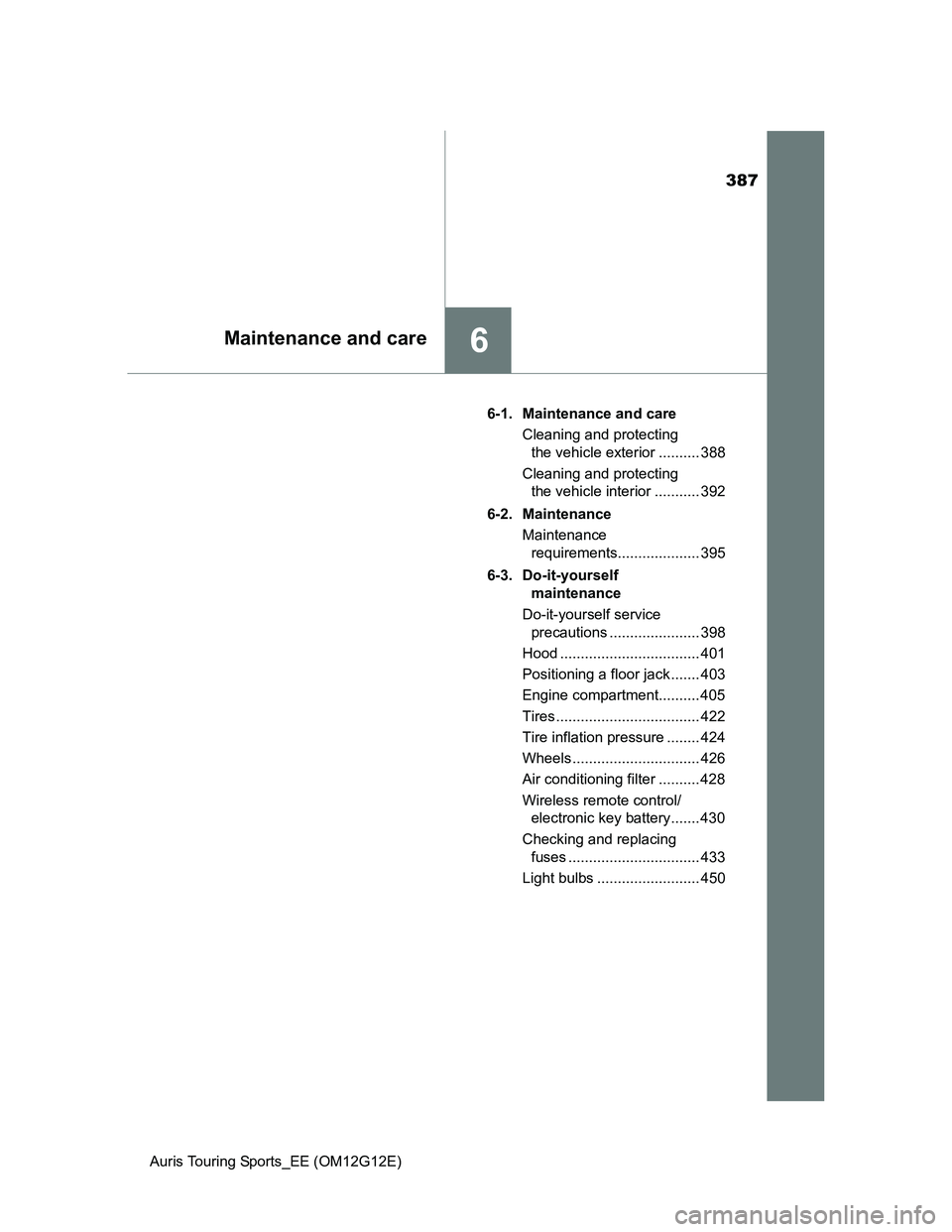
6Maintenance and care
Auris Touring Sports_EE (OM12G12E)6-1. Maintenance and care
Cleaning and protecting
the vehicle exterior .......... 388
Cleaning and protecting
the vehicle interior ........... 392
6-2. Maintenance
Maintenance
requirements.................... 395
6-3. Do-it-yourself
maintenance
Do-it-yourself service
precautions ...................... 398
Hood .................................. 401
Positioning a floor jack ....... 403
Engine compartment.......... 405
Tires ................................... 422
Tire inflation pressure ........ 424
Wheels ............................... 426
Air conditioning filter .......... 428
Wireless remote control/
electronic key battery....... 430
Checking and replacing
fuses ................................ 433
Light bulbs ......................... 450
Page 398 of 616
398
Auris Touring Sports_EE (OM12G12E)
6-3. Do-it-yourself maintenance
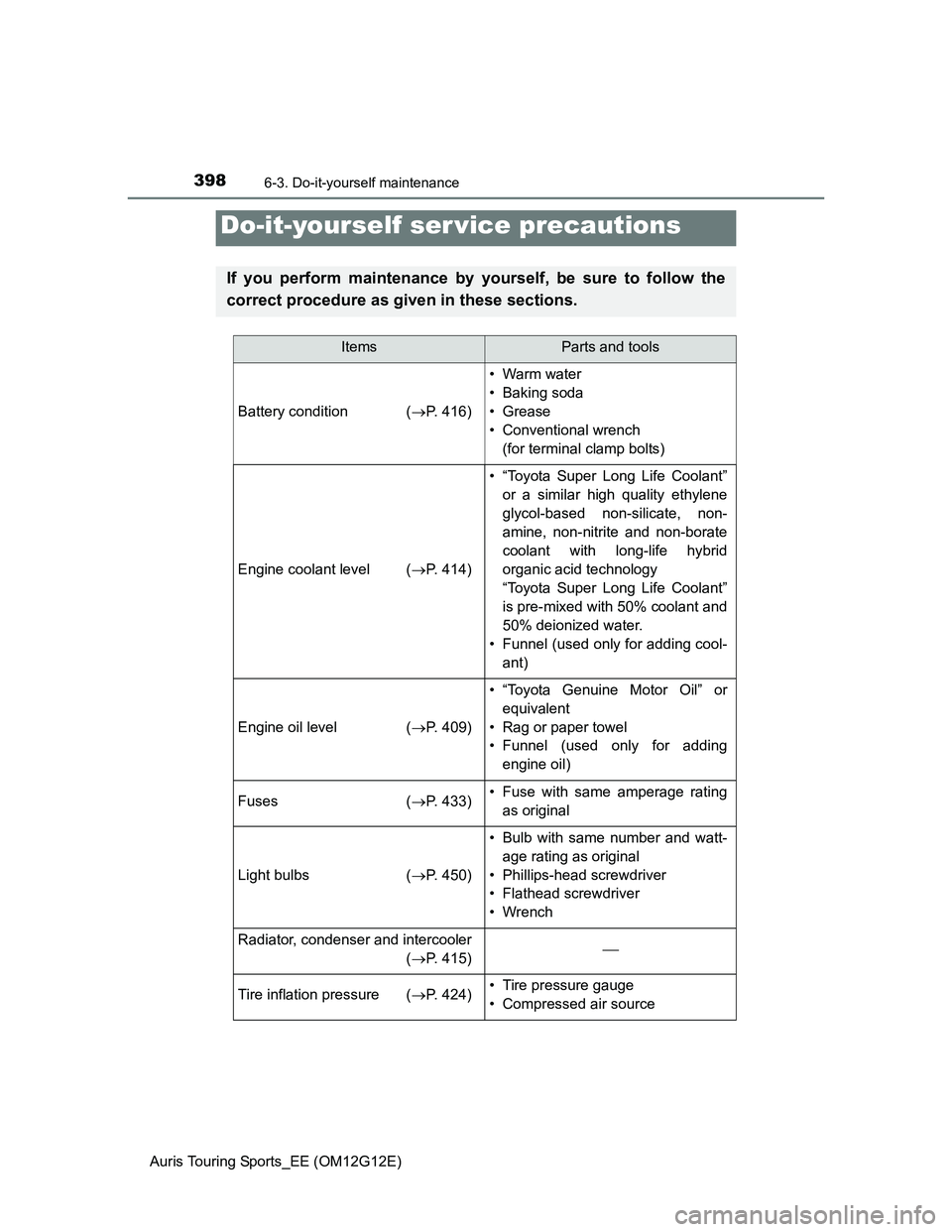
Do-it-yourself ser vice precautions
If you perform maintenance by yourself, be sure to follow the
correct procedure as given in these sections.
ItemsParts and tools
Battery condition (P. 416)
•Warm water
• Baking soda
• Grease
• Conventional wrench
(for terminal clamp bolts)
Engine coolant level (P. 414)
• “Toyota Super Long Life Coolant”
or a similar high quality ethylene
glycol-based non-silicate, non-
amine, non-nitrite and non-borate
coolant with long-life hybrid
organic acid technology
“Toyota Super Long Life Coolant”
is pre-mixed with 50% coolant and
50% deionized water.
• Funnel (used only for adding cool-
ant)
Engine oil level (P. 409)
• “Toyota Genuine Motor Oil” or
equivalent
• Rag or paper towel
• Funnel (used only for adding
engine oil)
Fuses (P. 433)• Fuse with same amperage rating
as original
Light bulbs (P. 450)
• Bulb with same number and watt-
age rating as original
• Phillips-head screwdriver
• Flathead screwdriver
•Wrench
Radiator, condenser and intercooler
(P. 415)
Tire inflation pressure (P. 424)• Tire pressure gauge
• Compressed air source
Page 423 of 616
4236-3. Do-it-yourself maintenance
Auris Touring Sports_EE (OM12G12E)
6
Maintenance and care
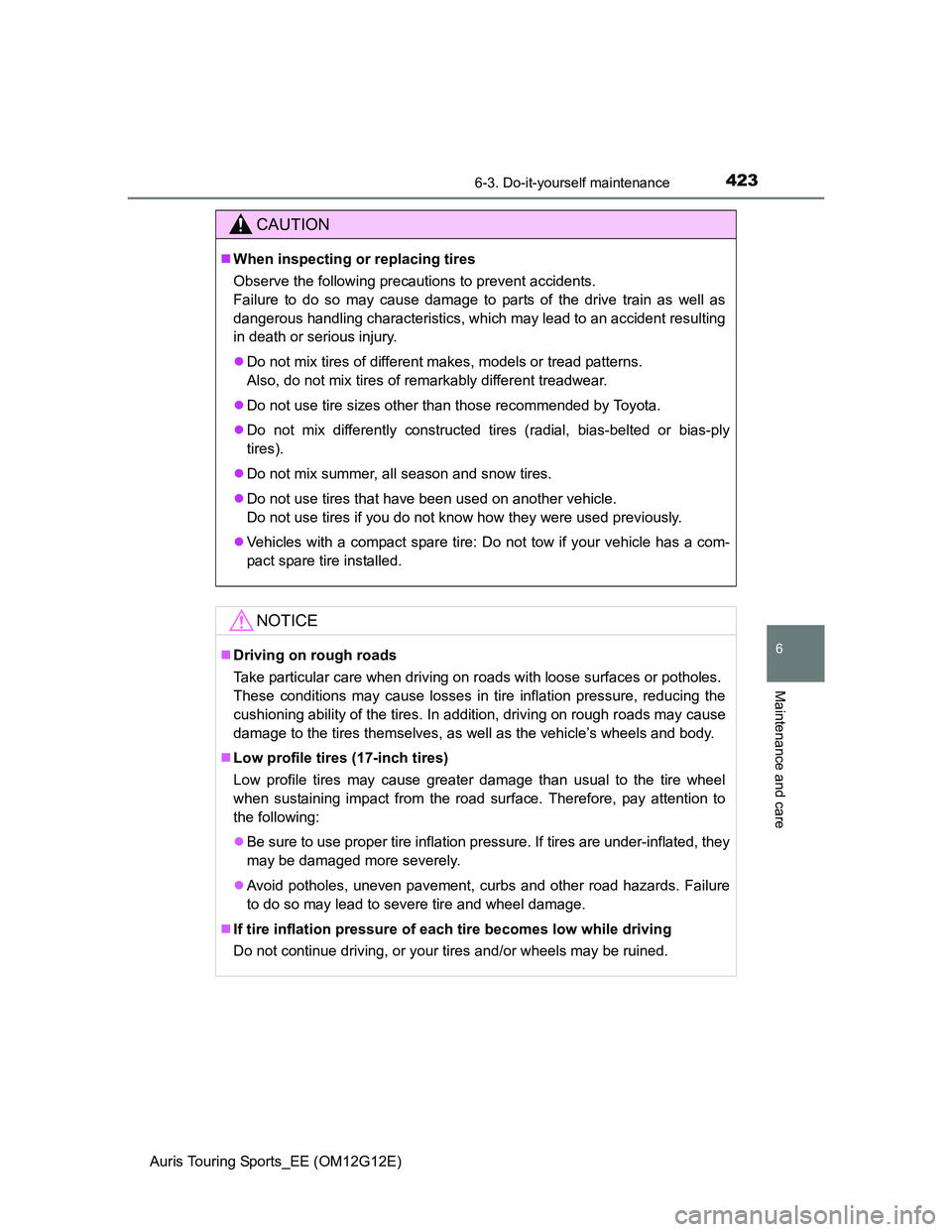
CAUTION
When inspecting or replacing tires
Observe the following precautions to prevent accidents.
Failure to do so may cause damage to parts of the drive train as well as
dangerous handling characteristics, which may lead to an accident resulting
in death or serious injury.
Do not mix tires of different makes, models or tread patterns.
Also, do not mix tires of remarkably different treadwear.
Do not use tire sizes other than those recommended by Toyota.
Do not mix differently constructed tires (radial, bias-belted or bias-ply
tires).
Do not mix summer, all season and snow tires.
Do not use tires that have been used on another vehicle.
Do not use tires if you do not know how they were used previously.
Vehicles with a compact spare tire: Do not tow if your vehicle has a com-
pact spare tire installed.
NOTICE
Driving on rough roads
Take particular care when driving on roads with loose surfaces or potholes.
These conditions may cause losses in tire inflation pressure, reducing the
cushioning ability of the tires. In addition, driving on rough roads may cause
damage to the tires themselves, as well as the vehicle’s wheels and body.
Low profile tires (17-inch tires)
Low profile tires may cause greater damage than usual to the tire wheel
when sustaining impact from the road surface. Therefore, pay attention to
the following:
Be sure to use proper tire inflation pressure. If tires are under-inflated, they
may be damaged more severely.
Avoid potholes, uneven pavement, curbs and other road hazards. Failure
to do so may lead to severe tire and wheel damage.
If tire inflation pressure of each tire becomes low while driving
Do not continue driving, or your tires and/or wheels may be ruined.
Page 424 of 616
4246-3. Do-it-yourself maintenance
Auris Touring Sports_EE (OM12G12E)
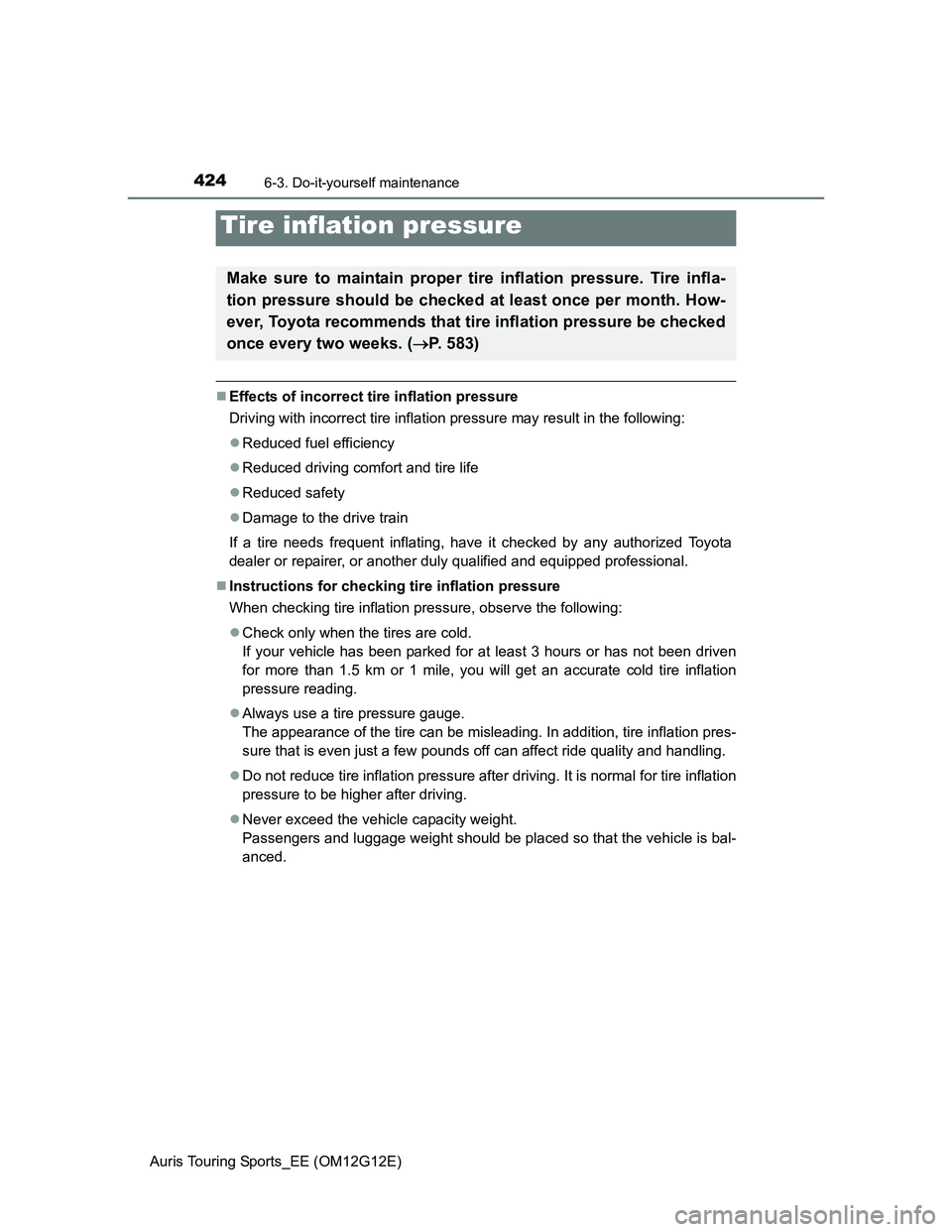
Effects of incorrect tire inflation pressure
Driving with incorrect tire inflation pressure may result in the following:
Reduced fuel efficiency
Reduced driving comfort and tire life
Reduced safety
Damage to the drive train
If a tire needs frequent inflating, have it checked by any authorized Toyota
dealer or repairer, or another duly qualified and equipped professional.
Instructions for checking tire inflation pressure
When checking tire inflation pressure, observe the following:
Check only when the tires are cold.
If your vehicle has been parked for at least 3 hours or has not been driven
for more than 1.5 km or 1 mile, you will get an accurate cold tire inflation
pressure reading.
Always use a tire pressure gauge.
The appearance of the tire can be misleading. In addition, tire inflation pres-
sure that is even just a few pounds off can affect ride quality and handling.
Do not reduce tire inflation pressure after driving. It is normal for tire inflation
pressure to be higher after driving.
Never exceed the vehicle capacity weight.
Passengers and luggage weight should be placed so that the vehicle is bal-
anced.
Tire inflation pressure
Make sure to maintain proper tire inflation pressure. Tire infla-
tion pressure should be checked at least once per month. How-
ever, Toyota recommends that tire inflation pressure be checked
once every two weeks. (P. 583)