2013 SUZUKI ERTIGA warning
[x] Cancel search: warningPage 139 of 207
Downloaded from www.Manualslib.com manuals search engine 5-44
OTHER CONTROLS AND EQUIPMENT
60MK0-14E
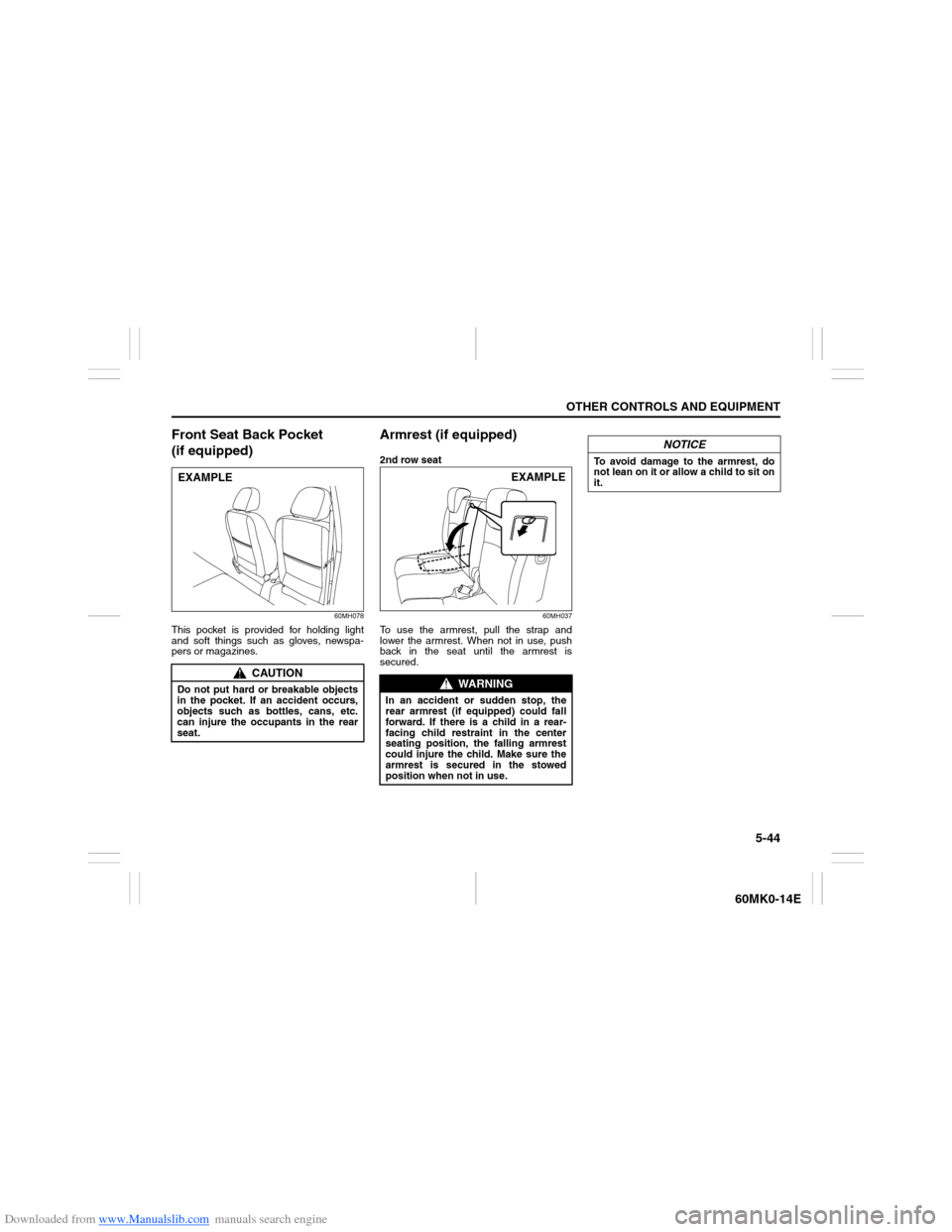
Front Seat Back Pocket
(if equipped)
60MH078
This pocket is provided for holding light
and soft things such as gloves, newspa-
pers or magazines.
Armrest (if equipped)2nd row seat
60MH037
To use the armrest, pull the strap and
lower the armrest. When not in use, push
back in the seat until the armrest is
secured.
CAUTION
Do not put hard or breakable objects
in the pocket. If an accident occurs,
objects such as bottles, cans, etc.
can injure the occupants in the rear
seat.EXAMPLE
WARNING
In an accident or sudden stop, the
rear armrest (if equipped) could fall
forward. If there is a child in a rear-
facing child restraint in the center
seating position, the falling armrest
could injure the child. Make sure the
armrest is secured in the stowed
position when not in use.
EXAMPLE
NOTICE
To avoid damage to the armrest, do
not lean on it or allow a child to sit on
it.
Page 140 of 207
Downloaded from www.Manualslib.com manuals search engine 5-45OTHER CONTROLS AND EQUIPMENT
60MK0-14E
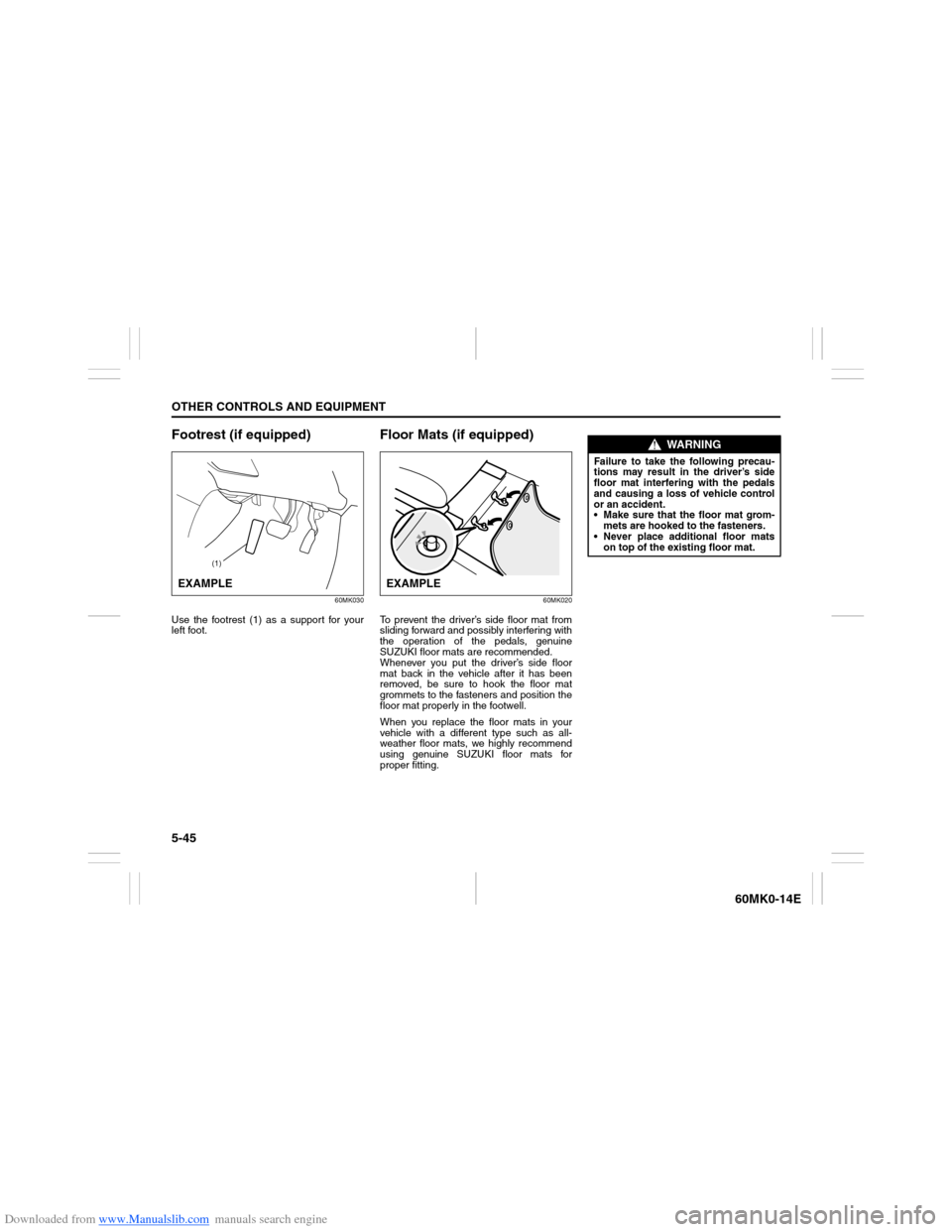
Footrest (if equipped)
60MK030
Use the footrest (1) as a support for your
left foot.
Floor Mats (if equipped)
60MK020
To prevent the driver’s side floor mat from
sliding forward and possibly interfering with
the operation of the pedals, genuine
SUZUKI floor mats are recommended.
Whenever you put the driver’s side floor
mat back in the vehicle after it has been
removed, be sure to hook the floor mat
grommets to the fasteners and position the
floor mat properly in the footwell.
When you replace the floor mats in your
vehicle with a different type such as all-
weather floor mats, we highly recommend
using genuine SUZUKI floor mats for
proper fitting.
(1)
EXAMPLE
EXAMPLE
WARNING
Failure to take the following precau-
tions may result in the driver’s side
floor mat interfering with the pedals
and causing a loss of vehicle control
or an accident.
Make sure that the floor mat grom-
mets are hooked to the fasteners.
Never place additional floor mats
on top of the existing floor mat.
Page 142 of 207

Downloaded from www.Manualslib.com manuals search engine 5-47OTHER CONTROLS AND EQUIPMENT
60MK0-14E
Rear
60MK007
The frame hook (3) is provided on the rear
of the vehicle for use in emergency situa-
tions and trailer/train/sea shipping pur-
poses only.
To tow your vehicle on the road or highway,
follow the instruction of “Towing” in “EMER-
GENCY SERVICE” section.
Other Hooks
60MH041
The hook (4) is provided for trailer/train/sea
shipping purposes only.
The hook (5) (or opposite side) is provided
for trailer/train shipping purposes only. The
hook (6) is provided for sea shipping pur-
pose only.
NOTICE
When you use the frame hook (3),
avoid the driving that gives signifi-
cant physical shock on hook. Such
operation can damage the hook, the
vehicle body or the drive system.
Do not accelerate suddenly.
Do not tow the vehicle heavier than
your vehicle.
(4)
(3)EXAMPLE
(5)
(6)
EXAMPLE
WARNING
Do not use the frame hooks to tow
another vehicle or to have your vehi-
cle towed on the road or highway.
The hook (1) is designed for use in
emergency situations such as if your
vehicle or another vehicle gets stuck
in deep mud or snow, and sea ship-
ping only. The hook (3) is designed
for use in emergency situations and
trailer/train/sea shipping only.
The hooks (4) and (5) are provided for
trailer/train shipping purposes only.
The hook (6) is provided for sea ship-
ping purpose only.
NOTICE
Never use the hooks (1) for trailer/
train shipping purposes to prevent
damage to the vehicle.
Page 144 of 207

Downloaded from www.Manualslib.com manuals search engine 6-1VEHICLE LOADING AND TOWING
60MK0-14E
Vehicle LoadingYour vehicle was designed for specific
weight capacities. The weight capacities of
your vehicle are indicated by the Gross
Vehicle Weight Rating (GVWR) and the
Gross Axle Weight Rating (GAWR, front
and rear). The GVWR and GAWR (front
and rear) are listed in the “SPECIFICA-
TIONS” section.
GVWR – Maximum permissible overall
weight of the fully loaded vehicle (including
all the occupants, accessories and cargo
plus the trailer nose weight if towing a
trailer).
GAWR – (Front and Rear) Maximum per-
missible weight on an individual axle.
Actual weight of the loaded vehicle and
actual loads at the front and rear axles can
only be determined by weighing the vehi-
cle. Compare these weights to the GVWR
and GAWR (front and rear). If the gross
vehicle weight or the load on either axle
exceeds these ratings, you must remove
enough weight to bring the load down to
the rated capacity.
Trailer TowingYour SUZUKI was originally designed to
carry people and a normal amount of
cargo, not to tow a trailer. SUZUKI does
not recommend you use your vehicle to
tow a trailer. Towing a trailer can adversely
affect handling, durability, and fuel econ-
omy.
WARNING
Never overload your vehicle. The
gross vehicle weight (sum of the
weights of the vehicle, all the occu-
pants, accessories, cargo plus trailer
nose weight if towing a trailer) must
never exceed the Gross Vehicle
Weight Rating (GVWR). In addition,
never distribute a load so that the
weight on either the front or rear axle
exceeds the Gross Axle Weight Rat-
ing (GAWR).
WARNING
Always distribute cargo evenly. To
avoid personal injury or damage to
your vehicle, always secure cargo to
prevent it from shifting if the vehicle
moves suddenly. Place heavier
objects on the floor and as far for-
ward in the cargo area as possible.
Never pile cargo higher than the top
of the seat backs.
Page 146 of 207
Downloaded from www.Manualslib.com manuals search engine 7-1INSPECTION AND MAINTENANCE
60MK0-14E
60B128S
WARNING
You should take extreme care when
working on your vehicle to prevent
accidental injury. Here are a few pre-
cautions that you should be espe-
cially careful to observe:
To prevent damage or unintended
activation of the air bag system or
seat belt pretensioner system, be
sure the battery is disconnected and
the ignition switch has been in the
“LOCK” position for at least 90 sec-
onds before performing any electri-
cal service work on your SUZUKI. Do
not touch air bag system compo-
nents, seat belt pretensioner system
components or wires.
The wires are wrapped with yellow
tape or yellow tubing, and the cou-
plers are yellow for easy identifica-
tion.
Do not leave the engine running in
garages or other confined areas.
(Continued)
WARNING
(Continued)
When the engine is running, keep
hands, clothing, tools, and other
objects away from the fan and drive
belt. Even though the fan may not
be moving, it can automatically
turn on without warning.
When it is necessary to do service
work with the engine running, make
sure that the parking brake is set
fully and the transaxle is in Neutral
(for manual transaxle vehicles) or
Park (for automatic transaxle vehi-
cles). Do not touch ignition wires or
other ignition system parts when
starting the engine or when the
engine is running, or you could
receive an electric shock.
Be careful not to touch a hot
engine, exhaust manifold and
pipes, muffler, radiator and water
hoses.
Do not allow smoking, sparks, or
flames around fuel or the battery.
Flammable fumes are present.
Do not get under your vehicle if it is
supported only with the portable
jack provided in your vehicle.
Be careful not to cause accidental
short circuits between the positive
and negative battery terminals.
(Continued)
WARNING
(Continued)
Keep used oil, coolant, and other
fluids away from children and pets.
Dispose of used fluids properly;
never pour them on the ground,
into sewers, etc.
Page 147 of 207
Downloaded from www.Manualslib.com manuals search engine 7-2
INSPECTION AND MAINTENANCE
60MK0-14E
Maintenance ScheduleThe following table shows the times when
you should perform regular maintenance
on your vehicle. This table shows in miles,
kilometers and months when you should
perform inspections, adjustments, lubrica-
tion and other services. These intervals
should be shortened if driving is usually
done under severe conditions (refer to
“Maintenance Recommended under
Severe Driving Conditions”).
Periodic Maintenance
Schedule“R” : Replace or Change
“I” : Inspect, clean, adjust, lubricate
or replace as necessary
“L” : Lubricate
NOTE:
This table includes services as scheduled
up to 90000 km (54000 miles) mileage.
Beyond 90000 km (54000 miles), carry out
the same services at the same intervals
respectively.
WARNING
SUZUKI recommends that mainte-
nance on items marked with an aster-
isk (*) be performed by your
authorized SUZUKI dealer or a quali-
fied service technician. If you are
qualified, you may perform mainte-
nance on the unmarked items by
referring to the instructions in this
section. If you are not sure whether
you can successfully complete any of
the unmarked maintenance jobs, ask
your authorized SUZUKI dealer to do
the maintenance for you.
NOTICE
Whenever it becomes necessary to
replace parts on your vehicle, it is
recommended that you use genuine
SUZUKI replacement parts or their
equivalent.
Page 149 of 207

Downloaded from www.Manualslib.com manuals search engine 7-4
INSPECTION AND MAINTENANCE
60MK0-14E
*Interval: This interval should be judged by odome-
ter reading or months, whichever comes first.km (x1000) 15 30 45 60 75 90
miles (x1000)9 1827364554
months 12 24 36 48 60 72BRAKE
*5-1. Brake discs and pads (front)IIIIII
Brake drums and shoes (rear)
–
I
–
I
–
I
*5-2. Brake hoses and pipes–I–I–I
5-3.
Brake fluid
Check, *Replacement
–
R
–
R
–
R
5-4. Brake lever and cable Check, *Adjustment (1st 15000 km only) I–––––
CHASSIS AND BODY
*6-1. Clutch (pedal and fluid level)IIIIII6-2.
Tires/Wheels
I
I
I
I
I
I
*6-3. Drive axle boots–– I –– I
*6-4.
Suspension system
–
I
–
I
–
I
*6-5. Steering system–I–I–I
*6-6.
Manual transaxle oil
(I: 1st 15000 km only)
I
–
R
–
–
R
6-7. Automatic transaxle Fluid level – I – I – I
* Fluid change
Replace every 165000 km (99000 miles)
* Fluid hose – – – I – –
6-8.
All latches, hinges and locks
–
I
–
I
–
I
*6-9. Air conditioner filter element (if equipped) – I R – I R
WARNING
The shock absorbers are filled with high pressure gas. Never attempt to disassemble them or throw them into a fire. Avoid
storing them near a heater or heating device. When scrapping the absorber, the gas must be released from the absorber
safely. Ask your dealer for assistance.
Page 152 of 207

Downloaded from www.Manualslib.com manuals search engine 7-7INSPECTION AND MAINTENANCE
60MK0-14E
Drive BeltMake sure the drive belt tension is correct.
If the belt is too loose, insufficient battery
charging, engine overheating, poor power
steering, poor air conditioning, or exces-
sive belt wear can result. When you press
the belt with your thumb midway between
the pulleys, there should be a deflection
according to the following chart.
The belts should also be examined to
ensure that they are not damaged.
If you need to replace or adjust the belt
have it done by your SUZUKI dealer.
52LM013
Engine Oil and FilterSpecified Oil
74LHT0718
(1) Preferred
Be sure that the engine oil you use comes
under the quality classification of SG, SH,
SJ, SL or SM. Select the appropriate oil
viscosity according to the above chart.
SAE 5W-30 (1) is the best choice for good
fuel economy, and good starting in cold
weather.
WARNING
When the engine is running, keep
hands, hair, clothing, tools, etc. away
from the moving fan and drive belts.
→: 100 N (10 kg, 22 lbs) press
GE: Generator
DEF: Deflection
AC: Air conditioner compressorDEF: 4.0 – 4.5 mm
(0.16 – 0.18 in.)
DEF: 3 – 5 mm
(0.12 – 0.20 in.)
GE
ACDEF: 7 – 8 mm
(0.28 – 0.31 in.)
L4