Page 178 of 484
178
2-1. Driving procedures
■Adaptive control
In order to realize smoother driving while driving in D position, an appropri-
ate gear is automatically selected by limiting upshifting and performing
downshifting operations according to driver operations and driving condi-
tions.
●When driving uphill, prevents unnecessary upshifting and downshifting.
●When driving downhill, downshift ing is performed at engine speeds
higher than usual.
●When driving on curves, prevents upshifting even when accelerating.
●When the brake pedal is depressed firmly, downshifting is automatically
performed, fully utilizing engine braking.
●When the accelerator pedal is suddenly released, prevents upshifting.
Adaptive control operates automatically when the select lever is in the D
position. (The function is canceled when the paddle shift levers are operated
or the select lever is shifted to the M position.)
WARNING
■When driving on slippery road surfaces
Be careful of downshifting and sudden acceleration, as this could result in
the vehicle skidding to the side or spinning.
■To prevent incorrect operation
Do not attach items such as accessories to the paddle shift levers.
Doing so may unintentionally move the paddle shift levers.
Page 191 of 484
191
2-2. Instrument cluster
2
When driving
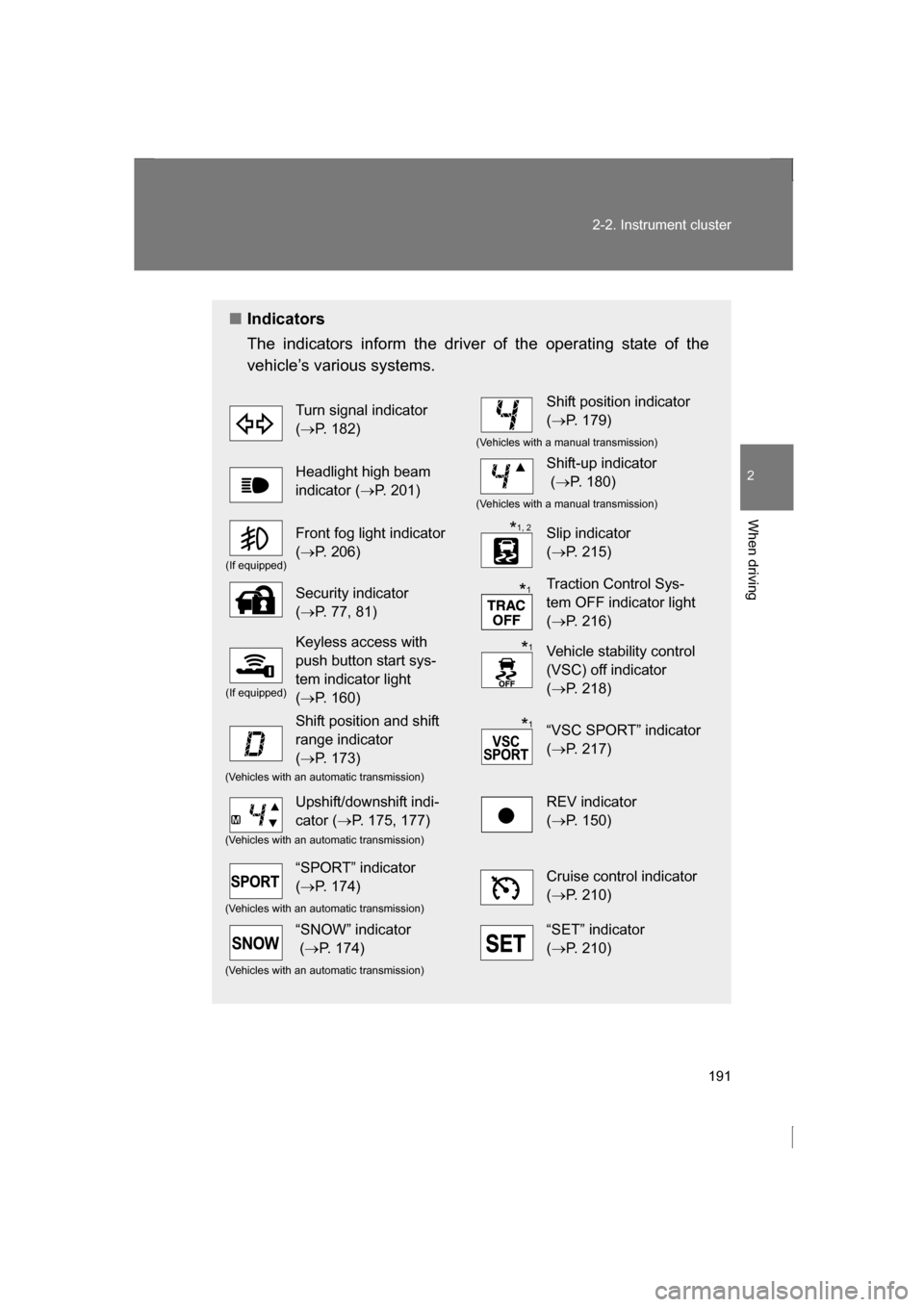
■Indicators
The indicators inform the driver of the operating state of the
vehicle’s various systems.
Turn signal indicator (→ P. 182)Shift position indicator (→ P. 179)
(Vehicles with a manual transmission)
Headlight high beam
indicator ( →P. 201)Shift-up indicator (→ P. 180)
(Vehicles with a manual transmission)
(If equipped)
Front fog light indicator (→ P. 206)Slip indicator (→ P. 215)
Security indicator (→ P. 77, 81)Traction Control Sys-
tem OFF indicator light (→ P. 216)
(If equipped)
Keyless access with
push button start sys-
tem indicator light (→ P. 160)Vehicle stability control
(VSC) off indicator (→ P. 218)
Shift position and shift
range indicator (→ P. 173)“VSC SPORT” indicator (→ P. 217)
(Vehicles with an automatic transmission)
Upshift/downshift indi-
cator ( →P. 175, 177)REV indicator (→ P. 150)
(Vehicles with an automatic transmission)
“SPORT” indicator (→ P. 174)Cruise control indicator (→ P. 210)
(Vehicles with an automatic transmission)
“SNOW” indicator (→ P. 174)“SET” indicator (→ P. 210)
(Vehicles with an automatic transmission)
*1, 2
*
1
*1
*
1
Page 200 of 484
200
2-3. Operating the lights and windshield wipers
Headlight switch
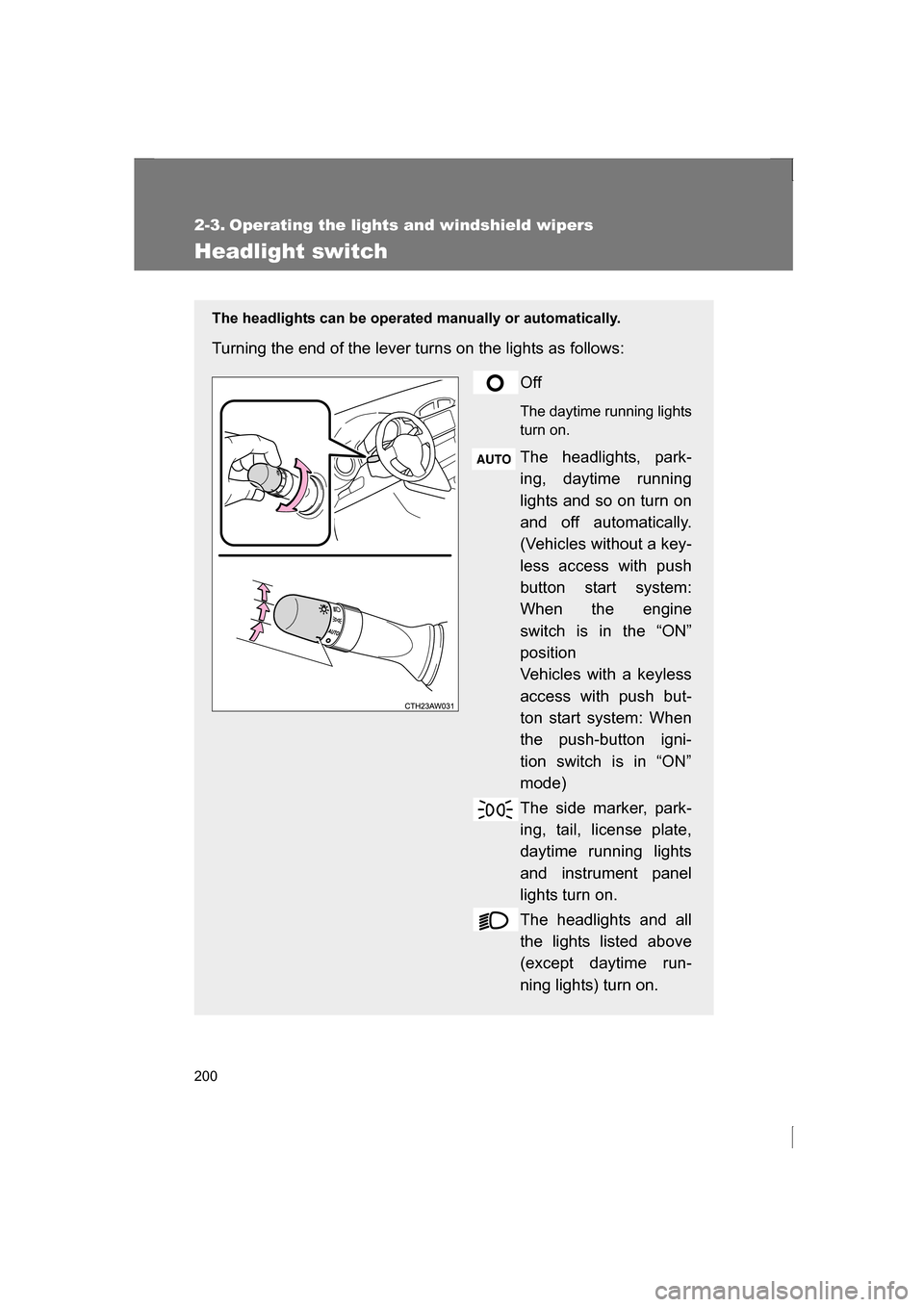
The headlights can be operated manually or automatically.
Turning the end of the lever turns on the lights as follows:Off
The daytime running lights turn on.
The headlights, park-
ing, daytime running
lights and so on turn on
and off automatically.
(Vehicles without a key-
less access with push
button start system:
When the engine
switch is in the “ON”
position
Vehicles with a keyless
access with push but-
ton start system: When
the push-button igni-
tion switch is in “ON”
mode)
The side marker, park-
ing, tail, license plate,
daytime running lights
and instrument panel
lights turn on.
The headlights and all
the lights listed above
(except daytime run-
ning lights) turn on.
Page 203 of 484
203
2-3. Operating the lights and windshield wipers
2
When driving
■Daytime running light system
●Vehicles with an automatic transmission: To make your vehicle more visi-
ble to other drivers, the daytime running lights turn on automatically
whenever the engine is started, the select lever is shifted out of P and the
parking brake is released. Daytime running lights are not designed for
use at night.
●Vehicles with a manual transmission: To make your vehicle more visible
to other drivers, the daytime running lights turn on automatically when-
ever the engine is started and the parking brake is released. Daytime
running lights are not designed for use at night.
●Compared to turning on the headlights, the daytime running light system
offers greater durability and consumes less electricity, so it can help
improve fuel economy.
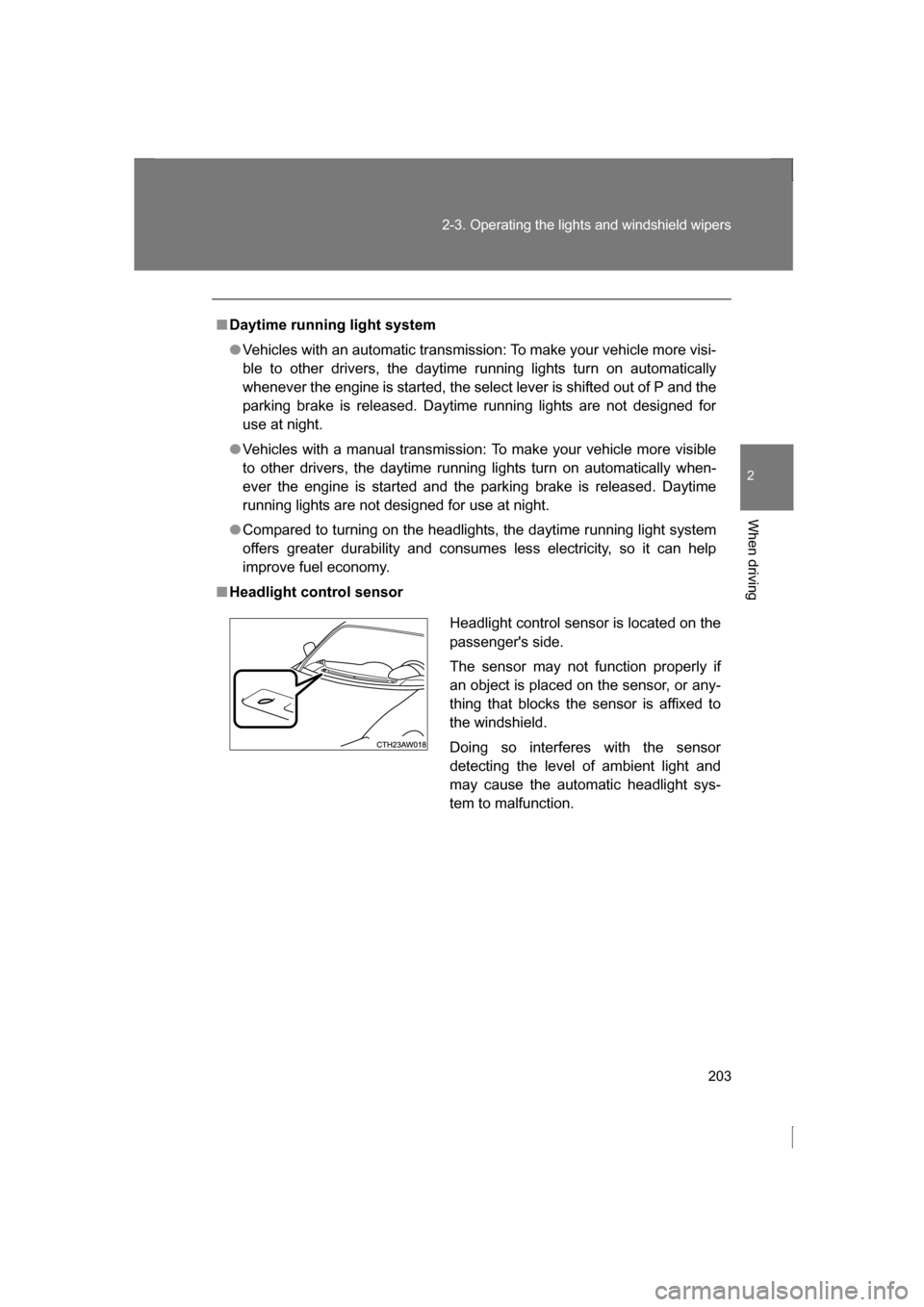
■Headlight control sensorHeadlight control sensor is located on the
passenger's side.
The sensor may not function properly if
an object is placed on the sensor, or any-
thing that blocks the sensor is affixed to
the windshield.
Doing so interferes with the sensor
detecting the level of ambient light and
may cause the automatic headlight sys-
tem to malfunction.
Page 204 of 484
204
2-3. Operating the lights and windshield wipers
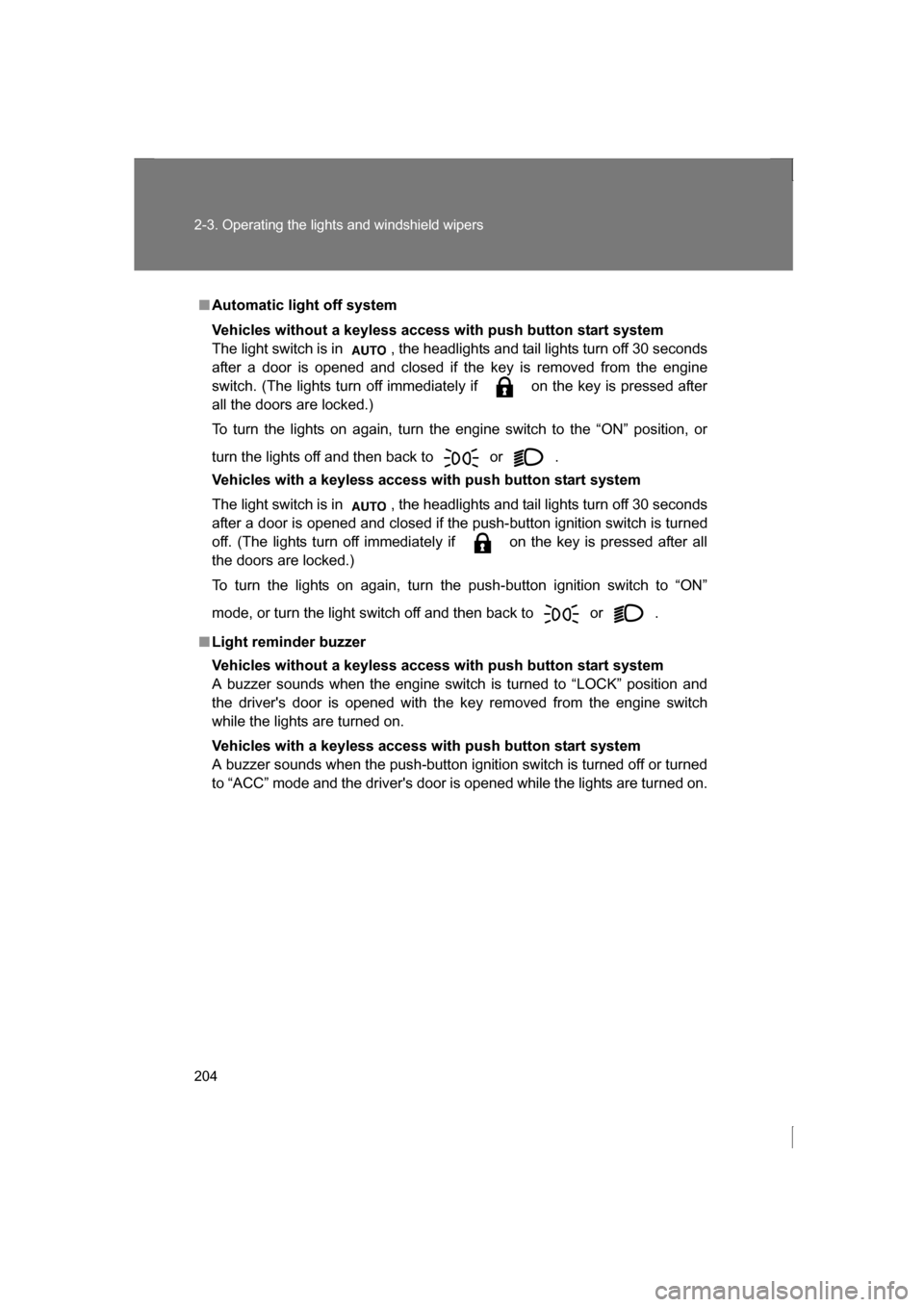
■Automatic light off system
Vehicles without a keyless access with push button start system
The light switch is in , the headlights and tail lights turn off 30 seconds
after a door is opened and closed if the key is removed from the engine
switch. (The lights turn off immediately if on the key is pressed after
all the doors are locked.)
To turn the lights on again, turn the engine switch to the “ON” position, or
turn the lights off and then back to or .
Vehicles with a keyless access with push button start system
The light switch is in , the headlights and tail lights turn off 30 seconds
after a door is opened and closed if the push-button ignition switch is turned
off. (The lights turn off immediately if on the key is pressed after all
the doors are locked.)
To turn the lights on again, turn the push-button ignition switch to “ON”
mode, or turn the light switch off and then back to or .
■Light reminder buzzer
Vehicles without a keyless access with push button start system
A buzzer sounds when the engine switch is turned to “LOCK” position and
the driver's door is opened with the key removed from the engine switch
while the lights are turned on.
Vehicles with a keyless access with push button start system
A buzzer sounds when the push-button ignition switch is turned off or turned
to “ACC” mode and the driver's door is opened while the lights are turned on.
Page 205 of 484
205
2-3. Operating the lights and windshield wipers
2
When driving
■Battery-saving function
In the following conditions, the headlights and the other remaining lights will
go off automatically after 20 minutes in order to prevent the vehicle battery
from being discharged:
●The headlights and/or tail lights are on.
●The key is removed from the engine switch (vehicles without a keyless
access with push button start system) or the push-button ignition switch
is turned off (vehicles with a keyless access with push button start sys-tem).
●The light switch is in , or .
This function will be canceled in any of the following situations:
●When the engine switch is turned to the “ON” position (vehicles without a
keyless access with push button start system) or the push-button ignition
switch is turned to “ON” mode (vehicles with a keyless access with push
button start system)
●When the light switch is operated
●When the door is opened or closed
■Customization that can be configured at your SUBARU dealer
Settings (e.g. light sensor sensitivity) can be changed.
(Customizable features →P. 439)
CAUTION
■To prevent battery discharge
Do not leave the lights on longer than necessary when the engine is not run- ning.
Page 208 of 484
208
2-3. Operating the lights and windshield wipers
■The windshield wipers and washer can be operated when
Vehicles without a keyless access with push button start system
The engine switch is in the “ON” position.
Vehicles with a keyless access with push button start system
The push-button ignition switch is in “ON” mode.
■If no windshield washer fluid sprays
Check that the washer nozzles are not blocked if there is washer fluid in the
windshield washer fluid reservoir.
WARNING
■Caution regarding the use of washer fluid
When it is cold, do not use the washer fluid until the windshield becomes
warm. The fluid may freeze on the windshield and cause low visibility. This
may lead to an accident, resulting in death or serious injury.
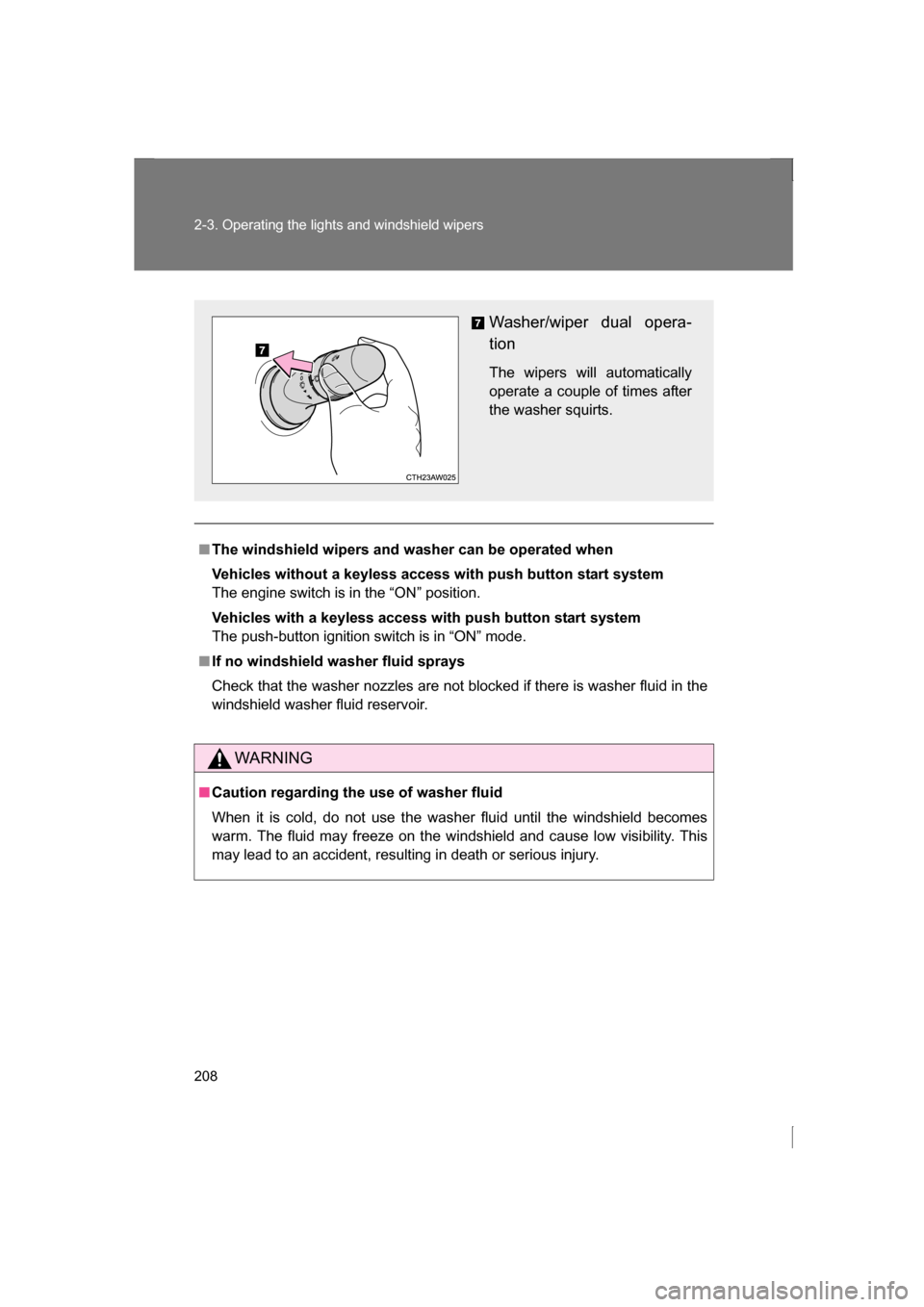
Washer/wiper dual opera-
tion
The wipers will automatically
operate a couple of times after
the washer squirts.
Page 212 of 484
212
2-4. Using other driving systems
■Cruise control can be set when
Vehicles with an automatic transmission
●The select lever is in D or M and the vehicle is in the 2nd
gear or higher.
●Vehicle speed is above approximately 25 mph (40 km/h).
Vehicles with a manual transmission
●The vehicle is in the 2 nd
gear or higher.
●Vehicle speed is above approximately 25 mph (40 km/h).
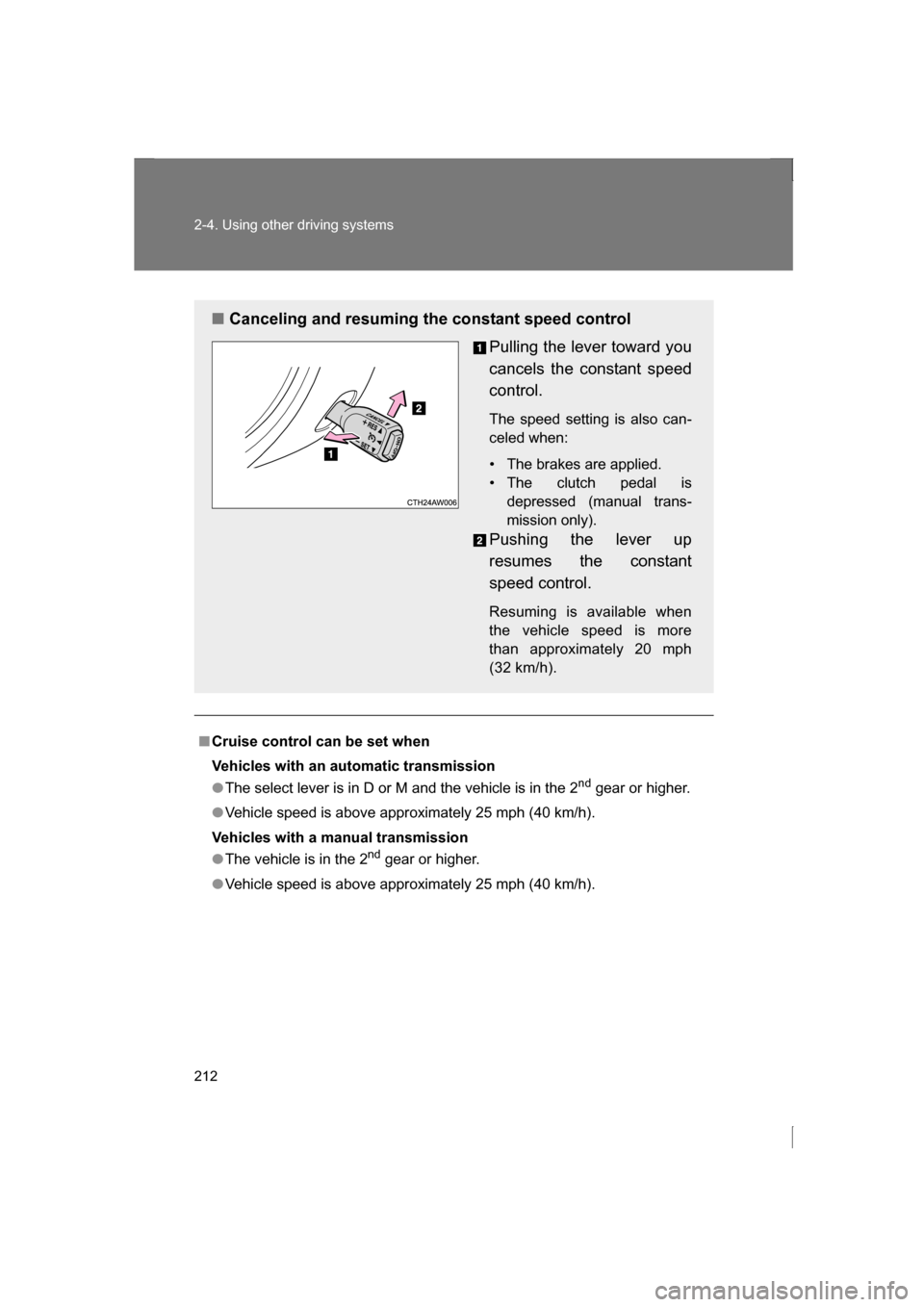
■Canceling and resuming the constant speed control
Pulling the lever toward you
cancels the constant speed
control.
The speed setting is also can-
celed when: