2013 SKODA SUPERB roof
[x] Cancel search: roofPage 52 of 274

OperationFig. 28
Control dial for the sliding/tilting
roof
First read and observe the introductory information and safety warn-
ings on page 48.
Comfort position
›
Turn the switch to position
C
» Fig. 28 .
When the sliding/tilting roof is in the comfort position, the intensity of the wind
noise is reduced.
Open partially
›
Turn the switch to a position in area
D
.
Open fully
›
Turn the switch to position
B
and hold it in this position (spring-tensioned po-
sition).
Tilting roof
›
Turn the switch to position
A
.
›
Press the switch in the region
E
towards the roof.
Closing
›
Turn the switch to position
A
.
›
Press the switch on the recess
E
down and pull forwards.
Force limiter
The sliding/tilting roof is fitted with a force limiter. The sliding/tilting roof stops and moves back several centimetres when it cannot be closed because there is
something in the way (e.g. ice). The sliding/tilting roof can be fully closed without
a force limiter by pressing the switch on the recess
E
down and then pushing it
forward until the sliding/tilting roof is fully closed » .
WARNINGWhen closing the sliding/tilting roof proceed with caution to avoid causing
crushing injuries – risk of injury!
CAUTION
During the winter it may be necessary to remove any ice and snow in the vicinity
of the sliding/tilting roof before opening it to prevent any damage to the opening
mechanism.
Opening/closing the sun screen
Fig. 29
Buttons for sun screen
First read and observe the introductory information and safety warn- ings on page 48.
The sun screen can be closed or opened using the buttons » Fig. 29.
Opening
›
Briefly press the button
F
» Fig. 29 to open fully.
›
Press and hold the button
F
to open to the desired position.
The opening process stops when one releases the button.
Closing
›
Briefly press the button
G
» Fig. 29 to close fully.
›
Press and hold the button
G
to close in the desired position.
The closing process stops when one releases the button.
49Unlocking and opening
Page 53 of 274

Convenience operation of Sliding/tilting roofFirst read and observe the introductory information and safety warn-ings
on page 48.
The sliding/tilting roof can be operated by locking/unlocking using the key or us-
ing the KESSY system with the aid of the sensor
1
» Fig. 14 on page 34.
Closing
›
Hold down the symbol button on the key, or when using the KESSY system,
keep your finger on the sensor
1
» Fig. 14 on page 34 » .
By releasing the lock or lifting your finger off the sensor
1
when using the KESSY
system, the closing process is immediately interrupted.
Tilting roof
›
Press and hold the symbol button
on the key.
WARNINGClose the sliding/tilting roof carefully – risk of injury! The force limiter does not
work when convenience closing is in operation.
50Using the system
Page 61 of 274
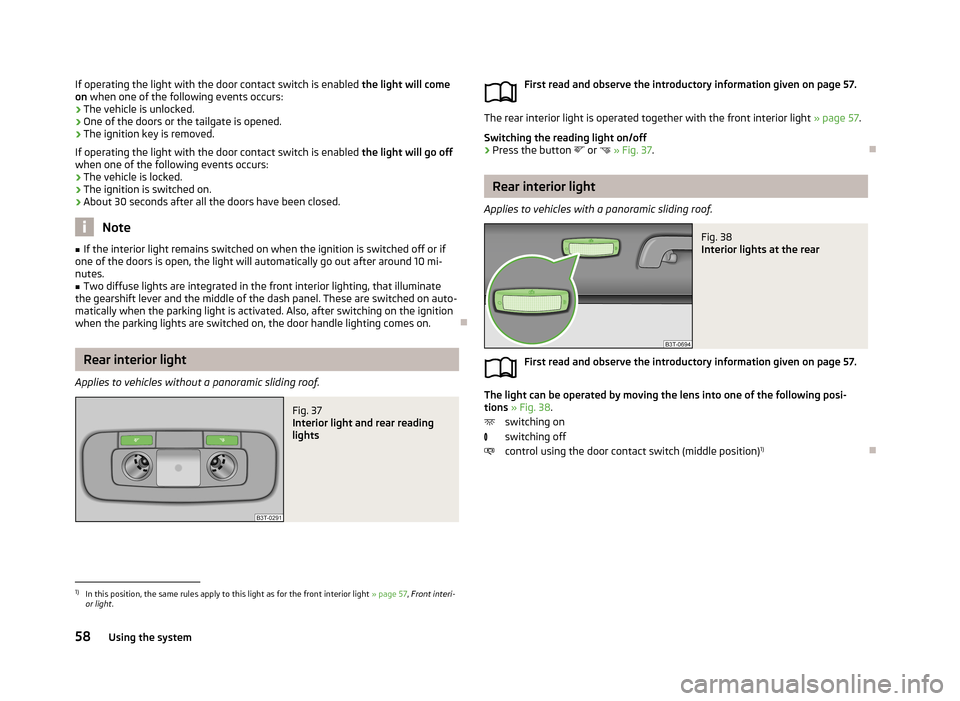
If operating the light with the door contact switch is enabled the light will come
on when one of the following events occurs:
› The vehicle is unlocked.
› One of the doors or the tailgate is opened.
› The ignition key is removed.
If operating the light with the door contact switch is enabled the light will go off
when one of the following events occurs:
› The vehicle is locked.
› The ignition is switched on.
› About 30 seconds after all the doors have been closed.
Note
■
If the interior light remains switched on when the ignition is switched off or if
one of the doors is open, the light will automatically go out after around 10 mi- nutes.■
Two diffuse lights are integrated in the front interior lighting, that illuminate
the gearshift lever and the middle of the dash panel. These are switched on auto-
matically when the parking light is activated. Also, after switching on the ignition when the parking lights are switched on, the door handle lighting comes on.
Rear interior light
Applies to vehicles without a panoramic sliding roof.
Fig. 37
Interior light and rear reading
lights
First read and observe the introductory information given on page 57.
The rear interior light is operated together with the front interior light » page 57.
Switching the reading light on/off
›
Press the button or
» Fig. 37 .
Rear interior light
Applies to vehicles with a panoramic sliding roof.
Fig. 38
Interior lights at the rear
First read and observe the introductory information given on page 57.
The light can be operated by moving the lens into one of the following posi-
tions » Fig. 38 .
switching on
switching off
control using the door contact switch (middle position) 1)
1)
In this position, the same rules apply to this light as for the front interior light
» page 57, Front interi-
or light .
58Using the system
Page 79 of 274

Storage compartment in the front centre consoleFig. 64
Opening the storage compart-
ment
First read and observe the introductory information and safety warn-
ings on page 74.
Open/close
›
Press on the edge of the roof
A
» Fig. 64 in the direction of the arrow.
Closing takes place in the reverse order.
WARNINGThe storage compartment must never be used as an ashtray or for the stor-
age of combustible materials - fire hazard and risk of damage to the storage
compartment!
Note
The storage compartment is equipped with an interior light which lights up when
the parking light is on.
Cup holdersFig. 65
Front centre console: Cup holder
Fig. 66
Rear armrest: Remove cup holder/insert cup holder
First read and observe the introductory information and safety warn-
ings
on page 74.
Two beverage containers can be placed into the cup holder.
Cup holder at the front
On vehicles that are fitted with a cover for cup holders, you can cover the cup
holder by pulling on the handle
A
» Fig. 65 in the direction of the arrow.
Rear cup holder
›
Press on the front end of the armrest in the direction of the arrow » Fig. 66 -
,
the cup holder comes out.
›
To slide the cup holder in again, press the middle part of the cup hold- er » Fig. 66 -
and slide it into the armrest in the direction of the arrow.
76Using the system
Page 99 of 274

›In the same way, insert the cross rod into the mount C on the other side of the
vehicle.
Folding›
First pull the cross rod back slightly on the one side and then on the other side and remove it from the mounts
C
» Fig. 101 .
›
Hold the cross rod in such a way that the net partition can slowly roll up into the
housing
B
without being damaged.
Note
If you wish to use the entire luggage compartment, the roll-up luggage compart-
ment cover can be removed » page 88.
Using the net partition behind the front seats
Fig. 102
Net partition behind the front
seats in the pulled-out state
First read and observe the introductory information and safety warn-
ings on page 95.
Pulling out
›
Fold the rear seats forward » page 73
.
›
Pull the net partition by the tab
A
» Fig. 102 .
›
First of all insert the cross rod into the mount
C
on one side and push it for-
ward.
›
In the same way, insert the cross rod into the mount
C
on the other side of the
vehicle.
Folding
›
First pull the cross rod back slightly on the one side and then on the other side and remove it from the mounts
C
» Fig. 102 .
›
Hold the cross rod in such a way that the net partition can slowly roll up into
the housing
B
without being damaged.
› Fold the rear seats back into their original positions
» page 73.
Removing and refitting the net partition housing
Fig. 103
Rear seats: Removing the net
partition housing
First read and observe the introductory information and safety warn- ings on page 95.
Removing
›
Fold the rear seats forward » page 73.
›
Open the rear right door.
›
Push the housing
A
in the direction of the arrow
1
and remove it from the
mounts on the right seat backrests in the direction of the arrow
2
» Fig. 103 .
Install
›
Insert the recesses on the housing
A
» Fig. 103 into the mounts on the rear
seat backrests.
›
Push the net partition housing in the opposite direction of the arrow
1
as far
as the stop.
›
Fold the rear seats back into their original positions » page 73.
Roof rack system
Introduction
This chapter contains information on the following subjects:
Attachment points
97
Roof load
97
96Using the system
Page 100 of 274

WARNING■The transported items on the roof rack must be securely attached – risk of
accident!■
Always secure the load with appropriate and undamaged lashing straps or
tensioning straps.
■
Distribute the load evenly over the roof rack system.
■
When transporting heavy objects or objects which take up a large area on
the roof rack system, the handling of the car may change as a result of the displacement of the centre of gravity. The style of driving and speed musttherefore be adapted to the current circumstances.
■
Avoid abrupt and sudden driving/braking manoeuvres.
■
Adjust the speed and driving style to the visibility, weather, road and traffic
conditions.
■
The permissible roof load, permissible axle loads and permissible total vehi-
cle weight must not be exceeded under any circumstances – risk of accident!
CAUTION
■ Only use roof rack systems approved by ŠKODA AUTO a.s■When dealing with roof racks, the installation instructions supplied with the
roof luggage rack system must be observed.■
On models fitted with a power sliding/tilting roof or a panoramic sliding roof,
ensure that the opened sliding/tilting roof or the panoramic sliding roof does not strike any items of luggage transported on the roof.
■
Ensure that the boot lid does not hit the roof load when opened.
■
The height of the vehicle changes after mounting a roof luggage rack system
and the load that is secured to it. Compare the vehicle height with available clear-
ances, such as underpasses and garage doors.
■
Always remove the roof luggage rack system before entering an automated car
wash.
■
Ensure the roof aerial is not impaired by the secured load.
For the sake of the environment
The increased aerodynamic drag results in a higher fuel consumption.
Attachment points
Does not apply to the Superb Combi.Fig. 104
Attachment points for roof bars
First read and observe the introductory information and safety warn-
ings
on page 96.
Installation location of the attachment points for roof bars » Fig. 104:
Forward attachment point
Rear attachment point
Perform the assembly and disassembly according to the enclosed instructions.
CAUTION
Observe the information regarding the assembly and disassembly in the enclosed
instructions.
Roof load
First read and observe the introductory information and safety warn-
ings
on page 96.
The maximum permissible roof load (including roof rack system) of 100 kg and the
maximum permissible total weight of the vehicle should not be exceeded.
The full permissible roof load cannot be used if a roof rack system with a lower
load carrying capacity is used. In this case, the roof rack system must only be loa-
ded up to the maximum weight limit specified in the fitting instructions.
AB97Seats and useful equipment
Page 105 of 274

adjustingFirst read and observe the introductory information and safety warnings
on page 100.
Recommended basic settings of the control elements of the air conditioning system for the respective operating modes:
SettingsControl dial settings » Fig. 107 on page 100Button » Fig. 107 on page 100Air outlet vents 2 » Fig. 105
on page 99ABC
Defrost/defog windscreen and
side windows a)Desired tempera-
ture3 or 4Automaticallyswitched onDo not switch onOpen and align with the side windowThe fastest heatingTo the right up tothe stop3Switched offBriefly switch onOpeningComfortable heatingDesired tempera- ture2 or 3Switched offDo not switch onOpeningThe fastest coolingTo the left up to
the stopbriefly 4, then 2 or 3ActivatedBriefly switch onOpeningComfortable coolingDesired tempera- ture1, 2 or 3ActivatedDo not switch onOpen and align to the roofFresh air mode - ventilationTo the left up tothe stopDesired positionSwitched offDo not switch onOpeninga)
We recommend that you do not use this setting in countries with high humidity levels. This can result in heavy cooling of the window glass and the following fogging from outside.
We recommend that you leave the air outlet vents 3 » Fig. 105 on page 99 in the
opened position.
Recirculated air mode
First read and observe the introductory information and safety warn-ings
on page 100.
Recirculated air mode prevents polluted air outside the vehicle from getting into
the vehicle, for example when driving through a tunnel or when standing in a traffic jam.
Switching on/off
›
Press the symbol button
.
The indicator light in the button lights up.
› Press the symbol button
again.
The indicator light in the button goes out.
Recirculated air mode is switched off automatically if the air distribution controlC
» Fig. 107 on page 100 is turned to position . Recirculated air mode can be
switched on again from this setting by repeatedly pressing the symbol button .
WARNINGDo not leave recirculated air mode on over a longer period of time, as “stale”
air can cause fatigue of the driver and passengers, reduce attention levels and
also cause the windows to mist up. The risk of having an accident increases.
Switch off recirculated air mode as soon as the windows start to mist up.
102Using the system
Page 106 of 274

Climatronic (automatic air conditioning system)
Introduction
This chapter contains information on the following subjects:
Control elements
103
automatic mode
104
Switching the cooling system on/off
104
Setting the temperature
104
Recirculation mode - Version 1
105
Recirculation mode - Version 2
106
Controlling blower
106
Defrosting windscreen
106
The Climatronic in automatic mode ensures the best-possible setting of the tem-
perature of the outflowing air, the blower stage and air distribution.
The system also takes sunlight into account, which eliminates the need to alterthe settings manually.
The cooling system operates only if the following conditions are met. The cooling system is switched on » page 100.
The engine is running.
The outside temperature is above approx. +2 °C.
The cooling system is switched off at a high coolant temperature in order to pro-
vide cooling at a high load of the engine.
Aeration of the vehicle when ignition is switched off
On models fitted with power sliding/tilting roof with sollar cells, the fresh air blower is automatically switched over to “solar mode” if the sun ray's are suffi-
cient after switching off the ignition. The solar cells on the sliding/tilting roof de-
liver power for the fresh air blower. This supplies the interior of the car with fresh air.
For an optimum ventilation, the air outlet vents 2 and 3 must be opened » Fig. 105
on page 99.
The ventilation functions only when the sliding/tilting roof is fully closed.
Note■ We recommend that you have Climatronic cleaned by a specialist garage once
every year.■
On vehicles equipped with a factory-fitted radio or radio navigation system, the
Climatronic information is also shown on their displays. This function can be
switched off, see » operating instructions for the radio or navigation system .
Control elements
Fig. 108
Climatronic: Control elements
First read and observe the introductory information given on page 103.
Functions of the individual controls » Fig. 108 :
Adjust the temperature for the left side » page 104
Adjust the blower speed
» page 106
Depending on equipment:
›
Aux. heating on/off » page 108
›
Switching the windscreen heater on/off » page 59
Adjust the temperature for the right side » page 104
Interior temperature sensor
ABCDE103Air conditioning system