2013 SKODA RAPID rims
[x] Cancel search: rimsPage 180 of 226

Always check the inflation pressure when the tyres are cold. Do not reduce the
higher pressure of warm tyres.
With greater additional load, adjust the tyre inflation pressure accordingly.
Driving style
Fast cornering, sharp acceleration and braking increase the wear of your tyres.
Balancing wheels
The wheels of a new vehicle are balanced. When driving, however, there are a
range of factors that may result in an imbalance. This may become apparent by a
“vibration” in the steering.
Have the wheels rebalanced after replacing the tyres.
Wheel alignment errors
Incorrect wheel alignment at the front or rear leads to excess wear of the tyres.
Tyre damage
Drive over kerbs and other such obstacles slowly and at right angles wherever
possible in order to avoid damage to tyres and wheel trims.
We recommend checking your tyres and wheel rims for damage (punctures, cuts,
splits and bulges, etc.) on a regular basis. Remove foreign bodies (e.g. small
stones) from the tyre tread immediately.
Replacing wheels
If significantly greater wear is present on the front tyres, we recommend replac-
ing the front wheels with the rear wheels as shown in the diagram » Fig. 142 . You
will then obtain approximately the same life for all the tyres.
We recommend that you swap the tyres every 10,000 km in order to achieve even wear on all tyres and to ensure optimal service life for the tyres.
Storing tyres
Identify disassembled tyres so that the previous direction of rotation can be maintained if the tyres are reassembled.
Always store wheels or tyres in a cool, dry place that is as dark as possible. Tyres
which are not fixed to a wheel trim should be stored upright.
Wear indicators
The base of the tread of the tyres has 1.6 mm high wear indicators installed.
These wear indicators are evenly spaced around the circumference of the tyre, depending on the make » Fig. 141 -
. Markings on the walls of the tyres through
the letters “TWI”, triangular symbols or other symbols identify the position of the
wear indicators.Tyre age
Tyres age and lose their original characteristics, even if they are not being used.
Therefore, we recommend not using summer or winter tyres older than 6 or 4
years old respectively.
New tyres
First read and observe the introductory information and safety warn-
ings
on page 175.
Only use radial tyres of the same type, size (rolling circumference) and tread pat-
tern on one axle on all four wheels.
The tyre/wheel combinations which are approved for your vehicle are indicated in
your vehicle documents.
Where possible, replace tyres by axle. Always fit the tyres with the deeper tread
depth to the front wheels.
Explanation of tyre markings
195/55 R 15 85 H
What this means is:
195Tyre width in mm » Fig. 141 on page 176 - 65Height/width ratio in % » Fig. 141 on page 176 - RCode letter for the type of tyre – Radial » Fig. 141 on page 176 - 15Rim diameter in inches » Fig. 141 on page 176 - 85Load index » HSpeed symbol »
The date of manufacture is stated on the tyre wall (possibly on the inside). e.g.
DOT ... 10 13 ..
means, for example, that the tyre was manufactured in the 10th week of 2013.
Load index
This indicates the maximum permissible load for each individual tyre. 487 kg
500 kg
515 kg
530 kg
83848586177Wheels
Page 183 of 226

Full wheel trimFirst read and observe the introductory information and safety warn-
ings
on page 175.
Extracting
›
Hook the clamp found in the vehicle tool kit into the reinforced edge of the wheel trim.
›
Push the wheel wrench through the clamp, support on the tyre and pull off the
wheel trim.
Installing
›
Press the wheel trim onto the wheel rim at the designated valve opening.
›
Then press the trim into the wheel rim until its entire circumference locks cor- rectly in place.
CAUTION
■ Use the pressure of your hand only, do not strike the full wheel trim. Avoid
heavy impacts when the trim has not yet been inserted into the wheel rim. This
could cause damage to the guide and centring elements of the trim.■
When using the anti-theft wheel bolt, ensure that it is in the hole in the valve
area » page 186 , Securing wheels against theft .
■
If wheel trims are retrofitted it must be ensured that an adequate flow of air is
assured to cool the brake system.
Wheel bolts
Fig. 145
Remove the capFirst read and observe the introductory information and safety warn-
ings on page 175.
Extracting
›
Push the extraction pliers » page 183 sufficiently far onto the cap until the in-
ner catches of the pliers are positioned at the collar of the cap » Fig. 145.
›
Remove the cap.
Installing
›
Push the caps onto the wheel bolts up to the stop.
The wheel bolt caps are housed in a plastic box in the spare wheel or in the stor-
age space for the spare wheel.
Wheel bolts
First read and observe the introductory information and safety warn-ings
on page 175.
Wheels and wheel bolts are matched to each other in terms of design. Each time
you fit other wheels rims, e.g. light alloy wheel rims or wheels with winter tyres,
you must also use the matching wheel bolts with the correct length and dome
shape. This is a prerequisite for ensuring that wheels are attached correctly.
Winter operation
Introduction
This chapter contains information on the following subjects:
Winter tyres
181
Snow chains
181
180General Maintenance
Page 184 of 226

Winter tyresFirst read and observe the introductory information given on page 180.
Fitting winter tyres will significantly improve the handling of your vehicle whendriving in wintry road conditions. Summer tyres have less grip on ice, snow and attemperatures below 7 °C. This is especially true of vehicles fitted with wide tyres
or high-speed tyres .
In order to achieve the best possible handling properties, winter tyres must be fit-
ted on all four wheels, the minimum tread depth must be 4 mm and tyres must be
no older than 4 years.
Winter tyres of a lower speed category can be used provided that the permissible
maximum speed of these tyres is not exceeded even if the possible maximum
speed of the vehicle is higher.
The speed limit for winter tyres can be set in the MAXI DOT display in the menu
item Winter tyres » page 28 .
For the sake of the environment
Fit the summer tyres on again in good time as they provide better handling prop-
erties, a shorter braking distance, less tyre noise, and reduced tyre wear on roadswhich are free of snow and ice as well as at temperatures above 7 °C. The fuel
consumption is also lower.
Snow chains
First read and observe the introductory information given on page 180.
When driving in wintry road conditions, snow chains improve not only traction,but also the braking performance.
Snow chains must only be mounted on the front wheels.
For technical reasons, it is only permissible to fit snow chains with the following wheel/tyre combinations.
Wheel sizeDepth (D)Tyre size5J x 14 a)35 mm175/706J x 15 b)38 mm185/606J x 15b)38 mm195/55a)
Only fit snow chains with links and locks not larger than
9 mm.
b)
Only fit snow chains with links and locks not larger than 13 mm.
CAUTION
■
The chains must be removed when driving on roads which are free of snow.
They adversely affect the handling of your vehicle, damage the tyres and are rap-
idly destroyed.■
Remove the full wheel trims before installing the snow chains.
181Wheels
Page 186 of 226

fire extinguisherFig. 148
Fire extinguisher
First read and observe the introductory information given on page 182.
The fire extinguisher is attached by two straps in a holder underneath the driver's
seat.
Removing/attaching
›
Loosen the two straps by pulling the buckles in the direction of the ar- row » Fig. 148 .
›
Remove the fire extinguisher.
Follow these steps in the reverse order for attachment.
Please read carefully the instructions which are attached to the fire extinguish-
er.
The fire extinguisher must be checked by an authorised person once a year. The
national legal requirements must be observed.
WARNINGThe fire extinguisher must always be secured safely so that they do not come loose when making an emergency braking or in a vehicle collision which could
cause injuries to occupants.
Note
■ The fire extinguisher must comply with national legal requirements.■Pay attention to the expiration date of the fire extinguisher. Proper functioning
of the fire extinguisher is not assured once it has passed its expiry date.■
The fire extinguisher is part of the scope of delivery in certain countries only.
Vehicle tool kitFig. 149
Vehicle tool kit
First read and observe the introductory information given on page 182.
The vehicle tool kit and the lifting jack are housed in a plastic box in the spare
wheel or in the storage space for the spare wheel. There is also space here for
the removable ball rod for the trailer towing device. The box is attached with a
strap on the spare wheel.
The components of the vehicle tool kit (depending on vehicle equip-
ment) » Fig. 149 .
Screwdriver
Adapter for anti-theft wheel bolts
Towing eye
Clamps for removing the wheel trims
Car jack
Wheel wrench
Extraction pliers for wheel bolt caps
Replacement bulb set
Screw the car jack back into its initial position after use in order to store it back in the box with the vehicle tool kit.
12345678183Emergency equipment and self-help
Page 187 of 226

WARNING■The factory-supplied lifting jack is only intended for your model of vehicle.
Under no circumstances use it to lift heavier vehicles or other loads – risk of
injury!■
Ensure that the vehicle tool kit is safely secured in the boot.
■
Ensure that the box is always secured with the strap.
Changing a wheel
Introduction
This chapter contains information on the following subjects:
Preliminary work
184
Changing a wheel
185
Follow-up work
185
Loosening/tightening wheel bolts
185
Raising the vehicle
186
Securing wheels against theft
186WARNING■ If you are in flowing traffic, switch on the hazard warning light system and
set up the warning triangle at the prescribed distance! The national legal re-
quirements must be observed.■
Park the vehicle as far away as possible from the flow of traffic. Park on as
flat and firm a surface as possible.
■
The following instructions must be followed if the vehicle is subsequently
fitted with tyres or rims that differ from the factory-fitted ones » page 177,
New tyres .
WARNINGObserve the following instructions for lifting the vehicle.■If the wheel has to be changed on a slope, first of all block the opposite
wheel with a stone or similar object to prevent the vehicle from unexpectedly
rolling away.■
Secure the base plate of the lifting jack with suitable means to prevent pos-
sible moving. A soft and slippery ground under the base plate may move the lifting jack, causing the vehicle to fall down. It is therefore always necessary to
place the lifting jack on a solid surface or use a wide and stable base. Use a non-slip base (e.g. a rubber foot mat) if the surface is smooth, such as cobbled
stones, tiled floor, etc.
■
Only attach the lifting jack to the attachment points provided for this pur-
pose.
■
Always raise the vehicle with the doors closed.
■
Never position any body parts, such as arms or legs under the vehicle, while
the vehicle is raised with a lifting jack.
■
Never start the engine when the vehicle is raised – risk of injury.
CAUTION
■ The prescribed tightening torque of the wheel bolts for steel and light alloy
wheels is 120 Nm.■
If the wheel bolts are fastened too tightly, this can cause damage to the anti-
theft wheel bolt or the adapter.
Note
The national legal requirements must be observed when changing a wheel.
Preliminary work
First read and observe the introductory information and safety warn-ings
on page 184.
Always change a wheel on a level surface as far as possible.
The following steps must be carried out before actually changing the wheel:
›
Have all of the occupants get out of the vehicle. While changing a tyre, the oc-
cupants of the vehicle should not stand on the road (they should instead remain
behind a crash barrier).
184Do-it-yourself
Page 206 of 226

Replacing the bulb for the fog lightFig. 174
Front bumper: Protective grille/removing the fog light
Fig. 175
Replacing the light bulb
First read and observe the introductory information and safety warn-
ings on page 200.
Removing the protective grille
›
Undo the protective grille in the area of the arrow » Fig. 174 -
using the clamp
for removing the wheel trims » page 183, Vehicle tool kit .
›
Remove the protective grille in the direction of the arrow
1
» Fig. 174 .
Changing light bulbs for fog lights
›
Unscrew the screws » Fig. 174 -
marked with the arrows 1)
.
›
Unlock the fuse in the direction of the arrow
2
with the screwdriver.
›
Remove the headlight in the direction of arrow
3
.
›
Remove the connector » Fig. 175.
›Turn the bulb holder in an
anti-clockwise direction as far as the stop and then
remove it » Fig. 175.›
Insert the bulb holder with the new bulb into the headlight and turn in a clock-
wise direction as far as the stop.
›
Attach the connector.
›
Replace the fog light by inserting it in the opposite direction of the arrow
3
» Fig. 174 and tighten.
›
Insert the protective grille and carefully press it in.
The protective grille must engage firmly.
Replacing the bulb for the licence plate light
Fig. 176
Remove the number plate light/replace the bulb
First read and observe the introductory information and safety warn-
ings
on page 200.
›
Open the boot lid.
›
Push in the lamp in the direction of the arrow
1
» Fig. 176 .
The lamp comes loose.
›
Swivel out the lamp in the direction of the arrow
2
and remove it.
›
Remove the faulty bulb from the holder in the direction of the arrow
3
.
›
Insert a new bulb into the holder.
›
Reinsert the lamp in the opposite direction to the arrow
1
.
›
Push on the light until the spring clicks into place.
Check that the light is securely inserted.
1)
The screwdriver is part of the tool kit.
203Fuses and light bulbs
Page 207 of 226

Rear light (Rapid)Fig. 177
Remove cover/light
Fig. 178
Installing the lamp connector/lamp
First read and observe the introductory information and safety warn-
ings
on page 200.
Removing
›
Open the boot lid.
›
Insert the clamp for removing the wheel trims » page 183, Vehicle tool kit into
the hole at the position indicated by the arrow » Fig. 177 -
.
›
Remove the cover in the direction of the arrow » Fig. 177 -
.
›
Use the screwdriver from the tool kit to unscrew the lamp » Fig. 177 -
.
›
Grip the tail lamp and carefully remove it by jiggling it out in the opposite direc-
tion of travel.
›
Pull the locking mechanism
1
» Fig. 178 on the connector in the direction of the
arrow.
›
Press the latching mechanism
2
» Fig. 178 and remove the connector.
Installing›Insert the connector into the lamp and lock it securely.›
Insert the lamp into the mounts in the body » Fig. 178 - .
›
Carefully press the tail lamp into the body so that the bolts
2
» Fig. 179 on
page 204 on the lamp engage into the mounts in the body » .
Ensure that the cable bundle does not become pinched between the body and
the lamp.
›
Screw the tail lamp into place and install the cover.
The cover must engage securely.
CAUTION
■ Ensure that the cable bundle does not become pinched between the body and
the lamp when it is being refitted – risk of damage to the electric installation and risk of water ingress.■
If you are not sure whether the cable bundle has become pinched, we recom-
mend that you have the light connection checked by a specialist garage.
■
Ensure that the vehicle paintwork and the tail lamp are not damaged when re-
moving and installing the tail lamp.
Replacing bulbs in rear light (Rapid)
Fig. 179
Outer part of the lamp/inner part of the lamp
First read and observe the introductory information and safety warn-
ings
on page 200.
Outer part of the lamp
›
Turn the bulb holder
1
» Fig. 179 in an anti-clockwise direction and remove it
from the lamp housing.
204Do-it-yourself
Page 208 of 226
›Replace the bulb, reinsert the holder with the bulb into the lamp housing and
turn to the stop in a clockwise direction.
Inner part of the lamp›
Unlock the bulb holder using the locking latches marked with arrows » Fig. 179 -
and remove the bulb holder from the tail lamp.
›
Turn the bulb holder to the stop » Fig. 179 - in an anti-clockwise direction and
remove it from the lamp housing.
›
Replace the bulb, reinsert the holder with the bulb into the lamp housing and turn to the stop in a clockwise direction.
›
Insert the bulb holder in the tail lamp assembly.
All locking mechanisms must audibly snap into place.
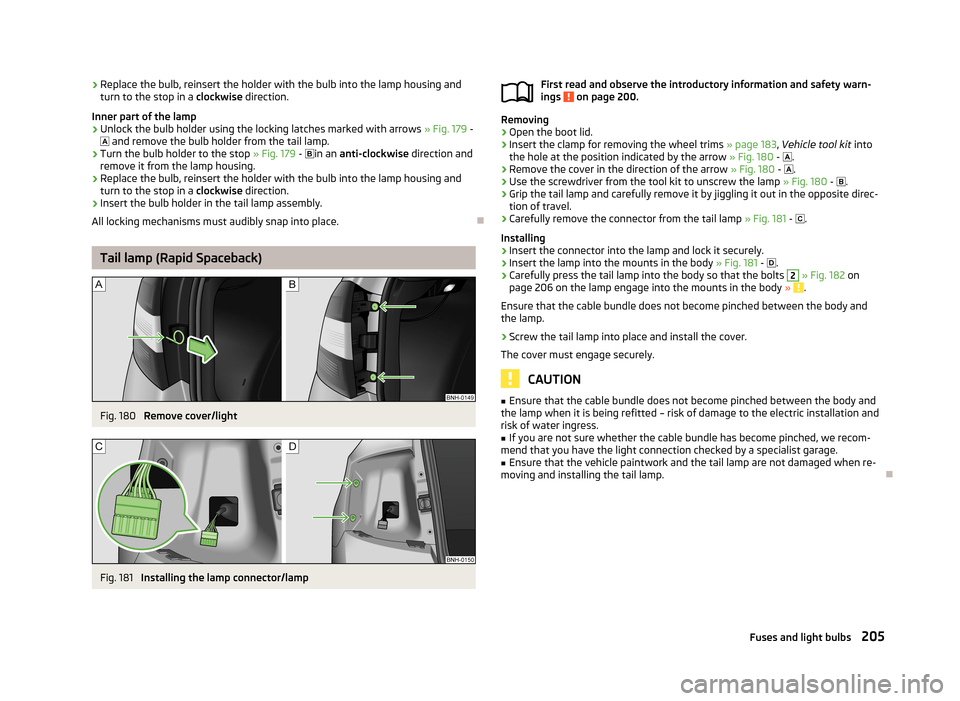
Tail lamp (Rapid Spaceback)
Fig. 180
Remove cover/light
Fig. 181
Installing the lamp connector/lamp
First read and observe the introductory information and safety warn-
ings on page 200.
Removing
›
Open the boot lid.
›
Insert the clamp for removing the wheel trims » page 183, Vehicle tool kit into
the hole at the position indicated by the arrow » Fig. 180 - .
›
Remove the cover in the direction of the arrow » Fig. 180 - .
›
Use the screwdriver from the tool kit to unscrew the lamp » Fig. 180 - .
›
Grip the tail lamp and carefully remove it by jiggling it out in the opposite direc-
tion of travel.
›
Carefully remove the connector from the tail lamp » Fig. 181 - .
Installing
›
Insert the connector into the lamp and lock it securely.
›
Insert the lamp into the mounts in the body » Fig. 181 -
.
›
Carefully press the tail lamp into the body so that the bolts
2
» Fig. 182 on
page 206 on the lamp engage into the mounts in the body » .
Ensure that the cable bundle does not become pinched between the body and
the lamp.
›
Screw the tail lamp into place and install the cover.
The cover must engage securely.
CAUTION
■ Ensure that the cable bundle does not become pinched between the body and
the lamp when it is being refitted – risk of damage to the electric installation and risk of water ingress.■
If you are not sure whether the cable bundle has become pinched, we recom-
mend that you have the light connection checked by a specialist garage.
■
Ensure that the vehicle paintwork and the tail lamp are not damaged when re-
moving and installing the tail lamp.
205Fuses and light bulbs