2013 SKODA OCTAVIA ECU
[x] Cancel search: ECUPage 50 of 287

The top lid position is adjusted, for example, in the following situations.
› When the space for opening the lid is limited (e.g. garage height).
› For a more convenient operation, such as by a person's height.
The top position which is reached when the lid opens automatically, is always
lower than the maximum top position which can be reached when the lid is
opened manually.
The lid always opens to the height which was last stored.
Malfunctions
First read and observe the introductory information and safety warn-
ings
on page 44.
If the battery is disconnected and reconnected while the lid is open, it is necessa-
ry to activate the system of the electric boot lid. Activation means closing the lid
by hand. Thus, the end position of the lid is stored under fully closed in secured lock.
Examples of operational malfunctions
Description of the malfunc-
tionPossible solutionsThe lid cannot be lifted out of
the lockEmergency unlocking of the lid » page 249The lid does not react to an
opening signalRemoving a possible obstacle (e.g. snow), re-
opening the lid » page 45
Press handle A
and pull the lid upwards
The lid remains in the top po-
sitionManual closing of the lid
Electrical power windows
Introduction
This chapter contains information on the following subjects:
Opening/closing the window from the driver seat
48
Opening the windows in the front passenger door and in the rear doors
48Force limit49Window convenience operation49
Operational faults
49
The electrical power windows can only be operated when the ignition is switched
on.
After switching the ignition off, it is still possible to open or close the windows for
approx. 10 minutes. The electrical power windows are only switched off com- pletely once the driver's door or front passenger door are opened.
When driving always use the existing heating, air conditioning and ventilation
system for ventilating the interior of the vehicle. If the windows are opened, dust
as well as other dirt can get into the vehicle and in addition the wind noise is
more at certain speeds.
WARNING■ Ensure that no persons are still left in the vehicle when locking the vehicle.
In an emergency, the windows will no longer be able to be opened from the
inside.■
The system is fitted with a force limiter » page 49. If there is an obstacle,
the closing process is stopped and the window goes down by several centi-
metres. The windows should nevertheless be closed carefully – risk of injury!
■
It is recommended to deactivate the electrically operated power windows in
the rear doors (safety switch)
S
if there are children in the rear seats » Fig. 23
on page 48.
CAUTION
■ Keep the windows clean to ensure the correct functionality of the electric win-
dows.■
In the event that the windows are frozen, first of all eliminate the
ice » page 207 , De-icing windows and exterior mirrors and only then operate the
electrical power windows. Otherwise, the window sealing and the electrical pow- er window mechanism could be damaged.
■
In the winter, ice accumulating on the surface of the window may cause there
to be more resistance when closing the window. The window will stop and move back several centimetres.
■
It is necessary to deactivate the force limiter to close the window » page 49.
■
When leaving the locked vehicle make sure that the windows are closed at all
times.
47Unlocking and opening
Page 79 of 287

Seat features
Introduction
This chapter contains information on the following subjects:
Seat heaters
76
Front armrest
77
Rear armrest
77
Folding front passenger seat
77
Seat backrests
78
Seat heaters
Fig. 51
Heating: Front seats/ rear seats
First read and observe the introductory information given on page 76.
The seat backrests and surfaces of the front seats and the two outer rear seats
can be heated electrically.
The seat heating can only be switched on when the engine is running.
Switching on
›
Press the corresponding symbol button
or
» Fig. 51 .
By pressing the button once, the heating is switched to the highest intensity - level 3, which is indicated by three of the warning lights underneath the respec-
tive switch » Fig. 51 -
or in the respective button » Fig. 51 -
illuminating.
With repeated pressing of the switch, the level of the seat heating is down-regu-
lated up to the switch-off. The level of the seat heating is indicated by the num- ber of illuminated warning lights underneath/in the switch.WARNINGIf you have a subdued pain and/or temperature sensitivity, e.g. through medi-
cation, paralysis or because of chronic illness (e.g. diabetes), we recommend
not to use the seat heating. This can lead to burns on the back, the posterior
and the legs which are difficult to heal. If the seat heating is used, we recom-
mend to make regular breaks in your journey when driving long distances, so
that the body can recuperate from the stress of the journey. Please consult
your doctor, who can evaluate your specific condition.
CAUTION
■ Do not kneel on the seats or otherwise apply concentrated pressure to them.■Do not turn on the seat heater if seats are not occupied.■
Do not switch on the seat heating if the seats have objects attached to or
placed on them, for example a child seat, a bag, etc. A fault of the heating ele-
ments in the seat heating can occur.
■
If additional seat covers or protective covers are attached to the seats, do not
turn on the seat heater - there is a risk of damaging the seat covers and seat
heating.
■
Do not clean the seats using moisture » page 210.
Note
If the on-board voltage drops, the seat heating is switched off automatically, in
order to provide sufficient electrical energy for the engine control » page 227,
Automatic load deactivation .
76Using the system
Page 81 of 287

The locking mechanism must audibly snap into place.
Folding backwards›
Place the lever in position
1
» Fig. 54 .
›
Fold the seat backrest in the opposite direction of the arrow
2
.
The locking mechanism must audibly snap into place.
WARNING■ The front passenger airbag should be switched off when transporting ob-
jects on the seat which was folded forwards » page 191.■
Adjust the seat backrest only when the vehicle is stationary.
■
When moving the seat backrest, make sure the seat backrest has been
properly secured – check by pulling on the seat backrest.
■
If the seat backrest is folded, passengers may only be transported on the
outer seat behind the driver.
■
When moving the seat backrest, keep limbs away from between the seat
cushion and seat backrest – risk of injury!
■
Never transport objects on the seat backrest which was folded forwards,
which: ■ impair driver visibility;
■ make it impossible for the driver to control the vehicle, e.g. if they are
placed under the pedals, or could protrude into the driver's zone;
■ could lead to injury to passengers due to a change of direction or braking
manouvre when accelerating sharply.
Seat backrestsFig. 55
Seat backrest: Locking/unlocking
Fig. 56
Luggage compartment: Folding the rear seat backrest forward (Oc-
tavia Estate)
First read and observe the introductory information given on page 76.
The luggage compartment can be increased in size by folding the seat backrests
forward. The seat backrests can be folded forward individually on vehicles with
divided rear seats.
78Using the system
Page 82 of 287

Folding forward
Before folding the seat backrests forwards, adapt the position of the front seats
in such a way that they are not damaged by the folded seat backrests 1)
.›
Push the lever
A
» Fig. 55 and fold the seat backrest completely forwards.
Fold forward from the luggage compartment
The rear seat backrests can also be unlocked and folded forward from the lug-
gage compartment.
There is a lever on the right side of the luggage compartment for unlocking the
right and the middle rear seat backrests.
There is a lever on the left side of the luggage compartment for unlocking the left
rear seat backrest.
›
Pull the corresponding lever in the direction of the arrow » Fig. 56.
The corresponding rear seat backrest is unlocked and can be folded forward.
Folding backwards
›
Hold the rear outer seat belt
C
» Fig. 55 against the side trim panel.
›
Then push the seat backrest back into the upright position until the securing
knob
A
clicks into place – check by pulling on the seat backrest » .
›
Make sure that the red pin
B
is hidden.
WARNING■
The belts and the belt locks must be in their original position after folding
back the seat backrests – they must be ready to use.■
The seat backrests must be securely locked in position so that no objects in
the luggage compartment can slide into the passenger compartment on sud- den braking – risk of injury.
■
Ensure that the rear seat backrests are properly engaged. Only then can the
seat belt for the middle seat reliably fulfil its function.
CAUTION■ Before folding the seat backrest forward from the luggage compartment, check
that there are no objects on the rear seat. When folding the seat backrest for-
ward, they could be damaged or cause damage to the seat backrest and the seat.■
Ensure that the seat belts are not damaged when operating the seat backrests.
Under no circumstances must the rear seat belts be jammed by the folded back
seat backrests.
■
On vehicles with a net partition first the left and then the right and middle rear
seat backrest must be unlocked 2)
.
Practical equipment
Introduction
This chapter contains information on the following subjects:
Car park ticket holder
80
Storage compartment on the driver's side
80
Storage compartments in the doors
81
Holder for reflective vest
81
storage compartment in the front center console - not lockable
82
Storage compartment in the front centre console
82
Cup holders
82
Cigarette lighter
83
Ashtray
83
12-volt power outlet
84
Waste container
85
Multimedia holder
85
Storage compartment under the front armrest
86
Glasses storage box
86
Storage compartment on the passenger side
87
Storage compartment under the passenger seat
87
Clothes hook
88
1)
If the front seats are too far back, we recommend that you have the rear head restraints removed
before the seat backrests are folded forward. Store the removed head restraints in such a way that
they are not be damaged or soiled.
2)
Applies to the Octavia Estate.
79Seats and useful equipment
Page 93 of 287

Rear seat backrest with long-cargo channelFig. 77
Rear seats: Cover handle/boot: Unlock button
First read and observe the introductory information and safety warn-
ings
on page 79.
After folding the rear armrest and cover up, an opening in the seat backrest be-
comes visible through which the removable through-loading bag with skis can be
pushed. The armrest and cover can be folded forward from the passenger com-
partment or the boot.
Opening from the passenger compartment
›
Fold the rear armrest dow (not as far as the stop) » page 77.
›
Pull the handle
A
» Fig. 77 in the direction of the arrow and fold the cover
downwards.
Opening from the boot
›
Push the unlock button
B
» Fig. 77 in the direction of the arrow and fold the
cover including the armrest forwards.
Closing
›
Fold the cover and rear armrest upwards to the stop - the cover must click into place.
Ensure that the armrest is always locked into place after closing. This is apparent
as the red field above the unlocking button
B
» Fig. 77 is not visible from the
boot.
WARNINGThe through-loading channel is only intended for transporting skis that are
placed in a properly secured, removable through-loading bag » page 90.
Removable ski bagFig. 78
Securing the through-loading
bag
First read and observe the introductory information and safety warn-
ings on page 79.
The removable through-loading bag is solely used for transporting skis.
Loading
›
Open the boot lid.
›
Fold the rear armrest and the cover in the seat backrest downwards » page 90.
›
Place the empty, removable through-loading bag in such a way that the end of
the bag with the zip is in the boot.
›
Push the skis into the removable through-loading bag from the boot » .
›
Close the through-loading bag.
Securing
›
Tighten the strap
A
on the free end around the skis in front of the bind-
ings » Fig. 78 .
›
Fold the seat backrest a little forward.
›
Guide the securing strap
B
through the opening in the seat backrest around
the upper part of the seat backrest.
›
Then push the seat backrest back into the upright position until the unlocking button clicks into place - check by pulling on the seat backrest.
›
Insert the securing strap
B
into the lock
C
until it clicks into place.
WARNING■ After placing skis into the through-loading bag, you must secure the bag
with the securing strap B » Fig. 78 .■
The strap
A
must hold the skis tight. 90Using the system
Page 96 of 287

Fixing netsFig. 81
Fastening examples for nets
Fig. 82
Fastening vertical pocket
First read and observe the introductory information and safety warn-
ings on page 91.
Examples for attaching the fixing nets » Fig. 81.
Horizontal pocket
Floor net
Vertical pocket
WARNINGDo not exceed the maximum permissible load of the fixing nets. Heavy objects are not secured sufficiently – risk of injury!ABCCAUTION■ The maximum permissible load of the fixing nets is 1.5 kg.■Do not place any sharp objects in the nets – risk of damaging the net.
Folding double hooks
Fig. 83
Folding double hooks
First read and observe the introductory information and safety warn-
ings on page 91.
The folding double hook is used to affix small items of luggage, e.g. bags.
The folding double hook can be located on either of the two sides of the luggage
compartment, according to the model.
CAUTION
An item of luggage with a maximum weight of 5 kg can be attached to each side
of the double hook.
93Seats and useful equipment
Page 98 of 287

CAUTIONThe double sided floor covering can only be used in vehicles without the variable
loading floor » page 99 - There is a risk of damage to the variable loading floor.
Note
For easier turning of the covering, use the loop attached.
Luggage net
Fig. 86
Luggage net
First read and observe the introductory information and safety warn-
ings on page 91.
The luggage net is located on the underside of the luggage compartment cover.
The net is designed for transporting lighter objects.
WARNINGOnly store soft objects with a total weight of 1.5 kg in the net. Heavy objects are not secured sufficiently – risk of injury!
CAUTION
Do not place any sharp objects into the net – risk of net damage.
Luggage compartment coverFig. 87
Removing/installing the luggage compartment cover
Fig. 88
Luggage compartment cover
stowed behind the rear seats
First read and observe the introductory information and safety warn-
ings on page 91.
Removing
›
Unhook support straps
1
» Fig. 87 .
›
On the underside of the cover, in the area between the holders, press
2
.
›
Remove the cover.
The removed boot cover can be stowed behind the seat backrest » Fig. 88.
Installing
›
Place the cover on the contact surfaces of the side trim panel.
›
Place the recesses of the cover
3
» Fig. 87 over the holders
2
in the side trim
panel.
›
Press on the upper side of the cover so that the mounts fully interlock in the holders.
›
Hook the support straps
1
on the boot lid.
95Seats and useful equipment
Page 101 of 287
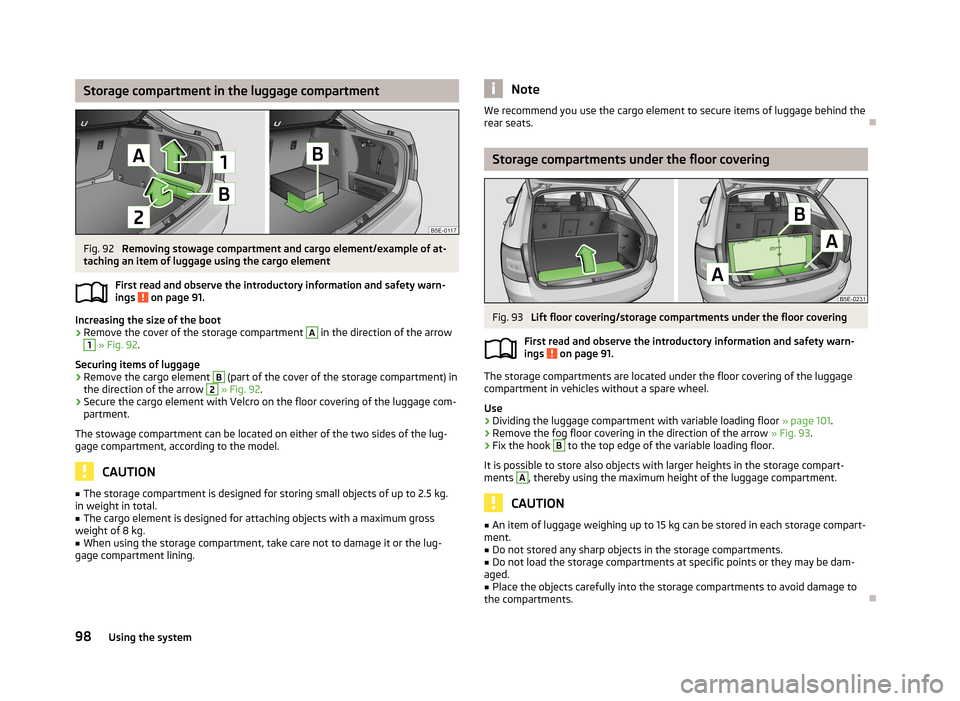
Storage compartment in the luggage compartmentFig. 92
Removing stowage compartment and cargo element/example of at-
taching an item of luggage using the cargo element
First read and observe the introductory information and safety warn-ings
on page 91.
Increasing the size of the boot
›
Remove the cover of the storage compartment
A
in the direction of the arrow
1
» Fig. 92 .
Securing items of luggage
›
Remove the cargo element
B
(part of the cover of the storage compartment) in
the direction of the arrow
2
» Fig. 92 .
›
Secure the cargo element with Velcro on the floor covering of the luggage com-
partment.
The stowage compartment can be located on either of the two sides of the lug-
gage compartment, according to the model.
CAUTION
■ The storage compartment is designed for storing small objects of up to 2.5 kg.
in weight in total.■
The cargo element is designed for attaching objects with a maximum gross
weight of 8 kg.
■
When using the storage compartment, take care not to damage it or the lug-
gage compartment lining.
NoteWe recommend you use the cargo element to secure items of luggage behind the
rear seats.
Storage compartments under the floor covering
Fig. 93
Lift floor covering/storage compartments under the floor covering
First read and observe the introductory information and safety warn-
ings
on page 91.
The storage compartments are located under the floor covering of the luggage compartment in vehicles without a spare wheel.
Use
›
Dividing the luggage compartment with variable loading floor » page 101.
›
Remove the fog floor covering in the direction of the arrow » Fig. 93.
›
Fix the hook
B
to the top edge of the variable loading floor.
It is possible to store also objects with larger heights in the storage compart- ments
A
, thereby using the maximum height of the luggage compartment.
CAUTION
■ An item of luggage weighing up to 15 kg can be stored in each storage compart-
ment.■
Do not stored any sharp objects in the storage compartments.
■
Do not load the storage compartments at specific points or they may be dam-
aged.
■
Place the objects carefully into the storage compartments to avoid damage to
the compartments.
98Using the system