2013 SKODA OCTAVIA light
[x] Cancel search: lightPage 228 of 287

WARNING■When you charge a battery, hydrogen is released, and a highly explosive gas
mixture is also produced. An explosion can be caused through sparkling over during unclamping or loosening of the cable plug while the ignition is on.■
Creating a bridge between the poles on the battery (e.g. with a metal object
or cable) creates a short circuit - risk of melting the lead bars, and risk of ex-
plosion, battery fire and acid splashes.
■
Avoid creating sparks when working with cables and electrical devices.
Strong sparking represents a risk of injury.
■
Before carrying out any work on the electrical system, switch off the engine,
the ignition and all electrical components and disconnect the negative termi-
nal (-) on the battery.
CAUTION
Improper handling of the battery can lead to damage occurring. We recommend
having all work on the vehicle battery carried out by a specialist garage.
CAUTION
■ The vehicle battery must only be disconnected if the ignition is switched off,
otherwise the vehicle's electrical system (electronic components) can be dam-
aged. When disconnecting the battery from the electrical system, first of all dis-
connect the negative terminal (-) of the battery, followed by the positive terminal
(+).■
When connecting the battery to the electrical system, first of all connect the
positive terminal (+) of the battery, followed by the negative terminal (-). Under no
circumstances must the battery cables be connected incorrectly – risk of a cable fire.
■
Ensure that battery acid does not come into contact with the bodywork – risk of
damage to the paintwork.
■
Do not place the battery in direct daylight in order to protect the vehicle battery
housing from the effects of ultra-violet light.
■
If the vehicle has not been driven for more than 3 to 4 weeks, the battery will
discharge. This is because certain electrical components consume electricity (e. g.
control units) also in idle state. Prevent the battery from discharging by discon-
necting the battery's negative terminal (-) or continuously charging the battery
with a very low charging current.
■
If the vehicle is frequently used for making short trips, the vehicle battery will
not have time to charge up sufficiently and may discharge.
For the sake of the environmentA vehicle battery that has been removed is a special type of hazardous waste.
These must be disposed of in accordance with national legal regulations.
Note
You should replace batteries older than 5 years.
Opening the cover
Fig. 187
Engine compartment: Polyester
cover of vehicle battery
First read and observe the introductory information and safety warn- ings on page 224.
The battery is located in the engine compartment - in some models, underneath apolyester cover » Fig. 187.
›
Fold out the cover on the battery in the direction of the arrow.
The battery cover is installed in reverse order.
The edge of the polyester battery cover is inserted between the battery and the
side wall of the battery cover when working on the battery.
225Inspecting and replenishing
Page 229 of 287

Checking the battery electrolyte levelFig. 188
Vehicle battery: Electrolyte level
indicator
First read and observe the introductory information and safety warn-
ings on page 224.
On vehicles with a vehicle battery fitted with a colour indicator, the so-called
magic eye » Fig. 188, the electrolyte level can be determined by looking at the
change in colour.
Air bubbles can influence the colour of the indicator. For this reason carefully
knock on the indicator before carrying out the check.
› Black colour – electrolyte level is correct.
› Colourless or light yellow colour – electrolyte level too low, the battery must be
replaced.
Vehicles with a START-STOP system are fitted with a battery control unit for checking the energy level for the recurring engine start.
We recommend that you have the acid level checked regularly by a specialist ga-
rage, especially in the following cases.
› High external temperatures.
› Longer day trips.
› After each charge.
Winter time
The vehicle battery only has a proportion of the starting power in lower tempera-
tures. A discharged vehicle battery may already freeze at temperatures just be-
low 0 °C .
We therefore recommend that you have the battery checked and, if necessary, re-
charged by a specialist garage before the start of the winter.
CAUTIONFor technical reasons, on vehicles with the description “AGM”, the electrolyte lev- el cannot be checked.
Note
The battery acid level is also checked regularly by a specialist garage as part of
the inspection service.
Charging
First read and observe the introductory information and safety warn-ings
on page 224.
A properly charged vehicle battery is essential for reliably starting the engine.
›
Switch off the ignition and all of the electrical components.
›
Only when performing a “quick-charge”, disconnect both battery cables (first of
all “negative”, then “positive”).
›
Attach the terminal clamps of the charger to the battery terminals (red = “posi- tive”, black = “negative”).
›
Plug the mains cable of the charger into the power socket and switch on the
device.
›
After charging has been successful: Switch off the charger and remove themains cable from the power socket.
›
Only then disconnect the charger's terminal clamps.
›
Reconnect the cables to the battery (first of all “positive”, then “negative”).
It is not necessary to disconnect the cables of the battery if you recharge the ve- hicle battery using low amperages (for example from a mini-charger). Refer to the
instructions of the charger manufacturer .
A charging current of 0.1 multiple of the total vehicle battery capacity (or lower) must be used until full charging is achieved.
It is necessary to disconnect both cables before charging the battery with high
amperages, so-called “ quick-charging”.
The vent plugs of the vehicle battery should not be opened for charging.
226General Maintenance
Page 230 of 287

WARNING“Quick-charging” the vehicle battery is dangerous and requires a special
charger and specialist knowledge.
CAUTION
On vehicles with the START/STOP system, the pole terminal of the charger must
not be connected directly to the negative terminal of the vehicle battery, but only
to the engine earth » page 244, Jump-starting in vehicles with the START-STOP
system .
Note
We therefore recommend that vehicle batteries be rapid charged by a specialist
garage.
Replacing
First read and observe the introductory information and safety warn-
ings
on page 224.
When replacing a battery, the new vehicle battery must have the same capacity,
voltage, amperage and be the same size. Suitable vehicle battery types can be
purchased from a specialist garage.
We recommend having the battery replaced by a specialist garage, where the
new vehicle battery will be installed properly and the original battery will be dis-
posed of in accordance with national regulations.
Disconnecting and reconnecting
First read and observe the introductory information and safety warn-
ings
on page 224.
On disconnecting and reconnecting the vehicle battery, the following functions
are initially deactivated or are no longer able to operate fault-free:
OperationOperating measureElectrical power window (operational faults)» page 49Enter the radio/navigation system code num-
ber» Operating instructions for Info-
tainment Radio or » Operating
instructions for Infotainment
NavigationSetting the clock» page 14Data in the multifunction display are deleted» page 29
Note
We recommend having the vehicle checked by a specialist garage in order to en-
sure full functionality of all electrical systems.
Automatic load deactivation
First read and observe the introductory information and safety warn-ings
on page 224.
The vehicle voltage control unit automatically prevents the battery from discharg-
ing when the bettery is subjected to heavy loads. This manifests itself by the fol-
lowing.
› The idling speed is raised to allow the generator to deliver more electricity to
the electrical system.
› Where appropriate large convenience consumers, e.g. seat heaters, rear win-
dow heaters, have their power limited or in case of emergency shut off com-
pletely.
CAUTION
■ Despite such intervention by the vehicle electric system management, the vehi-
cle battery may be drained. For example, when the ignition is switched on a long
time with the engine turned off or the side or parking lights are turned on during longer parking.■
Consumers which are supplied via a 12 V socket can cause the vehicle battery to
discharge when the ignition is switched off.
Note
Driving comfort is not disrupted by any shutting off of consumers. Often the driv-
er is not aware of it having taken place.
227Inspecting and replenishing
Page 232 of 287
WARNING (Continued)■The prescribed tightening torque of the wheel bolts for steel and light alloy
wheels is 120 Nm.■
If the wheel bolts are tightened to a too low tightening torque, the rim can
come loose when the car is moving – risk of accident! A tightening torque
which is too high can damage the bolts and threads and this can result in per-
manent deformation of the contact surfaces on the rim.
■
In case of incorrect treatment of the wheel bolts, the wheel can loosen
when the car is moving – risk of accident!
WARNINGObserve the following information regarding the spare wheel.■Only use the spare wheel while absolutely necessary.■
Never drive with more than one spare wheel mounted.
■
The snow chains cannot be used on the spare wheel.
CAUTION
■ If a spare wheel is used that is not identical to the fitted tyres, the following
must be observed » page 232, Spare wheel .■
Protect the tyres from contact with oil, grease and fuel.
■
Replace lost dust caps.
■
If, in the event of a puncture, it is necessary to fit a spare wheel with a tyre
without a dedicated running direction or the opposite running direction, drive
carefully as the optimum characteristics of the tyre are no longer applicable in
this situation.
For the sake of the environment
Tyres which are insufficiently inflated increase your fuel consumption.
Note
■ We recommend that any work on the wheels or tyres be carried out by a spe-
cialist garage.■
We recommend that you use wheel rims, tyres, full wheel trims and snow chains
from ŠKODA Original Accessories.
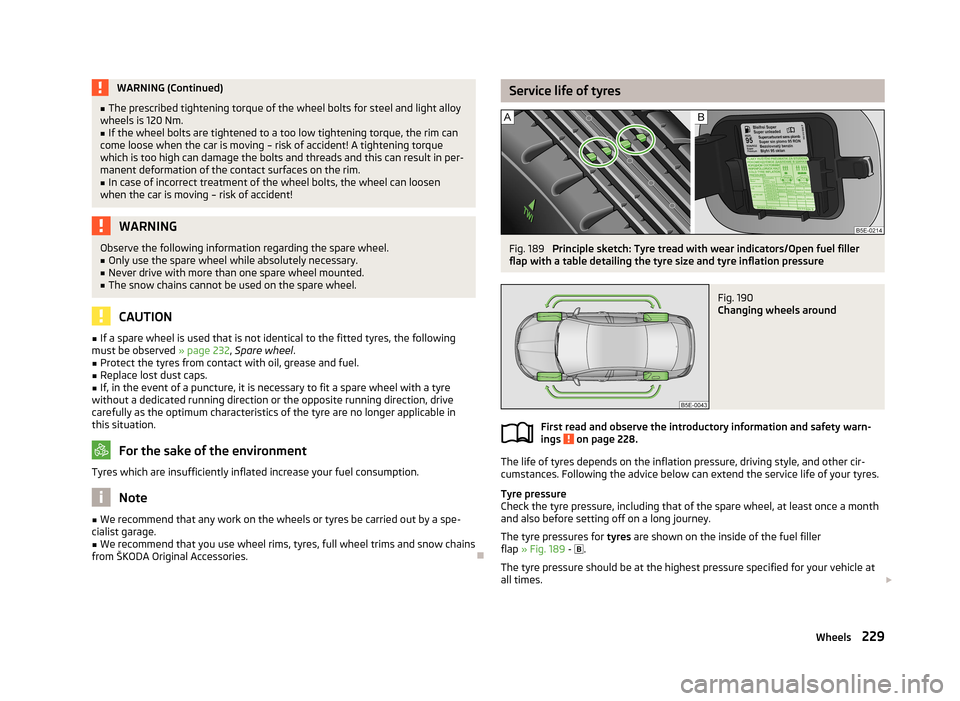
Service life of tyresFig. 189
Principle sketch: Tyre tread with wear indicators/Open fuel filler
flap with a table detailing the tyre size and tyre inflation pressure
Fig. 190
Changing wheels around
First read and observe the introductory information and safety warn-
ings on page 228.
The life of tyres depends on the inflation pressure, driving style, and other cir-
cumstances. Following the advice below can extend the service life of your tyres.
Tyre pressure
Check the tyre pressure, including that of the spare wheel, at least once a month and also before setting off on a long journey.
The tyre pressures for tyres are shown on the inside of the fuel filler
flap » Fig. 189 -
.
The tyre pressure should be at the highest pressure specified for your vehicle at all times.
229Wheels
Page 234 of 287

690 kg
730 kg
775 kg
Speed symbol
This indicates the maximum permissible vehicle speed with mounted tyres for the respective category.
130 km/h
160 km/h
170 km/h
180 km/h
190 km/h
200 km/h
210 km/h
240 km/h
270 km/h
300 km/h
CAUTION
The information about the load index and the speed symbol for your vehicle are
listed in your vehicle documents.
Unidirectional tyres
First read and observe the introductory information and safety warn-
ings
on page 228.
The direction of rotation of the tyres is marked by arrows on the wall of the tyre.
The indicated direction of rotation must be adhered to in order to obtain the best
benefits from the characteristics of these tyres.
These characteristics are mainly. › Increased driving stability.
› Reduced risk of aquaplaning.
› Reduced tyre noise and reduced tyre wear.
959799MQRSTUHVWYTyre control displayFig. 191
Button for setting the tyre infla-
tion pressure control value
First read and observe the introductory information and safety warn-
ings on page 228.
Calibration
After changing the tyre inflation pressure » page 229, in section Introduction ,
after changing one or several wheels, the position of a wheel on the vehicle or
when the warning light lights up while driving, a calibration of the system must
be carried out as follows:
›
Inflate all of the tyres to the specified inflation pressure » page 229.
›
Switch on the ignition.
›
Start the system calibration.
On vehicles with Infotainment » Operating instructions for Infotainment , chap-
ter Vehicle settings (CAR button) .
On vehicles with the radio preinstallation .
›
Press the symbol button
» Fig. 191 for longer than 2 seconds.
While pressing the button,
the warning light comes
on. At the same time,
the system memory is cleared and the new calibration process is started. This is
confirmed by an acoustic signal followed by the warning light
going off.
If the warning light
does not go out after the calibration, this indicates a sys-
tem fault. Seek help from a specialist garage.
Tyre pressure indicator
The warning light
lights up when any of the following conditions are true.
› The tyre inflation pressure is low.
› The structure of the tyre is damaged.
› The vehicle is loaded on one side.
231Wheels
Page 235 of 287

›The wheels of one axle are loaded more heavily (e.g. when towing a trailer or
when driving uphill or downhill).
› Snow chains are mounted.
› The spare wheel is mounted.
› One wheel per axle was changed.
For vehicles with Infotainment 1)
it can be determined which tyres should be
checked » Manual Infotainment , chapter Vehicle settings (key CAR) .WARNING■
When the warning light illuminates, immediately reduce the speed and
avoid sudden steering and brake manoeuvres. Stop the vehicle as soon as
possible and inspect the tyres and their inflation pressure.■
Under certain circumstances (e.g. sporty style of driving, wintry or unpaved
roads) the may light up after a delay, or not at all.
CAUTION
■
The tyre control display does therefore not replace the regular tyre inflation
pressure control, as the system cannot detect an even loss of pressure.■
The system cannot warn in case of very rapid tyre inflation pressure loss, e.g. in
case of sudden tyre damage. In this case carefully bring the vehicle to a standstill
without sudden steering movements or sharp braking.
■
To ensure a proper functioning of the tyre control display, it is necessary to re-
peat the basic setting every 10000 km or once a year.
Spare wheel
Fig. 192
Luggage compartment: Spare
wheel
First read and observe the introductory information and safety warn-
ings on page 228.
The spare wheel is located in a well under the floor covering in the boot and is
fixed in place with a special bolt » Fig. 192.
Take out wheel
›
Open the boot lid.
›
Raise the floor covering in the boot » page 99.
›
Remove the box with the tool kit.
›
Pull out safety lock
1
» Fig. 192 in the direction of the arrow.
›
Unscrew the
2
bolt in a counterclockwise direction.
›
Remove the wheel.
Store wheel away
›
Place the replaced wheel into the spare wheel well with the wheel rim pointing
downward.
›
Screw in bolt
2
» Fig. 192 in a clockwise direction, until the wheel is secure.
›
Insert safety lock
1
» Fig. 192 in the opposite direction to which the arrow is
pointing.
›
Place the box with the tool kit back into the spare wheel and secure it with the
tape.
›
Fold back the floor covering in the boot » page 99.
›
Shut the boot lid.
Install a wheel having the appropriate version and dimensions as soon as possi-
ble.
If the dimensions or design of the spare wheel differ from the tyres fitted to the
vehicle (e.g. winter tyres or low-profile tyres), it must only be used briefly in the
event of a puncture and if an appropriately cautious style of driving is adop-
ted »
.
Temporary spare wheel
A yellow warning label is displayed on the rim of the temporary spare wheel.
Please note the following if you intend to use the temporary spare wheel. › The warning label must not be covered after installing the wheel.
› Be specially attentive when driving.
› The inflation pressure for the temporary spare wheel is identical to the maxi-
mum inflation pressure of the standard tyres.
› Only use this temporary spare wheel to reach the nearest specialist garage, as it
is not intended for long-term use.
1)
Does not apply to vehicles with the Infotainment Blues and Swing system.
232General Maintenance
Page 236 of 287

WARNING■Never use the temporary spare wheel if it is damaged.■If the dimensions or design of the temporary spare wheel differ from the fit-
ted tyres, never drive faster than 80 km/h (or 50 mph).■
Avoid accelerating at full throttle, sharp braking and fast cornering.
CAUTION
Observe instructions on the warning sign of the emergency wheel.
Full wheel trim
First read and observe the introductory information and safety warn-
ings
on page 228.
Extracting
›
Hook the clamp found in the vehicle tool kit into the reinforced edge of the wheel trim.
›
Push the wheel wrench through the clamp, support on the tyre and pull off the
wheel trim.
Installing
›
Press the wheel trim onto the wheel rim at the valve opening provided.
›
Then press the trim into the wheel rim until its entire circumference locks cor- rectly in place.
CAUTION
■ Use the pressure of your hand only, do not strike the full wheel trim. Avoid
heavy knocks when the trim is not yet inserted in the wheel rim. This could cause damage to the guide and centring elements of the trim.■
When using the anti-theft wheel bolt, ensure that it is in the hole in the valve
area » page 240 , Securing wheels against theft .
■
If wheel trims are retrofitted it must be ensured that an adequate flow of air is
assured to cool the brake system.
Wheel boltsFig. 193
Remove the cap
First read and observe the introductory information and safety warn-
ings on page 228.
Extracting
›
Push the extraction pliers » page 236 sufficiently far onto the cap until the in-
ner catches of the pliers are positioned at the collar of the cap » Fig. 193.
›
Remove the cap.
Installing
›
Push the caps onto the wheel bolts up to the stop.
The wheel bolt caps are housed in a plastic box in the spare wheel or in the stor-
age space for the spare wheel.
Wheel bolts
First read and observe the introductory information and safety warn-ings
on page 228.
Wheels and wheel bolts are matched to each other in terms of design. Each time
you fit other wheels, e.g. light alloy wheels or wheels with winter tyres, you must
also use the matching wheel bolts of the correct length and shape of spherical cap. This is a prerequisite for ensuring that wheels are attached correctly.
233Wheels
Page 239 of 287

Fire extinguisherFig. 196
Fire extinguisher
First read and observe the introductory information given on page 235.
The fire extinguisher is attached by two straps in a holder underneath the driver's
seat.
Removing/attaching
›
Loosen the two straps by pulling the buckles in the direction of the ar- row » Fig. 196 .
›
Remove the fire extinguisher.
Follow these steps in the reverse order for attachment.
Please read carefully the instructions which are attached to the fire extinguish-
er.
The fire extinguisher must be checked by an authorised person once a year. The
national legal requirements must be observed.
WARNINGThe fire extinguisher must always be secured safely so that they do not come loose when making an emergency braking or in a vehicle collision which could
cause injuries to occupants.
Note
■ The fire extinguisher must comply with national legal requirements.■Pay attention to the expiration date of the fire extinguisher. If the fire extin-
guisher is used after the expiration date, its proper function is not assured.■
The fire extinguisher is part of the scope of delivery in certain countries only.
Vehicle tool kitFig. 197
Vehicle tool kit
First read and observe the introductory information given on page 235.
The vehicle tool kit and the lifting jack are housed in a plastic box in the spare wheel or in the storage space for the spare wheel. There is also space here for
the removable ball rod for the trailer towing device. The box is attached with a
strap on the spare wheel.
The components of the vehicle tool kit (depending on vehicle equip- ment) » Fig. 197 .
Screwdriver
Key for removing and installing the tail light
Adapter for anti-theft wheel bolts Towing eye
Clamps for removing the wheel trims
Car jack
Crank for the jack
Wheel wrench
Extraction pliers for wheel bolt caps Replacement bulb set
Screw the jack back into its home position after use to allow you to store it in the
box with the toolkit.
12345678910236Do-it-yourself