2013 SKODA FABIA weight
[x] Cancel search: weightPage 125 of 223

The distribution of the weight is very poor if your vehicle is unladen and the trail-
er is laden. Maintain a particularly low speed if you cannot avoid driving with this
combination.
Tyre pressure
Correct the tyre inflation pressure on your vehicle for a “full load” » page 174,
Tyre service life .
Trailer load
The permissible trailer load must not be exceeded under any circumstan- ces » page 201 , Technical data .
The trailer loads specified apply only to altitudes up to 1 000 metres above mean
sea level.
The engine output falls as altitude increases, as does the ability to climb. There-
fore, for every additional 1000 m in height (or part), the maximum permissible
towed weight must be reduced by 10 %.
The towed weight comprises the actual weights of the (loaded) towing vehicleand the (loaded) trailer.
The trailer and drawbar load information on the type plate of the towing equip- ment are merely test data for the towing equipment. The vehicle-specific values
are detailed in the vehicle documents.WARNING■ Do not exceed the maximum permissible axle and drawbar load and the
maximum permissible total or towed weight of the vehicle and the trailer –
there is the risk of an accident and serious injury.■
Slipping loads can significantly affect the stability and safety of the vehicle/
trailer combination – there is the risk of an accident and serious injury.
Towing a trailer
First read and observe the introductory information and safety warn-
ings
on page 121.
Exterior mirrors
You have to have additional exterior mirrors fitted if you are not able to see the
traffic behind the trailer with the standard rear-view mirrors. National legal re-
quirements must be observed.
Headlights
The front of the vehicle can be lifted when a trailer is being towed and the head-
lights can dazzle other road users.
Adjust the headlight setting on the headlight range control » page 44, Headlight
beam adjustment .
Driving speed
For safety reasons, do not drive faster than 80 km/h when towing a trailer.
Immediately reduce your speed as soon as even the slightest swaying of the trail- er is detected. Never attempt to stop the trailer from “swaying” by accelerating.
Brakes
Apply the brakes in good time! If the trailer is fitted with a trailer brake, apply the
brakes gently at first, then brake firmly. This will avoid brake jolts resulting from
the trailer wheels locking.
On downhill sections shift down a gear in good time to also use the engine as a
brake.
Engine overheating
The speed must be reduced immediately if the needle for the coolant tempera- ture gauge moves into the right-hand area or the red area of the scale.
Stop and switch off the engine if the warning light
in the instrument cluster
starts to flash. Wait a few minutes and check the level of coolant » page 167,
Checking the coolant level .
The following guidelines must be observed » page 22,
Coolant .
The coolant temperature can be reduced by switching on the heating.WARNING■ Adapt your speed to the conditions of the road surface and to the traffic sit-
uation.■
Improper or incorrectly connected electric cables can energise the trailer and
cause functional faults to the vehicle's entire electrical system as well as acci-
dents and severe injuries.
■
Work on the electrical system must only be carried out by specialist garages.
■
Never directly connect the trailer's electrical system with the electrical con-
nections for the tail lights or other current sources.
122Driving
Page 132 of 223

WARNINGObserve the following instructions for the proper use of the seat belts.■Never use a seatbelt to secure two persons (not even children). Nor may the
seat belt be placed over a child who is sitting on the lap of another passenger.■
The lock tongue should only be inserted into the lock which is the correct
one for your seat. Wrong use of the safety belt will reduce its capacity to pro-
tect and the risk of injury increases.
■
The slot of the belt tongue must not be blocked otherwise the belt tongue
will not lock in place properly.
■
Many layers of clothing and loose clothing (e. g. a winter coat over a jacket)
do not allow you to be correctly seated and impairs proper operation of the
seat belts.
■
It is prohibited to use clamps or other objects to adjust seat belts (e. g. for
shortening the belts for smaller persons).
■
The seat belts for the rear seats can only fulfil their function reliably when
the seat backrests are correctly locked into position » page 56.
WARNINGObserve the following instructions for proper use of the seat belts.■The belt webbing must always be kept clean. Soiled belts may impair proper
operation of the inertia reel » page 157, Seat belts .■
The seat belts must not be removed or changed in any way. Do not attempt
to repair the seat belts yourself.
■
Check the condition of all the seat belts on a regular basis. If any damage to
the seat belts, seat belt connections, inertia reel or the lock is detected, the
seat belt concerned must be replaced by a specialist garage.
■
Damaged seat belts which have been subjected to stress in an accident and
were therefore stretched, must be replaced - this is best done by a specialist
garage. The anchorage points of the belts must also be inspected. The an-
chorage points for the belts should also be checked.
Note
The national legal requirements must be observed when using seat belts.
The physical principle of a frontal collisionFig. 108
Driver without a fastened seat belt/rear seat passenger without a
fastened seat belt
First read and observe the introductory information and safety warn-ings
on page 128.
As soon as the vehicle is moving, so-called kinetic energy (the energy of motion)
is produced both in terms of the car as well as in terms of the occupants.
The magnitude of this kinetic energy depends essentially on the speed at which
the vehicle is travelling and on the weight of the vehicle including the occupants.
The greater the speed and weight increase, the greater the amount of energy
which has to be absorbed in the event of an accident.
The speed of the vehicle is the most important factor. Doubling the speed of the
vehicle from 25 km/h up to 50 km/hour increases the kinetic energy four times.
The notion that it is possible to support your body with your hands in a minor ac-cident is incorrect. Even in a collision at only a low speed, the forces acting on thebody are such that it is no longer possible to support your body.
Even if you only drive at a speed of 30 km/h to 50 km/h, the forces that your body is exposed to in the event of an accident can exceed a ton (1000 kg).
For example, a person's weight of 80 kg “increases” at 50 km/h to 4.8 tons
(4800 kg).
In the event of a frontal collision, occupants of the car not wearing a seat belt are
thrown forward in an uncontrolled way and strike parts of the interior of the car,
such as the steering wheel, dash panel or windscreen » Fig. 108 -
. In certain
circumstances you could even be thrown out of the vehicle, which could cause life threatening or even fatal injuries.
129Seat belts
Page 145 of 223

Child safety and side airbagFig. 118
Incorrect seated position of a child who is not properly secured – at
risk from the side airbag/Child properly protected by safety seat
First read and observe the introductory information and safety warn-
ings
on page 140.
The child must not be positioned in the area into which the side airbag will de-
ploy » Fig. 118 -
.
There must be sufficient room between the child and the area into which the side
airbag will deploy to allow the airbag to provide as much protection as possi-
ble » Fig. 118 -
.
WARNING■
Children must never be seated with their head in the deployment area of
the side airbag – there is a risk of injury.■
Do not place any objects within the deployment area of the side airbags –
there is a risk of injury.
Classification of child seats
First read and observe the introductory information and safety warn-
ings
on page 140.
Classification of child seats according to the ECE-R 44 standard.
GroupWeight of the childApproximate age0up to 10 kgup to 9 months0+up to 13 kgup to 18 months19-18 kgup to 4 years215-25 kgup to 7 years322-36 kgover 7 years
Use of child seats fastened with a seat belt
First read and observe the introductory information and safety warn-ings
on page 140.
Overview of the use of child seats fastened with a seat belt on each of the seats
in accordance with the ECE-R 16 standard.
GroupFront passenger seatRear seatsoutsideRear seat centre0
up to 10 kgUUU0+
up to 13 kgUUU1
9-18 kgUUU2
15-25 kgUUU3
22-36 kgUUU
“Universal” child seat category - a child seat designed for fastening on the
seat with the seat belt.
U142Safety
Page 204 of 223
Technical data
Technical data
Vehicle data
Introduction
This chapter contains information on the following subjects:
Vehicle identification data
201
Dimensions
202
Vehicle-specific details according to engine type
204
The details given in the vehicle's technical documentation always take prece-
dence over the details in the Owner's Manual.
The listed performance values were determined without performance-reducing
equipment, e.g. air conditioning system.
Vehicle identification data
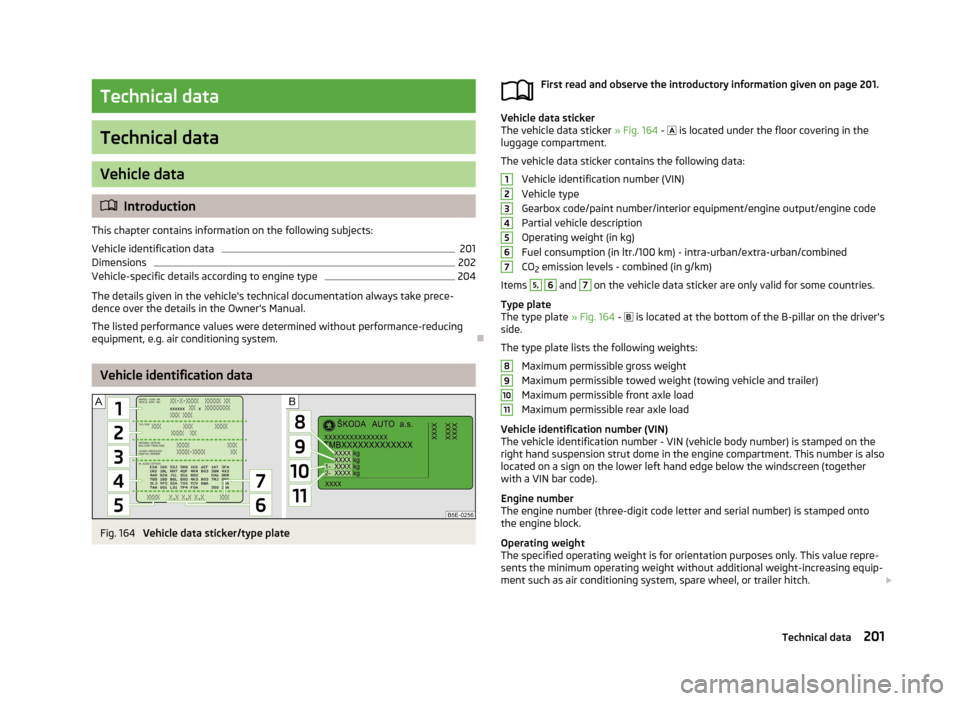
Fig. 164
Vehicle data sticker/type plate
First read and observe the introductory information given on page 201.
Vehicle data sticker
The vehicle data sticker » Fig. 164 - is located under the floor covering in the
luggage compartment.
The vehicle data sticker contains the following data: Vehicle identification number (VIN)
Vehicle type
Gearbox code/paint number/interior equipment/engine output/engine code Partial vehicle description
Operating weight (in kg)
Fuel consumption (in ltr./100 km) - intra-urban/extra-urban/combined
CO 2 emission levels - combined (in g/km)
Items
5,
6
and
7
on the vehicle data sticker are only valid for some countries.
Type plate
The type plate » Fig. 164 -
is located at the bottom of the B-pillar on the driver's
side.
The type plate lists the following weights:
Maximum permissible gross weight
Maximum permissible towed weight (towing vehicle and trailer)
Maximum permissible front axle load
Maximum permissible rear axle load
Vehicle identification number (VIN)
The vehicle identification number - VIN (vehicle body number) is stamped on the
right hand suspension strut dome in the engine compartment. This number is also
located on a sign on the lower left hand edge below the windscreen (together
with a VIN bar code).
Engine number
The engine number (three-digit code letter and serial number) is stamped onto
the engine block.
Operating weight
The specified operating weight is for orientation purposes only. This value repre- sents the minimum operating weight without additional weight-increasing equip-ment such as air conditioning system, spare wheel, or trailer hitch.
1234567891011201Technical data
Page 205 of 223
The operating weight also contains the weight of the driver (75 kg), the weight of
the operating fluids, the tool kit, and a fuel tank filled to 90 % capacity.
It is possible to calculate the approximate loading capacity from the difference
between the permissible total weight and the operating weight »
.
The payload consists of the following components: › Passengers
› All items of luggage and other loads
› Roof load including roof rack system
› Equipment not included in the operating weight
› Trailer drawbar load when towing a trailer (max. 50 kg).
Measuring the fuel consumption and CO 2 emissions according to the ECE
regulations and EU directives
The measurement of the intra-urban cycle begins with a cold start of the engine.
Afterwards urban driving is simulated.
In the extra-urban driving cycle, the vehicle is accelerated and decelerated in all gears, corresponding to daily routine driving conditions. The driving speed varies
between 0 and 120 km/h.
The calculation of the combined fuel consumption considers a weighting of about 37 % for the intra-urban cycle and 63 % for the extra-urban cycle.WARNINGDo not exceed the specified maximum permissible weights – there is the riskof an accident and damage.
Note
■ If required, you can find out the precise weight of your vehicle by contacting a
specialist garage.■
The fuel consumption and emission values have been determined in accordance
with rules and under conditions set out by legal or technical requirements for de-
termining operational and technical data for motor vehicles.
■
Depending on the range of equipment, style of driving, traffic situation, weather
influences and vehicle condition, consumption values may deviate from the indi-
cated values.
Dimensions
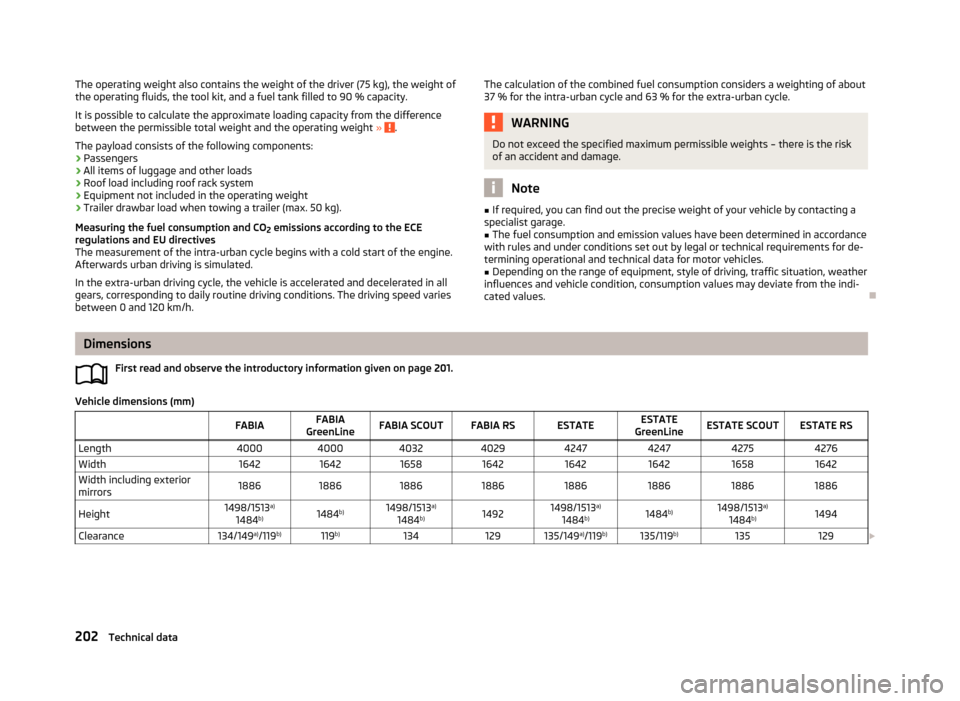
First read and observe the introductory information given on page 201.
Vehicle dimensions (mm)
FABIAFABIA
GreenLineFABIA SCOUTFABIA RSESTATEESTATE
GreenLineESTATE SCOUTESTATE RSLength40004000403240294247424742754276Width16421642165816421642164216581642Width including exterior
mirrors18861886188618861886188618861886Height1498/1513 a)
1484 b)1484 b)1498/1513 a)
1484 b)14921498/1513 a)
1484 b)1484b)1498/1513 a)
1484 b)1494Clearance134/149 a)
/119 b)119b)134129135/149 a)
/119 b)135/119 b)135129
202Technical data
Page 219 of 223

U
Underbody protection
154
Underbody waxing154
Unleaded petrol109
unlock Central locking system
33
Unlocking Remote control
34
without central locking30
Unlocking and locking28
USB94
Useful equipment69
12-volt power outlet70
Ashtray69
Car park ticket holder71
Cigarette lighter70
Clothes hood71
Cupholders69
Using the selector lever101
V
Variable loading floor
62
Dividing the luggage compartment62
Removing and refitting63
Vehicle battery Automatic load deactivation
172
Charging171
Checking the electrolyte level171
Cover170
Disconnecting and reconnecting172
Operation in winter171
Replacing172
Safety instructions169
Vehicle care Alcantara
156
Care of the interior155
Decorative films153
Fabrics156
Polishing152
Rubber seals153
Seat covers157
Synthetic leather156
Underbody waxing154
Vehicle exterior care151
Waxing152
Vehicle data sticker201
Vehicle dimensions202
Vehicle identification number (VIN)201
Vehicle key28
Vehicle status see Auto Check Control
19
Vehicle tool kit181
Visors50
W
Warning lights
20
Warning symbols see warning lights
20
Warning triangle180
Warranty5
Washing145
Automatic car wash system151
by hand150
Chrome parts153
High-pressure cleaner151
Water Driving through
109
Waxing See Vehicle care
152
Weights201
Wheel bolts Anti-theft wheel bolt
184
Caps178
Loosening and tightening183
Wheels Bolts
179
Changing181
Full trim178
General information173
Load index175
Snow chains179
Spare wheel177
Speed symbol176
Storing wheels174
Swapping wheels around174
Temporary spare wheel177
Tyre pressure174
Tyre service life174
Tyre wear indicator174
Unidirectional tyres176
Wheel sizes174
Winter tyres179
Wheels and tyres Hubcaps
178
Window convenience operation40
Windows153
Deicing153
See Electrical power windows38
Window wipers Replacing the rear window wiper blade
52
Windscreen Deicing
153
Windscreen washer fluid Checking
163
Replenishing163
Warning light26
Winter163
Windscreen washer system163
Windscreen wash system Windscreen washer
51
Windscreen wiper Operate
51
Replacing the windscreen wiper blades52
Windscreen wipers Cleaning the windscreen wiper blades
52
Windscreen washer fluid163
Winter Deicing windows
153
216Index
Page 221 of 223
ŠKODA AUTO a.s. pursues a policy of constant product and model development.We trust that you will understand that changes to models in terms of shape,equipment and engineering, may be introduced at any time. The informationabout appearance, performances, dimensions, weight, standards and functions ofthe vehicle is correct at the time of publication. Some equipment may only be re-leased later or may only be offered in certain markets. Information may be ob-
tained from ŠKODA Partners. It is therefore not possible for legal claims to be
made based on the data, illustrations and descriptions contained in this Owner's Manual.Reprinting, reproduction, translation, or any other use, either in whole or in part,
is not permitted without the written consent of ŠKODA AUTO a.s..
ŠKODA AUTO a.s. expressly reserves all rights relating to copyright laws.
Subject to change.
Issued by: ŠKODA AUTO a.s.
© ŠKODA AUTO a.s. 2013