2013 SKODA FABIA ECU
[x] Cancel search: ECUPage 38 of 223

Folding in the key bit›Press the button 4 » Fig. 16 and fold in the key bit.
Unlocking
The turn signal lights flash twice as confirmation that the vehicle has been un-
locked. If the vehicle is unlocked using button 1
» Fig. 16 and none of the doors
or the tailgate are opened within the next 30 seconds, the vehicle is automatical-
ly locked again and the safe securing system or anti-theft alarm system is reacti- vated. This function is intended to prevent the car being unlocked unintentional-ly.
In addition, when the car is unlocked, the electrically adjustable seats and exteri-
or mirrors move into the position assigned to this key. The stored setting of driver
seat and exterior mirrors is retrieved.
Locking
The turn signal lights flash once to confirm that the vehicle has been correctly
locked.
If the doors or the boot lid remain open after the vehicle has been locked, the
turn signal lights do not flash until they have been closed.
WARNINGIf the car is locked from the outside and the safe securing system is activated,
there must not be any person in the car as it is then not possible to open ei-
ther a door or a window from the inside. The locked doors make it more diffi-
cult for rescuers to get into the vehicle in an emergency – risk of death.
Note
■ Only operate the remote control when the doors and boot lid are closed and the
vehicle is in your line of sight.■
A ŠKODA partner can also activate/deactivate the acoustic signals on vehicles
with an anti-theft alarm system.
Synchronization
First read and observe the introductory information given on page 34.
If the vehicle does not unlock when the remote control is pressed, the key may
not be synchronised. This can occur when the buttons on the remote control key are pressed several times outside the operating range of the equipment or if the
battery in the remote control key has been replaced.
Synchronise the key as follows.
›
Press any button on the remote control key.
›
Unlock the door with the key within 1 minute of pressing the button.
Anti-theft alarm system
Introduction
This chapter contains information on the following subjects:
Operation
36
Interior monitor and towing protection
36
The anti-theft alarm system increases the level of protection against people
seeking to break into the vehicle. The system triggers audible and visual warning
signals if an attempt is made to break into the vehicle.
Note
■ The working life of the alarm siren is 5 years.■Before leaving the car, it must be checked that all of the windows, doors and
the electric sliding/tilting roof are properly closed to ensure the full functionality
of the anti-theft alarm system.■
Coding of the radio remote control and the receiver unit precludes the use of
the radio remote control from other vehicles.
35Unlocking and locking
Page 39 of 223

OperationFirst read and observe the introductory information given on page 35.
How is the alarm system activated?
The anti-theft alarm system is activated when the vehicle is locked with the radio remote control or the key in the driver's door . It is activated 30 seconds after
locking the door.
How is the alarm system deactivated?
The alarm system is deactivated by pressing the button on the remote control.
The anti-theft alarm system is reactivated if the vehicle is not opened within 30
seconds after transmitting the radio signal.
If the vehicle is unlocked by inserting the key into the driver door, the key must
be inserted into the ignition lock and the ignition switched on within 15 seconds
of unlocking the door to deactivate the alarm system. The alarm is triggered if
the ignition is not switched on within 15 seconds.
When is the alarm triggered?
The following security areas of the locked vehicle are monitored:
› bonnet;
› boot lid;
› doors;
› ignition lock;
› Vehicle inclination
» page 36;
› Interior of the vehicle
» page 36;
› A drop in voltage of the on-board power supply;
› Socket of the factory-fitted towing device.
An alarm is immediately triggered if either of the two battery terminals is discon- nected while the anti-theft alarm system is activated.
How is the alarm switched off?
The alarm is turned off by pressing the
button on the remote control key or
switching the ignition on.
Interior monitor and towing protectionFig. 17
Button for interior monitor and
towing protection
First read and observe the introductory information given on page 35.
The interior monitor detects movements inside the car and then triggers the
alarm.
Switching off
›
Switch off the ignition.
›
Open the driver door.
›
Press the
» Fig. 17 button in the driver's door.
›
Lock the vehicle within 30 seconds.
The interior monitor and the towing protection are switched on again automati- cally the next time the car is locked.
Note
■ Switch off the interior monitor and the towing protection if there is a possibility
of the alarm being triggered by movements from (e.g. children or animals) within
the vehicle interior or if the vehicle has to be transported (e.g. by train or ship) or towed.■
The opened glasses storage compartment reduces the effectiveness of the in-
terior monitor. To ensure the full functionality of the interior monitor, the glasses
storage compartment must always be closed before locking the vehicle.
36Using the system
Page 55 of 223
Headlight cleaning systemFirst read and observe the introductory information and safety warn-
ings
on page 50.
The headlights are sprayed briefly if the low beam or main beam are switched on
and the windscreen wiper stalk is pulled to position
5
» Fig. 33 on page 51. To
clean the headlights, the windshield is also sprayed after every five squirts.
You should remove stubborn dirt (such as insect residues) from the headlight len-
ses at regular intervals, for example when refuelling. The following guidelines
must be observed » page 154, Headlight lenses .
To ensure the proper operation of the cleaning system during the winter, any
snow should be removed from the washer nozzle fixtures and ice should be
cleared with a de-icing spray.
CAUTION
Never remove the nozzles from the headlight cleaning system by hand – there is
risk of damage.
Replacing the windscreen wiper blades
Fig. 34
Windscreen wiper blade
First read and observe the introductory information and safety warn- ings on page 50.
Removing the wiper blade
›
Lift the windscreen wiper arm away from the windscreen.
›
Press the locking button
1
» Fig. 34 and remove the wiper blade in the direc-
tion of arrow
2
.
Fitting the wiper blade›Push the wiper blade in until it latches on the stop.›
Check that the wiper blade is correctly attached.
›
Fold the wiper arms back to the windscreen.
Windshield wiper blades in proper condition are essential to obtain good visibility.
Wiper blades should not be allowed to become dirtied by dust, insect remains and
preserving wax.
Juddering or smearing of the wiper blades could then be due to wax residues left on the windshield by vehicle washing in automatic vehicle wash systems. It is
therefore important to degrease the lips of the windshield wiper blades after ev-
ery pass through an automatic vehicle wash system .
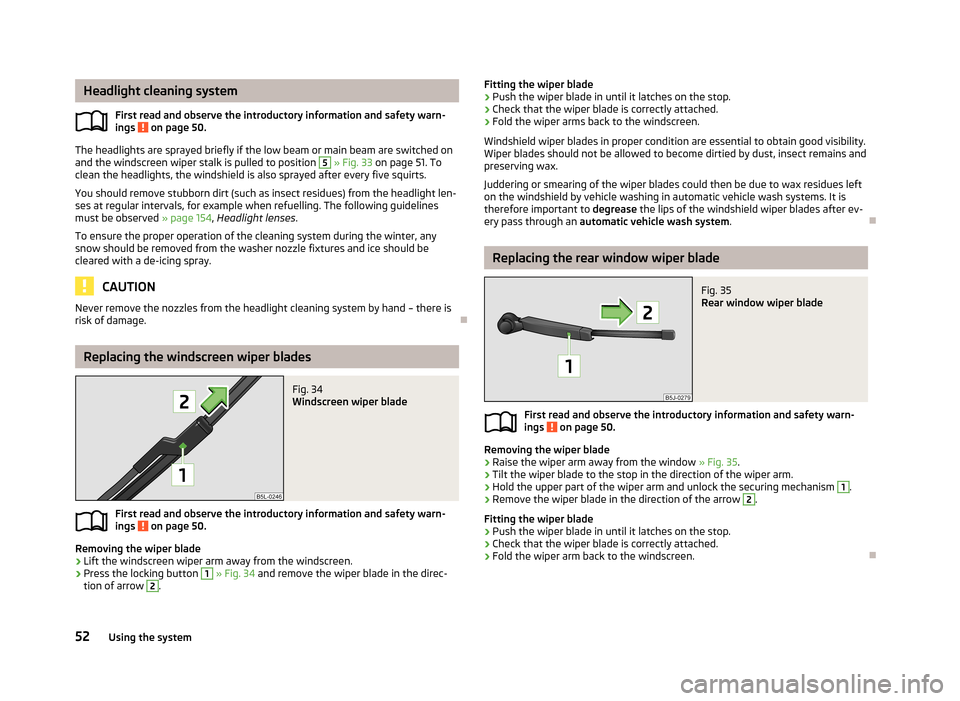
Replacing the rear window wiper blade
Fig. 35
Rear window wiper blade
First read and observe the introductory information and safety warn-
ings on page 50.
Removing the wiper blade
›
Raise the wiper arm away from the window » Fig. 35.
›
Tilt the wiper blade to the stop in the direction of the wiper arm.
›
Hold the upper part of the wiper arm and unlock the securing mechanism
1
.
›
Remove the wiper blade in the direction of the arrow
2
.
Fitting the wiper blade
›
Push the wiper blade in until it latches on the stop.
›
Check that the wiper blade is correctly attached.
›
Fold the wiper arm back to the windscreen.
52Using the system
Page 59 of 223

WARNINGIf, as an occupant, you have a subdued pain and/or temperature sensitivity,
e.g. through medication, paralysis or because of chronic illness (e.g. diabetes),
we recommend not to use the seat heating. This can lead to burns on the
back, the posterior and the legs which are difficult to heal. If the seat heating
is used, we recommend to make regular breaks in your journey when driving
long distances, so that the body can recuperate from the stress of the jour- ney. Please consult your doctor, who can evaluate your specific condition.
CAUTION
■ Do not kneel on the seats or otherwise apply pressure at specific points to
avoid damaging the heating elements for the seat heaters.■
Do not turn on the seat heater if seats are not occupied.
■
Do not switch on the seat heating if the seats have objects attached to or
placed on them, for example a child seat, a bag, etc. A fault of the heating ele- ments in the seat heating can occur.
■
If additional seat covers or protective covers are attached to the seats, do not
turn on the seat heater - there is a risk of damaging the seat covers and seat
heating.
■
Do not clean the seats using moisture » page 157.
Note
■
The seat heating should only be switched on when the engine is running. This
has a significant effect of saving on the battery capacity.■
If the on-board voltage drops, the seat heating is switched off automatically, in
order to provide sufficient electrical energy for the engine control » page 172,
Automatic load deactivation .
Rear seats
Introduction
This chapter contains information on the following subjects:
Folding the seat backrest forwards
56
Folding the seat cushions forwards, removing
57
Folding the seat backrest forwardsFig. 40
Unlock the seat backrest
First read and observe the introductory information given on page 56.
The luggage compartment can be increased in size by folding the seat backrests
forward. The seat backrests can be folded forward individually on vehicles with
divided rear seats.
Folding forward
›
Before folding the rear seats forwards, adapt the position of the front seats in such a way that they are not damaged by the folded rear seats.
›
Unlock the seat backrest by pressing the securing knob
A
» Fig. 40 and fold it
forwards.
›
Pull the head restraint out of the seat backrest.
›
Fold the seat backrest completely forwards.
Folding backwards
›
Push the head restraint into the slightly lifted seat backrest.
›
Then push the seat backrest back into the upright position until the securing knob clicks into place - check by pulling on the seat backrest » .
›
Make sure that the red pin
B
is hidden.
WARNING■
The belts and the belt locks must be in their original position after folding
back the seat backrests - they must be ready to use.■
The seat backrests must be securely latched in position so that no objects
from the luggage compartment can slip into the passenger compartment un-
der sudden braking – there is a risk of injury.
■
Ensure that the rear seat backrests are properly engaged. It is only then that
the three-point seat belt for the middle seat can reliably fulfil its function.
56Using the system
Page 63 of 223

NoteThe upper front lashing eyes are located underneath the folding rear seat back-
rest » Fig. 44 .
Folding hooks
Fig. 45
Boot: folding hooks
First read and observe the introductory information and safety warn-
ings on page 58.
Folding hooks for attaching small items of luggage, such as bags etc., are provi- ded on both sides of the luggage compartment. » Fig. 45.
CAUTION
The maximum permissible load of the hook is 7.5 kg.
Fixing netsFig. 46
Fixing net: double horizontal pocket, floor fixing net/double vertical
pockets
First read and observe the introductory information and safety warn-
ings
on page 58.
Fixing examples for a fixing net as a horizontal pocket, floor fixing net » Fig. 46 -
and a horizontal pocket » Fig. 46 -
.
WARNINGDo not exceed the maximum permissible load of the fixing nets. Heavy objects
are not secured adequately – there is a risk of injury.
CAUTION
■ The maximum permissible load of the fixing nets is 1.5 kg.■Do not place any sharp objects in the nets – risk of damaging the net.
60Using the system
Page 65 of 223

CAUTIONIn this position » Fig. 48 - the luggage compartment cover is designed for small
objects up to a weight of 2.5 kg.
Retractable luggage compartment cover (Fabia Estate)
Fig. 49
Boot: foldable boot cover/removing foldable boot cover
First read and observe the introductory information and safety warn-
ings
on page 58.
Pulling out
›
Pull the retractable luggage compartment cover in direction of arrow
1
» Fig. 49 as far as the stop into the secured position.
Retracting
›
Press the cover in the handle area in the direction of the arrow
2
, and the cov-
er automatically rolls up into position.
Removing
›
The fully folded luggage compartment cover can be removed to transport bulky
goods by pressing on the side of the cross rod in the direction of the arrow
3
and taking it out by moving it in the direction of the arrow
4
.
WARNINGNo objects should be placed on the foldable boot cover.
Variable loading floor in the luggage compartment
(Fabia Estate)
Introduction
This chapter contains information on the following subjects:
Dividing up the luggage compartment with variable loading floor
62
Removing and refitting the variable loading floor
63
Removing and installing carrier rails
63
The variable loading floor makes handling of bulky items of luggage easier.
CAUTION
The maximum permissible load of the variable loading floor is 75 kg.
Note
The room under the variable loading floor can be used to stow objects.
Dividing up the luggage compartment with variable loading
floor
Fig. 50
Dividing the boot with variable
loading floor
First read and observe the introductory information and safety warn-
ings on page 62.
›
Lift up the part with the grip and secure it by sliding it into the grooves marked
with the arrows » Fig. 50.
62Using the system
Page 66 of 223

Removing and refitting the variable loading floorFig. 51
Fold up variable loading floor/remove
First read and observe the introductory information and safety warn-
ings
on page 62.
Removing
›
Unlock the variable loading floor by turning the securing bolts
A
around 180°
anticlockwise » Fig. 51.
›
Fold up the loading floor by moving it in the direction of the arrow
B
.
›
Fold up the variable loading floor in the direction of the arrow
1
» Fig. 51 and
remove by pulling in the direction of the arrow
2
Fitting
›
Fold up the variable loading floor and place it on the carrier rails.
›
Fold out the variable loading floor.
›
Lock the variable loading floor by turning the locking bolt
A
to the right by ap-
prox. 180°.
WARNINGEnsure that the carrier rails and variable loading floor are correctly fastened
when fitting the variable loading floor. If this is not the case, there is a risk of
injury for the occupants.
Removing and installing carrier railsFig. 52
Slacken check points/remove carrier rails
First read and observe the introductory information and safety warn- ings
on page 62.
Removing
›
Undo the securing points
B
» Fig. 52 on the carrier rails using the vehicle key or
a flat screwdriver.
›
Grasp the carrier rail
A
at position
1
and slacken it by pulling in the direction
of arrow. You can take out the removable storage compartments in order to fa-
cilitate the removal » page 75, Storage compartments in the boot .
›
Grasp the carrier rail
A
at position
2
and slacken it by pulling in the direction
of arrow.
›
The carrier rail on the other side of the luggage compartment can be removed in
the same way.
Fitting
›
Position the carrier rails on the sides of the boot.
›
Press the two securing points
B
» Fig. 52 on each carrier rail to the stop.
›
Check the attachment of the carrier rails by pulling it.
WARNINGEnsure that the carrier rails and variable loading floor are correctly fastened
when fitting the variable loading floor. If this is not the case, there is a risk of
injury for the occupants.
63Seats and storage
Page 67 of 223

Net partition (Fabia Estate)
Introduction
This chapter contains information on the following subjects:
Using the net partition behind the rear seats
64
Using the net partition behind the front seats
65
Removing and refitting the net partition housing
65WARNING■ The belt locks and the belts must be in their original position after folding
back the seat cushions and backrests - they must be ready to use.■
The seat backrests must be securely latched in position so that no objects
from the luggage compartment can slip into the passenger compartment un- der sudden braking – there is a risk of injury.
■
Ensure that the rear seat backrests are properly engaged. It is only then that
the three-point seat belt for the middle seat can reliably fulfil its function.
■
Make sure that the transverse rod is inserted into the mounts
C
» Fig. 53
on page 64 or » Fig. 54 on page 65 in the forward position.
Using the net partition behind the rear seats
Fig. 53
Extending/retracting the net partition
First read and observe the introductory information and safety warn-
ings on page 64.
Extending
›
Open the rear right door.
›
Fold down the rear seat backrests slightly forwards, which makes it possible to
clear the access for removing the net partition.
›
Pull the net partition by tab
A
» Fig. 53 out of the housing
B
in the direction of
mounts
C
.
›
Insert the transverse rod into one of the mounts
C
and push forwards.
›
Insert the transverse rod into the mount
C
on the other side of the vehicle in
the same way.
›
Then push the seat backrest back into the upright position until the securing
knob clicks into place - check by pulling on the seat backrest.
Retracting
›
Pull the transverse rod back slightly first on one side and then on the other and
remove it from the mounts
C
» Fig. 53 .
›
Hold the transverse rod in such a way that the net partition can slowly roll up
into the housing
B
without being damaged.
If you wish to use the entire boot, the foldable boot cover can be re- moved » page 62 .
64Using the system