2013 SKODA CITIGO coolant capacity
[x] Cancel search: coolant capacityPage 128 of 176

In the following situation, it is possible that the tank cannot be fully filled with
natural gas.
› At very high ambient temperatures. The natural gas refuelling systems have
overheating protection. When the ambient temperature reaches a predefined value, the refuelling system automatically switches off.
› If the refuelling system has been in operation for a longer period, the filling
pressure of the natural gas refuelling system slightly drops.WARNING■ Stop the engine before refuelling.■Always switch off your mobile phone, do not smoke and do not use open
flames when refuelling with natural gas – risk of explosion!■
When refuelling, never get into the vehicle. If you have to get into your vehi-
cle in exceptional cases, close the door and touch a metal surface before you
touch the filling coupling again. This will avoid electrostatic discharges, which
may generate sparks. Sparks can cause a fire during refuelling.
■
Natural gas is highly explosive and flammable. Incorrect refuelling or improp-
er handling of natural gas can cause a fire, an explosion and injuries.
Note
■ The natural gas system of your vehicle is suitable both for fuelling from small
compressors (slow fuelling) and for fuelling from natural gas stations with large
compressors (quick fuelling).■
Noises that occur during refuelling represent no risk.
■
If the vehicle is parked for a longer period of time immediately after refuelling,
the situation may arise in which the pointer of the fuel tank gauge does not indi- cate exactly the same level as was the case immediately after refuelling when theengine is restarted. This is not due to any system leakages but a drop in pressurein the natural gas fuel tank due to technical reasons after a cooling phase directly
after refuelling.
■
For frequent short-haul traffic, especially at low outside temperatures, the vehi-
cle is driven more frequently in petrol mode than in natural gas mode. This is why the petrol tank runs empty faster than the natural gas tank.
■
The capacity of the natural gas tank is about 11 kg, of which about 1.5 kg are a
reserve.
■
The capacity of the petrol tank is about 10 l, of which about 5 l are a reserve.
Automatic switching from CNG to petrol mode
First read and observe the introductory information and safety warn-
ings
on page 123.
The vehicle automatically switches over from CNG mode to petrol mode when the following conditions are met:
› when starting the engine, if the coolant temperature is below 15 °C,
› when the natural gas tank is empty,
› after refuelling with natural gas.
Natural gas as fuel
First read and observe the introductory information and safety warn-ings
on page 123.
Natural gas is an alternative fuel for motor vehicles. Its main component is meth-
ane (CH 4). The rest is carbon dioxide and lower hydrocarbons.
The strict legal requirements for exhaust emissions of motor vehicles are decisive for the current significance of natural gas. In direct comparison to all other fossil
fuels, natural gas is one of the fuels which cause the lowest emissions.
Natural gas is odourless and lighter than air. For safety reasons, it is saturated
with odorous substances, so that is perceived even in very small amounts.
Regular gas system checks
First read and observe the introductory information and safety warn-ings
on page 123.
Every two years, the following inspections must be carried out:
› Check the condition of the fuel filler cap, filler neck and sealing ring, and clean
sealing ring if necessary.
› Check gas system for leaks.
The following checks must be carried out every four years: › Check gas tank mounting for secure attachment and possible damage.
The gas tank must be filled prior to the regular gas system check.
125Inspecting and replenishing
Page 132 of 176

›Take the bonnet support out of its holder 3
» Fig. 104 in the direction if the
arrow and secure the opened bonnet by inserting the end of the support in the
opening 4
designed for it.
Closing
›
Lift the bonnet slightly and unhook the bonnet support. Insert the bonnet sup-
port into the holder
3
designed for this purpose » Fig. 104.
›
Let the bonnet drop into the lock carrier lock from a height of around 20 cm – do
not push it in .
WARNINGCheck that the bonnet is closed properly.
CAUTION
Never open the bonnet using the locking lever » Fig. 103.
Engine compartment overview
Fig. 105
Schematic diagram: Engine compartment
First read and observe the introductory information and safety warn- ings
on page 127.
Engine oil dipstick
131
Engine oil filler opening
131
Coolant expansion reservoir
132123Brake fluid reservoir133Vehicle battery134
Windscreen washer fluid reservoir
129
Radiator fan
First read and observe the introductory information and safety warn-
ings
on page 127.
The radiator fan is powered by an electric motor. Operation is controlled accord-
ing to the temperature of the coolant.
WARNINGAfter switching off the ignition, the fan may intermittently continue to oper-
ate for approx. 10 minutes.
Windscreen washer system
Fig. 106
Engine compartment: Wind-
screen washer fluid reservoir
First read and observe the introductory information and safety warn- ings on page 127.
The windscreen washer fluid reservoir is located in the engine compartment and
contains the cleaning fluid for the windscreen or rear window.
The capacity of the windscreen washer fluid reservoir is approximately 3 litres.
Water alone is not sufficient to intensively clean the windscreen. We recommend using clean water together with a screen cleaner from the range of ŠKODA Origi-
nal Accessories (with antifreeze in winter) , which will remove any stubborn dirt.
456129Inspecting and replenishing
Page 135 of 176

Coolant
Introduction
This chapter contains information on the following subjects:
Capacity
132
Checking the coolant level
132
Replenishing
133
The coolant consists of water with coolant additive. This mixture guarantees anti- freeze protection, protects the cooling/heater system against corrosion and pre-
vents lime formation.
Vehicles exported to countries with a mild climate are already factory-filled with
a coolant which offers antifreeze protection down to about -25 ℃. In these coun-
tries, the concentration of coolant additive should be at least 40%.
Vehicles exported to countries with a cold climate are already factory-filled with a
coolant which offers antifreeze protection down to about -35 °C. In these coun-
tries, the concentration of coolant additive should be at least 50%.
If a higher concentration of antifreeze is required for climatic reasons, the con-centration of coolant additive can be increased up to a maximum of 60% (anti-
freeze protection down to approx. -40 °C).
When refilling, only use the antifreeze with the title given on the coolant expan-
sion tank » Fig. 108 on page 132.
WARNING■
The engine compartment of your car is a hazardous area. The following
warning instructions must be followed at all times when working in the en-
gine compartment » page 127.■
Do not continue your journey if for some reason it is not possible to top
up the coolant under the prevailing conditions! Switch off the engine and seek
assistance from a specialist garage.
CAUTION
■ The concentration of coolant additive in the coolant must never be under 40%.■Over 60% of coolant additive in the coolant reduces the antifreeze protection
and cooling effect.■ A coolant additive that does not comply with the correct specifications can sig-
nificantly reduce the corrosion protection.■
Any faults resulting from corrosion may cause a loss of coolant and can conse-
quently result in major engine damage!
■
Do not fill the coolant above the mark
A
» Fig. 108 on page 132.
■
If a fault causes the engine to overheat, we recommend visiting a specialist ga-
rage, as otherwise serious engine damage may occur.
Capacity
First read and observe the introductory information and safety warn-
ings
on page 132.
Coolant capacity (in litres)
Petrol enginesFilling level1.0 ltr./44 kW MPI4.21.0 ltr./55 kW MPI4.21.0 l/50 kW - CNG4.2
Checking the coolant level
Fig. 108
Engine compartment: Coolant
expansion reservoir
First read and observe the introductory information and safety warn-
ings on page 132.
The coolant expansion bottle is located in the engine compartment.
›
Switch off the engine.
›
Open the bonnet » page 128.
132General Maintenance
Page 169 of 176
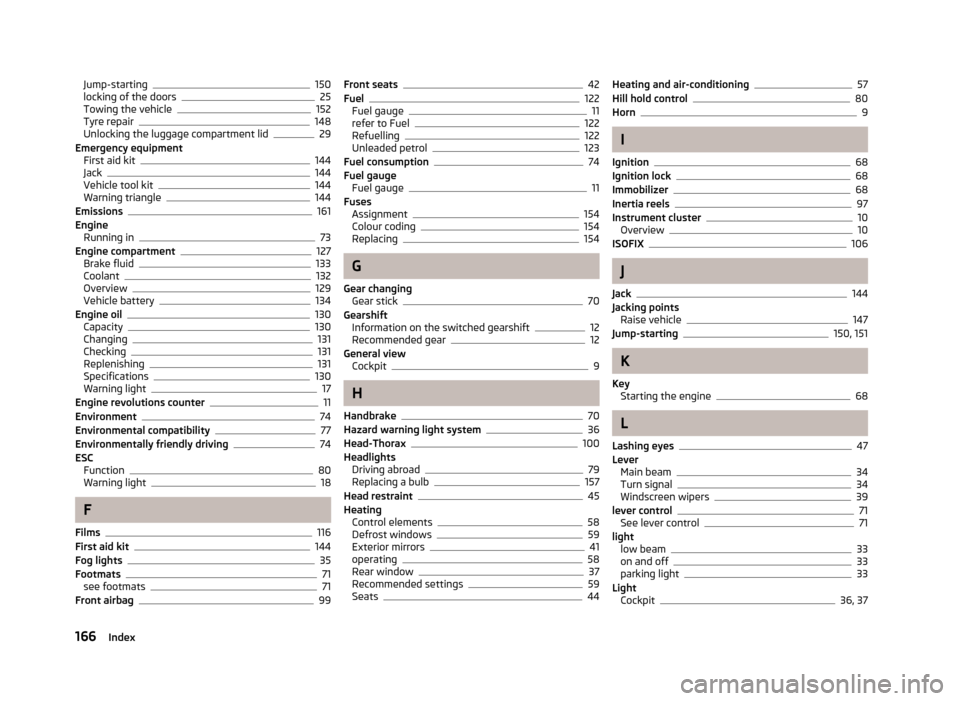
Jump-starting150
locking of the doors25
Towing the vehicle152
Tyre repair148
Unlocking the luggage compartment lid29
Emergency equipment First aid kit
144
Jack144
Vehicle tool kit144
Warning triangle144
Emissions161
Engine Running in
73
Engine compartment127
Brake fluid133
Coolant132
Overview129
Vehicle battery134
Engine oil130
Capacity130
Changing131
Checking131
Replenishing131
Specifications130
Warning light17
Engine revolutions counter11
Environment74
Environmental compatibility77
Environmentally friendly driving74
ESC Function
80
Warning light18
F
Films
116
First aid kit144
Fog lights35
Footmats71
see footmats71
Front airbag99
Front seats42
Fuel122
Fuel gauge11
refer to Fuel122
Refuelling122
Unleaded petrol123
Fuel consumption74
Fuel gauge Fuel gauge
11
Fuses Assignment
154
Colour coding154
Replacing154
G
Gear changing Gear stick
70
Gearshift Information on the switched gearshift
12
Recommended gear12
General view Cockpit
9
H
Handbrake
70
Hazard warning light system36
Head-Thorax100
Headlights Driving abroad
79
Replacing a bulb157
Head restraint45
Heating Control elements
58
Defrost windows59
Exterior mirrors41
operating58
Rear window37
Recommended settings59
Seats44
Heating and air-conditioning57
Hill hold control80
Horn9
I
Ignition
68
Ignition lock68
Immobilizer68
Inertia reels97
Instrument cluster10
Overview10
ISOFIX106
J
Jack
144
Jacking points Raise vehicle
147
Jump-starting150, 151
K
Key Starting the engine
68
L
Lashing eyes
47
Lever Main beam
34
Turn signal34
Windscreen wipers39
lever control71
See lever control71
light low beam
33
on and off33
parking light33
Light Cockpit
36, 37
166Index