2013 Seat Mii lock
[x] Cancel search: lockPage 66 of 306
64Ensuring you are correctly and safely seated
Automatic belt retainer, belt tensioner, belt tension limiter
Seat belts are part of the vehicle safety concept ⇒ page 65 and consist of
the following important functions:
Automatic belt retainer
Every seat belt is equipped with an automatic belt retainer on the shoulder
belt. If the belt is pulled slowly or during normal driving, the system allows
for total freedom of movement on the shoulder belt. However, during sud-
den braking, during travel in mountains or bends and during acceleration,
the automatic belt retainer on the seat belt is locked is pulled quickly.
Belt tensioners
The seat belts for the occupants in the front seats are equipped with belt
tensioners.
Sensors will trigger the belt tensioners during severe head-on, lateral and
rear collisions and retract and tighten the seat belts. If the seat belt is
loose, it is retracted to reduce the forwards movement of occupants or
movement in the direction of the collision. The belt tensioner works in com-
bination with the airbag system. The belt tensioner will not be triggered in
the event of the vehicle overturning if the side airbags are not deployed.
If the belt tensioner is triggered, a fine dust is produced. This is normal and
it is not an indication of fire in the vehicle.
Belt tension limiter
The belt tension limiter reduces the force of the seat belt on the body in the
event of an accident.
Note
The relevant safety requirements must be observed when the vehicle or
components of the system are scrapped. These requirements are known to
specialised workshops ⇒ page 64. Service and disposal of belt tensioners
If you work on the belt tensioners or remove and install other parts of the
vehicle when performing other repair work, the seat belt may be damaged.
The consequence may be that, in the event of an accident, the belt tension-
ers function incorrectly or not at all.
So that the effectiveness of the belt tensioner is not reduced and that re-
moved parts do not cause any injuries or environmental pollution, regula-
tions must be observed. These requirements are known to specialised work-
shops.
WARNING
Improper handling and homemade repairs of seat belts, automatic belt
retainers and tension devices increase the risk of sustaining severe or fa-
tal injuries. The belt tensioner may fail to trigger or may trigger in the
wrong circumstances.
● Never attempt to repair, adjust or remove or install parts of the belt
tensioners or seat belts. Any work must be performed by a specialised
workshop only ⇒ page 222.
● Belt tensioners and automatic belt retainers cannot be repaired and
must be replaced.
For the sake of the environment
Airbag modules and belt tensioners may contain perchlorate. Observe the
legal requirements for their disposal.
Page 73 of 306

71
Ensuring you are correctly and safely seated
When the front airbags are triggered they fill the zones marked in
red ⇒ Fig. 47 and ⇒ Fig. 48 (radius of action). Therefore, objects should
never be placed or mounted in these areas ⇒
, Factory-fitted accessories
are outside the range of the front airbag for the driver and the front passen-
ger, e.g. the baseplate for the mobile phone support.
The airbag covers fold out of the steering wheel ⇒ Fig. 47 or dash panel
⇒ Fig. 48 when the driver and front passenger airbags are triggered. The air-
bag covers remain connected to the steering wheel or the dash panel.
WARNING
The airbag is deployed at high speed in fractions of a second.
● Always keep the deployment areas of the front airbags vacant.
● Never secure objects to the covers or in the deployment area of the
airbag modules, e.g. drink holders or phone supports.
● The deployment space between the front passengers and the airbags
must not in any case be occupied by other passenger, pets and objects.
● Never fix any object to the windscreen above the front airbag on the
front passenger side.
● Do not alter, cover or stick anything to the steering wheel hub or the
surface of the airbag module on the passenger side of the dash panel.
WARNING
Front airbags are deployed in front of the steering wheel ⇒ Fig. 47 and
the dash panel ⇒ Fig. 48.
● When driving, always hold the steering wheel on the outer edge of
the ring with both hands: 9 o'clock and 3 o'clock position.
WARNING (Continued)
● Adjust the driver seat so that there is a distance of at least 25 cm
(10 inches) between the centre of your chest and the hub of the steering
wheel. If you physical constitution prevents you from meeting these re-
quirements, make sure you contact a specialised workshop.
● Adjust the front passenger seat so there is as much distance as possi-
ble between the front passenger and the dash panel.
Deactivating and activating the front passenger front
airbag using the key switch
Fig. 49 On front passen-
ger side: key switch for
disabling and enabling
the front passenger front
airbag
The front passenger front airbag must be disabled when a rear-facing child
seat is mounted.
Disabling the front passenger front airbag
● Switch the ignition off.
● Open the door on the front passenger side.
● Unfold the key shaft ⇒ page 28.
Vehicle diagramPrior to a journey...While drivingCare, cleaning and mainte-
nanceIf and whenTechnical specifications
Page 81 of 306

79
Ensuring you are correctly and safely seated
● Insert the latch plate into the buckle for the appropriate seat and push it
down until it is securely locked with an audible click.
● Ensure that the upper belt web lies tightly on the child seat.
● Pull the belt (it must be no longer possible to pull the lower belt web-
bing out).
Removing the child seat
The seat belt must not be unfastened until the vehicle has come to a stand-
still ⇒
.
● Press the red button on the buckle. The latch plate is released from the
buckle.
● Guide the belt back by hand so that it rolls up easily and the trim will not
be damaged.
● Remove the child seat from the vehicle.
WARNING
Unbuckling the seat belt while the vehicle is in motion can cause severe
or fatal injuries in the event of an accident or sudden braking.
● The seat belt must not be unfastened until the vehicle has come to a
standstill.
Securing the child seat using the lower anchor points (ISOFIX, LATCH)
Fig. 53 On the vehicle
seat: Identification var-
iants of the anchor points
for the child seats Each seat of the rear seat bench has
two retainers named lower anchor
points.
Overview of ISOFIX installation
In compliance with the European directive ECE 16, The following table de-
tails the installation possibilities for ISOFIX child seats with the lower an-
chor points in each of the vehicle seats.
The allowed body weight for the child seat or information regarding size A
to G is indicated on the label on the child seat with certification “universal”
or “semi-universal”.
Vehicle diagramPrior to a journey...While drivingCare, cleaning and mainte-
nanceIf and whenTechnical specifications
Page 83 of 306
81
Ensuring you are correctly and safely seated
Securing a child seat using a Top Tether retaining strap
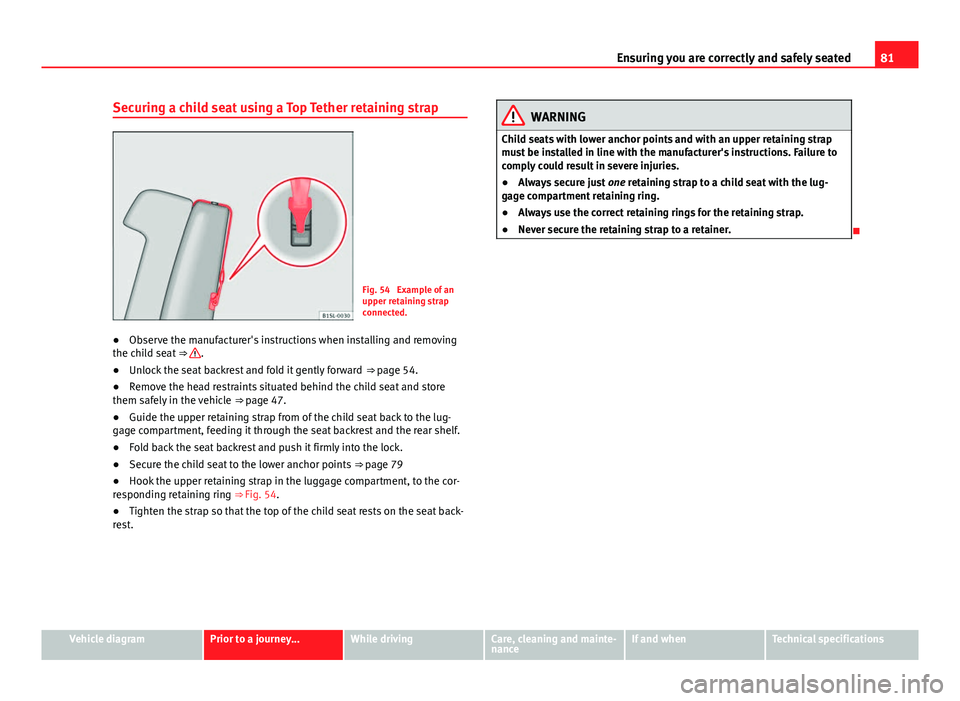
Fig. 54 Example of an
upper retaining strap
connected.
● Observe the manufacturer's instructions when installing and removing
the child seat ⇒
.
● Unlock the seat backrest and fold it gently forward
⇒ page 54.
● Remove the head restraints situated behind the child seat and store
them safely in the vehicle ⇒ page 47.
● Guide the upper retaining strap from of the child seat back to the lug-
gage compartment, feeding it through the seat backrest and the rear shelf.
● Fold back the seat backrest and push it firmly into the lock.
● Secure the child seat to the lower anchor points
⇒ page 79
● Hook the upper retaining strap in the luggage compartment, to the cor-
responding retaining ring ⇒ Fig. 54.
● Tighten the strap so that the top of the child seat rests on the seat back-
rest.
WARNING
Child seats with lower anchor points and with an upper retaining strap
must be installed in line with the manufacturer's instructions. Failure to
comply could result in severe injuries.
● Always secure just one retaining strap to a child seat with the lug-
gage compartment retaining ring.
● Always use the correct retaining rings for the retaining strap.
● Never secure the retaining strap to a retainer.
Vehicle diagramPrior to a journey...While drivingCare, cleaning and mainte-
nanceIf and whenTechnical specifications
Page 88 of 306

86Lights and visibility
Headlight range control, lighting of instruments and
controls
Fig. 57 Next to the
steering wheel: Head-
light range control
Headlamp height adjustment
The headlight range control ⇒ Fig. 57 is modified according to the value of
the headlight beam and the vehicle load status. This offers the driver opti-
mum visibility and the headlights do not dazzle oncoming drivers ⇒
.
The headlights can only be adjusted when the dipped beam is switched on.
To reset, turn switch ⇒ Fig. 57:ValueVehicle load status a)–Two front occupants, luggage compartment empty1All seats occupied, luggage compartment empty2All seats occupied, luggage compartment full3Driver only, luggage compartment fulla)
If the vehicle load does not correspond to those shown in the table, it is possible to select
intermediary positions. Instrument and switch lighting
When the side lights or dipped beam headlights are switched on, the light-
ing for instruments and controls lights up at a constant brightness.
WARNING
Heavy objects in the vehicle may mean that the headlights dazzle and
distract other drivers. This could result in a serious accident.
● Adjust the light beam to the vehicle load status so that it does not
blind other drivers.
Reading light
Button/ Switcheffect
Switching off the reading light.
Switching on the reading light.
Switches door contact control on (central position).
The reading light comes on automatically when the vehicle is un-
locked, a door is opened or the key is removed from the ignition.
The light goes off a few seconds after all the doors are closed,
the vehicle is locked or the ignition is switched on.
Note
The reading lights go out when the vehicle is locked, or a few minutes after
the key is removed from the ignition. This prevents the battery from dis-
charging.
Page 92 of 306

90Lights and visibility
Move the lever to the required position ⇒ :
0Windscreen wiper off.
1Windscreen interval wipe.
2Slow wipe.
3Continuous wipe.
4Brief wipe - short wipe. Hold the lever down for more time to
increase the wipe frequency.
5Automatic wipe for cleaning windscreens with the lever up.
6Interval wipe for rear window. The wiper will clean the win-
dow approximately every 6 seconds.
7Automatic wipe for cleaning rear windows with the lever
pressed.
CAUTION
If the ignition is switched off while the windscreen wipers are on, the wind-
screen wipers carry on wiping at the same level when the ignition is switch-
ed back on. Ice, snow and other obstacles may damage the windscreen wip-
er and the wiper motor.
● If necessary, remove snow and ice from the windscreen wipers before
starting your journey.
● Carefully lift the frozen windscreen wipers from the glass. SEAT recom-
mends a de-icer spray for this operation.
Note
The windscreen wipers will only work when the ignition is switched on.
Note
The interval wipe speed varies according to the vehicle speed. The faster
the vehicle is moving, the more often the windscreen is cleaned.
Note
The rear wiper is automatically switched on when the windscreen wiper is
on and the car is in reverse gear.
Windscreen wiper functions
Windscreen wiper performance in different situations:If the vehicle is at a stand-
still:The activated position provisionally changes
to the previous position.
For the interval wipe:The intervals between wipes vary according
to the speed of the vehicle. The higher the
vehicle speed the shorter the intervals.
Note
The wiper will try to wipe away any obstacles that are on the windscreen.
The wiper will stop moving if the obstacle blocks its path. Remove the ob-
stacle and switch the wiper back on again.
Page 94 of 306

92Lights and visibility
● To top up, mix water with a window cleaner recommended by SEAT ⇒
.
Please follow the instructions for use found on the packaging.
● In cold weather, a special antifreeze should also be added to prevent
the water from freezing ⇒
.
Reservoir capacity
The washer bottle capacity is approximately. 3 litres.
WARNING
Never mix an unsuitable antifreeze or other similar additives with the
windscreen washer water. A greasy layer may be formed on the wind-
screen which will impair visibility.
● Use clean water with a window cleaner recommended by SEAT.
● If necessary, add a suitable antifreeze to the water in the reservoir.
CAUTION
● Do not mix cleaning products recommended by SEAT with other prod-
ucts. This could lead to flocculation and may block the windscreen washer
jets.
● When topping up service fluids, make absolutely certain that you fill the
fluids into the correct reservoirs. Using the wrong fluids could cause serious
malfunctions and engine damage!
Page 98 of 306

96Transporting
Transporting a load
Secure all objects in the vehicle
●Distribute the load throughout the vehicle and on the roof as uniformly
as possible.
● Transport heavy objects as far forward as possible in the luggage com-
partment and lock the seat backs in the vertical position.
● Check the headlight adjustment ⇒ page 82.
● Use the suitable tyre pressure according to the load being transported.
Read the tire inflation information label ⇒ page 210.
CAUTION
Objects on the shelf could chafe against the wires of the heating element in
the heated rear window and cause damage.
Note
Please refer to the notes on loading the roof carrier ⇒ page 104.
Driving with the rear lid open
Driving with the rear lid open creates an additional risk. Secure all objects
and secure the rear lid correctly and take all measures possible to reduce
toxic gases from entering the vehicle.
WARNING
Driving with the rear lid unlocked or open could cause serious injuries.
● Always drive with the rear lid closed.
WARNING (Continued)
● Secure all objects in the vehicle. Loose items could fall out of the ve-
hicle and injure other road users or damage other vehicles.
● Drive particularly carefully and think ahead.
● Avoid sudden manoeuvres and braking given that this could cause an
uncontrolled movement of the open rear lid.
● When transporting objects that protrude out of the luggage compart-
ment, indicate them suitably. Observe legal requirements.
● If objects must project out of the luggage compartment, the rear lid
must never be used to “secure” or “attach” objects.
● If a baggage rack is fitted on the rear lid, it should be removed before
travelling with the rear lid open.
WARNING
Toxic gases may enter the vehicle interior when the rear lid is open. This
could cause loss of consciousness, carbon monoxide poisoning, serious
injury and accidents.
● To avoid toxic gases entering the vehicle always drive with the rear lid
closed.
● In exceptional circumstances, if you must drive with the rear lid open,
observe the following to reduce the entry of toxic gases inside the vehi-
cle:
–Close all windows.
– Disable air recirculation mode.
– Open all of the air outlets on the instrument panel.
– Switch on the blower to maximum.
CAUTION
An open rear lid changes the length and height of the vehicle.