2013 Seat Mii fuel type
[x] Cancel search: fuel typePage 179 of 306
177
At the filling station
Fuel
Introduction
You will find a factory-fitted sticker containing information on the type of
fuel for your vehicle on the inside of the fuel tank flap.
Additional information and warnings:
● ⇒ Booklet Maintenance Programme
● Refuelling ⇒ page 171
● Electronic power control and exhaust gases purification system
⇒ page 237
WARNING
Refuelling or handling fuel carelessly can cause an explosion or fire re-
sulting in serious burns and injuries.
● Fuel is a highly explosive, easily flammable substance.
● Observe current safety instructions and local regulations concerning
the handling of fuel.
Types of fuel
The type of fuel to use when refilling will depend on the vehicle's engine.
You will find a factory-fitted sticker containing information on the type of
fuel for your vehicle on the inside of the fuel tank flap.
SEAT recommends the use of sulphur-free or low sulphur fuel to reduce con-
sumption and prevent engine damage.
Possible types of fuelAlternative namesFurther information
91a)
RONNormal petrol, normal unlea-
ded petrol
⇒ page 17795 a)
RONPremium unleaded petrol (95
RON)
98 a)
RONPremium unleaded petrol (98
RON)
a) RON = Regulation Octane Number
Petrol
Petrol types
Vehicles with petrol engines must refuel using unleaded petrol according to
European norm EN 228 ⇒
.
Petrol types are categorised according to their octane number (e.g. 91, 95,
98 or 99 RON (RON = “Research Octane Number”). You may use petrol with
a high octane number than the one recommended for your engine. Howev-
er, this has no advantage in terms of fuel consumption and engine power.
SEAT recommends refuelling with a low sulphur content or sulphur-free pet-
rol to reduce fuel consumption for petrol engines.
Petrol additives
The quality of the fuel influences the behaviour, performance and service
life of the engine. This is why the petrol you use should carry suitable addi-
tives already included by the petrol industry, free of metals. These additives
will help to prevent corrosion, keep the fuel system clean and prevent de-
posits from building up in the engine.
If good quality petrol with metal-free additives is not available or engine
problems arise, the necessary additives must be added when refuelling
⇒
.
Vehicle diagramPrior to a journey...While drivingCare, cleaning and mainte-
nanceIf and whenTechnical specifications
Page 180 of 306

178At the filling station
Not all petrol additives have been shown to be effective. The use of unsuita-
ble petrol additives may cause significant damage to the engine and the
catalytic converter. Metal additives should never be used. Metal additives
may also be contained in petrol additives for improving anti-detonation rat-
ings or octane ratings ⇒
.
SEAT recommends “genuine Volkswagen Group fuel additives for petrol en-
gines”. These additives can be bought at SEAT Authorised Services, where
information on how to use them can also be obtained.
CAUTION
● Do not refuel if the filler indicates that the fuel contains metal. LRP (lead
replacement petrol) fuels contain high concentrations of metal additives.
Using them may damage the engine!
● Only use fuel with an octane rating that is in line with the norm EN 228,
otherwise significant damage could be caused to the engine and fuel sys-
tem. Furthermore, it could lead to a loss of performance with the conse-
quent engine fault.
● The use of unsuitable petrol additives could seriously damage the en-
gine and the catalytic converter.
● If, in exceptional circumstances, petrol with a lower octane rating to that
recommended is used, only use moderate engine speeds and a light throt-
tle. Avoid using full throttle and overloading the engine. Otherwise engine
damage may occur. Fill up with fuel of a suitable octane rating as soon as
possible.
● Just filling one full tank of leaded fuel or with other metal additives
would seriously impair the efficiency of the catalytic converter and could
damage it.
Natural gas
Natural gas, in addition to others, can be in liquid form. Liquefied natural gas (LNG) is the result of heavy cooling of natural gas.
Therefore its volume is considerably reduced compared with compressed
natural gas (CNG). In vehicles with a natural gas engine, liquefied natural
gas cannot be directly refilled, given that the gas would expand excessively
in the vehicle gas tank.
Therefore, vehicles with a natural gas engine must only be refuelled using
compressed natural gas
⇒
.
Natural gas quality and consumption
Natural gas is divided into the groups H and L depending on its quality.
Gas type H has a superior heating power and inferior nitrogen and carbon
dioxide content than type L. The higher the heating power of the natural
gas, the lower the consumption will be.
However, the heating power and the proportion of nitrogen and carbon di-
oxide can fluctuate within the quality groups. Therefore, vehicle consump-
tion can also vary when using one type of gas only.
The engine management automatically adapts to the natural gas used ac-
cording to its quality. Therefore, different quality gases can be mixed in the
tank, without the need for comprehensive draining before applying a differ-
ent quality gas.
Natural gas and safety
If you can smell gas or suspect that there is a leak ⇒
:
● Stop the vehicle immediately.
● Switch the ignition off.
● Open the doors to appropriately ventilate the vehicle.
● Immediately extinguish cigarettes.
● Move away from the vehicle or switch off objects that may cause sparks
or a fire.
● If you continue to smell gas, do not continue driving!
● Seek specialist assistance. Have the fault repaired.
Page 204 of 306

202Vehicle care and maintenance
● Insert a new blade of the same length and type in the windscreen wiper
arm in the opposite direction to the arrow B
and hook into place. This fea-
ture is operational when the knob is in position (arrow A).
● Return the windscreen wiper arm to the windscreen. Do not let it simply
drop down!
WARNING
Worn or dirty wiper blades reduce visibility and increase the risk of acci-
dent and serious injury.
● Always replace damaged or worn blades or blades which do not clean
the windscreen correctly.
CAUTION
● Damaged or dirty windscreen wipers could scratch the glass.
● If products containing solvents, rough sponges or sharp objects are
used to clean the blades, the graphite layer will be damaged.
● Never use fuel, nail varnish remover, paint thinner or similar products to
clean the windows.
Note
If wax deposits, other cleaning products from the automatic car wash, or
other care products, are left on the windscreen and the rear window, the
blades can scratch the glass. Remove wax deposits with a special product
or cleaning cloths.
Caring for and polishing the vehicle paintwork
Waxing
Regular waxing protects the paintwork. It is time to apply a good coat of wax
when water no longer forms droplets and rolls off the clean paintwork. Even if a
wax solution is used regularly in the automatic car wash, SEAT rec-
ommends protecting the paint with a hard wax coating at least twice a year.
Polishing
Polishing is only necessary if the paint has lost its shine, and the gloss can-
not be brought back by applying wax.
If the polish does not contain wax, a wax product should be applied after
polishing.
CAUTION
● To prevent damage, car polish or hard wax should not be used on com-
ponents painted in matt paint, plastic components and the glass headlamp
and tail light covers.
● Do not polish your vehicle in a sandy or dusty environment.
Care and cleaning of chrome and aluminium wheel rims
● Use a clean, damp, lint-free, smooth cloth to clean anodized surfaces.
● If there is a lot of dirt, use a special cleaning product which does not
contain solvents.
● Then, polish the chrome and aluminium wheel trims with a smooth dry
cloth.
CAUTION
In order to prevent damage to the aluminium and chrome wheel trims:
● Do not clean or polish them in direct sunlight.
● Do not clean or polish them in sandy or dusty environments.
● Do not use abrasive cleaning agents such as home cream cleaners.
● Do not use insect sponges, scouring pads, or similar products to clean
insect deposits.
Page 213 of 306

211
Vehicle care and maintenance
About your tyres and wheels
Fig. 123 Diagram for
changing wheels
The tyres of a vehicle are the components which are subjected to most
stress and are the most underestimated. Tyres are very important, as the
support offered by their narrow surface is the only point of contact between
the vehicle and the road.
The service life of tyres is dependent on tyre pressure, driving style, the care
they receive and the correct fitting.
The tyres and wheel rims are an essential part of the vehicle's design. The
tyres and rims approved by SEAT are specially matched to the characteris-
tics of the vehicle and our critical to good road holding and safe handling.
Avoiding damage to tyres and wheels
● If you have to drive over a kerb or similar obstacle, drive very slowly and
as near as possible at a right angle to the kerb.
● Inspect the tyres regularly for damage (punctures, cuts, cracks, dents).
● Remove any foreign bodies found on the outside of the tread provided
they have not passed through the wall of the tyre
⇒ page 216.
● The instructions for tyre control systems should always be observed. ●
Replace damaged or worn tyres as soon as possible ⇒ page 216.
● Regularly check tyres for non-visible damage ⇒ page 216.
● Never exceed the maximum permitted speed or loads specified for the
type of tyre fitted on your vehicle ⇒ page 218.
● Do not allow tyres (including the spare wheel) to come into contact with
aggressive substances, grease, oil, fuel or brake fluid ⇒
.
● Lost valve caps should be replaced immediately.
Tyres with directional tread pattern
Tyres with directional tread pattern have been designed to operate best
when rotating in only one direction. An arrow on the tyre sidewall indicates
the direction of rotation on tyres with directional tread ⇒ page 218. Always
observe the direction of rotation indicated when mounting the wheel. This
guarantees optimum grip and helps to avoid aquaplaning, excessive noise
and wear.
If the tyre is mounted in the opposite direction of rotation, drive with ex-
treme caution, as the tyre is no longer being used correctly. This is of partic-
ular importance when the road surface is wet. Change the tyre as soon as
possible or remount it with the correct direction of rotation.
Interchanging tyres
To ensure that the wear is equal on all tyres the wheels should be changed
round from time to time according to the system ⇒ Fig. 123. The useful life
of all the tyres will then be about the same time.
SEAT recommends you take the vehicle to a specialised workshop to have
the tyres changed.
Tyres that are over 6 years old
Tyres are subject to an ageing process as a result of physical and chemical
processes. This may affect their performance. Tyres which are stored for
long periods of time without being used, harden and become more fragile
than tyres which are in constant use.
SEAT recommends that tyres over six years old are replaced with new tyres.
This also applies to tyres (including the spare wheel) which appear to be in
Vehicle diagramPrior to a journey...While drivingCare, cleaning and mainte-
nanceIf and whenTechnical specifications
Page 216 of 306
214Vehicle care and maintenance
Note
If you use tyres that are approved by SEAT, you can be sure that the true tyre
dimensions will be correct for your vehicle. For other tyre models, the tyre
vendor should provide the manufacturer's certificate with the tyre, indicat-
ing that this type of tyre is suitable for your vehicle. This certificate should
always be carried with the vehicle.
Tyre pressures
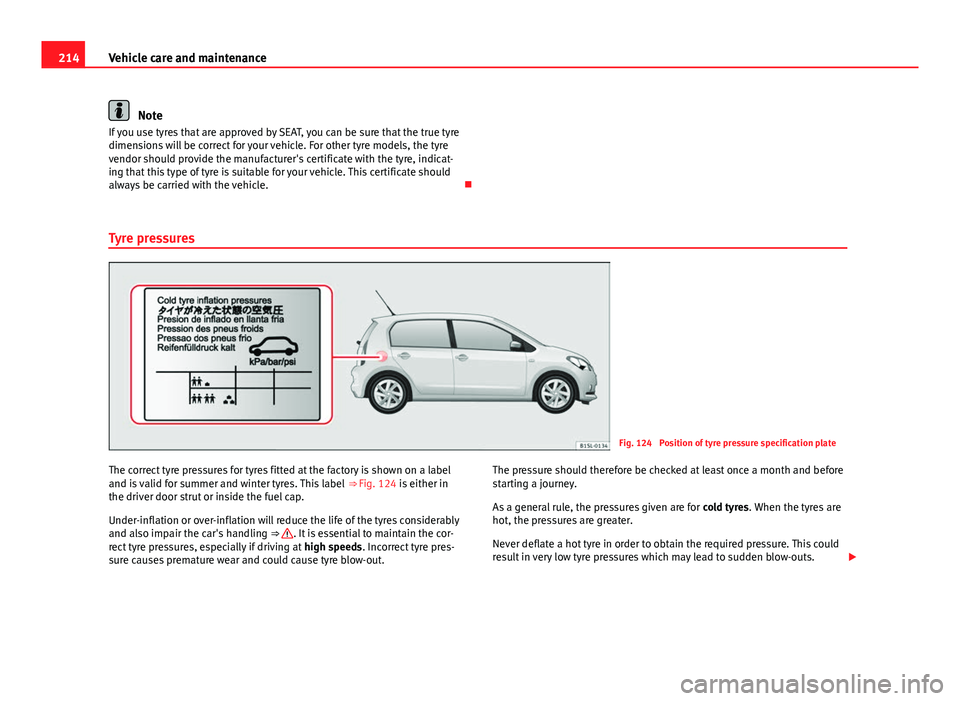
Fig. 124 Position of tyre pressure specification plate
The correct tyre pressures for tyres fitted at the factory is shown on a label
and is valid for summer and winter tyres. This label ⇒ Fig. 124 is either in
the driver door strut or inside the fuel cap.
Under-inflation or over-inflation will reduce the life of the tyres considerably
and also impair the car's handling ⇒
. It is essential to maintain the cor-
rect tyre pressures, especially if driving at high speeds. Incorrect tyre pres-
sure causes premature wear and could cause tyre blow-out. The pressure should therefore be checked at least once a month and before
starting a journey.
As a general rule, the pressures given are for
cold tyres. When the tyres are
hot, the pressures are greater.
Never deflate a hot tyre in order to obtain the required pressure. This could
result in very low tyre pressures which may lead to sudden blow-outs.
Page 236 of 306

234Vehicle care and maintenance
Warning of high voltage label
There is a label close to the bonnet lock which warns of high voltage in the
vehicle electrical installation.
Warning relating to the City Safety Assist system laser sensor
There are some warning and information signs on the City Safety Assist sys-
tem laser sensor ⇒ Fig. 132.
Using your vehicle in other countries and continents
The vehicle is manufactured at the factory for use in a particular country in
accordance with the national legislation in force at the time of manufacture.
If the vehicle is sold in another country or used in another country for an ex-
tended period of time, the applicable legislation of that country should be
observed.
It may be necessary to fit or remove certain pieces of equipment or to deac-
tivate certain functions. Service work may also be affected. This is particu-
larly true if the vehicle is used in a different climate for an extended period
of time.
As there are different types of frequency bands around the world, you may
find that the radio system or the Portable Navigation System (supplied by
SEAT) supplied at the factory does not work in another country.
CAUTION
● SEAT does not accept liability for any damage to the vehicle due to the
use of a lower quality fuel, an inadequate service or the non-availability of
genuine spare parts.
● SEAT does not accept liability if the vehicle does not comply in part or in
full with the legal requirements of other countries or continents. Radio reception and the aerial
For factory-fitted radio equipment, the aerial for radio reception is fitted to
the roof of the vehicle.
Note
If electrical equipment such as mobile telephones, is used near a roof aer-
ial, you may observe interference in the reception of AM stations.
Notes on SEAT repairs
Information about authorised SEAT services and authorised SEAT repairs
can be requested by payment at the following addresses:
Clients in Europe, Asia, Australia, Africa, Central America and South
America
Contact a Technical Service or specialised workshop, or request the corre-
sponding documentation at www.erwin.volkswagen.de.
WARNING
Repairs or modifications which are not performed correctly may result in
damage or errors in the vehicle operation, affecting the effectiveness of
the driver assist and airbag systems. This could result in serious acci-
dent.
● Have any repairs or modifications carried out at a specialised work-
shop.
Page 285 of 306

283
Description of specifications
Vehicle identification data
Fig. 166 Vehicle data la-
bel:
Fig. 167 Vehicle identifi-
cation number
Vehicle identification number
The vehicle identification number (chassis number) can be read from out-
side the vehicle through a viewer in the windscreen ⇒ Fig. 167. This viewer
is located in the lower part of the windscreen. The vehicle identification number (chassis number) is also stamped on the right water drain channel.
The water drain channel is located between the suspension tower and the
wing. Open the bonnet to read the vehicle identification number
.
Vehicle data plate
The vehicle data label ⇒ Fig. 166 is at the front of the spare wheel well. It
contains the following data:
Vehicle identification number (chassis number)
Vehicle type, engine power, gearbox type
Engine and gearbox code, paint number, interior equipment.
Optional extras, PR numbers
These data are also provided in the Maintenance Programme.
Specific vehicle weight information
The instructions in the official vehicle documents take precedence. All the
technical data provided in this documentation is applicable to the basic
model. The vehicle data label in the Maintenance Programme or the vehicle
documentation shows which engine is installed in your vehicle.
The figures may be different depending whether additional equipment is fit-
ted, for different models and for special vehicles.
Kerb weight values shown in the following table apple for a vehicle with
driver (75 kg), liquids including a fuel tank 90% full, in addition to tools and
a spare wheel ⇒
. The kerb weight indicated increases with optional
equipment and retrofitting of accessories, while proportionally reducing car-
rying capacity.
The load is equivalent to the following weights:
1
234
Vehicle diagramPrior to a journey...While drivingCare, cleaning and mainte-
nanceIf and whenTechnical specifications
Page 296 of 306

Exterior mirrors . . . . . . . . . . . . . . . . . . . . . . . . . . 93Controlling function . . . . . . . . . . . . . . . . . . . 94
folding . . . . . . . . . . . . . . . . . . . . . . . . . . . . . . 93
Vehicle care . . . . . . . . . . . . . . . . . . . . . . . . 200
Exterior views . . . . . . . . . . . . . . . . . . . . . . . . . . . . 6
F
FAQs . . . . . . . . . . . . . . . . . . . . . . . . . . . . . . . . . 239
Fault Parking distance warning system . . . . . . . 150
Fault finding . . . . . . . . . . . . . . . . . . . . . . . . . . . 239
Fault memory Connector . . . . . . . . . . . . . . . . . . . . . . . . . . 227
Faults . . . . . . . . . . . . . . . . . . . . . . . . . . . . . . . . 239 Air conditioner . . . . . . . . . . . . . . . . . . . . . . 168
Filling the tank . . . . . . . . . . . . . . . . . . . . . . . . . 171 Refilling precautions . . . . . . . . . . . . . . . . . 176
Fire extinguisher . . . . . . . . . . . . . . . . . . . . . . . . 243
First-aid kit Storage . . . . . . . . . . . . . . . . . . . . . . . . . . . . 243
First aid kit . . . . . . . . . . . . . . . . . . . . . . . . . . . . 243 see First aid kit . . . . . . . . . . . . . . . . . . . . . . 243
Floor mats . . . . . . . . . . . . . . . . . . . . . . . . . . . . . 127
Fluids . . . . . . . . . . . . . . . . . . . . . . . . . . . . . . . . 224
Fog lights . . . . . . . . . . . . . . . . . . . . . . . . . . . . . . 84
Frequently asked questions . . . . . . . . . . . . . . 239
Front airbags See "Airbag system" . . . . . . . . . . . . . . . . . . 70
Front passenger front airbag Deactivating using the key switch . . . . . . . . 71
See "Airbag system" . . . . . . . . . . . . . . . . . . 65 Fuel . . . . . . . . . . . . . . . . . . . . . . . . . . . . . . . . . . 177
Information on consumption . . . . . . . . . . . 284
Petrol . . . . . . . . . . . . . . . . . . . . . . . . . . . . . . 177
Type of fuel . . . . . . . . . . . . . . . . . . . . . . . . . 177
Fuel consumption Economic driving . . . . . . . . . . . . . . . . . . . . 144
¿Why does it increase? . . . . . . . . . . . . . . . . 237
Fuel gauge . . . . . . . . . . . . . . . . . . . . . . . . . . . . 172 Control lamp . . . . . . . . . . . . . . . . . . . . . . . . 172
Fuel . . . . . . . . . . . . . . . . . . . . . . . . . . . . . . . 172
Refuelling . . . . . . . . . . . . . . . . . . . . . . . . . . 172
Fuel tank flap close . . . . . . . . . . . . . . . . . . . . . . . . . . . . . . 174
open . . . . . . . . . . . . . . . . . . . . . . . . . . . . . . 174
Petrol . . . . . . . . . . . . . . . . . . . . . . . . . . . . . . 174
Fuses . . . . . . . . . . . . . . . . . . . . . . . . . . . . . . . . . 263 Fuse box . . . . . . . . . . . . . . . . . . . . . . . . . . . 264
Identifying blown fuses . . . . . . . . . . . . . . . 265
Identifying by colours . . . . . . . . . . . . . . . . 264
Preparation before replacing . . . . . . . . . . . 265
Replacement . . . . . . . . . . . . . . . . . . . . . . . . 265
G
General instrument panel Turn signal and headlight lever . . . . . . . . . . 83
Glove compartment see Compartments . . . . . . . . . . . . . . . 110, 111
H
Handbrake . . . . . . . . . . . . . . . . . . . . . . . . . . . . 136
Hazard warning lights . . . . . . . . . . . . . . . . . . . 241 Headlamp range adjustment . . . . . . . . . . . . . . . 11
Headlight lever . . . . . . . . . . . . . . . . . . . . . . . . . . 83
Headlight range control . . . . . . . . . . . . . . . . . . . 86
Headlights
Driving abroad . . . . . . . . . . . . . . . . . . . . . . . 85
Headlight washers . . . . . . . . . . . . . . . . . . . . 90
Heated rear window . . . . . . . . . . . . . . . . . . . . . 167
Heated seats . . . . . . . . . . . . . . . . . . . . . . . . . . . . 54
Heating and ventilation system Controls . . . . . . . . . . . . . . . . . . . . . . . . . . . . 166
see also Air conditioning system . . . . . . . 164
High pressure cleaning apparatus . . . . . . . . . 199
Hill driving assistant . . . . . . . . . . . . . . . . . . . . 162
Hill hold . . . . . . . . . . . . . . . . . . . . . . . . . . . . . . 160 Control lamp . . . . . . . . . . . . . . . . . . . . . . . . 160
Start-Stop system . . . . . . . . . . . . . . . . . . . . 161
Warning lamp . . . . . . . . . . . . . . . . . . . . . . . 160
Horn . . . . . . . . . . . . . . . . . . . . . . . . . . . . . . . . . . 11
I
Identification number . . . . . . . . . . . . . . . . . . . 283
Identification plate . . . . . . . . . . . . . . . . . . . . . . 283
Ignition See "Engine and ignition" . . . . . . . . . . . . . 119
Ignition key see vehicle key . . . . . . . . . . . . . . . . . . . . 29, 30
Ignition lock . . . . . . . . . . . . . . . . . . . . . . . . . . . 120 Safety interlock . . . . . . . . . . . . . . . . . . . . . . 121
Unauthorised vehicle key . . . . . . . . . . . . . 120
Immobiliser . . . . . . . . . . . . . . . . . . . . . . . . . . . . 122
294 Index