2013 PORSCHE 911 CARRERA ECO mode
[x] Cancel search: ECO modePage 15 of 76

2829
When you know your strengths,
it’s easy to acquire new ones.
The new 911 Carrera 4.
One thing is for certain. When it comes
to finding your own strengths, it always
helps to know who you are and where
you come from. Where the 911 is con
cerned, we call this Porsche identit y.
The immense power that is embodied in
this strong identit y is immediately apparent
in the new all wheel drive 911 Carrera 4.
Its enhanced Porsche Traction Management
(PTM) converts power directly into motion.
Not in a heav y handed way, but intelligently.
Sensors control the rotational speeds of
all four wheels, the vehicle’s lateral and
longitudinal acceleration and the steering
angle. In this way, the active all wheel drive can continually respond to different
driving situations and precisely distribute
drive forces bet ween the front and rear
axles. Tuned to provide even more poised
and balanced handling during performance
driving, PTM quickly and clearly
demon
strates, especially in the wet and snow,
what we at Porsche understand by traction.
Expressed in simple terms, the new
911 Carrera 4 is self assured. An assured
ness that has been assisted by engineer
ing and aesthetic details such as
the wider
body – the rear wings are 44 mm
wider
than those of the 911 Carrera – the
295 mm wide rear t yres, the special air intakes, the illuminated rear light strip
with taillights and parking light function,
and distinctive sideskirts.
One of its inherent strengths is, of course,
its engine: the 3.4 litre flat six power unit
delivers 257 kW (350 hp) at 7,400 rpm
and accelerates the new 911 Carrera 4
from 0 to 62 mph in just 4.9 seconds.
Top speed is 177 mph. One strength may
possibly come as a surprise: by
downsiz
ing the engine, it has been possible to
reduce the fuel consumption and CO
2
emissions by up to 15 % compared with
the previous model.
For fuel consumption and CO
2 emissions, please refer to pages 143/145.
Strength | The new 911 Carrera 4
Let ’s now bring the power of identit y
to bear on the road. With the aid of the
7 speed manual transmission or the
optional PDK. Both feature sports ratios
for gears 1 to 6 and a long ratio 7th
gear for fuel efficiency.
The 911 has many strengths. The new
911 Carrera 4, with its superlative traction,
dynamic performance and safet y, has
acquired even more. Why not take your
seat behind the wheel and make these
strengths your own?
Page 16 of 76

3031
Switchbacks, hairpins, zigzags, S-bends ...
There are countless reasons for having intelligent all-wheel drive.
The new 9 11 Carrera 4S.
Steadfastness. Another apparent Porsche
contradiction. But whilst it ’s true that
sports cars are all about movement, about
surging forwards, it ’s even more impor
tant to stay calm at all times, to act with
composure and never rashly. So it ’s re
assuring that you can rely on the handling
characteristics of the new 911 Carrera 4S.
Particularly dependable is the enhanced
Porsche Traction Management (PTM)
active all wheel drive system, especially
when driving the car at the limits of per
formance. To achieve this, our engineers
have travelled right to the physical bound
aries – and extended them. PTM now ensures that the car is even more poised
and balanced and really comes into its
own
when adopting a sport y driving
st yle or travelling in extreme weather
conditions.
At the rear, the car is the personification
of road holding, with its 44 mm wider
body, wider track and road hugging
305 mm wide rear wheels. The seamless
horizontal taillight strip continues the
same st yling language. The all wheel
drive model is also recognisable from the
front thanks to its dynamically accentuat
ed cooling air intakes in the front end. Though the car is practically at one with
the ground, it cannot keep still. This is
unsurprising when it is powered by a
3.8 litre engine developing 294 kW
(400 hp) at 7,400 rpm. When combined
with Porsche Doppelkupplung (PDK),
this power unit can accelerate the car to
62 mph in just 4.3 seconds. And contin
ue up to a maximum speed of 184 mph.
This hasn’t come at the expense of fuel
consumption and CO
2 emissions either.
Figures for the new 911 Carrera 4S are
up to 13 % lower than those of its prede
cessor. Fuel efficient technologies, such
as electrical system recuperation, auto
start /stop – both fit ted as standard – and
the ‘coasting’ function of PDK, prove that
Porsche is continually resolving conflict
ing aims through Intelligent Performance.
Where safety is concerned, the mono
bloc fixed brake calipers at the front
have six pistons instead of four, whilst
the brake pads are 10 % larger. The result
is even shorter braking distances. Proof
that, at Porsche, safet y is an integral
part of performance, not its polar
opposite.
Steadfast through and through.
Corner after corner.
For fuel consumption and CO
2 emissions, please refer to pages 143/145.
Strength | The new 911 Carrera 4S
Page 17 of 76

3233
engine developing 257 kW (350 hp) at
7,400 rpm, which displays superlative per
formance. The 0 to 62 mph sprint is
completed in 5.1 seconds, for example.
And it boasts a top speed of 175 mph.
Equally superlative are the fuel consump
tion and CO
2 emissions figures which
are up to 16 % lower than those of the
previous model.
When it comes to traction, however,
composure and reason prevail in the
form of the further enhanced Porsche
Traction Management (PTM) active all
wheel drive system. Working together
with Porsche Stability Management
It may come as a surprise to you, but
our engineers are very emotional people.
And clear thinkers. There is no conflict
bet ween these t wo traits. On the contrary,
they are ideal qualifications for those
tasked with the development of a cabrio
let that is more than just a fair weather
car: the new 911 Carrera 4 Cabriolet.
Entirely without contradiction, it com
bines the thrills of open top driving with
outstanding road holding.
May we now appeal to your emotions?
Here goes. The new 9 11 Carrera 4
Cabriolet is powered by a 3.4 litre flat six
Strength | The new 911 Carrera 4 Cabriolet
There’s a lot of emotion in engineering.
Such as that unique cornering feel.
The new 911 Carrera 4 Cabriolet.
(PSM), PTM ensures excellent levels of
stabilit y and safet y. So you can give free
rein to your emotions. Even in the wet
and snow.
The new hood of the
9 11 Carrera 4
Cabriolet is able to adapt to the weather
and your mood in precisely 13 seconds.
That ’s all the time it needs to open or
close at road speeds of up to 31 mph.
Magnesium support elements make the
hood light weight, yet extremely rigid and
robust. An integral wind deflector is fit ted
as standard. Electrically powered, it
extends in just t wo seconds. There’s a feeling of pride that the fabric
hood creates the same elegant silhouet te
as that of the
9 11 Coupé models. The
powerful proportions – the body that is
44 mm wider at the rear, the wider rear
track and 295 mm wide rear t yres – are
characteristic of all wheel drive design.
All this combines to create that unique
Porsche cornering feel.
We think that it ’s bet ter to play out your
emotions than to conceal them. Because
only a weak character shows no feelings
at all. The new
9 11 Carrera 4 Cabriolet.
For fuel consumption and CO
2 emissions, please refer to pages 143/145.
Page 18 of 76
3435
Which vital ingredients do you need to
experience moments of true happiness?
It ’s our conviction, at least, that you need
impressive road holding. Plus safety,
reliabilit y and faith in technology that won’t
let you down when you need it most.
Because only when we have peace of
mind are we truly free.
All these ingredients have been brought
together in the 911 Carrera 4S Cabriolet.
The car, powered by a 3.8 litre direct fuel
injection (DFI) engine with a maximum out
put of 294 kW (400 hp) at 7,400 rpm,
sprints from 0 to 62 mph in 4.7 seconds
and boasts a top speed of 183 mph.
Strength | The new 911 Carrera 4S Cabriolet
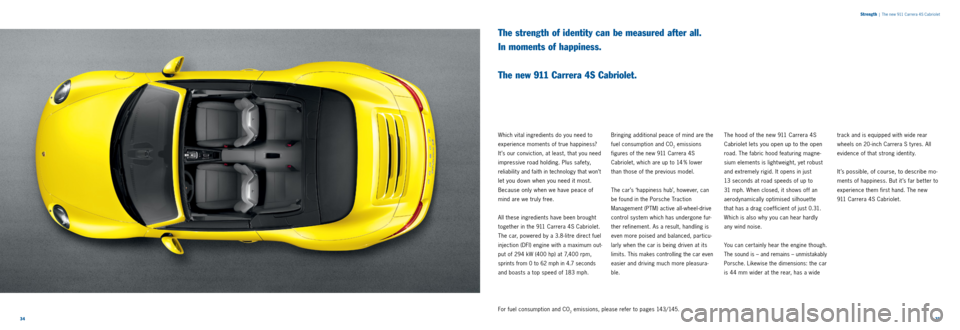
The strength of identity can be measured after all.
In moments of happiness.
The new 911 Carrera 4S Cabriolet.
Bringing additional peace of mind are the
fuel consumption and CO
2 emissions
figures of the new 911 Carrera 4S
Cabriolet, which are up to 14 % lower
than those of the previous model.
The car’s ‘happiness hub’, however, can
be found in the Porsche Traction
Ma na
gement (PTM) active all wheel drive
control system which has undergone fur
ther refinement. As a result, handling is
even more poised and balanced, particu
larly when the car is being driven at its
limits.
This makes controlling the car even
easier
and driving much more pleasura
ble.
The hood of the new 911 Carrera 4S
Cabriolet lets you open up to the open
road. The fabric hood featuring magne
sium elements is light weight, yet robust
and extremely rigid. It opens in just
13 seconds at road speeds of up to
31 mph. When closed, it shows off an
aerodynamically optimised silhouette
that has a drag coefficient of just 0.31.
Which is also why you can hear hardly
any wind noise.
You can certainly hear the engine though.
The sound is – and remains – unmistakably
Porsche. Likewise the dimensions:
the car
is 44 mm wider at the rear, has a wide track and is equipped with wide rear
wheels on 20
inch Carrera S t yres. All
evidence of that strong identit y.
It’s possible, of course, to describe mo
ments of happiness. But it ’s far bet ter to
experience them first hand. The new
911 Carrera 4S Cabriolet.
For fuel consumption and CO
2 emissions, please refer to pages 143/145.
Page 21 of 76

1
2
3
4
5
6
7
89
10
11
12
13
14
15
16
17
18
19
20
21
22
23
2425
26
27
28
29
30
31
4041
Temperament
|
Engines
Engine cross section: 3.8 litre boxer engine
911 Carrera S models: 294 kW (400 hp) at 7,400 rpm, 440 Nm at 5,600 rpm
1. High pressure pump
2. High pressure injector
3. Ignition rod module
4. Camshaft controller
5. Valve lif t adjustment switch valve
6. Switch tappet with integrated valve clearance
compensation
7. Intake camshaf t
8. Intake valves
9. Valve spring
10. Combustion chamber with Alusil cylinder liner
surface
11. Forged aluminium piston
12. Forged connecting rod
13. Crankshaft
14. Water pump
15. Air conditioning compressor
16. Power steering pump (in conjunction with PDCC)
17. Vibration damper
18. Alternator pulley with freewheel
19. Hydraulic belt tensioner
20. Resonance valve
21. Resonance distributor
22. Resonance valve actuator
23. Intake manifold with integrated sound chamber
24. Electronically controlled throttle valve
25. Oil filter
26. Electronic map controlled thermostat
27. Vacuum pump
28. Coolant jacket
29. Crankcase breather
30. Timing chain
31. S t a r t e r
911 Carrera models: 257 kW (350 hp) at 7,400 rpm, 390 Nm at 5,600 rpm
The 3.4-litre engine.
The 911 Carrera base models are
equipped with a 3.4 litre boxer engine
with direct fuel injection (DFI) and
VarioCam Plus. It develops 257 kW
(350 hp) at 7,400 rpm and the maximum
torque is 390 Nm at 5,600 rpm. For the 911 Carrera with 7
speed manual
gearbox, this means acceleration from
0 to 62 mph in 4.8 seconds and a top
speed of 179 mph. The new 911 Carrera 4
accelerates to 62 mph in 4.9 seconds
and has a top speed of 177 mph.
For fuel consumption and CO
2 emissions, please refer to pages 143/145.
40 60 80
100
120 140 160 180 200 220 240 260
1500 75008000
2000 2500300035004000450050005500600065007000
1000
294 kW (400 hp)440 Nm
300
280
Power (kW)
T orque (Nm)
Engine speed (rpm)
200
280 300 320 340 360 380 400 420
220 240 260
460
44040
60 80
100
120 140 160 180 200 220 240 260
1500 75008000
2000 2500300035004000450050005500600065007000
1000
300
280
Power (kW)
T orque (Nm)
Engine speed (rpm)
200
280 300 320 340 360 380 400 420
220 240 260
460
440
257 kW (350 hp)
390 Nm
The 3.8-litre engine.
The 911 Carrera S models are powered
by a 3.8
litre boxer engine with direct
fuel injection (DFI) and VarioCam Plus. It
produces 294 kW (400 hp) at 7,400 rpm
and the maximum torque of 440 Nm is
achieved at 5,600 rpm. With optional Porsche Doppelkupplung
(PDK), the 911 Carrera S accelerates
from 0 to 62 mph in 4.3 seconds and
achieves a top speed of 187 mph.
The new Carrera 4S completes the
0 to 62 mph sprint in 4.3 seconds and
boasts a top speed of 184 mph.
Page 24 of 76

4647
Temperament
|
Engines
Integrated dry-sump lubrication.
Integrated dr y sump lubrication ensures
a reliable supply of oil even when a
sport y driving st yle is adopted. It also
has additional cooling functions.
The oil tank is located in the engine,
thereby eliminating the need for an
external oil tank, which saves both space
and weight. To reduce power loss and
increase efficiency, an electronically
controlled oil pump supplies the lubricat
ing points inside the engine as and
when required. When demand is low, the
oil pump is operated at reduced power,
thereby saving fuel.
Air intake system.
The resonance intake system increases
the intake volume by exploiting the fact
that air oscillates as it passes through
the intake manifold. The system can
adjust to engine speed. Benefits of this
include higher torque at low engine
speeds and a flat ter torque curve.
The
9 11 Carrera S models operate a t wo
stage
system.
The entire intake system is made from
light weight plastic. In the 9 11 Carrera
model range, the resonator volume of
the air filter housing varies with engine
speed to bring added character to the
engine sound, which becomes much
more powerful at higher rpm.
Exhaust system.
The exhaust system of the 911 Carrera
models has been redesigned, acoustics
included.
The stainless steel exhaust system com
prises t wo distinctive and independent
exhaust tracts. The cataly tic converters
heat up rapidly for effective emissions
reduction.
A selectable t win tube sports exhaust
system featuring distinctive polished
stainless steel tailpipes is available as an
option. Activated by a but ton, it produces
an even more intensive sports car sound.
Engine management system.
The EMS SDI 9.1 engine management
system ensures optimum engine perfor
mance at all times. It controls, for
example, the position of the electronic
throt tle valve (ETC) – a prerequisite for
compati bility with the Porsche Stability
Management (PSM), which comes as
standard. It also regulates all engine
related functions to achieve optimum
fuel consumption, emissions and power
output whatever the driving st yle.
Another function is the cylinder specific
knock control. Since the cylinders never
all work under exactly the same condi
tions, the knock control function monitors
each one separately. The ignition point
is shifted individually, as and when
necessary, to protect the cylinders and
pistons at high engine speeds.
For compliance with EU standards, the
on board diagnostics detect any faults
and defects that may occur in the exhaust
and fuel systems and then notify the
driver immediately. This also prevents
increased pollutant emissions and
unnecessary fuel consumption.
Twin tailpipe of the sports exhaust system Single
tube tailpipe on the 911 Carrera
Twin tube tailpipe on the 911 Carrera S
For fuel consumption and CO2 emissions, please refer to pages 143/145.
Page 26 of 76

462135
7R
5051
Porsche Doppelkupplung (PDK).
Available as an option for all 911 Carrera
models is 7speed PDK, featuring manu
al and automatic modes. It facili
tates
extremely fast gear changes
with no
interruption in the flow of power, whilst at
the same time improving acceleration
and fuel efficiency. In total, PDK has seven gears at its dis
posal. Gears 1 to 6 have a sports ratio
and top speed is reached in 6th gear.
7th
gear has a long ratio and helps to
reduce fuel consumption by keeping
engine revs low.
PDK is essentially t wo gearboxes in one
and thus requires t wo clutches. This
double clutch arrangement provides an
Porsche Doppelkupplung (PDK)
alternating, non positive connection
bet ween the t wo half gearboxes and the
engine by means of t wo separate input
shafts.
The flow of power from the engine is
transmit ted through one half gearbox and
one clutch at a time, while the next gear
is preselected in the second half gearbox. During a gear change, therefore, one
clutch simply opens and the other closes
at the same time, enabling gear changes
to take place within milliseconds.The effect is instant. Driving feels even
sportier and more dynamic, and agility
is increased. Depending on the gearshift
programme (SPORT button activated
Temperament | Transmission
or deactivated), the gear change is opti
mised for comfort or for sport y driving.
With the optional Sport Chrono Package,
PDK is enhanced by the ‘Launch Control’
and ‘motorsport derived gearshif t strategy’
functions (p. 67).
Coasting.
The ‘coasting’ function available with
Porsche Doppelkupplung (PDK) enables
you to save even more fuel where the
situation allows. The engine is decoupled
from the transmission to prevent deceler
ation caused by engine braking. In this
way, optimum use is made of the vehi
cle’s momentum, allowing it to coast for
longer distances.
For example, you may want to slow down
from 62 mph to 49 mph in anticipation
of the change of speed limit ahead. As
soon as you release the accelerator
pedal, PDK deselects the current gear auto
matically and you begin to coast
in neutral until you have reached your
desired speed. The moment you engage
the accelerator or brake pedal, PDK
selects the appropriate gear smoothly
and seamlessly within a fraction of a
second. In short, driving in coasting mode makes
a real impact on fuel consumption without
any need for compromise on comfort or
sporty performance.
Another way to reduce fuel consumption is
to utilise the coasting function on downhill
gradients that are gentle enough for you
to maintain a constant speed. Efficient on
long journeys, such as on the motorway,
PDK remains ready to respond as swiftly
and precisely as you would expect.
For fuel consumption and CO2 emissions, please refer to pages 143/145.
Page 29 of 76

5657
Temperament
| Chassis and body
Engineered design.
The innovative bodyshell of the 911 fulfils
t wo structural design requirements: first,
excellent driving dynamics due to the
body’s extremely high rigidit y; second,
a vehicle weight saving of up to 65 kg
primarily as a result of the intelligent
lightweight construction. To meet the second requirement, we
employed state
of the art techniques for
combining various materials in order
to utilise specific material properties
exactly where they are needed.
For the bodyshell, therefore, we used
very thin, but nevertheless extremely
rigid, sheets of steel. Aluminium and magnesium were used extensively in
areas such as the roof, underbody, front
end, doors, rear wings and engine com
partment and luggage compartment lids.
Magnesium, which is a particularly light
weight material, was also selected for
the cockpit and centre console support
beam and, in the Cabriolet models, the
hood shell elements. Such material effi ciency is key to reducing the overall
weight and, as a result, fuel consumption
of the vehicle.
For the driver, this intelligent blend
of materials reduces the weight of the
vehicle and offers a high level of comfort
thanks to excellent vibration damping
characteristics and particularly high com
posite rigidit y, an increase in dynamic
torsional stiffness of up to 25 % compared
with that of the previous model, and
even
sportier handling despite a further
improvement in the weight to power ratio.
The longer wheelbase improves comfort
as well as straight line accuracy and
driving stabilit y at high speeds and in
fast corners.
Front and rear axles.
The independent suspension at the front
features a light weight spring strut axle
with longitudinal and transverse links and
cross members that have been refined
for stiffness. Each front wheel is precisely
located, ensuring excellent directional stability, superior handling and reduced
pitching under braking, and the wide
track optimises turn
in.
The rear axle is equipped with a
motorsport derived multi link suspension
and chassis subframe. Refined axle
kinematics for improved longitudinal
damping reduce acceleration squat and increase comfort. Light weight spring
struts further enhance agilit y.
The high proportion of aluminium used in
the construction of the axles reduces the
weight of the vehicle and of the unsprung masses, helping to improve fuel economy,
comfort and agility.
Rear axle of the 911 Carrera S
Front axle of the 911 Carrera S
Aluminium
Deep
drawn steels
Multiphase steels
Super high strength micro alloyed steels
Boron alloyed steels