Page 133 of 184
Child safety
131
SAFETY
5
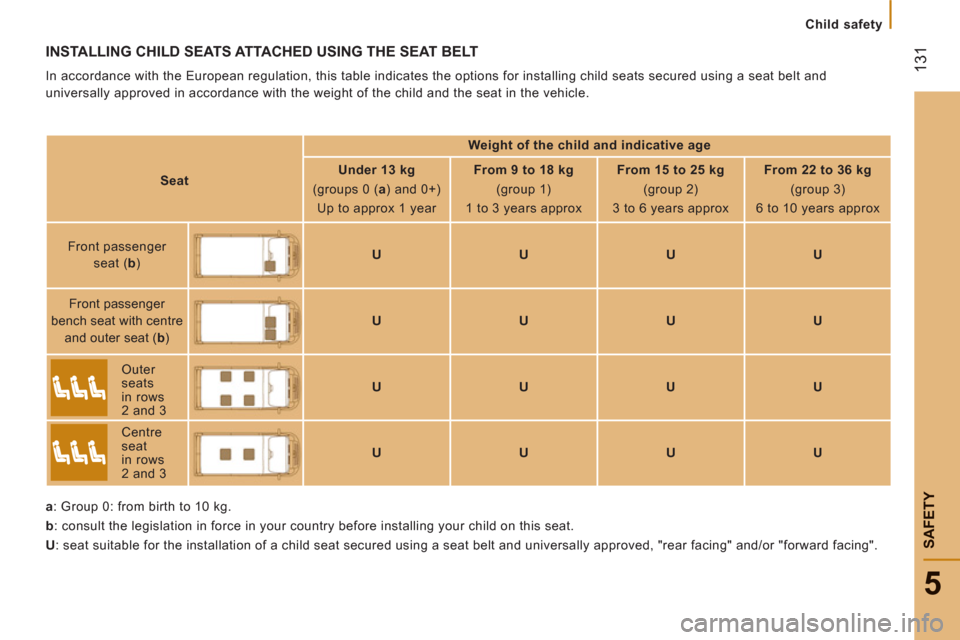
INSTALLING CHILD SEATS ATTACHED USING THE SEAT BELT
In accordance with the European regulation, this table indicates the options for installing child seats secured using a seat belt and
universally approved in accordance with the weight of the child and the seat in the vehicle.
Weight of the child and indicative age
Seat
Under 13 kg
(groups 0 ( a
) and 0+)
Up to approx 1 year
From 9 to 18 kg
(group 1)
1 to 3 years approx
From 15 to 25 kg
(group 2)
3 to 6 years approx
From 22 to 36 kg
(group 3)
6 to 10 years approx
Front passenger
seat ( b
)
U
U
U
U
Front passenger
bench seat with centre
and outer seat ( b
)
U
U
U
U
Outer
seats
in rows
2 and 3
U
U
U
U
Centre
seat
in rows
2 and 3
U
U
U
U
a
: Group 0: from birth to 10 kg.
b
: consult the legislation in force in your country before installing your child on this seat.
U
: seat suitable for the installation of a child seat secured using a seat belt and universally approved, "rear facing" and/or "forward facing".
Page 134 of 184
Child safety
132
ADVICE ON CHILD SEATS
The incorrect installation of a child seat in a
vehicle compromises the child's protection in
the event of an accident.
Remember to fasten the seat belts or the
child seat harnesses keeping the slack
in
relation to the child's body to a minimum
,
even for short journeys.
For optimum installation of the "forward
facing" child seat, ensure that the back of
the child seat is in contact with the back of
the vehicle's seat and that the head restraint
does not cause any discomfort.
If the head restraint has to be removed,
ensure that it is stored or attached securely
to prevent it from being thrown around the
vehicle in the event of sharp braking.
Children under the age of 10 must not travel
in the "forward facing" position on the front
passenger seat, unless the rear seats are
already occupied by other children, cannot
be used or are absent. Deactivate the passenger's airbag when a
"rear facing" child seat is installed on the
front seat.
Otherwise, the child would risk being
seriously injured or killed if the airbag were
to inflate.
As a safety precaution, do not leave:
- one or more children alone and
unsupervised in a vehicle,
- a child or an animal in a vehicle which
is exposed to the sun, with the windows
closed,
- the keys within reach of children inside
the vehicle.
To prevent accidental opening of the doors,
use the "Child Lock".
Take care not to open the rear windows by
more than one third.
To protect young children from the rays of
the sun, fit side blinds to the rear windows.
Installing a booster seat
The chest part of the seat belt must be
positioned on the child's shoulder without
touching the neck.
Ensure that the lap part of the seat belt
passes correctly over the child's thighs.
PEUGEOT recommends the use of a
booster seat which has a back, fitted with a
seat belt guide at shoulder level.
Crew cab
Do not install child seats, booster cushions
or carrycots on the rear seats of the cab.
Page 154 of 184

Changing a wheel
152
- If a pressure of at least 3 bars
is not
reached within 5 minutes, disconnect
the compressor from the valve and the
power socket, then move the vehicle
forward by approximately 10 metres to
distribute the sealant fluid inside the
tyre.
- Then repeat the inflating operation:
●
if a pressure of at least 3 bars
is not
reached within 10 minutes, switch off
your vehicle: the tyre has suffered too
much damage and repair has not been
possible. Consult a PEUGEOT dealer.
●
if the tyre has been inflated to a
pressure of 4 bars
, set off again
immediately.
After driving for approximately 10 minutes,
stop and check the pressure of the tyre
again.
Adjust the pressure if necessary and contact
a PEUGEOT dealer as soon as possible.
Checking and adjusting the pressure
The compressor can only be used to check
and adjust the pressure.
- Disconnect the hose I
and connect it to
the tyre valve directly; the cartridge will
then be connected to the compressor
and the filling fluid will not be injected.
If it is necessary to deflate the tyre, connect
the hose I
to the tyre valve and press the
yellow button, placed in the centre of the
switch on the compressor.
Replacing the sealant fluidcartridge
To replace the cartridge, carry out the
following operations:
- disconnect the hose I
,
- turn the cartridge to be replaced
anticlockwise and lift it,
- insert the new cartridge and turn it clockwise,
- reconnect the hose I
and connect the
hose B
in its location.
The cartridge contains ethylene-glycol, a
product which is harmful if swallowed and
which causes irritation to the eyes.
Keep out of reach of children.
After use, do not discard the cartridge in the
environment, take it to a PEUGEOT dealer or
to an organisation responsible for its collection.
This replacement kit is available from
PEUGEOT dealers.
Page 179 of 184
17
7
Interior
10
VISUAL SEARCH
Seat belts 119-120
Airbags 122-124
Deactivating the passenger airbag 123
Parking brake,
handbrake 114
Seats, adjustments 65-66
Seat with variable damping 66
2-seat bench 67
Tools, jack 148
Child seats 125-132
Rear view mirror 77
Cab courtesy lamp 74, 155
Changing a courtesy lamp bulb 155
Courtesy lamps 76, 155
12 volt socket 75
Battery (+), charging,
starting 145-147
Earth point (-) 138
Fuses in the right hand door pillar 159
Load space 75-76
●
stowing rings,
●
load retainer,
●
roof box,
●
trims,
●
inspection lamp.
Seats / rear bench seats 68-69
Rear heating /
air conditioning 60-61
Reversing camera 84-85
Sliding side windows 76
ISOFIX mountings 129-130
Crew cab 70
Accessories 135-136
Page:
< prev 1-8 9-16 17-24
