2013 PEUGEOT 3008 screen
[x] Cancel search: screenPage 87 of 352
85
AC
C
The key cannot be removed
from the lock until the cap is
put back on the tank.
Opening the cap may trigger an in-
rush of air. This vacuum, which is
completely normal, is caused by the
sealing of the fuel system.
FUEL TANK
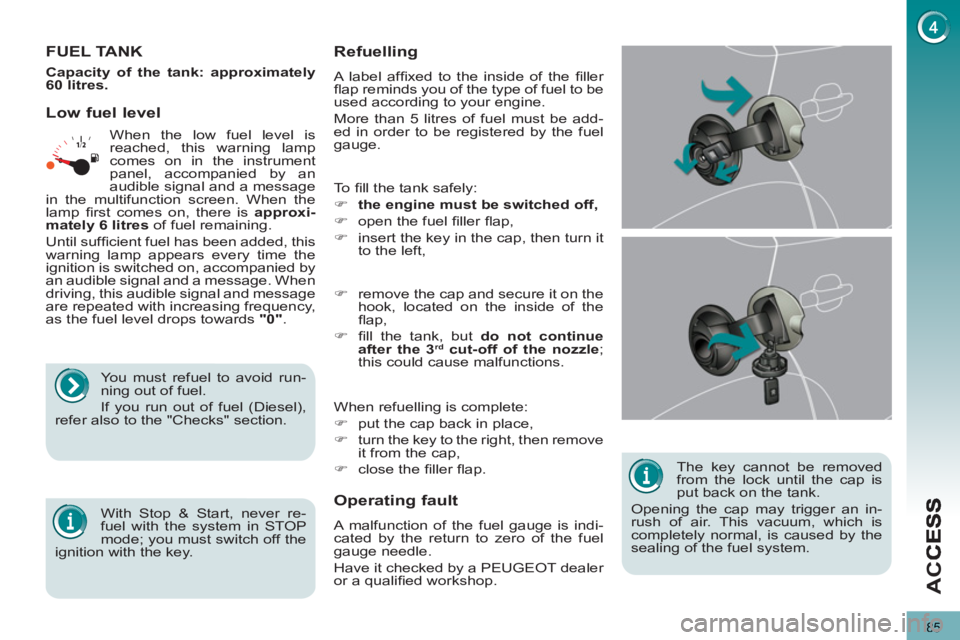
To fi ll the tank safely:
)
the engine must be switched off,
)
open the fuel fi ller fl ap,
)
insert the key in the cap, then turn it
to the left,
When refuelling is complete:
)
put the cap back in place,
)
turn the key to the right, then remove
it from the cap,
)
close the fi ller fl ap.
)
remove the cap and secure it on the
hook, located on the inside of the
fl ap,
)
fi ll the tank, but do not continue
after the 3
rd cut-off of the nozzle
;
this could cause malfunctions.
Low fuel level
Operatin
g fault
A malfunction of the fuel gauge is indi-
cated by the return to zero of the fuel
gauge needle.
Have it checked by a PEUGEOT dealer
or a qualifi ed workshop.
Refuelling
A label affi xed to the inside of the fi ller
fl ap reminds you of the type of fuel to be
used according to your engine.
More than 5 litres of fuel must be add-
ed in order to be registered by the fuel
gauge. When the low fuel level is
reached, this warning lamp
comes on in the instrument
panel, accompanied by an
audible signal and a message
in the multifunction screen. When the
lamp fi rst comes on, there is approxi-
mately
6 litres
of fuel remaining.
Until suffi cient fuel has been added, this
warning lamp appears every time the
ignition is switched on, accompanied by
an audible signal and a message. When
driving, this audible signal and message
are repeated with increasing frequency,
as the fuel level drops towards "0"
.
You must refuel to avoid run-
ning out of fuel.
If you run out of fuel (Diesel),
refer also to the "Checks" section.
With Stop & Start, never re-
fuel with the system in STOP
mode; you must switch off the
ignition with the key.
Capacity of the tank: approximately
60 litres.
Page 91 of 352
89
VIS
Manual guide-me-home lighting
The temporary illumination of the dipped
beam headlamps after the vehicle's ig-
nition has been switched off makes
the driver's exit easier when the light is
poor.
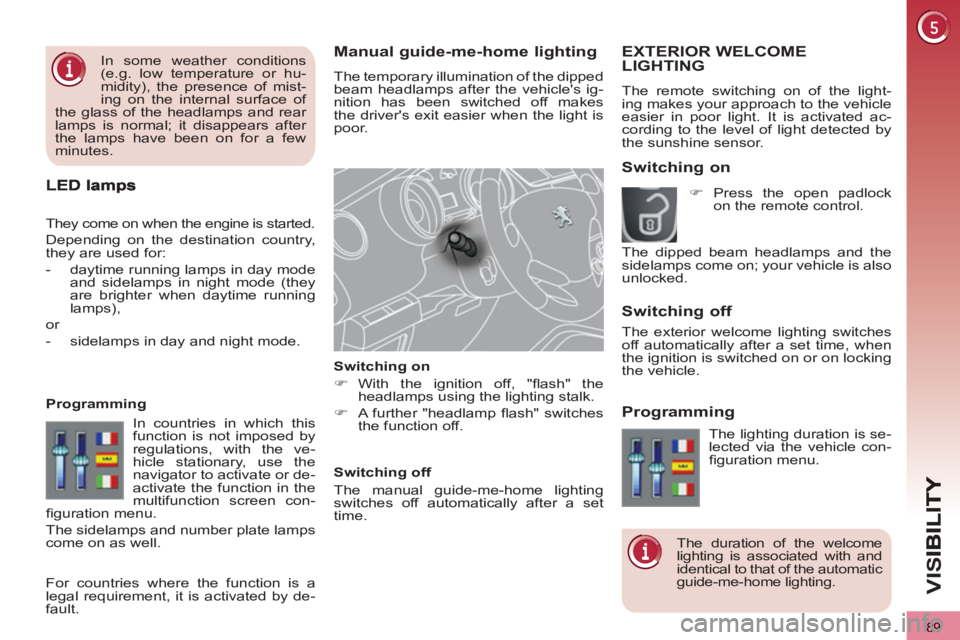
Switching on
)
With the ignition off, "fl ash" the
headlamps using the lighting stalk.
)
A further "headlamp fl ash" switches
the function off.
Switching off
The manual guide-me-home lighting
switches off automatically after a set
time.
EXTERIOR WELCOMELIGHTING
The remote switching on of the light-
ing makes your approach to the vehicle
easier in poor light. It is activated ac-
cording to the level of light detected by
the sunshine sensor.
Switching on
Switchin
g off
Programming
In countries in which this
function is not imposed by
regulations, with the ve-
hicle stationary, use the
navigator to activate or de-
activate the function in the
multifunction screen con-
fi guration menu.
The sidelamps and number plate lamps
come on as well. Programming
The lighting duration is se-
lected via the vehicle con-
fi guration menu.
The duration of the welcome
lighting is associated with and
identical to that of the automatic
guide-me-home lighting.
For countries where the function is a
legal requirement, it is activated by de-
fault.
)
Press the open padlock
on the remote control.
The dipped beam headlamps and the
sidelamps come on; your vehicle is also
unlocked.
In some weather conditions
(e.g. low temperature or hu-
midity), the presence of mist-
ing on the internal surface of
the glass of the headlamps and rear
lamps is normal; it disappears after
the lamps have been on for a few
minutes.
The exterior welcome lighting switches
off automatically after a set time, when
the ignition is switched on or on locking
the vehicle.
They come on when the engine is started.
Depending on the destination country,
they are used for:
- daytime running lamps in day mode
and sidelamps in night mode (they
are brighter when daytime running
lamps),
or
- sidelamps in day and night mode.
Page 92 of 352
90
VIS
In fog or snow, the sunshine
sensor may detect suffi cient
light. In this case, the lighting
will not come on automatically.
Do not cover the sunshine sensor,
coupled with the rain sensor and lo-
cated in the centre of the windscreen
behind the rear view mirror; the as-
sociated functions would no longer
be controlled.
Automatic "guide-me-home" lightingAutomatic illumination of headlamps
When a low level of ambient light is de-
tected by a sunshine sensor, the num-
ber plate lamps, sidelamps and dipped
beam headlamps are switched on auto-
matically, without any action on the part of
the driver. They can also come on if rain is
detected, at the same time as automatic
operation of the windscreen wipers.
As soon as the brightness returns to a
suffi cient level or after the windscreen
wipers are switched off, the lamps are
switched off automatically.
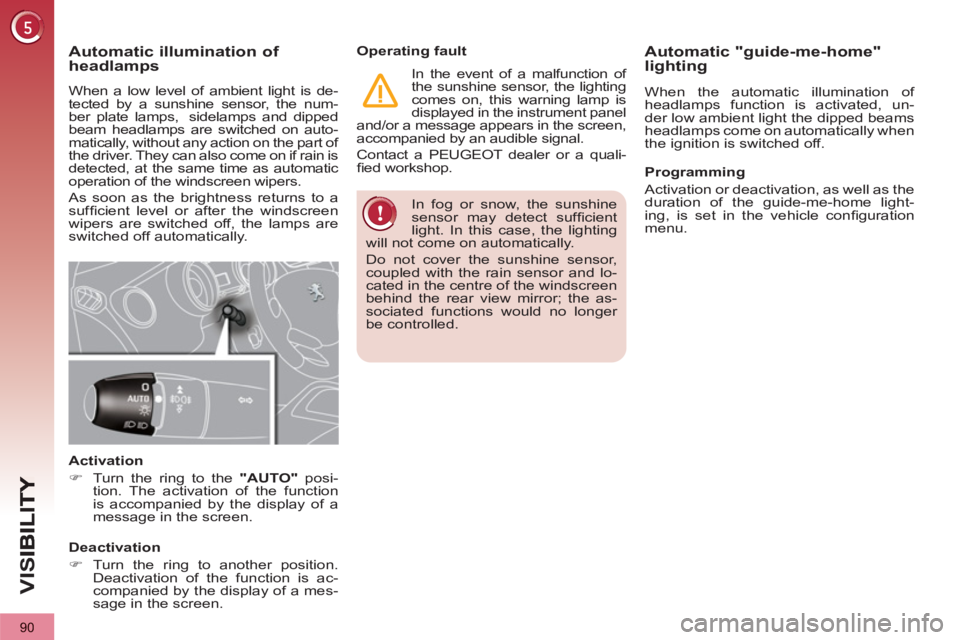
Activation
)
Turn the ring to the "AUTO"
posi-
tion. The activation of the function
is accompanied by the display of a
message in the screen.
Deactivation
)
Turn the ring to another position.
Deactivation of the function is ac-
companied by the display of a mes-
sage in the screen.
Operating fault
In the event of a malfunction of
the sunshine sensor, the lighting
comes on, this warning lamp is
displayed in the instrument panel
and/or a message appears in the screen,
accompanied by an audible signal.
Contact a PEUGEOT dealer or a quali-
fi ed workshop.
When the automatic illumination of
headlamps function is activated, un-
der low ambient light the dipped beams
headlamps come on automatically when
the ignition is switched off.
Programming
Activation or deactivation, as well as the
duration of the guide-me-home light-
ing, is set in the vehicle confi guration
menu.
Page 93 of 352
91
VIS
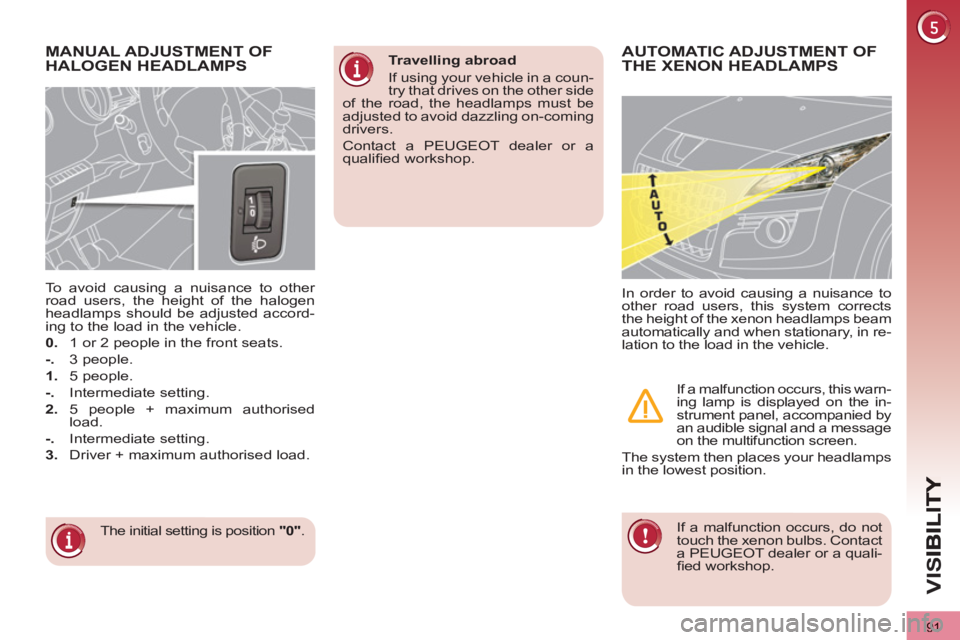
MANUAL ADJUSTMENT OF
HALOGEN HEADLAMPS
The initial setting is position "0"
.
To avoid causing a nuisance to other
road users, the height of the halogen
headlamps should be adjusted accord-
ing to the load in the vehicle.
0.
1 or 2 people in the front seats.
-.
3 people.
1.
5 people.
-.
Intermediate setting.
2.
5 people + maximum authorised
load.
-.
Intermediate setting.
3.
Driver + maximum authorised load.
Travelling abroad
If using your vehicle in a coun-
try that drives on the other side
of the road, the headlamps must be
adjusted to avoid dazzling on-coming
drivers.
Contact a PEUGEOT dealer or a
qualifi ed workshop.
AUTOMATIC ADJUSTMENT OF THE XENON HEADLAMPS
If a malfunction occurs, do not
touch the xenon bulbs. Contact
a PEUGEOT dealer or a quali-
fi ed workshop.
In order to avoid causing a nuisance to
other road users, this system corrects
the height of the xenon headlamps beam
automatically and when stationary, in re-
lation to the load in the vehicle.
If a malfunction occurs, this warn-
ing lamp is displayed on the in-
strument panel, accompanied by
an audible signal and a message
on the multifunction screen.
The system then places your headlamps
in the lowest position.
Page 94 of 352
92
VIS
DIRECTIONAL LIGHTING
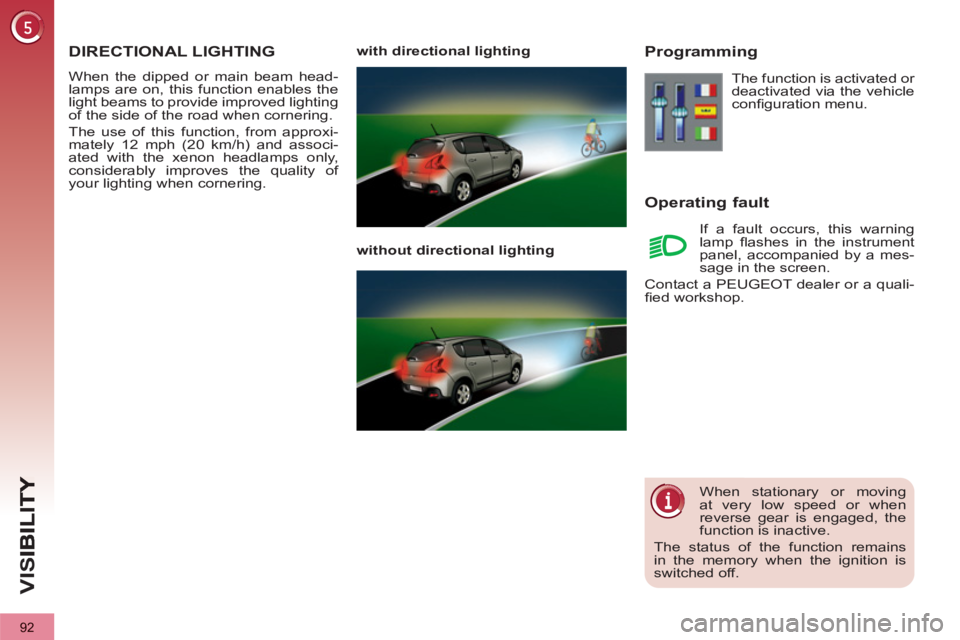
When the dipped or main beam head-
lamps are on, this function enables the
light beams to provide improved lighting
of the side of the road when cornering.
The use of this function, from approxi-
mately 12 mph (20 km/h) and associ-
ated with the xenon headlamps only,
considerably improves the quality of
your lighting when cornering.
with directional lighting
without directional lighting
Programming
Operatin
g fault
The function is activated or
deactivated via the vehicle
confi guration menu.
If a fault occurs, this warning
lamp fl ashes in the instrument
panel, accompanied by a mes-
sage in the screen.
Contact a PEUGEOT dealer or a quali-
fi ed workshop.
When stationary or moving
at very low speed or when
reverse gear is engaged, the
function is inactive.
The status of the function remains
in the memory when the ignition is
switched off.
Page 95 of 352
93
VIS
WIPER CONTROLS
System for selection and control of the
various front and rear wiping modes for
the elimination of rain and cleaning.
The vehicle's front and rear wipers are
designed to improve the driver's visibility
progressively according to the climatic
conditions.
Manual controls
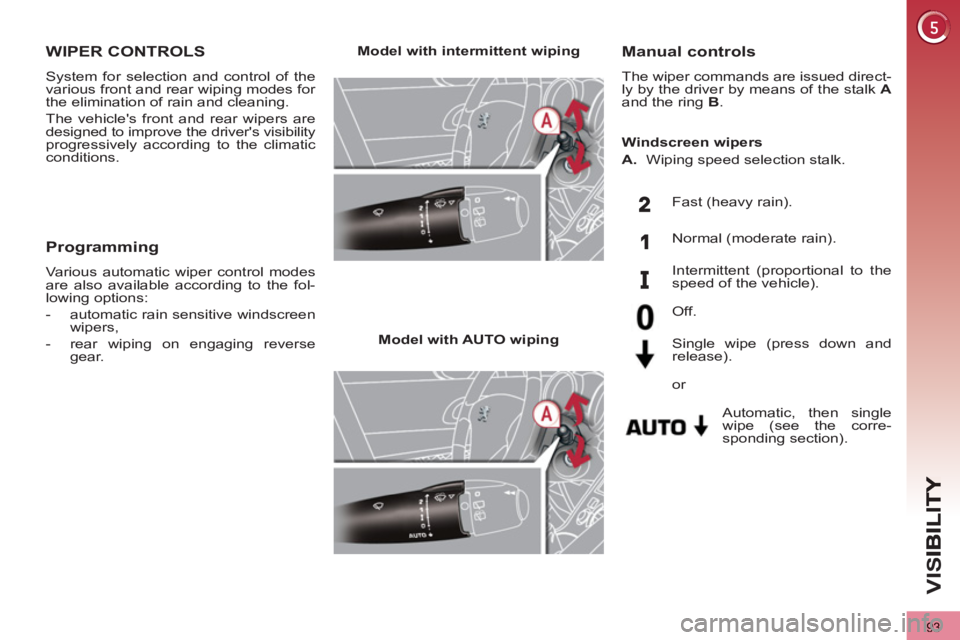
The wiper commands are issued direct-
ly by the driver by means of the stalk A
and the ring B
.
Model with intermittent wiping
Model with AUTO wiping
Fast (heavy rain).
Normal (moderate rain).
Intermittent (proportional to the
speed of the vehicle).
Automatic, then single
wipe (see the corre-
sponding section).
Off.
Single wipe (press down and
release).
Windscreen wipers
A.
Wiping speed selection stalk.
or
Programming
Various automatic wiper control modes
are also available according to the fol-
lowing options:
- automatic rain sensitive windscreen
wipers,
- rear wiping on engaging reverse
gear.
Page 96 of 352
94
VIS
Windscreen and headlamp
wash
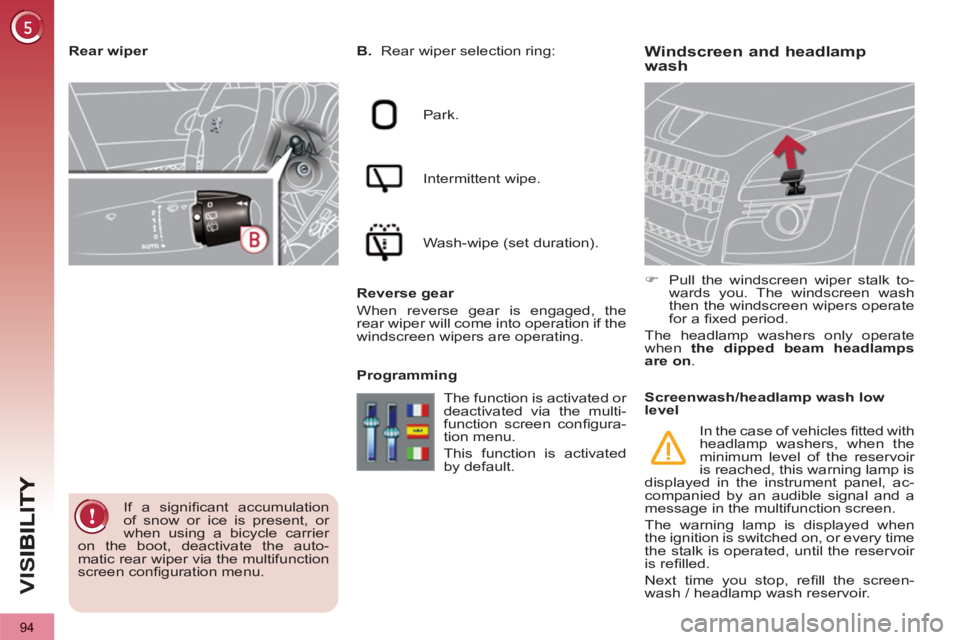
B.
Rear wiper selection ring:
Park.
Intermittent wipe.
Wash-wipe (set duration).
Reverse gear
When reverse gear is engaged, the
rear wiper will come into operation if the
windscreen wipers are operating.
Programming
)
Pull the windscreen wiper stalk to-
wards you. The windscreen wash
then the windscreen wipers operate
for a fi xed period.
The headlamp washers only operate
when the dipped beam headlamps
are on
.
Rear wiper
If a signifi cant accumulation
of snow or ice is present, or
when using a bicycle carrier
on the boot, deactivate the auto-
matic rear wiper via the multifunction
screen confi guration menu. The function is activated or
deactivated via the multi-
function screen confi gura-
tion menu.
This function is activated
by default.
Screenwash/headlamp wash low
level
In the case of vehicles fi tted with
headlamp washers, when the
minimum level of the reservoir
is reached, this warning lamp is
displayed in the instrument panel, ac-
companied by an audible signal and a
message in the multifunction screen.
The warning lamp is displayed when
the ignition is switched on, or every time
the stalk is operated, until the reservoir
is refi lled.
Next time you stop, refi ll the screen-
wash / headlamp wash reservoir.
Page 97 of 352
95
VIS
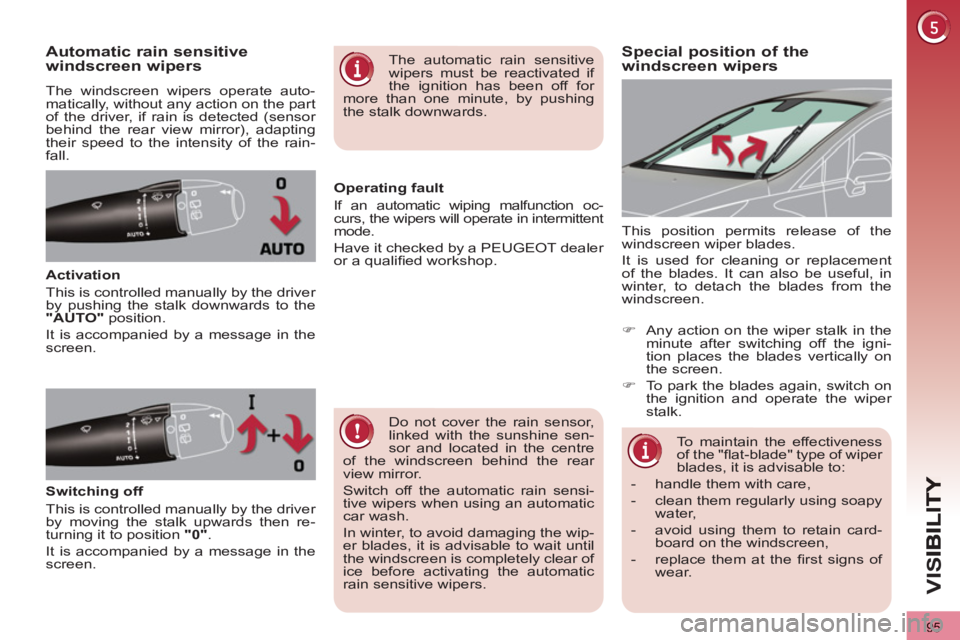
Special position of the
windscreen wipersAutomatic rain sensitive
windscreen wipers
The windscreen wipers operate auto-
matically, without any action on the part
of the driver, if rain is detected (sensor
behind the rear view mirror), adapting
their speed to the intensity of the rain-
fall.
Activation
This is controlled manually by the driver
by pushing the stalk downwards to the
"AUTO"
position.
It is accompanied by a message in the
screen. This position permits release of the
windscreen wiper blades.
It is used for cleaning or replacement
of the blades. It can also be useful, in
winter, to detach the blades from the
windscreen.
Do not cover the rain sensor,
linked with the sunshine sen-
sor and located in the centre
of the windscreen behind the rear
view mirror.
Switch off the automatic rain sensi-
tive wipers when using an automatic
car wash.
In winter, to avoid damaging the wip-
er blades, it is advisable to wait until
the windscreen is completely clear of
ice before activating the automatic
rain sensitive wipers.
The automatic rain sensitive
wipers must be reactivated if
the ignition has been off for
more than one minute, by pushing
the stalk downwards.
Switching off
This is controlled manually by the driver
by moving the stalk upwards then re-
turning it to position "0"
.
It is accompanied by a message in the
screen.
Operating fault
If an automatic wiping malfunction oc-
curs, the wipers will operate in intermittent
mode.
Have it checked by a PEUGEOT dealer
or a qualifi ed workshop.
To maintain the effectiveness
of the "fl at-blade" type of wiper
blades, it is advisable to:
- handle them with care,
- clean them regularly using soapy
water,
- avoid using them to retain card-
board on the windscreen,
- replace them at the fi rst signs of
wear.
)
Any action on the wiper stalk in the
minute after switching off the igni-
tion places the blades vertically on
the screen.
)
To park the blades again, switch on
the ignition and operate the wiper
stalk.