2013 NISSAN GT-R check oil
[x] Cancel search: check oilPage 121 of 346
2-26Instruments and controls
WARNING
.Your brake system may not be
working properly if the warning light
is on. Driving could be dangerous. If
you judge it to be safe, drive care-
fully to the nearest service station
for repairs. Otherwise, have your
vehicle towed because driving it
could be dangerous.
. Pressing the brake pedal with the
engine stopped and/or low brake
fluid level may increase your stop-
ping distance and braking will re-
quire greater pedal effort as well as
pedal travel.
. If the brake fluid level is below the
minimum or MIN mark on the brake
fluid reservoir, do not drive until the
brake system has been checked at a
GT-R certified NISSAN dealer.
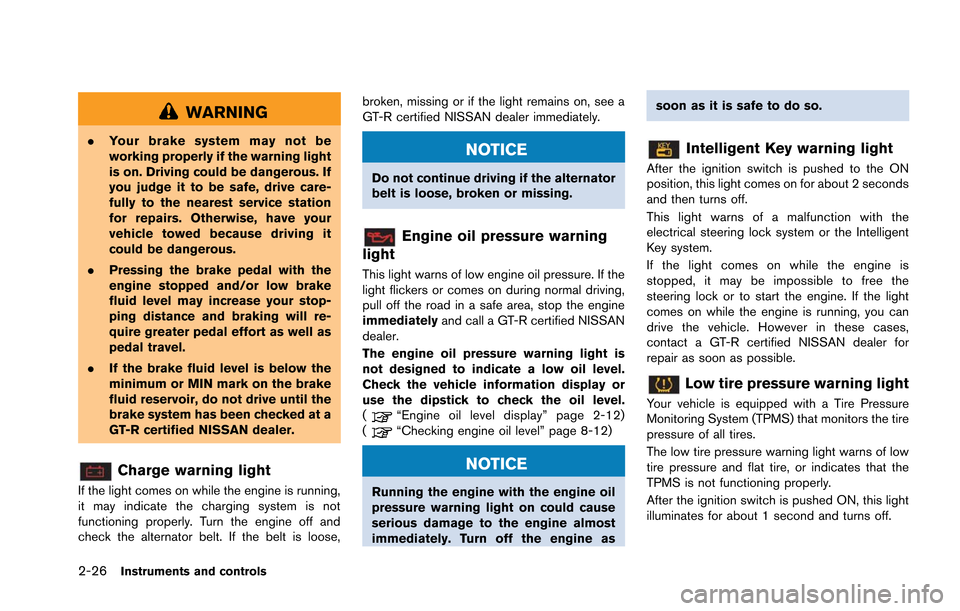
Charge warning light
If the light comes on while the engine is running,
it may indicate the charging system is not
functioning properly. Turn the engine off and
check the alternator belt. If the belt is loose, broken, missing or if the light remains on, see a
GT-R certified NISSAN dealer immediately.
NOTICE
Do not continue driving if the alternator
belt is loose, broken or missing.
Engine oil pressure warning
light
This light warns of low engine oil pressure. If the
light flickers or comes on during normal driving,
pull off the road in a safe area, stop the engine
immediately and call a GT-R certified NISSAN
dealer.
The engine oil pressure warning light is
not designed to indicate a low oil level.
Check the vehicle information display or
use the dipstick to check the oil level.
(
“Engine oil level display” page 2-12)
(“Checking engine oil level” page 8-12)
NOTICE
Running the engine with the engine oil
pressure warning light on could cause
serious damage to the engine almost
immediately. Turn off the engine as soon as it is safe to do so.
Intelligent Key warning light
After the ignition switch is pushed to the ON
position, this light comes on for about 2 seconds
and then turns off.
This light warns of a malfunction with the
electrical steering lock system or the Intelligent
Key system.
If the light comes on while the engine is
stopped, it may be impossible to free the
steering lock or to start the engine. If the light
comes on while the engine is running, you can
drive the vehicle. However in these cases,
contact a GT-R certified NISSAN dealer for
repair as soon as possible.
Low tire pressure warning light
Your vehicle is equipped with a Tire Pressure
Monitoring System (TPMS) that monitors the tire
pressure of all tires.
The low tire pressure warning light warns of low
tire pressure and flat tire, or indicates that the
TPMS is not functioning properly.
After the ignition switch is pushed ON, this light
illuminates for about 1 second and turns off.
Page 124 of 346
.The supplemental air bag warning light
remains on after approximately 7 seconds.
. The supplemental air bag warning light
flashes intermittently.
. The supplemental air bag warning light does
not come on at all.
Unless checked and repaired, the supplemental
restraint system (air bag system) and/or the
pretensioners may not function properly.
(
“Supplemental restraint system” page 1-
31)
WARNING
If the supplemental air bag warning
light is on, it could mean that the front
air bag, side air bag, curtain air bag
and/or pretensioner systems will not
operate in an accident. To help avoid
injury to yourself or others, have your
vehicle checked by a GT-R certified
NISSAN dealer as soon as possible.
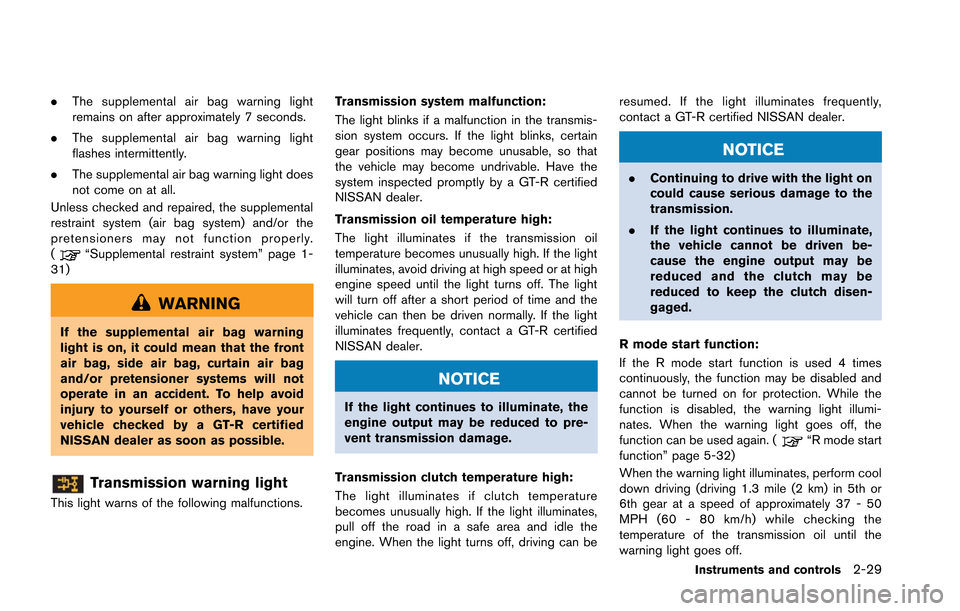
Transmission warning light
This light warns of the following malfunctions. Transmission system malfunction:
The light blinks if a malfunction in the transmis-
sion system occurs. If the light blinks, certain
gear positions may become unusable, so that
the vehicle may become undrivable. Have the
system inspected promptly by a GT-R certified
NISSAN dealer.
Transmission oil temperature high:
The light illuminates if the transmission oil
temperature becomes unusually high. If the light
illuminates, avoid driving at high speed or at high
engine speed until the light turns off. The light
will turn off after a short period of time and the
vehicle can then be driven normally. If the light
illuminates frequently, contact a GT-R certified
NISSAN dealer.
NOTICE
If the light continues to illuminate, the
engine output may be reduced to pre-
vent transmission damage.
Transmission clutch temperature high:
The light illuminates if clutch temperature
becomes unusually high. If the light illuminates,
pull off the road in a safe area and idle the
engine. When the light turns off, driving can be resumed. If the light illuminates frequently,
contact a GT-R certified NISSAN dealer.
NOTICE
.
Continuing to drive with the light on
could cause serious damage to the
transmission.
. If the light continues to illuminate,
the vehicle cannot be driven be-
cause the engine output may be
reduced and the clutch may be
reduced to keep the clutch disen-
gaged.
R mode start function:
If the R mode start function is used 4 times
continuously, the function may be disabled and
cannot be turned on for protection. While the
function is disabled, the warning light illumi-
nates. When the warning light goes off, the
function can be used again. (
“R mode start
function” page 5-32)
When the warning light illuminates, perform cool
down driving (driving 1.3 mile (2 km) in 5th or
6th gear at a speed of approximately 37 - 50
MPH (60 - 80 km/h) while checking the
temperature of the transmission oil until the
warning light goes off.
Instruments and controls2-29
Page 129 of 346
2-34Instruments and controls
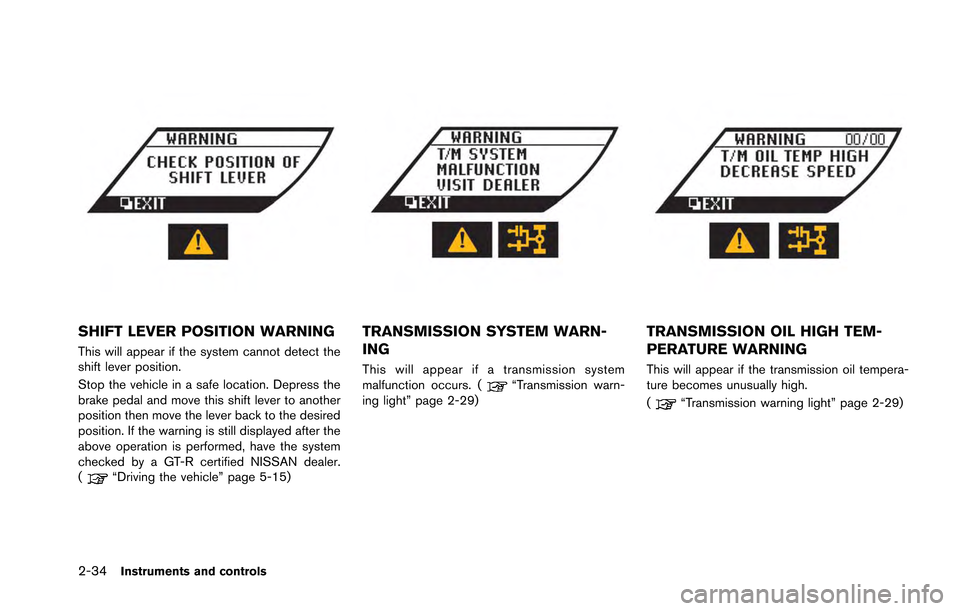
SHIFT LEVER POSITION WARNING
This will appear if the system cannot detect the
shift lever position.
Stop the vehicle in a safe location. Depress the
brake pedal and move this shift lever to another
position then move the lever back to the desired
position. If the warning is still displayed after the
above operation is performed, have the system
checked by a GT-R certified NISSAN dealer.
(
“Driving the vehicle” page 5-15)
TRANSMISSION SYSTEM WARN-
ING
This will appear if a transmission system
malfunction occurs. (“Transmission warn-
ing light” page 2-29)
TRANSMISSION OIL HIGH TEM-
PERATURE WARNING
This will appear if the transmission oil tempera-
ture becomes unusually high.
(
“Transmission warning light” page 2-29)
Page 182 of 346
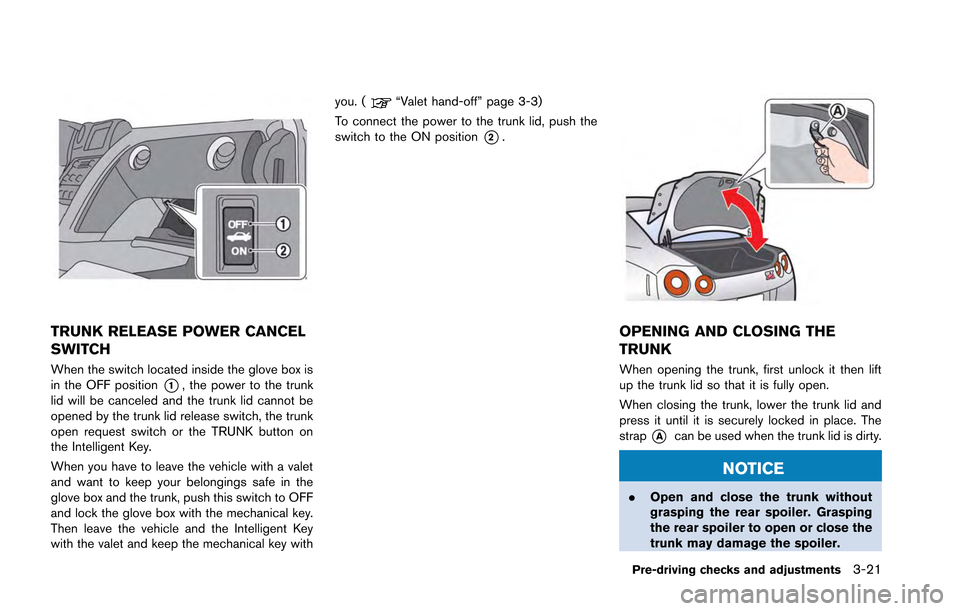
TRUNK RELEASE POWER CANCEL
SWITCH
When the switch located inside the glove box is
in the OFF position
*1, the power to the trunk
lid will be canceled and the trunk lid cannot be
opened by the trunk lid release switch, the trunk
open request switch or the TRUNK button on
the Intelligent Key.
When you have to leave the vehicle with a valet
and want to keep your belongings safe in the
glove box and the trunk, push this switch to OFF
and lock the glove box with the mechanical key.
Then leave the vehicle and the Intelligent Key
with the valet and keep the mechanical key with you. (
“Valet hand-off” page 3-3)
To connect the power to the trunk lid, push the
switch to the ON position
*2.
OPENING AND CLOSING THE
TRUNK
When opening the trunk, first unlock it then lift
up the trunk lid so that it is fully open.
When closing the trunk, lower the trunk lid and
press it until it is securely locked in place. The
strap
*Acan be used when the trunk lid is dirty.
NOTICE
. Open and close the trunk without
grasping the rear spoiler. Grasping
the rear spoiler to open or close the
trunk may damage the spoiler.
Pre-driving checks and adjustments3-21
Page 183 of 346
3-22Pre-driving checks and adjustments
.Do not leave the key inside the
trunk.
NOTE:
. To prevent the Intelligent Key from
being accidentally locked in the trunk,
lockout protection is equipped with the
Intelligent Key system. When the trunk
lid is closed with the Intelligent Key
inside the trunk, the outside buzzer will
sound and the trunk will open.
. The trunk of this vehicle is slightly
more difficult to close than an ordinary
vehicle (particularly when the vehicle is
new) . This is because the trunk rigidity
has been increased to handle the high
load on the rear spoiler during vehicle
operation. This does not indicate that
there is a malfunction. Check that the
trunk is securely locked.
EMERGENCY TRUNK LID RELEASE
WARNING
Closely supervise children when they
are around cars to prevent them from
playing and becoming locked in the
trunk where they could be seriously
injured. Keep the car locked, with the
trunk lid securely latched, when not in
use, and prevent children’s access to
Intelligent Keys.
The emergency trunk lid release mechanism allows opening of the trunk lid in the event that
people become locked inside the trunk or in the
event of the loss of electrical power such as a
discharged battery.
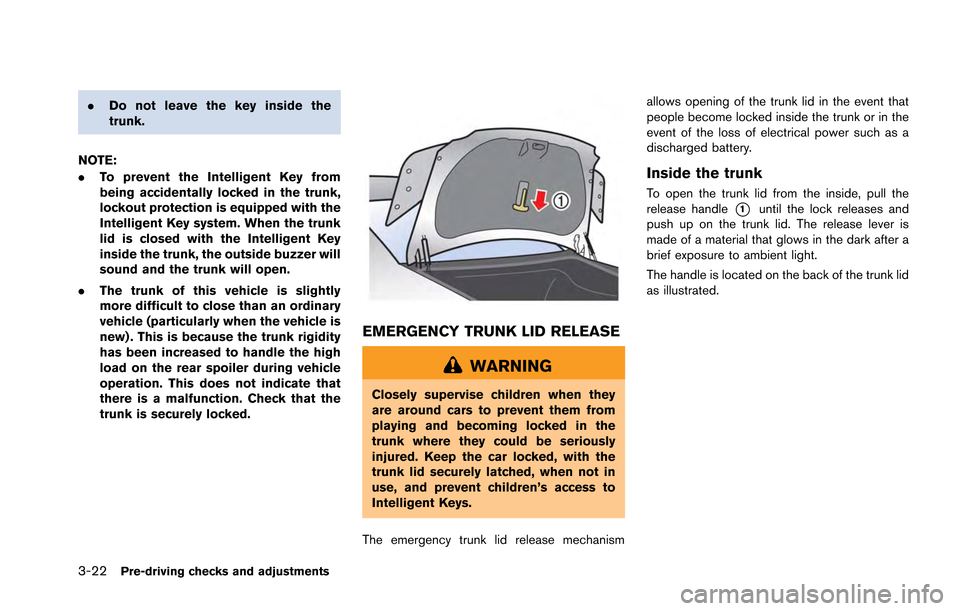
Inside the trunk
To open the trunk lid from the inside, pull the
release handle
*1until the lock releases and
push up on the trunk lid. The release lever is
made of a material that glows in the dark after a
brief exposure to ambient light.
The handle is located on the back of the trunk lid
as illustrated.
Page 184 of 346
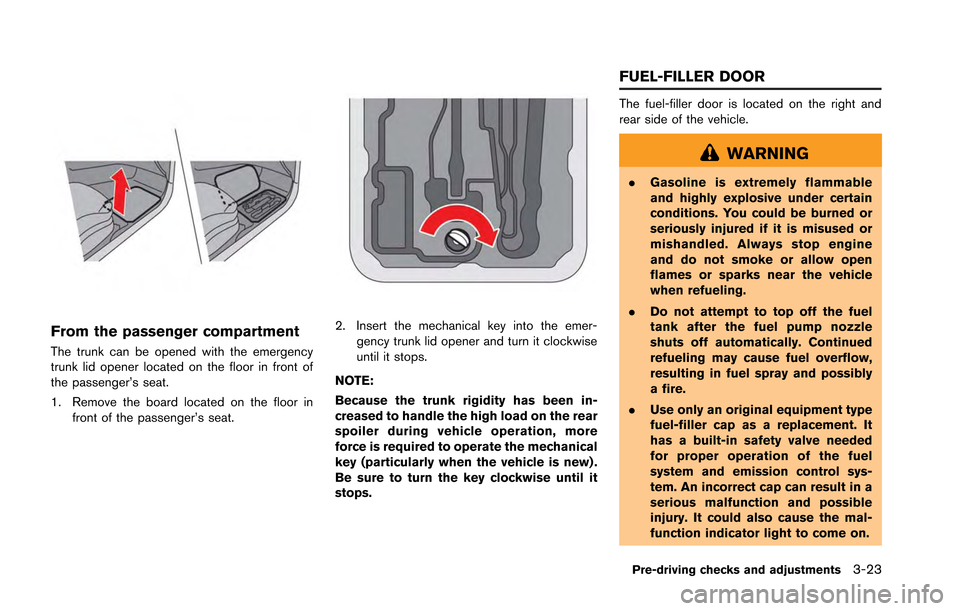
From the passenger compartment
The trunk can be opened with the emergency
trunk lid opener located on the floor in front of
the passenger’s seat.
1. Remove the board located on the floor infront of the passenger’s seat.
2. Insert the mechanical key into the emer-gency trunk lid opener and turn it clockwise
until it stops.
NOTE:
Because the trunk rigidity has been in-
creased to handle the high load on the rear
spoiler during vehicle operation, more
force is required to operate the mechanical
key (particularly when the vehicle is new) .
Be sure to turn the key clockwise until it
stops.
The fuel-filler door is located on the right and
rear side of the vehicle.
WARNING
. Gasoline is extremely flammable
and highly explosive under certain
conditions. You could be burned or
seriously injured if it is misused or
mishandled. Always stop engine
and do not smoke or allow open
flames or sparks near the vehicle
when refueling.
. Do not attempt to top off the fuel
tank after the fuel pump nozzle
shuts off automatically. Continued
refueling may cause fuel overflow,
resulting in fuel spray and possibly
a fire.
. Use only an original equipment type
fuel-filler cap as a replacement. It
has a built-in safety valve needed
for proper operation of the fuel
system and emission control sys-
tem. An incorrect cap can result in a
serious malfunction and possible
injury. It could also cause the mal-
function indicator light to come on.
Pre-driving checks and adjustments3-23
FUEL-FILLER DOOR
Page 206 of 346
.Make sure the area around the vehicle is
clear.
. Check fluid levels such as engine oil, cool-
ant, brake fluid and window washer fluid as
frequently as possible, or at least whenever
you refuel.
. Check that all windows and lights are clean.
. Visually inspect tires for their appearance
and condition. Also check tires for proper
inflation.
. Lock all doors.
. Position seat.
. Adjust inside and outside mirrors.
. Fasten seat belts and ask all passengers to
do likewise.
. Check the operation of warning lights when
the ignition switch is pushed to the ON
position. (
“Warning/indicator lights
and audible reminders” page 2-24)
NOTE:
. This vehicle includes spark plugs that
are designed for maximum perfor-
mance. If the start time becomes long-
er, the plugs may be fouled, making the
engine difficult to start. If this occurs,
start the engine using the procedure
described in this section.
. A click sound may be heard when the
brake pedal is depressed and released.
This is normal.
. A low rattling operating sound may
occur when the engine is started or
stopped. This is because of the trans-
mission gear design, light flywheel and
dry sump lubrication system used in
this transmission. This does not indi-
cate that there is a malfunction. This
sound is likely to occur in particular if
the engine is stopped when the tem-
perature of the transmission oil is high.
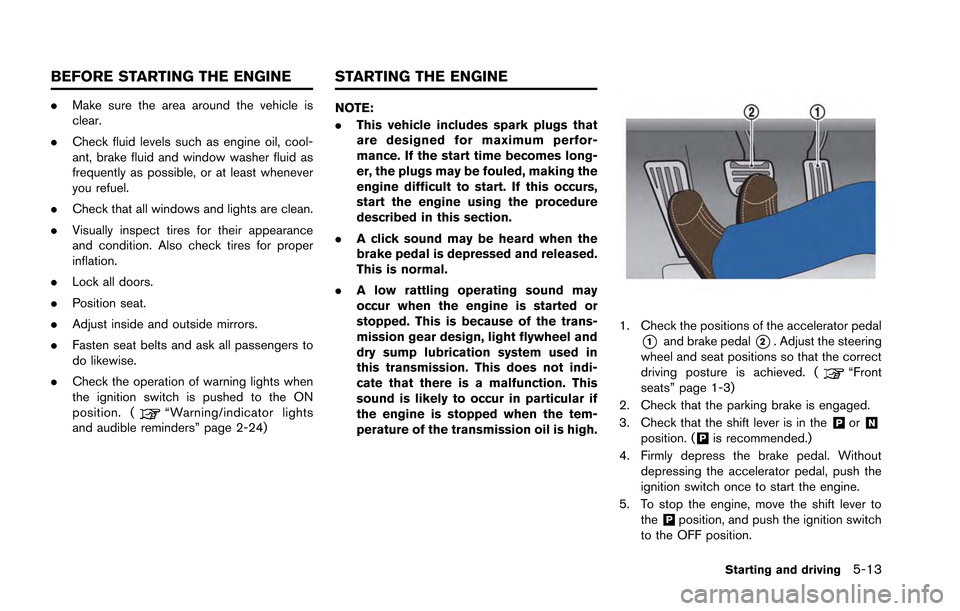
1. Check the positions of the accelerator pedal
*1and brake pedal*2. Adjust the steering
wheel and seat positions so that the correct
driving posture is achieved. (
“Front
seats” page 1-3)
2. Check that the parking brake is engaged.
3. Check that the shift lever is in the
&Por&Nposition. (&Pis recommended.)
4. Firmly depress the brake pedal. Without depressing the accelerator pedal, push the
ignition switch once to start the engine.
5. To stop the engine, move the shift lever to the
&Pposition, and push the ignition switch
to the OFF position.
Starting and driving5-13
BEFORE STARTING THE ENGINE STARTING THE ENGINE
Page 224 of 346
See your 2013 Warranty Information Booklet for
important related information and warranty
coverage exclusions. See also section 2 (page
2-29) and section 5 (page 5-49) of this Owner’s
Manual, “Transmission Clutch Temperature
High” and “Vehicle Dynamic Control (VDC)
System” for important additional related informa-
tion.The turbocharger system uses engine oil for
lubrication and cooling of its rotating compo-
nents. The turbocharger turbine turns at extre-
mely high speeds and it can get very hot. It is
essential to maintain a supply of oil flowing
through the turbocharger system. Therefore, a
sudden interruption of oil supply may cause a
malfunction in the turbocharger.
To ensure prolonged life and performance of the
turbocharger, it is essential to perform the
following maintenance procedure:
.Change your engine oil according to the
recommended intervals shown in the sepa-
rate Service and Maintenance Guide. Use
only the recommended engine oil.
. If the engine had been operating at high
engine speed for an extended period of time,
let it idle for a few minutes prior to shut-
down.
. Do not accelerate your engine to high
engine speed immediately after start.
NOTICE
.This vehicle includes spark plugs
that are designed for high perfor-
mance. For this reason, if the engine
is repeatedly started and stopped over a short time, the spark plugs
may become fouled, making the
engine difficult to start. To prevent
diminished starting performance,
avoid starting and stopping the
engine repeatedly during a short
period of time.
NOTE:
. When the vehicle is delivered, the
engine oil level is 0.39 in (10 mm)
below the H mark on the engine oil
dipstick for optimum high performance
driving. The engine oil can be filled up
to the H mark if not engaging in
performance driving.
. Because of the high performance char-
acteristics of the GT-R engine, more
frequent oil level inspections are ne-
cessary. Check the oil level every 1,800
miles (3,000km) and adjust as neces-
sary. Also, change the engine oil based
on the driving conditions. For the
information regarding oil replacement
intervals, refer to the 2013 NISSAN
GT-R Service and Maintenance Guide.
. Some amount of oil is consumed by
your engine under normal operating
Starting and driving5-31
TURBOCHARGER SYSTEM