Page 485 of 602
6-10 For emergencies
6
Spare tire information
N00849600331
Compact spare tireThe compact spare tire is stowed beneath the luggage floor
board of the luggage compartment. It is designed to save space
in the luggage compartment. Its lighter weight makes it easier
to use if a flat tire occurs.
WARNING
!�Tires, including spare tire, degrade over time with
age even when they are not being used. It is recom-
mended that tires over 6 years generally be replaced
even if damage is not obvious.
CAUTION
!�While the compact spare tire is stowed, the inflation
pressure should be checked at least once a month to
assure that it remains at the recommended inflation
pressure. See the tire and loading information plac-
ard attached to the driver’s door sill. Refer to “Tire
and loading information placard” on page 9-4.�Driving with an improperly inflated tire can cause
an accident. If you have no choice but to drive with
an under-inflated tire, keep your speed down and
avoid sudden steering or braking, if possible. Inflate
the tire to the correct pressure as soon as possible.
Refer to “Tire inflation pressures” on page 7-27.
� The compact spare tire should be used only tempo-
rarily. While the compact spare tire is being used,
the tire pressure monitoring system will not function
properly. Have the tire replaced or repaired at an
authorized Mitsubishi Motors dealer or a repair
facility of your choice as soon as possible.�Do not go over 50 mph (80 km/h) when driving with
the compact spare tire.�Avoid sudden starting and braking when driving
with the compact spare tire.�Do not drive through automatic car washes and over
obstacles that could possibly damage the underside
of your vehicle. Because the compact spare tire is
smaller than the original tire, there is less clearance
between the ground and your vehicle.�Because the compact spare tire is designed only for
your vehicle, do not use it on any other vehicle.�Do not put the compact spare tire on a different
wheel, and do not put standard tires, snow tires,
wheel covers or trim rings on the compact spare
wheel. Otherwise, you could damage these parts or
other parts on your vehicle.�Do not use tire chains with your compact spare tire.
Using a chain could cause damage to your vehicle
and loss of the chains.
CAUTION
!
BK0150700US.book 10 ページ 2012年3月22日 木曜日 午後6時46分
Page 506 of 602
Vehicle care and maintenance7-5
7
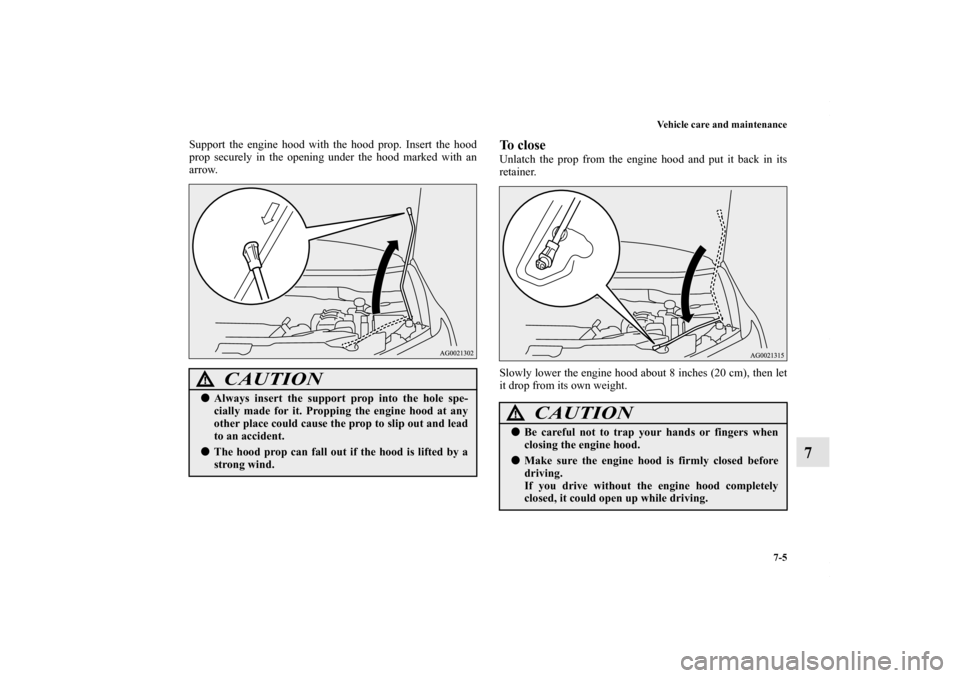
Support the engine hood with the hood prop. Insert the hood
prop securely in the opening under the hood marked with an
arrow.
To closeUnlatch the prop from the engine hood and put it back in its
retainer.
Slowly lower the engine hood about 8 inches (20 cm), then let
it drop from its own weight.
CAUTION
!�Always insert the support prop into the hole spe-
cially made for it. Propping the engine hood at any
other place could cause the prop to slip out and lead
to an accident.�The hood prop can fall out if the hood is lifted by a
strong wind.
CAUTION
!� Be careful not to trap your hands or fingers when
closing the engine hood.�Make sure the engine hood is firmly closed before
driving.
If you drive without the engine hood completely
closed, it could open up while driving.
BK0150700US.book 5 ページ 2012年3月22日 木曜日 午後6時46分
Page 524 of 602
Vehicle care and maintenance7-23
7
Tires
N00939200494
It is important to familiarize yourself with the following terms:
� Cold tire pressure:
• The measured pressure after the vehicle has been parked for at least three hours,
or
• The measured pressure when the vehicle is driven less than 1 mile (1.6 km) after having been parked for three
hours.
� Maximum pressure: the maximum permissible cold tire
inflation pressure for this tire.
� Recommended inflation pressure: the inflation pressure
for optimum tire performance. �
Intended outboard sidewall:
• The sidewall that contains a whitewall, bears white let-
tering or bears manufacturer, brand, and/or model name
molding that is higher or deeper than the same molding
on the other sidewall of the tire, or
• The outward facing sidewall of an asymmetrical tire that has a particular side that must always face outward
when mounted on a vehicle.
� Passenger car tire: a tire intended for use on passenger
cars, multipurpose passenger vehicles, and trucks, that
have a gross vehicle weight rating (GVWR) of 10,000
pounds or less.
� Light truck (LT) tire: a tire designated by its manufacturer
as primarily intended for use on lightweight trucks or mul-
tipurpose passenger vehicles.
� Tread: portion of a tire that comes into contact with the
road.
� Tread rib: a tread section running circumferentially
around a tire.
� Tread separation: pulling away of the tread from the tire
carcass.
� Carcass: the tire structure, except tread and sidewall rub-
ber which, when inflated, bears the load.
� Sidewall: portion of a tire between the tread and bead.
� Section width: the linear distance between the exteriors of
the sidewalls of an inflated tire, excluding elevations due
to labeling, decoration, or protective bands.
� Bead: the part of the tire that is made of steel wires,
wrapped or reinforced by ply cords and that is shaped to
fit the rim.
� Ply: a layer of rubber-coated parallel cords.
� Cord: the strands forming the plies in the tire.
WARNING
!�Driving with tires that are worn, damaged or
improperly inflated is dangerous.
These type tire conditions will adversely affect vehi-
cle performance.
These type tire conditions can also cause a tread sep-
aration or blowout which may result in an accident
causing serious injury or death.�Tires, including spare tire, degrade over time with
age even when they are not being used.
It is recommended that tires over 6 years generally
be replaced even if damage is not obvious.
BK0150700US.book 23 ページ 2012年3月22日 木曜日 午後6時46分
Page 529 of 602
7-28 Vehicle care and maintenance
7
Check your tires each time you refuel. If one tire looks lower
than the others, check the pressure for all of them.
You should also take the following safety precautions:� Keep your tires inflated to the recommended pressures.
(See the tire and loading information placard attached to
the driver’s door sill.)
� Stay within the recommended load limits.
� Make sure that the weight of any load in your vehicle is
evenly distributed.
� Drive at safe speeds.
� After filling your tires to the correct pressure, check them
for damage and air leaks. Be sure to reinstall the caps on
the valve stems.
Replacing tires and wheels
N00939600241
CAUTION
!�Avoid using different size tires from the one listed
and the combined use of different types of tires, as
this can affect driving safety.
Refer to “Tires and wheels” on page 9-8.�On all-wheel drive vehicles, always use tires of the
same size, same type, and same brand, and which
have no wear differences. Using tires that differ in
size, type, brand or the degree of wear, will increase
the differential oil temperature, resulting in possible
damage to the driving system. Further, the drive
train will be subjected to excessive loading, possibly
leading to oil leakage, component seizure, or other
serious problems.�Only Mitsubishi Motors Authorized wheels should
be used, because your vehicle is equipped with a tire
pressure monitoring system.
Use of another type of wheel risks air leaks and sen-
sor damage, as it will not be possible to install the
tire pressure sensor properly.
BK0150700US.book 28 ページ 2012年3月22日 木曜日 午後6時46分
Page 584 of 602
9
Specifications
Vehicle labeling . . . . . . . . . . . . . . . . . . . . . . . . . . .9- 2
Vehicle dimensions . . . . . . . . . . . . . . . . . . . . . . . .9- 5
Vehicle weights . . . . . . . . . . . . . . . . . . . . . . . . . . .9- 6
Engine specifications . . . . . . . . . . . . . . . . . . . . . . .9- 7
Battery . . . . . . . . . . . . . . . . . . . . . . . . . . . . . . . . . .9- 8
Tires and wheels. . . . . . . . . . . . . . . . . . . . . . . . . . .9- 8
Capacity . . . . . . . . . . . . . . . . . . . . . . . . . . . . . . . . .9- 9
BK0150700US.book 1 ページ 2012年3月22日 木曜日 午後6時46分
Page 589 of 602
9-6 Specifications
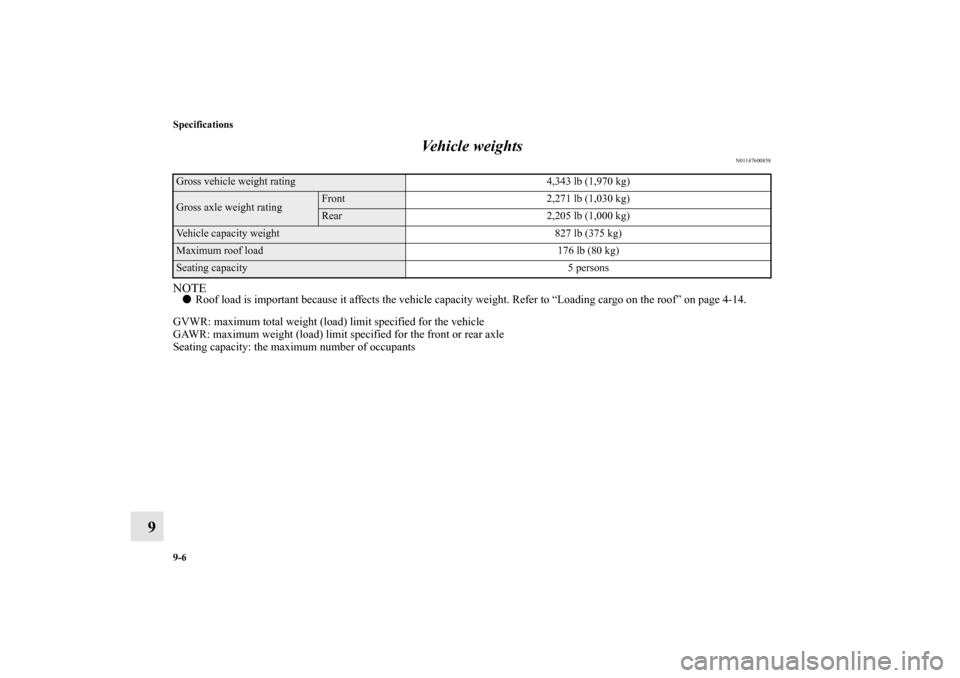
9Vehicle weights
N01147600858
NOTE�
Roof load is important because it affects the vehicle capacity weight. Refer to “Loading cargo on the roof” on page 4-14.
GVWR: maximum total weight (load) limit specified for the vehicle
GAWR: maximum weight (load) limit specified for the front or rear axle
Seating capacity: the maximum number of occupantsGross vehicle weight rating 4,343 lb (1,970 kg)Gross axle weight rating
Front2,271 lb (1,030 kg)Rear 2,205 lb (1,000 kg)
Vehicle capacity weight 827 lb (375 kg)Maximum roof load 176 lb (80 kg)Seating capacity 5 personsBK0150700US.book 6 ページ 2012年3月22日 木曜日 午後6時46分
Page 600 of 602
Alphabetical index7
To change a tire 6-8
Tread wear indicator 7-29
Tire pressure monitoring system 3-115
Tires Tire and loading information placard 9-4
Tire chains 7-32
Tools 6-7 Storage 6-7
Towing 6-21
Trailer towing 4-16
Transfer oil 7-18
,9-9
Turn signal light Indicators 3-177
Lever 3-192
U
USB input terminal 3-231How to connect an iPod 3-233
USB input terminal device How to connect a USB memory 3-231
V
Vanity mirror 3-237
Vanity mirror lightsBulb capacity 7-50
Vehicle care precautions 7-69
Vehicle dimensions 9-5
Vehicle labeling 9-2 Vehicle preparation before driving 4-5
Vehicle weights 9-6
Vents 5-2
W
Warning lights 3-177
Washer
Fluid 7-19
,9-9
Rear window washer 3-201
Switch 3-200
Washing 7-71
Waxing 7-73
Weights 9-6
Wheel Covers 6-19
Specification 9-8
Wiper Rear window wiper 3-201
Switch 3-194
Wiper blades 7-34
Numerics
4-wheel drive operation 3-87
BK0150700USIX.fm 7 ページ 2012年3月29日 木曜日 午後2時51分
Page:
< prev 1-8 9-16 17-24