Page 222 of 714

Features and controls
3-107
3
NOTE�To prevent mistakes in operating the lever, make sure you
stop briefly at each position. After operating, check the
position in the multi-information display.
�If the brake pedal is not depressed and held, the shift-lock
device activates to prevent the selector lever from being
moved from the “P” (PARK) position.
�For a shift indicated by in the illustration, depress the
brake pedal before moving the selector lever. If you
attempt to move the selector lever before depressing the
brake pedal, the selector lever may be immovable.
When the selector lever cannot be shifted from the “P”
(PARK) position
N00563300010
When the selector lever cannot be shifted from the “P” (PARK)
position to another position while the brake pedal is pressed
and held down with the ignition switch at the “ON” position,
the battery may be flat or the shift-lock mechanism may be
malfunctioning.
Immediately have your vehicle checked by an authorized
Mitsubishi Motors dealer or a repair facility of your choice.
If you need to move the vehicle, shift the selector lever as fol-
lows.
1. Make sure the parking brake is fully applied.
2. Stop the engine if it is running.
3. Insert a screwdriver with a cloth over its tip into the notch
(A) of the cover. Pry gently as shown to remove the cover.
BK0150600US.book 107 ページ 2012年3月30日 金曜日 午前10時43分
Page 223 of 714
3-108 Features and controls
3
4. Depress the brake pedal with the right foot.
5. Turn the ignition switch to the “ACC” position.NOTE�For vehicles with the Free-hand Advanced Security
Transmitter (F.A.S.T.-key), turn the ignition switch to the
“ACC” position with the emergency key if the vehicle
battery is flat.
6. Insert a screwdriver in the shift-lock release hole (B).
Shift the selector lever to the “N” (NEUTRAL) position
while pressing the screwdriver down.
Selector lever position display
N00560400049
When the ignition switch is turned to the “ON” position, the
selector lever position is shown on the multi-information dis-
play.
Ty p e 2 Ty p e 1
BK0150600US.book 108 ページ 2012年3月30日 金曜日 午前10時43分
Page 225 of 714

3-110 Features and controls
3
Selector lever positions (Main gate)
N00560600041
“P” PARKThis position locks the transmission to prevent the vehicle
from moving. The engine can be started from the “P” (PARK)
position.“R” REVERSEMove the lever to this position only after the vehicle has come
to a complete stop.“N” NEUTRALAt this position, the transmission is disengaged. It is the same
as the neutral position on a manual transaxle and should be
used when the vehicle is not moving for an extended length of
time during driving, such as in a traffic jam.
“D” DRIVEThis position is used for most city and highway driving. The
transmission will automatically and continuously change its
gear ratio depending on road and driving conditions.
CAUTION
!�Never shift into the “P” (PARK) or “R”
(REVERSE) position while the vehicle is in motion.
If the lever is shifted into the “P” (PARK) or “R”
(REVERSE) position while the vehicle is in motion,
the transmission may be damaged.
WA R N I N G
!�Never move the selector lever to the “N” (NEU-
TRAL) position while driving since you could acci-
dentally slip it into the “P” (PARK) or “R”
(REVERSE) position, damaging the transmission.
�To prevent the vehicle from rolling when stopped on
a slope, the engine should be started in the “P”
(PARK) position, not in “N” (NEUTRAL) position.�To prevent rolling, always keep your foot on the
brake pedal when the vehicle is in “N” (NEUTRAL)
position, or when shifting into or out of “N” (NEU-
TRAL) position.
CAUTION
!�To prevent transmission damage, never shift into the
“D” (DRIVE) position from the “R” (REVERSE)
position while the vehicle is in motion.
WA R N I N G
!
BK0150600US.book 110 ページ 2012年3月30日 金曜日 午前10時43分
Page 230 of 714

Features and controls
3-115
3 Electronically controlled 4WD system
(if so
equipped)N00517200142
The electronically controlled 4WD system is an all-wheel drive
system that allows one of three drive modes to be selected with
a switch, in accordance with the driving conditions.
The following drive modes are available.
4-wheel drive operation requires special driving skills.
Carefully read the “4-wheel drive operation” section on page 3-
123 and take care to drive safely.
Drive mode-selectorThe drive mode can be switched by turning the dial while the
ignition switch is in the “ON” position.
The drive mode is displayed as an interrupt display on the
information screen in the multi-information display when the
drive mode is switched.
After a few seconds, the information screen returns from the
drive mode display to the previous screen.
Drive mode
Function
2WDThis mode is for economical
driving on normal dry roads
and freeways.
Driving in front-wheel drive.
4WD AUTOThe default mode.
This mode is for automatically
controlling the distribution of
driving torque to all four
wheels according to the driving
conditions.
4WD LOCKThis mode is for driving in slip-
pery conditions such as on
snow-covered roads or sand.
The large amount of driving
torque that is applied to the rear
tires enables getting out of slip-
pery areas and powerful driving
is possible across all ranges.
1- 2WD
2- 4WD AUTO
3- 4WD LOCK
BK0150600US.book 115 ページ 2012年3月30日 金曜日 午前10時43分
Page 231 of 714
3-116 Features and controls
3
NOTE�The drive mode can be switched while driving or stopped.Drive mode indicatorNormally the indicator illuminates when the ignition switch is
turned to the “ON” position, and then the drive mode is dis-
played a few seconds after the engine is started.
The status of each drive mode display is as follows.
Drive mode
Display
Ty p e 1
Ty p e 2
2WD
4WD AUTO
4WD LOCKCAUTION
!�Do not operate the drive mode-selector with the
front wheels spinning on a snowy road or in similar
conditions. The vehicle could lunge in an unexpected
direction. �Driving on dry, paved roads in “4WD LOCK” mode
causes increased fuel consumption, noise, and pre-
mature tire wear.�Do not drive with the tires spinning in “2WD” mode.
Doing so could generate heat in the drive-system
components.
Type 1 Type 2
Drive
Mode
Drive mode
indicator
“4WD” indicator
“LOCK” indicator
2WD OFF OFF
4WD AUTO ON OFF
4WD LOCK ON ON
BK0150600US.book 116 ページ 2012年3月30日 金曜日 午前10時43分
Page 233 of 714

3-118 Features and controls
3S-AWC (Super-All Wheel Control)
(if so
equipped)N00541300049
S-AWC is an integrated vehicle dynamics control system that
enhances driving performance, cornering performance and
vehicle stability over a wide range of driving conditions. It
does this by integrated controls over the front-rear distribution
of driving torque to the wheels and the left-right distribution of
driving torque to the front wheels.NOTE�If the parking brake lever is pulled up while the vehicle is
moving, the front-rear distribution of driving torque con-
trol will be forced to turn OFF which will allow the rear
wheel to lock easier.
CAUTION
!�Always use tires of the same size, type, and brand
that have no wear differences. Using tires that differ
in size, type, brand, or wear amount may activate
the protection of the drive-system components, caus-
ing the drive mode in “4WD AUTO” mode to lock or
the “4WD” and “LOCK” indicators to blink alter-
nately.
CAUTION
!�Do not over-rely on the S-AWC. Even the S-AWC
cannot prevent the natural laws of physics from act-
ing on the vehicle. This system, like any other sys-
tem, has limits and cannot help you to maintain
traction and control of the vehicle in all circum-
stances. Reckless driving can lead to accidents. It is
the driver’s responsibility to drive carefully. This
means taking into account the traffic, road and envi-
ronmental conditions.�Be sure to use tires that are the same specified size,
type, and brand, and have no difference in the
amount of wear for all four wheels. Otherwise, the
S-AWC may not work properly.
BK0150600US.book 118 ページ 2012年3月30日 金曜日 午前10時43分
Page 234 of 714
Features and controls
3-119
3
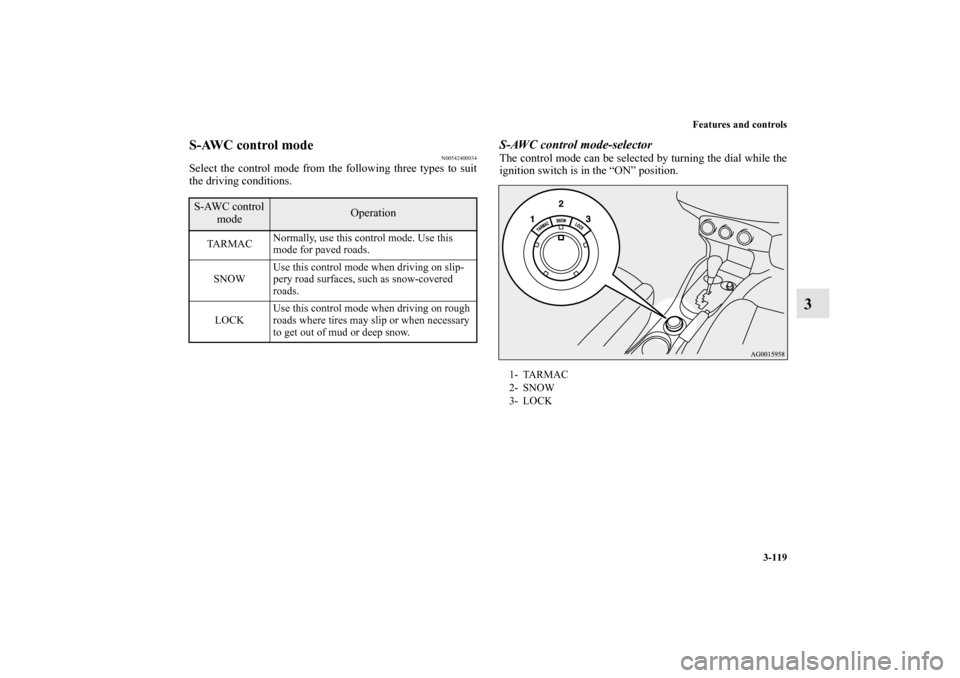
S-AWC control mode
N00542400034
Select the control mode from the following three types to suit
the driving conditions.
S-AWC control mode-selectorThe control mode can be selected by turning the dial while the
ignition switch is in the “ON” position.
S-AWC control
mode
Operation
TA R M A CNormally, use this control mode. Use this
mode for paved roads.
SNOWUse this control mode when driving on slip-
pery road surfaces, such as snow-covered
roads.
LOCKUse this control mode when driving on rough
roads where tires may slip or when necessary
to get out of mud or deep snow.
1- TARMAC
2- SNOW
3- LOCK
BK0150600US.book 119 ページ 2012年3月30日 金曜日 午前10時43分
Page 235 of 714

3-120 Features and controls
3
NOTE�The control mode can be changed while the vehicle is
moving.
S-AWC control mode displayThe currently selected control mode is displayed on the multi-
information display.
In addition, when the control mode is changed, the selected
mode appears on the interrupt display screen of the information
screen in the multi-information display.
The control mode display will appear on the information
screen for a few seconds, and then the original screen will
return.
CAUTION
!�Do not operate the dial while the tires are spinning.
The vehicle might suddenly move in an unantici-
pated direction.�Driving on dry, paved roads in “LOCK” mode will
increase fuel consumption and noise, and cause pre-
mature tire wear.�When the tires spin, especially if “LOCK” mode has
been selected and the ASC has been turned off, you
may experience strong steering feedback. Grip the
steering wheel firmly.
Example: “TARMAC” mode is selected.
BK0150600US.book 120 ページ 2012年3月30日 金曜日 午前10時43分