Page 13 of 706

2 Quick index
Anti-lock braking system warning light�When this light comes on, the anti-lock braking system is not func-
tioning and only the ordinary braking system is functioning.
�Park your vehicle in a safe place and stop the engine.
Test the system as described on page 3-145.
�If the light does not go out after the test, or if it comes on again, we
recommend that you have the system checked at an authorized Mit-
subishi Motors dealer or a repair facility of your choice as soon as
possible.P.3-144,
3-145
SRS warning light�It is not necessary to stop the vehicle immediately, but we recommend
that you have the airbag and the pre-tensioner seat belt system
checked at an authorized Mitsubishi Motors dealer as soon as possi-
ble.P. 2 - 2 5 ,
2-46
Tire pressure monitoring system warning light�If the warning light comes on, you should stop and adjust the tires to
the proper inflation pressure as soon as possible.
(See “Tire inflation pressures” on page 7-32.)
Once adjustments have been made, the warning light will go off after
a few minutes of driving.
�If the warning light blinks for approximately 1 minute and then
remains continuously illuminated, the system is not operating prop-
erly. If the system returns to normal, the warning light will go off. If
the warning light does not go off, have the vehicle inspected at an
authorized Mitsubishi Motors dealer.P.3-164
Warning light
Do this
Ref. page
BK0151000US.book 2 ページ 2012年3月29日 木曜日 午後6時8分
Page 39 of 706
2-10 Seat and restraint systems
2
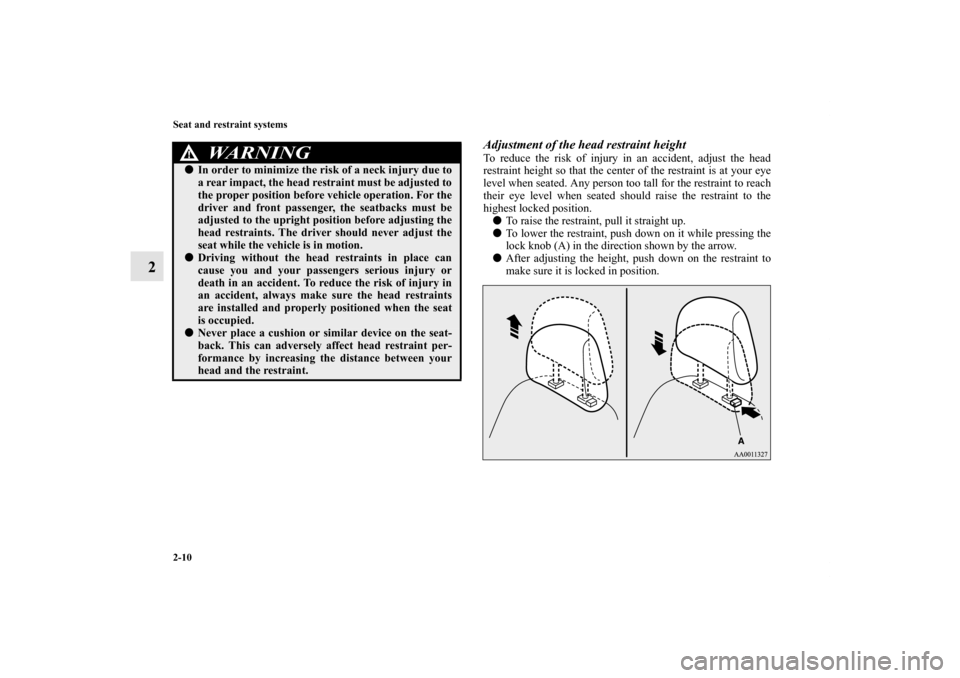
Adjustment of the head restraint heightTo reduce the risk of injury in an accident, adjust the head
restraint height so that the center of the restraint is at your eye
level when seated. Any person too tall for the restraint to reach
their eye level when seated should raise the restraint to the
highest locked position.
�To raise the restraint, pull it straight up.
�To lower the restraint, push down on it while pressing the
lock knob (A) in the direction shown by the arrow.
�After adjusting the height, push down on the restraint to
make sure it is locked in position.
WA R N I N G
!�In order to minimize the risk of a neck injury due to
a rear impact, the head restraint must be adjusted to
the proper position before vehicle operation. For the
driver and front passenger, the seatbacks must be
adjusted to the upright position before adjusting the
head restraints. The driver should never adjust the
seat while the vehicle is in motion.�Driving without the head restraints in place can
cause you and your passengers serious injury or
death in an accident. To reduce the risk of injury in
an accident, always make sure the head restraints
are installed and properly positioned when the seat
is occupied. �Never place a cushion or similar device on the seat-
back. This can adversely affect head restraint per-
formance by increasing the distance between your
head and the restraint.
BK0151000US.book 10 ページ 2012年3月29日 木曜日 午後6時8分
Page 43 of 706

2-14 Seat and restraint systems
2
NOTE�When the seatback of a front seat is reclined, return it to
the upright position before driving.
Folding the rear seatbacks forward
N00405700093
The rear seatbacks can be folded forward to extend luggage
compartment.NOTE�Before folding the rear seatbacks forward, make sure that
the arm rest is stowed and the head restraints are lowered
completely.
�You can separately fold the right and left side of the seat-
back.
1. Push the rear seat release button (A) to manually fold the
rear seatback forward, or pull the luggage compartment
lever (B) to automatically fold the seatback forward.
�The front passenger seat is equipped with weight
sensors. Depending on the weight detected, the front
passenger airbag is disabled or enabled. When fold-
ing the rear seats forward for increased cargo
capacity, the front passenger seat and seatback must
be adjusted to assure they are not contacting the
rear seat. In the event the front seat or seatback is
allowed to contact the folded rear seat, proper oper-
ation of the front passenger airbag system may be
affected.
CAUTION
!�In the luggage compartment, do not load the luggage
higher than the top of the seats and make sure that
the luggage is firmly secured. Restricted rear vision
or unsecured objects entering the passenger com-
partment from the luggage compartment during
sudden braking can cause serious injury or an acci-
dent.�Seatbacks should always be folded and put back into
normal position by an adult. Seat adjustments by a
child could lead to an unexpected accident.�When adjusting the seats, be careful not to catch
your hand or leg. Personal injury could result.
WA R N I N G
!
Rear seat release buttons
BK0151000US.book 14 ページ 2012年3月29日 木曜日 午後6時8分
Page 172 of 706
Features and controls
3-79
3 Inside day/night rearview mirror
N00548600067
Adjust the inside rearview mirror only after making any seat
adjustments so as to have a clear view to the rear of the vehicle.
WA R N I N G
!�After adjusting, make sure the lock lever is secured
in the locked (1) position. �Do not attempt to adjust the steering wheel while
driving. This can be dangerous.�When releasing the tilt lock lever {moving it to the
position (2)}, be sure to hold the steering wheel
firmly. Otherwise, the steering wheel may slip down
too suddenly.
WA R N I N G
!�Do not attempt to adjust the inside rearview mirror
while driving. This can be dangerous.
Be sure to adjust the mirror before driving.
BK0151000US.book 79 ページ 2012年3月29日 木曜日 午後6時8分
Page 176 of 706

Features and controls
3-83
3 Outside rearview mirrors
N00512200192
Adjust the outside rearview mirrors only after making any seat
adjustments so you have a clear view to the rear of the vehicle.
To adjust the mirror positionThe outside rearview mirrors can be adjusted when the ignition
switch is in the “ON” or “ACC” position.
Move the lever (A) to the same side as the mirror you wish to
adjust.
Press the switch (B) to adjust the mirror position. NOTE�After adjusting, return the lever to the “•” (off) position
(C).
WA R N I N G
!�Do not attempt to adjust the outside rearview mir-
rors while driving. This can be dangerous.
Be sure to adjust the mirrors before driving.�Your passenger’s side mirror is convex. The objects
you see in the mirror will look smaller and farther
away than they appear in a regular flat mirror.
Do not use this mirror to estimate the distance of
vehicles following you when changing lanes.
L- Left outside mirror adjustment
R- Right outside mirror adjustment
1- Up
2- Down
3- Right
4- Left
BK0151000US.book 83 ページ 2012年3月29日 木曜日 午後6時8分
