Page 337 of 706
3-244 Features and controls
3
Vehicles equipped with rain sensor
N00569400026
The windshield wipers can be operated with the ignition switch
in the “ON” or “ACC” position.
If the blades are frozen to the windshield or rear window, do
not operate the wipers until the ice has melted and the blades
are freed, otherwise the wiper motor may be damaged.Rain sensor (if so equipped)
Can only be used when the ignition switch is “ON” position.
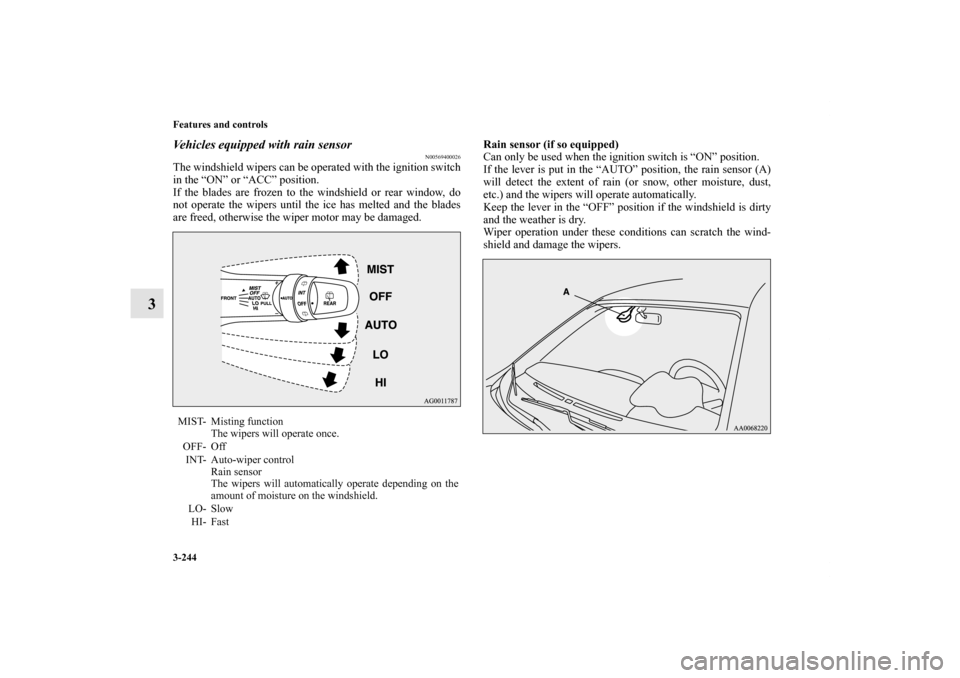
If the lever is put in the “AUTO” position, the rain sensor (A)
will detect the extent of rain (or snow, other moisture, dust,
etc.) and the wipers will operate automatically.
Keep the lever in the “OFF” position if the windshield is dirty
and the weather is dry.
Wiper operation under these conditions can scratch the wind-
shield and damage the wipers.MIST- Misting function
The wipers will operate once.
OFF- Off
INT- Auto-wiper control
Rain sensor
The wipers will automatically operate depending on the
amount of moisture on the windshield.
LO- Slow
HI- FastBK0151000US.book 244 ページ 2012年3月29日 木曜日 午後6時8分
Page 338 of 706
Features and controls
3-245
3
NOTE�To protect the rubber parts of the wipers, this operation of
the wipers does not take place when the vehicle is station-
ary and the ambient temperature is about 32 °F (0 °C) or
lower.
�Do not cover the sensor by affixing a sticker or label to the
windshield. Also, do not put any water-repellent coating
on the windshield. The rain sensor would not be able to
detect the extent of rain, and the wipers might stop work-
ing normally.
�In the following cases, the rain sensor may be malfunc-
tioning. Have the vehicle checked at an authorized Mit-
subishi Motors dealer or a repair facility of your choice.
• When the wipers operate at a constant interval despite
changes in the extent of rain.
• When the wipers do not operate even though it is rain-
ing.
�The wipers may automatically operate when things such
as insects or foreign objects are affixed to the windshield
on top of the rain sensor or when the windshield is frozen.
Objects affixed to the windshield will stop the wipers
when the wipers cannot remove them. To operate the wip-
ers again, move the lever to the “LO” or “HI” position.
Also, the wipers may operate automatically due to strong
direct sunlight or electromagnetic wave. To stop the wip-
ers, move the lever to the “OFF” position.
�Contact an authorized Mitsubishi Motors dealer or a
repair facility of your choice when replacing the wind-
shield glass.
CAUTION
!�With the ignition switch in the “ON” position and
the lever in the “AUTO” position, the wipers may
automatically operate in the situations described
below.
• When cleaning the outside surface of the wind-
shield, if you touch the rain sensor.
• When cleaning the outside surface of the wind-
shield, if you wipe with a cloth the rain sensor.
• When using an automatic car wash.
• A physical shock is applied to the windshield.
• A physical shock is applied to the rain sensor.If your hands get trapped, you could suffer injuries
or the wipers could malfunction. To deactivate the
rain sensor, place the lever in the “OFF” position.
BK0151000US.book 245 ページ 2012年3月29日 木曜日 午後6時8分
Page 339 of 706
3-246 Features and controls
3
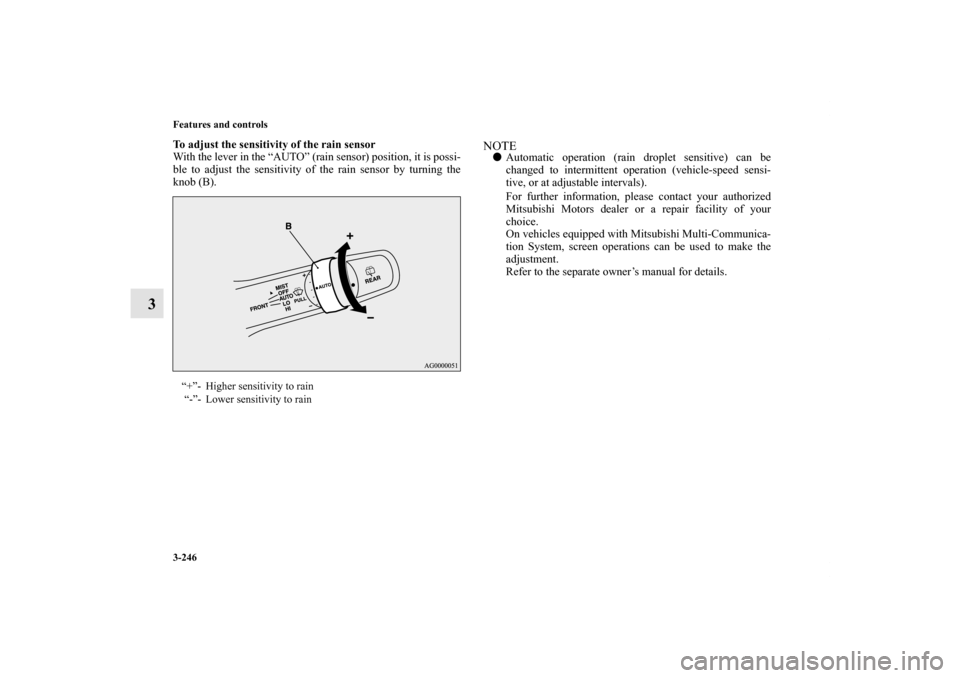
To adjust the sensitivity of the rain sensor
With the lever in the “AUTO” (rain sensor) position, it is possi-
ble to adjust the sensitivity of the rain sensor by turning the
knob (B).
NOTE�Automatic operation (rain droplet sensitive) can be
changed to intermittent operation (vehicle-speed sensi-
tive, or at adjustable intervals).
For further information, please contact your authorized
Mitsubishi Motors dealer or a repair facility of your
choice.
On vehicles equipped with Mitsubishi Multi-Communica-
tion System, screen operations can be used to make the
adjustment.
Refer to the separate owner’s manual for details.
“+”- Higher sensitivity to rain
“-”- Lower sensitivity to rain
BK0151000US.book 246 ページ 2012年3月29日 木曜日 午後6時8分
Page 402 of 706
Driving safety
4-5
4 Vehicle preparation before driving
N00629000685
For a safer and more enjoyable trip, always observe the follow-
ing: Seat belts and seats �Before starting the vehicle, make certain that you and all
passengers are seated and wearing their seat belts properly
(with children in the rear seat, in appropriate restraints),
and that all the doors and the rear hatch are locked.
�Move the driver’s seat as far backward as possible, while
still keeping good visibility, and good control of the steer-
ing wheel, brakes, accelerator, and controls. Check the
instrument panel indicators and multi-information display
for any possible problem.
�Move the front passenger seat as far back as possible.
�Make sure that infants and small children are properly
restrained in accordance with all laws and regulations.Defrosters Check these by selecting the defroster mode, and set the blower
switch on high. You should be able to feel the air blowing
against the windshield.
(Refer to “Defrosting or defogging (windshield, door win-
dows)” on page 5-14, 5-23, 5-33, 5-43.)
Tires Check all the tires for heavy tread wear or uneven wear pat-
terns. Look for stones, nails, glass, or other objects stuck in the
tread. Look for any tread cuts or sidewall cracks. Check the
wheel nuts for tightness, and the tires (including spare tire) for
proper pressures. Replace your tires before they are heavily
worn out.
As your vehicle is equipped with a tire pressure monitoring
system, there is a risk of damage to the tire inflation pressure
sensors when the tire is replaced on the rim. Tire replacement
should, therefore, be performed only by an authorized Mitsub-
ishi Motors dealer.Lights Have someone watch while you turn all the exterior lights on
and off. Also check the turn signal indicators and high-beam
indicators on the instrument panel. Fluid leaks Check the ground under the vehicle after parking overnight, for
fuel, water, oil, or other leaks. Make sure all the fluid levels are
correct. Also, if you can smell fuel, you need to find out why
immediately and have it fixed.
BK0151000US.book 5 ページ 2012年3月29日 木曜日 午後6時8分
Page 438 of 706
Comfort controls
5-25
5 Automatic air conditioning with Fahrenheit
scale
(if so equipped)
N00731500284
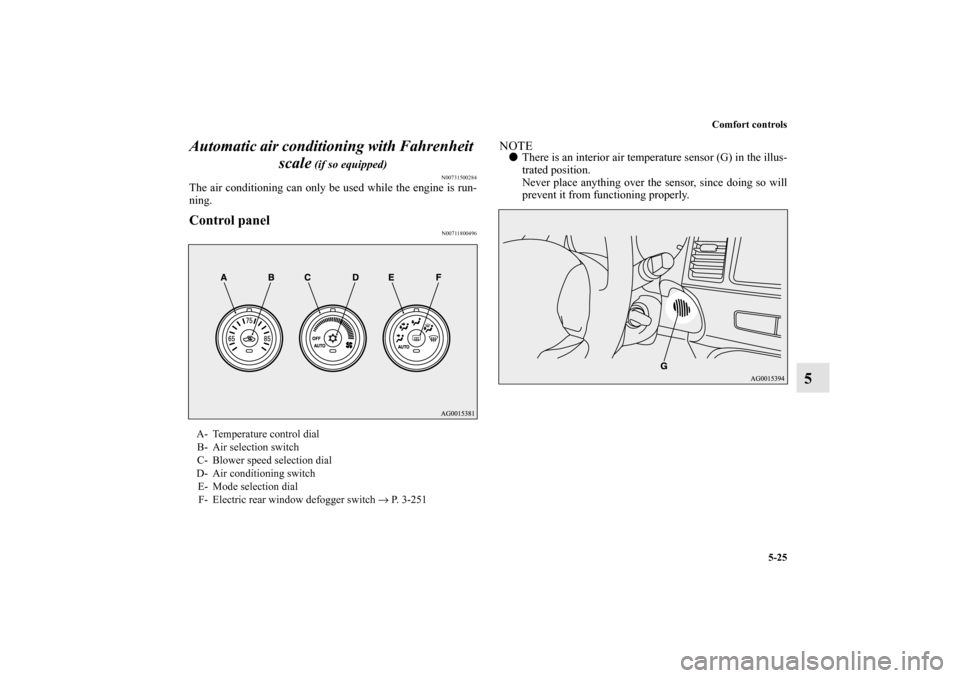
The air conditioning can only be used while the engine is run-
ning.Control panel
N00711800496
NOTE�There is an interior air temperature sensor (G) in the illus-
trated position.
Never place anything over the sensor, since doing so will
prevent it from functioning properly.
A- Temperature control dial
B- Air selection switch
C- Blower speed selection dial
D- Air conditioning switch
E- Mode selection dial
F- Electric rear window defogger switch → P. 3-251
BK0151000US.book 25 ページ 2012年3月29日 木曜日 午後6時8分
Page 448 of 706
Comfort controls
5-35
5 Automatic air conditioning with Celsius
scale
(if so equipped)
N00731500297
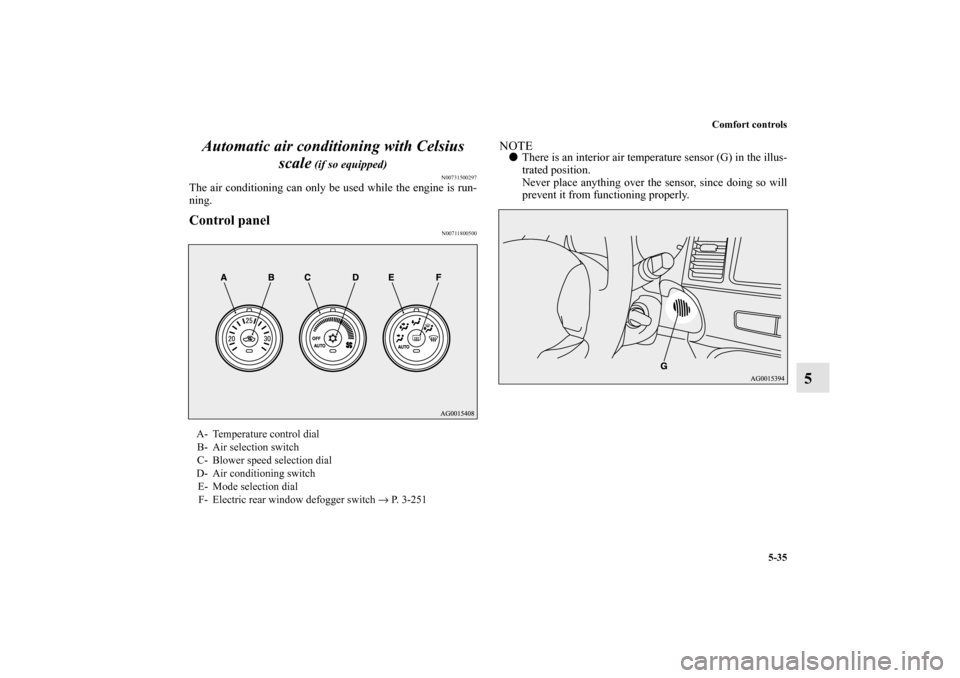
The air conditioning can only be used while the engine is run-
ning.Control panel
N00711800500
NOTE�There is an interior air temperature sensor (G) in the illus-
trated position.
Never place anything over the sensor, since doing so will
prevent it from functioning properly.
A- Temperature control dial
B- Air selection switch
C- Blower speed selection dial
D- Air conditioning switch
E- Mode selection dial
F- Electric rear window defogger switch → P. 3-251
BK0151000US.book 35 ページ 2012年3月29日 木曜日 午後6時8分
Page 604 of 706
Vehicle care and maintenance
7-23
7 Battery
N00939100826
The condition of the battery is very important for quick starting
and to keep the vehicle’s electrical system working properly.
Check the battery regularly. Removing and installing the battery upper cover
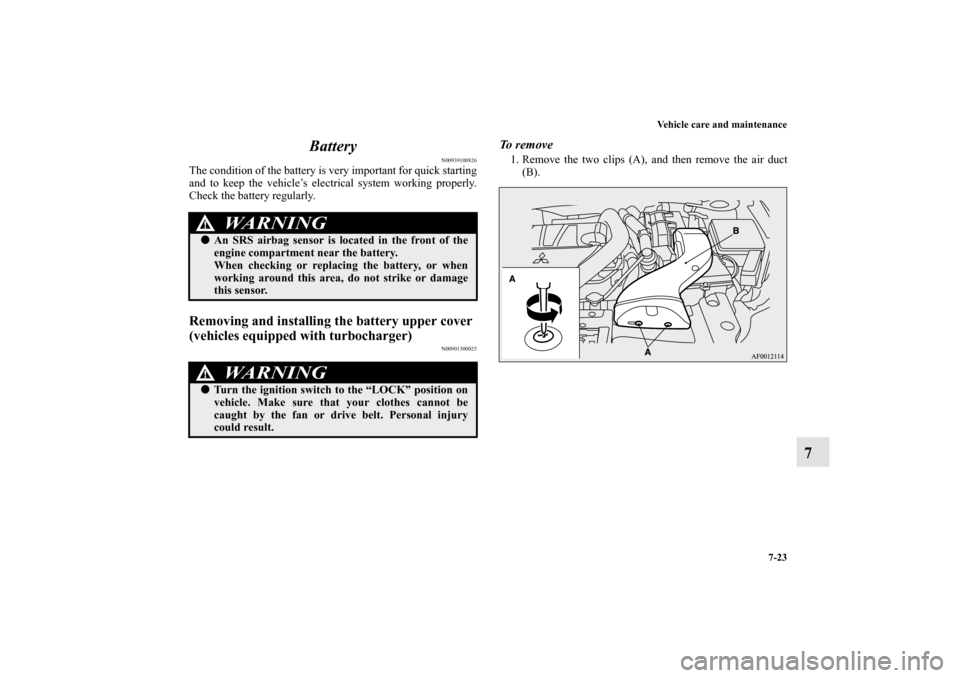
(vehicles equipped with turbocharger)
N00901300025
To r e m o v e1. Remove the two clips (A), and then remove the air duct
(B).
WA R N I N G
!�An SRS airbag sensor is located in the front of the
engine compartment near the battery.
When checking or replacing the battery, or when
working around this area, do not strike or damage
this sensor.
WA R N I N G
!�Turn the ignition switch to the “LOCK” position on
vehicle. Make sure that your clothes cannot be
caught by the fan or drive belt. Personal injury
could result.
BK0151000US.book 23 ページ 2012年3月29日 木曜日 午後6時8分
Page 615 of 706
7-34 Vehicle care and maintenance
7
Replacing tires and wheels
N00939600371
Tire maintenance
N00939700154
The following maintenance steps are recommended:
�Check tire pressures regularly.
�Have regular maintenance done on the wheel balance and
front and rear suspension alignment.
�Rotate your tires regularly as described in the “Tire rota-
tion” section on page 7-36.
CAUTION
!�Avoid using different size tires and wheels from the
ones listed, and avoid the combined use of different
types of tires and wheels. Using different size or type
tires and wheels may affect driving safety.
Refer to “Tires and wheels” on page 9-9.�For All-wheel drive vehicles, always use tires of the
same size, same type, and same brand, and which
have no wear differences. Using tires that differ in
size, type, brand or the degree of wear, will increase
the differential oil temperature, resulting in possible
damage to the driving system. Further, the drive
train will be subjected to excessive loading, possibly
leading to oil leakage, component seizure, or other
serious problems.�Even if a wheel has the same rim size and offset as
the specified type of wheel, its shape may prevent it
from being fitted correctly. Consult an authorized
Mitsubishi Motors dealer or a repair facility of your
choice before using wheels that you have.�Only Mitsubishi Motors genuine wheels should be
used, because your vehicle is equipped with a tire
pressure monitoring system.
Use of another type of wheel risks air leaks and sen-
sor damage, as it will not be possible to install the
tire pressure sensor properly.
BK0151000US.book 34 ページ 2012年3月29日 木曜日 午後6時8分