Page 25 of 706
1-6 General information
1
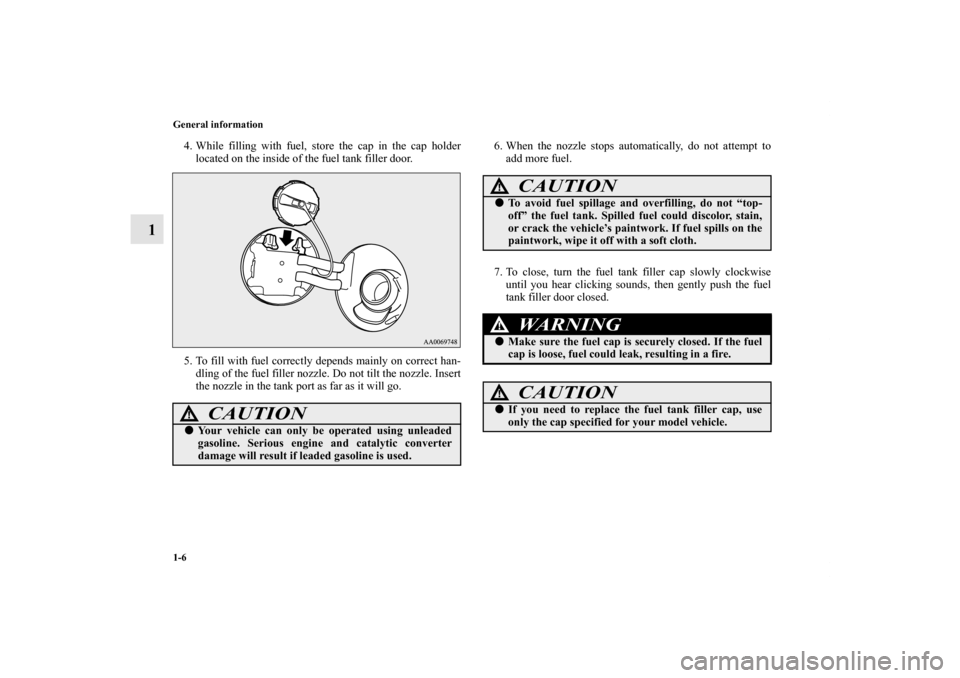
4. While filling with fuel, store the cap in the cap holder
located on the inside of the fuel tank filler door.
5. To fill with fuel correctly depends mainly on correct han-
dling of the fuel filler nozzle. Do not tilt the nozzle. Insert
the nozzle in the tank port as far as it will go.6. When the nozzle stops automatically, do not attempt to
add more fuel.
7. To close, turn the fuel tank filler cap slowly clockwise
until you hear clicking sounds, then gently push the fuel
tank filler door closed.
CAUTION
!�Your vehicle can only be operated using unleaded
gasoline. Serious engine and catalytic converter
damage will result if leaded gasoline is used.
CAUTION
!�To avoid fuel spillage and overfilling, do not “top-
off” the fuel tank. Spilled fuel could discolor, stain,
or crack the vehicle’s paintwork. If fuel spills on the
paintwork, wipe it off with a soft cloth.
WA R N I N G
!�Make sure the fuel cap is securely closed. If the fuel
cap is loose, fuel could leak, resulting in a fire.
CAUTION
!�If you need to replace the fuel tank filler cap, use
only the cap specified for your model vehicle.
BK0151000US.book 6 ページ 2012年3月29日 木曜日 午後6時8分
Page 32 of 706
Seat and restraint systems
2-3
2 Seats and restraint systems
N00401600182
Your vehicle has seat belts and other features that help protect
you and your passengers in an accident.
Seat belts are the most important safety device. When worn
properly, seat belts can reduce the chance of serious injury or
death in various types of crashes. For added protection during a
severe frontal collision, your vehicle has a Supplemental
Restraint System (SRS) with airbags for the driver and passen-
gers. The seats, head restraints, and door locks also are safety
equipment, which must be used correctly.
Always check the following before you drive:
�That everyone in your vehicle is properly wearing their
seat belt.
�That infants and small children are properly secured in
appropriate child restraint systems in the rear seat.
�That all doors are fully closed and locked.
�That seatbacks are upright, with head restraints properly
adjusted.
Safety equipment cannot prevent injury or death in all motor
vehicle accidents. You can help reduce the risk of injury or
death, however, by following the instructions in this manual.
Front seats
N00401800328
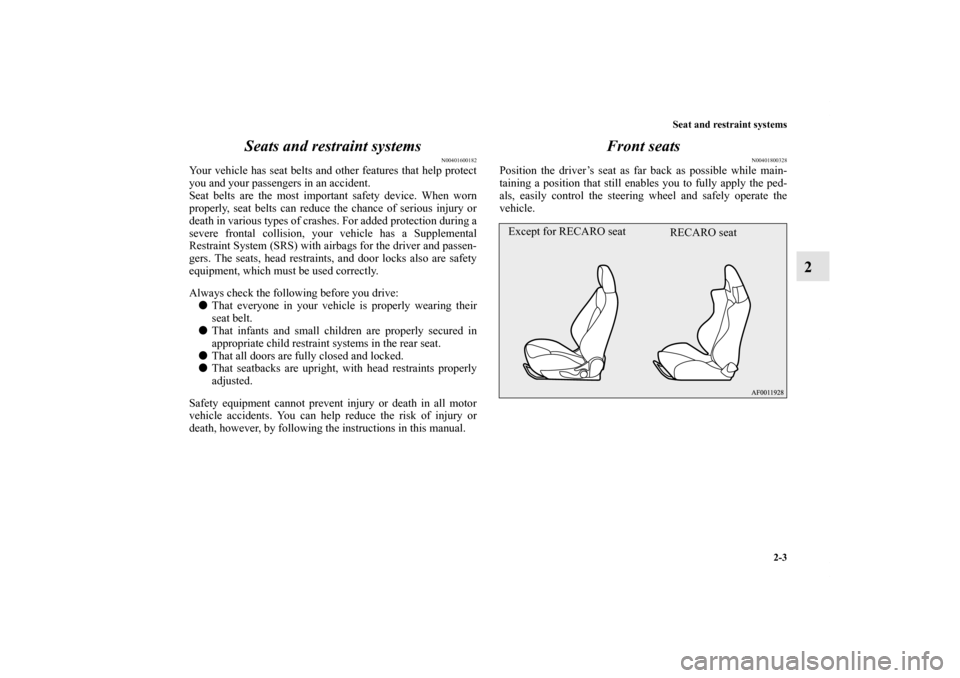
Position the driver’s seat as far back as possible while main-
taining a position that still enables you to fully apply the ped-
als, easily control the steering wheel and safely operate the
vehicle.Except for RECARO seat
RECARO seat
BK0151000US.book 3 ページ 2012年3月29日 木曜日 午後6時8分
Page 33 of 706
2-4 Seat and restraint systems
2
WA R N I N G
!�Do not attempt to adjust the seat while driving. This
can cause loss of vehicle control and result in an
accident.�After adjusting the seat, make sure that the seat is
securely locked into position.�To reduce the risk to the driver of serious injury or
death during deployment of the driver’s airbag,
always properly wear the seat belt and adjust the
driver’s seat as far back as possible while maintain-
ing a position that still enables you to fully apply the
pedals, easily control the steering wheel, and safely
operate the vehicle.�To reduce the risk to the front passenger of serious
injury or death during deployment of the passen-
ger’s airbag, always properly wear the seat belt and
adjust the front passenger’s seat as far back as pos-
sible.�Always place children 12 years old and under in the
rear seat and use appropriate child restraint sys-
tems.
CAUTION
!�Make sure that the seat is adjusted by an adult. If it
is adjusted by a child, an unexpected accident might
occur.�Do not place a cushion or the like between your back
and the seatback while driving. The effectiveness of
the head restraints will be reduced in the event of an
accident.�When sliding the seats, be careful not to catch your
hand or leg.�When sliding or reclining the seat rearward, pay
careful attention to the rear seat passengers.
BK0151000US.book 4 ページ 2012年3月29日 木曜日 午後6時8分
Page 34 of 706
Seat and restraint systems
2-5
2
To adjust the seat forward or backward
N00401900257
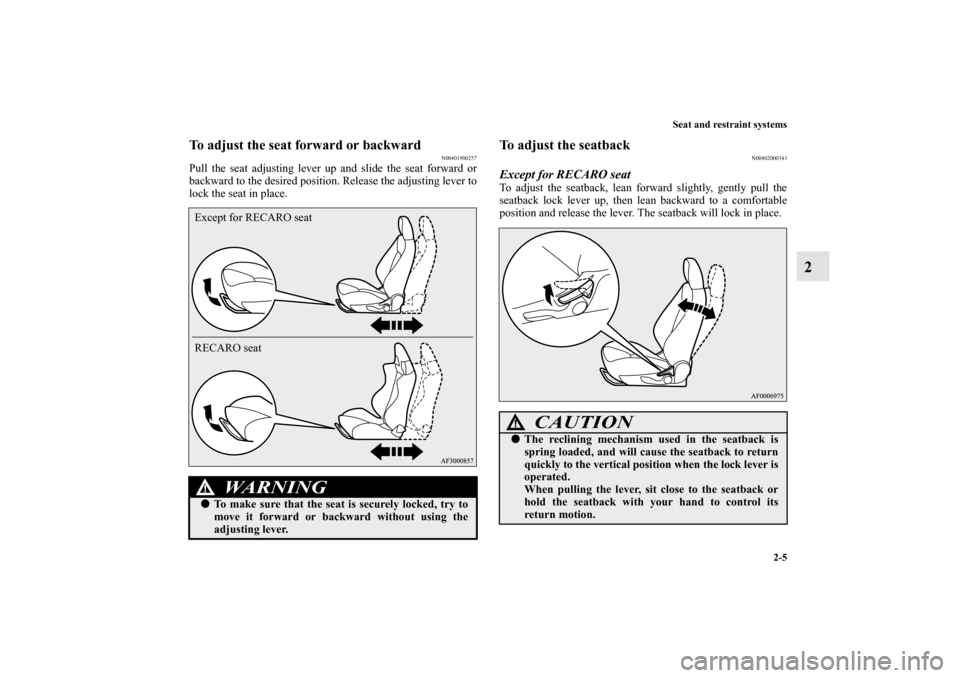
Pull the seat adjusting lever up and slide the seat forward or
backward to the desired position. Release the adjusting lever to
lock the seat in place.
To adjust the seatback
N00402000343
Except for RECARO seatTo adjust the seatback, lean forward slightly, gently pull the
seatback lock lever up, then lean backward to a comfortable
position and release the lever. The seatback will lock in place.
WA R N I N G
!�To make sure that the seat is securely locked, try to
move it forward or backward without using the
adjusting lever. Except for RECARO seat
RECARO seat
CAUTION
!�The reclining mechanism used in the seatback is
spring loaded, and will cause the seatback to return
quickly to the vertical position when the lock lever is
operated.
When pulling the lever, sit close to the seatback or
hold the seatback with your hand to control its
return motion.
BK0151000US.book 5 ページ 2012年3月29日 木曜日 午後6時8分
Page 39 of 706
2-10 Seat and restraint systems
2
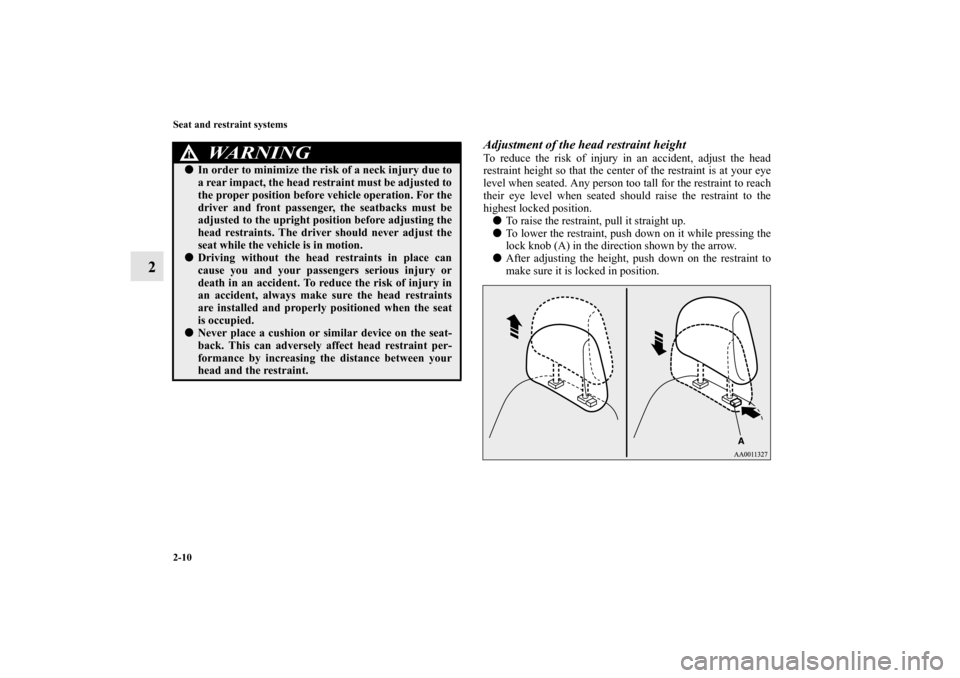
Adjustment of the head restraint heightTo reduce the risk of injury in an accident, adjust the head
restraint height so that the center of the restraint is at your eye
level when seated. Any person too tall for the restraint to reach
their eye level when seated should raise the restraint to the
highest locked position.
�To raise the restraint, pull it straight up.
�To lower the restraint, push down on it while pressing the
lock knob (A) in the direction shown by the arrow.
�After adjusting the height, push down on the restraint to
make sure it is locked in position.
WA R N I N G
!�In order to minimize the risk of a neck injury due to
a rear impact, the head restraint must be adjusted to
the proper position before vehicle operation. For the
driver and front passenger, the seatbacks must be
adjusted to the upright position before adjusting the
head restraints. The driver should never adjust the
seat while the vehicle is in motion.�Driving without the head restraints in place can
cause you and your passengers serious injury or
death in an accident. To reduce the risk of injury in
an accident, always make sure the head restraints
are installed and properly positioned when the seat
is occupied. �Never place a cushion or similar device on the seat-
back. This can adversely affect head restraint per-
formance by increasing the distance between your
head and the restraint.
BK0151000US.book 10 ページ 2012年3月29日 木曜日 午後6時8分
Page 40 of 706
Seat and restraint systems
2-11
2
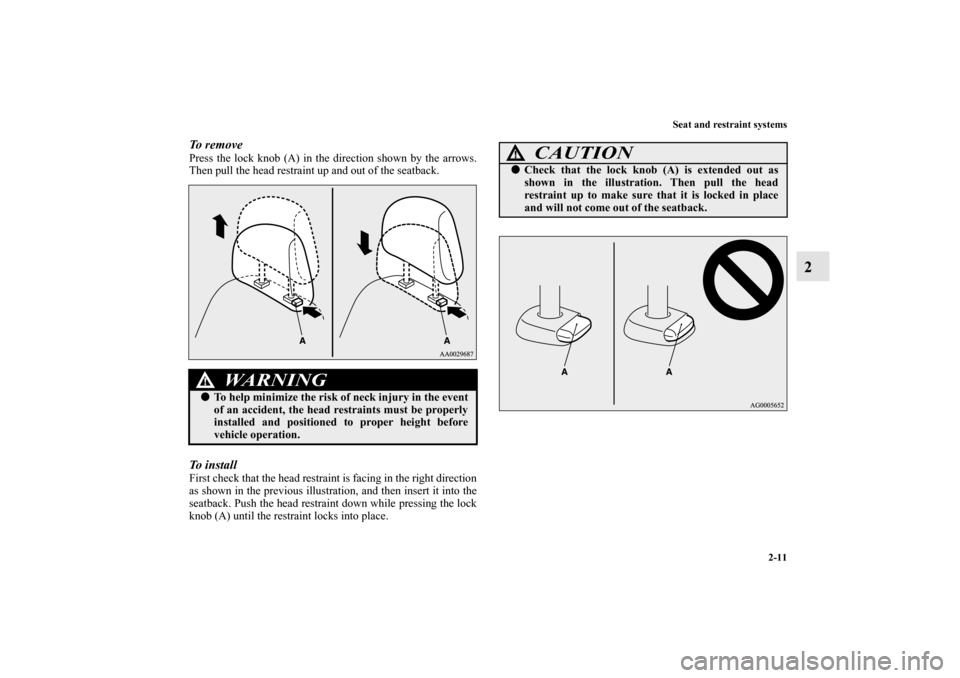
To r e m o v ePress the lock knob (A) in the direction shown by the arrows.
Then pull the head restraint up and out of the seatback.To i n s t a l lFirst check that the head restraint is facing in the right direction
as shown in the previous illustration, and then insert it into the
seatback. Push the head restraint down while pressing the lock
knob (A) until the restraint locks into place.
WA R N I N G
!�To help minimize the risk of neck injury in the event
of an accident, the head restraints must be properly
installed and positioned to proper height before
vehicle operation.
CAUTION
!�Check that the lock knob (A) is extended out as
shown in the illustration. Then pull the head
restraint up to make sure that it is locked in place
and will not come out of the seatback.
BK0151000US.book 11 ページ 2012年3月29日 木曜日 午後6時8分
Page 44 of 706
Seat and restraint systems
2-15
2
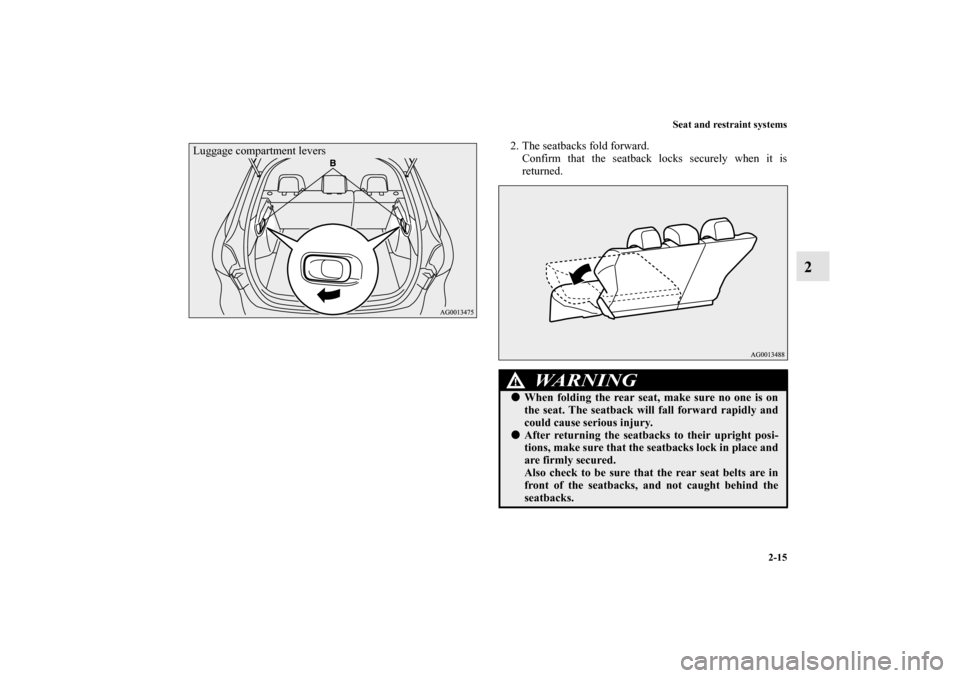
2. The seatbacks fold forward.
Confirm that the seatback locks securely when it is
returned.
Luggage compartment levers
WA R N I N G
!�When folding the rear seat, make sure no one is on
the seat. The seatback will fall forward rapidly and
could cause serious injury.�After returning the seatbacks to their upright posi-
tions, make sure that the seatbacks lock in place and
are firmly secured.
Also check to be sure that the rear seat belts are in
front of the seatbacks, and not caught behind the
seatbacks.
BK0151000US.book 15 ページ 2012年3月29日 木曜日 午後6時8分
Page 46 of 706
Seat and restraint systems
2-17
2
Seat belt instructions
N00406200428
All seats are equipped with a seat belt which uses one com-
bined lap-and-shoulder belt with an emergency locking retrac-
tor.
This system is designed to provide both comfort and safety. It
permits full extension and automatic retraction of the belts dur-
ing normal vehicle operation. A sensing device inside the belt
retractor is designed to lock the retractor in the event of a sud-
den change in the vehicle’s motion.NOTE�For instructions on installing a child restraint system using
a seat belt, refer to “Installing a child restraint system
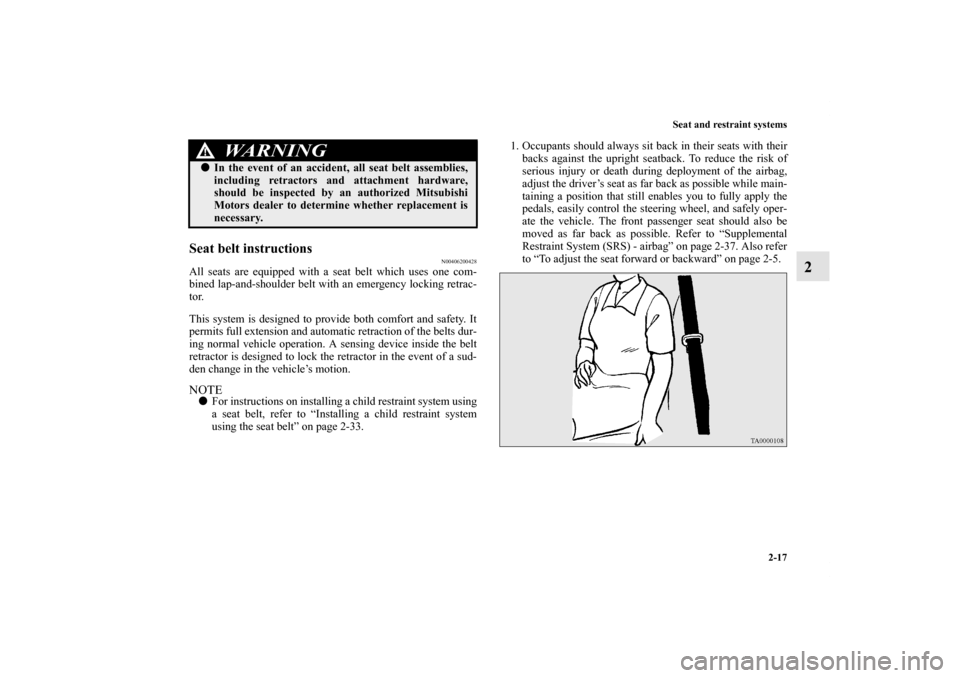
using the seat belt” on page 2-33.1. Occupants should always sit back in their seats with their
backs against the upright seatback. To reduce the risk of
serious injury or death during deployment of the airbag,
adjust the driver’s seat as far back as possible while main-
taining a position that still enables you to fully apply the
pedals, easily control the steering wheel, and safely oper-
ate the vehicle. The front passenger seat should also be
moved as far back as possible. Refer to “Supplemental
Restraint System (SRS) - airbag” on page 2-37. Also refer
to “To adjust the seat forward or backward” on page 2-5.�In the event of an accident, all seat belt assemblies,
including retractors and attachment hardware,
should be inspected by an authorized Mitsubishi
Motors dealer to determine whether replacement is
necessary.
WA R N I N G
!
BK0151000US.book 17 ページ 2012年3月29日 木曜日 午後6時8分