2013 MERCEDES-BENZ M-Class 300
[x] Cancel search: 300Page 7 of 458

Anti-lock braking system
see ABS (Anti-lock Braking System)
Anti-theft alarm system
see ATA (Anti-Theft Alarm system)
Approach/departure angle ..............190
Ashtray ............................................... 346
Assistance menu (on-board
computer) .......................................... 272
ASSYST PLUS Displaying a service message ........369
Hiding a service message ..............369
Notes ............................................. 368
Resetting the service interval
displa y........................................... 369
Service message ............................ 368
Special service requirements ......... 369
ATA (Anti-Theft Alarm system)
Activating/deactivating ...................75
Function .......................................... .75
Switching off the alarm ....................75
ATTENTIO NASSIST
Activating/deactivating .................273
Display message ............................ 302
Function/notes ............................. 230
Audio menu (on-board computer) ....269
Audio system see separate operating instructions
Authorized Centers
see Qualified specialist workshop
Authorized Mercedes-Benz Center
see Qualified specialist workshop
Authorized workshops
see Qualified specialist workshop
AUTO lights
Display message ............................ 298
see Lights
Automatic engine start (ECO start/
stop function) .................................... 162
Automatic engine switch-off (ECO
start/stop function) ..........................162
Automatic headlamp mode ..............120
Automatic transmission Automatic drive program ...............169
Changing gea r............................... 168
DIRECT SELECT leve r..................... 165
Display message ............................ 312
Drive program displa y.................... 165Driving tips
.................................... 168
Emergency running mode ..............173
Engaging drive position .................. 167
Engaging neutra l............................ 166
Engaging par kposition
automatically ................................. 166
Engaging revers egear ................... 166
Engaging the par kposition ............ 165
Kickdow n....................................... 168
Manual drive program ....................171
Overview ........................................ 165
Problem (malfunction) ...................173
Progra mselector button ................169
Pulling away ................................... 160
Shift range s................................... 170
Starting the engine ........................159
Steering wheel paddle shifters ......169
Trailer towing ................................. 168
Transmission position displa y........ 165
Transmissio npositions .................. 167
Automatic transmission
emergency mode ............................... 173
Axle load, permissible (trailer
towing) ............................................... 455 B
Bag hook ............................................ 337
Ball coupling Installing ........................................ 255
Removing ....................................... 259
Storing ........................................... 260
BAS (Brake Assist System) .................67
BAS PLUS (Brake Assist System
PLUS) .................................................... 67
Battery (SmartKey) Checking .......................................... 81
Important safety notes ....................81
Replacing ......................................... 81
Battery (vehicle)
Charging ........................................ 387
Display message ............................ 300
Important safety notes ..................385
Jump starting ................................. 389
Overview ........................................ 385
Blin dSpot Assist
Activating/deactivating .................273
Display message ............................ 306 Index
5
Page 12 of 458

Snow chains
.................................. 401
Symmetrical low bea m.................. 120
Tire ruts ......................................... 189
Towing atrailer .............................. 253
Traveling uphill ............................... 190
Wet road surface ........................... 183
DSR (Downhill Spee dRegulation)
Display message ............................ 305
Function/notes ............................. 246
DVD audio
Operating (on-board computer) .....270
DVD video
Operating (on-board computer) .....270 E
EASY-ENTRY feature Activating/deactivating .................277
Function/notes ............................. 112
EASY-EXIT feature
Crash-responsive ........................... 113
Function/notes ............................. 112
Switching on/off ........................... 277
EASY-PACK load-securing kit ...........340
EBD (electronic brake force
distribution)
Display message ............................ 285
Function/notes ................................ 73
ECO start/stop function
Automatic engine start ..................162
Automatic engine switch-off ..........162
Deactivating/activating .................163
General information .......................161
Important safety notes ..................161
Electronic Stability Program
see ESP ®
(Electroni cStability Program)
Emergenc yrelease
Driver's door .................................... 86
Vehicle ............................................. 86
Emergency spare wheel
Important safety notes ..................436
Points to remember .......................437
Removing ....................................... 437
Storage location ............................ 437
Technical data ............................... 439
Emergency Tensioning Devices
Function .......................................... .59
Safety guideline s............................. 43Emergency unlocking
Tailgate ............................................ 91
Emissions control
Service and warranty information ....24
Engine
Check Engine warning lamp ........... 325
Display message ............................ 299
ECO start/stop function ................161
Engine number ............................... 444
Irregularr unning............................ 164
Jump-starting ................................. 389
Starting problems ..........................164
Starting the engine with the
SmartKey ....................................... 159
Starting with KEYLESS-GO .............160
Switching off .................................. 180
Tow-starting (vehicle) ..................... 394
Engine electronics
Problem (malfunction) ...................164
Engine oil
Adding ........................................... 366
Additives ........................................ 450
Checking the oil level ..................... 365
Checking the oil level using the
dipstick .......................................... 366
Display message ............................ 300
Filling capacity ............................... 450
Notes about oil grades ................... 449
Notes on oil level/consumption ....365
Temperature (on-board computer) .278
Viscosity ........................................ 450
ESP ®
(Electronic Stability
Program) AMG menu (on-board computer) ...279
Deactivating/activating ...................71
Display message ............................ 283
ETS/4ETS ........................................ 70
Function/notes ................................ 70
Important safety information ...........71
Trailer stabilization ........................... 72
Warning lamp ................................. 321
ETS/4ETS (Electronic Traction
System) ................................................ 70
Exhaus tcheck ................................... 182
Exhaus tpipe (cleaning
instructions) ...................................... 37410
Index
Page 37 of 458

Multifunction steering wheel
Function Page
0002
Multifunction display 265
0003
COMAND display; see the
separate Operating
Instructions
001F
0003
Switches on the Voice
Control System; see the
separate operating
instructions
001E
000D
Rejects or ends a call 270
Exits phone book/redial
memory
0004
Makes or accepts a call
Switches to the redial
memory
0009000A
Adjusts the volume
0006
Mute Function Page
001C
00020005
Selects a menu 264
00030004
Selects a submenu or
scrolls through lists
264
000B
Confirms yours
election 264
Hides display messages 282
001D
0007
Back 264
Switches off the Voice
Control System; see the
separate operating
instructionsMultifunction steering wheel
35At a glance
Page 302 of 458

Display messages Possible causes/consequences and
0001 Solutions
000B The battery is no
tbeing charged.
Aw arning tone also sounds.
Possible causes are:
R a defective alternator
R a torn poly-V-belt
R a malfunction in the electronics
X Pull ove rand stop the vehicle safely and switch off the engine,
paying attention to road and traffic conditions.
X Ope nthe hood.
X Check whether the poly-V-belt is torn.
If the poly-V-belt is torn:
! Do not continue driving. The engine could otherwise overheat.
X Consult a qualified specialist workshop.
If the poly-V-belt is not damaged:
X Visit a qualified specialist workshop. 0013
Check Engine Oil
At Next Refueling The engine oil level has dropped to the minimum level.
Aw
arning tone also sounds.
X Chec kthe oil level when next refueling, at the latest
(Y page 366).
X If necessary, add engine oil (Y page 366).
X Have the engine checked at a qualified specialist workshop if
engine oil needs to be added more often than usual.
! Avoid long journeys with too little engine oil. The engine will
otherwise be damaged.
Information on approved engine oils can be obtained from any
qualified specialist workshop or on the Internet at http://
www.mbusa.com (USA only). 300
Display messagesOn-board computer and displays
Page 418 of 458
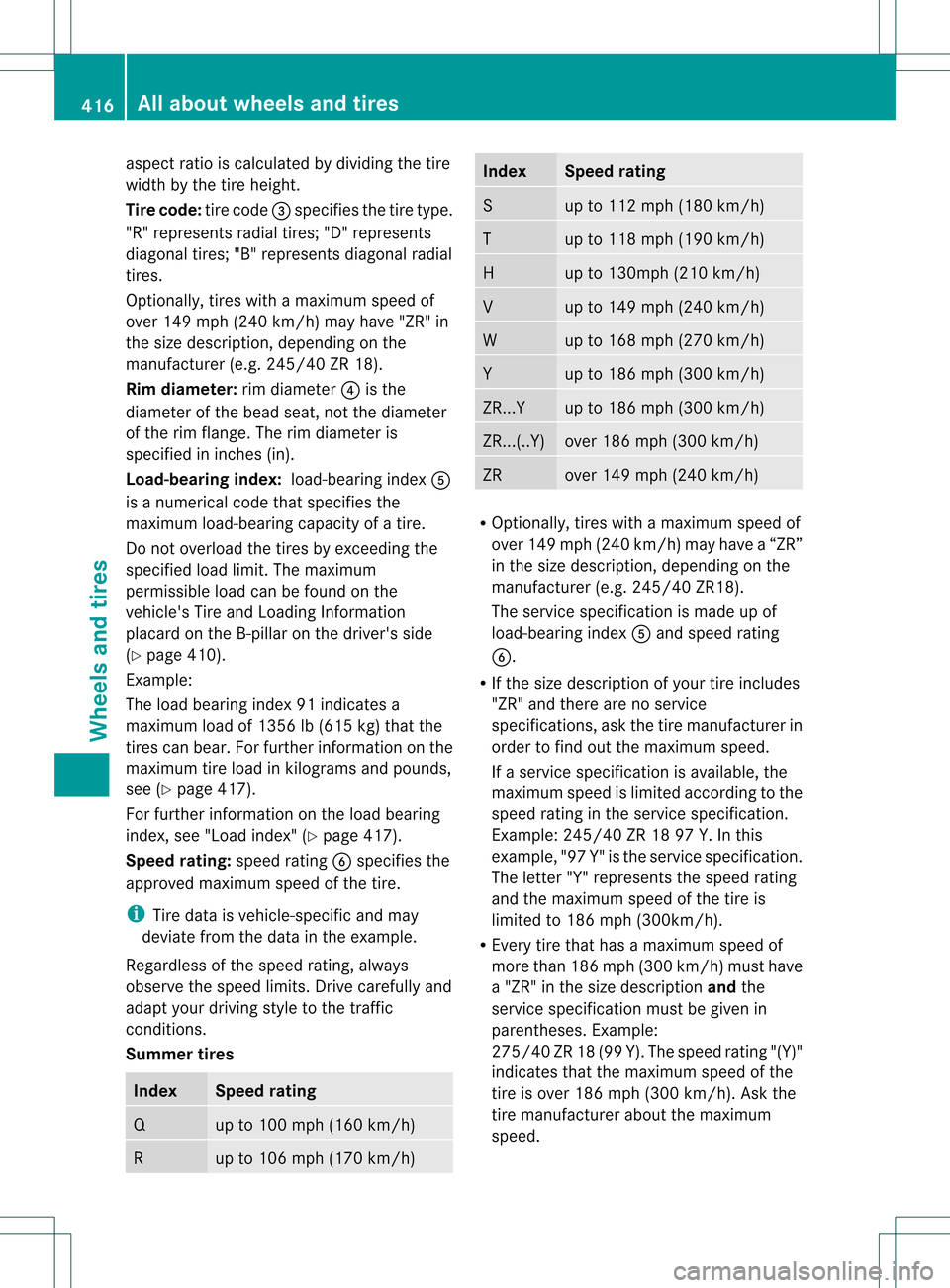
aspec
tratio is calculated by dividing the tire
width by the tire height.
Tire code: tire code001Fspecifies the tire type.
"R" represents radial tires; "D" represents
diagonal tires; "B" represents diagonal radial
tires.
Optionally, tires with a maximum speed of
over 149 mph (240 km/h) may have "ZR" in
the size description, depending on the
manufacturer (e.g. 245/40 ZR 18).
Rim diameter: rim diameter001Eis the
diamete rofthe bead seat, not the diameter
of the rim flange. The rim diameter is
specified in inches (in).
Load-bearing index: load-bearing index001C
is a numerical code that specifies the
maximum load-bearing capacity of a tire.
Do not overload the tires by exceeding the
specified load limit. The maximum
permissible load can be found on the
vehicle's Tire and Loading Information
placard on the B-pillar on the driver's side
(Y page 410).
Example:
The load bearing index 91 indicates a
maximum load of 1356 lb (615 kg) that the
tires can bear. For further information on the
maximum tire load in kilograms and pounds,
see (Y page 417).
For further information on the load bearing
index, see "Load index" (Y page 417).
Speed rating: speed rating001Dspecifies the
approved maximum speed of the tire.
i Tire data is vehicle-specific and may
deviate from the data in the example.
Regardless of the speed rating, always
observe the speed limits. Drive carefully and
adapt your driving style to the traffic
conditions.
Summer tires Index Speed rating
Q up to 100 mph (160 km/h)
R up to 106 mph (170 km/h) Index Speed rating
S up to 112 mph (180 km/h)
T up to 118 mph (190 km/h)
H up to 130mph (210 km/h)
V up to 149 mph (240 km/h)
W up to 168 mph (270 km/h)
Y up to 186 mph (300 km/h)
ZR...Y up to 186 mph (300 km/h)
ZR...(..Y) over 186 mph (300 km/h)
ZR over 149 mph (240 km/h)
R
Optionally, tires with a maximum speed of
over 149 mph (240 km/h) may have a “ZR”
in the size description, depending on the
manufacturer (e.g. 245/40 ZR18).
The service specification is made up of
load-bearing index 001Cand speed rating
001D.
R If the size description of your tire includes
"ZR" and there are no service
specifications, ask the tire manufacturer in
order to find out the maximum speed.
If a service specification is available, the
maximum speed is limited according to the
speed rating in the service specification.
Example: 245/40 ZR 18 97 Y.In this
example, "97 Y" is the service specification.
The letter "Y" represents the speed rating
and the maximum speed of the tire is
limited to 186 mph (300km/h).
R Every tire that has amaximum speed of
mor ethan 186 mph (300 km/h) must have
a "ZR" in the size description andthe
service specification must be given in
parentheses. Example:
275/40 ZR 18 (99 Y). The speed rating "(Y)"
indicates that the maximum speed of the
tire is over 186 mph (300 km/h). Ask the
tire manufacturer about the maximum
speed. 416
All about wheels and tiresWheels and tires
Page 423 of 458

Traction
Traction is the result of friction between the
tires and the road surface.
TWR (Tongue Weight Rating)
The TWR specifies the maximu mpermissible
weight that the ball coupling of the trailer tow
hitch can support.
Treadwear indicators
Narrow bars (tread wear bars) that are
distributed over the tire tread. If the tire tread
is level with the bars, the wear limit of 0008in
(1.6 mm) has been reached.
Occupant distribution
The distribution of occupants in a vehicle at
their designated seating positions.
Total load limit
Rated cargo and luggage load plus
68 kilograms (150 lb) multiplied by the
number of seats in the vehicle. Changing
awheel Flat tire
You can find information on wha tto do in the
event of a flat tire in the "Breakdown
assistance" section (Y page 381).
Information on driving with MOExtended tires
in the event of a flat tire can be found under
"MOExtended tires (tires with run-flat
characteristics" (Y page 382).
The "Breakdown assistance" section
(Y page 381) contains information and notes
on how to deal with a flat tire. Information on
driving with MOExtended tires in the event of
a flat tire can be found under "MOExtended
tires (tires with run-flat characteristics"
(Y page 382).
Vehicles with an emergency spare
wheel: in the event of a flat tire, mount the
emergency spare wheel according to the
description under "Mounting a wheel"
(Y page 422). Rotating the wheels
G
WARNING
Interchanging the front and rear wheels may
severely impair the driving characteristics if
the wheels or tires have different dimensions.
The wheel brakes or suspension components
may also be damaged. There is a risk of
accident.
Rotate front and rear wheels only if the wheels
and tires are of the same dimensions.
! On vehicles equipped with a tire pressure
monitor, electronic components are
located in the wheel.
Tire-mounting tools should not be used
near the valve. This could damage the
electronic components.
Only have tires changed at a qualified
specialist workshop.
Always observe the instructions and safety
notes in the "Mounting awheel" section
(Y page 422).
The wear patterns on the front and rear tires
differ, depending on the operating conditions.
Rotate the wheels before a clear wear pattern
has formed on the tires. Front tires typically
wear more on the shoulders and the rear tires
in the center.
If your vehicle's tire configuration allows, you
can rotate the wheels according to the
intervals in the tire manufacturer's warranty
book in your vehicle documents. If this is not
available, the tires should then be rotated
every 3000 to 6000 miles (5000 to
10,000 km), or earlier if the tire wear requires
this. Do not change the direction of wheel
rotation.
Cleant he contact surfaces of the wheel and
the brake disc thoroughly every time a wheel
is interchanged. Check the tire pressure and,
if necessary, restart the tire pressure loss
warning system or the tire pressure monitor. Changing
awheel
421Wheels and tires Z
Page 444 of 458

Useful information
i This Operator's Manual describes all
models and all standard and optional
equipment of your vehicle available at the
time of publication of the Operator's
Manual. Country-specific differences are
possible. Please note that your vehicle may
not be equipped with all features
described. This also applies to safety-
related systems and functions.
i Read the information on qualified
specialist workshops: (Y page 27).Information regarding technical data
i The data stated here specifically refers to
a vehicle with standard equipment .Consult
an authorized Mercedes-Benz Center for
the data for all vehicle variants and trim
levels. Genuine Mercedes-Benz parts
G
WARNING
Driving safety may be impaired if non-
approved parts, tires and wheels or safety-
relevant accessories are used.
This could lead to malfunctions in safety-
relevant systems, e.g. the brake system. This
could cause you to lose control of your vehicle
and cause an accident.
For this reason, Mercedes-Benz recommends
that you use genuine Mercedes-Benz parts or
parts of equal quality. Only use tires, wheels
and accessories that have been specifically
approved for your vehicle. H
Environmental note
Daimler AG also supplies reconditioned major
assemblies and parts which are of the same
quality as new parts. They are covered by the
same Limited Warranty entitlements as new
parts. !
Air bags and Emergency Tensioning
Devices, as well as control units and
sensors for these restraint systems, may be
installed in the following areas of your
vehicle:
R doors
R door pillars
R door sills
R seats
R cockpit
R instrument cluster
R center console
Do not install accessories such as audio
systems in these areas. Do not carry out
repairs or welding. You could impair the
operating efficiency of the restraint
systems.
Have aftermarket accessories installed at
a qualified specialist workshop.
Genuine Mercedes-Benz parts are subject to
strictq uality control .Each part has been
specially developed, manufactured or
selected for Mercedes-Ben zvehicles and
fine-tuned for them. Only genuine Mercedes-
Benzp arts should therefor ebe used.
More than 300,000 different genuine
Mercedes-Benzp arts are available for
Mercedes-Ben zmodels.
All authorized Mercedes-Benz Centers
maintain a supply of genuine Mercedes-Benz
parts for necessary service and repair work.
In addition, strategically located parts
delivery centers provide quick and reliable
parts service.
Always specify the vehicle identification
number (VIN) (Y page 443) and the engine
number (Y page 444) when ordering genuine
Mercedes-Benz parts. Warranty
Your vehicle is covered under the terms of the
warranties printed in the Service and
Warranty Information booklet. 442
WarrantyTechnical data
Page 448 of 458

If there is no premium-grade unleaded
gasoline available and regular unleaded
gasoline must be used, please observe the
following precautions:
R
only fill the fuel tank to half full with
regular unleaded gasoline and fill the rest
with premium-grade unleaded gasoline
as soon as possible.
R do not drive at the maximum speed.
R avoid sudden acceleration.
R if the vehicle is carrying a lightl oad, e.g.
two passengers without luggage, do not
allow the engine to rev above 3000 rpm.
R if the vehicle is fully loaded or is being
operated in mountainous terrain, do not
depress the accelerator pedal further
than 0001of the pedal travel.
Only refuel using premium-grade unleaded
gasoline with a minimum octane rating of 91.
Reformulated Gasoline (RFG) and/or
unleaded gasoline with additives can be used.
The concentration of additives in the fuel,
however, must not exceed 10%, e.g.:
R Ethanol
R TAME
R ETBE
R IPA
R TBA
For MTBE, the concentration should not
exceed 15%.
The concentration of methanol in gasoline,
including other additives, must not exceed
3%.
Using mixtures of methanol and ethanol is not
permitted. Gasohol, a mixture of 10% ethanol
and 90% unleaded gasoline, may be used.
All of these blends must fulfill the fuel
requirements, e.g.:
R knock resistance
R boiling point
R vapor pressure
You will usually find information about the fuel
grade on the pump. If you cannot find the label on the pump, ask the staff for
assistance.
i
For further information, consult a
qualified specialist workshop or on the
Internet at http://www.mbusa.com (USA
only).
Information on refueling (Y page 174).
Additives
! Operating the engine with fuel additives
can increase wear and tear to the fuel
system high-pressure pump and lead to
contamination of the entire fuel system.
The repair costs are high. This does not
include additives for the removal and
prevention of residue buildup. gasoline
must only be mixed with additives
recommended by Mercedes-Benz. More
information about recommended additives
can be obtained from any authorized
Mercedes-Benz Center.
One of the main problems of poor fuel quality
is the forming of deposits that are created
during the gasoline combustion process.
Mercedes-Benz recommends that you use
branded fuels that have additives.
If you use fuels without these additives over
a longer period of time, carbon deposits may
build up. These deposits form at the inlet
valves and in the combustion chamber in
particular.
This could lead to engine problems, e.g.:
R longer engine warm-up phase
R uneven idle
R engine noise
R misfiring
R loss of power
Carbon deposits may form if the availability
of gasoline with relevant additives is
insufficient (in certain regions). In this case,
Mercedes-Benz recommends additives
approved for use in Mercedes-Benz vehicles;
see http://bevo.mercedes-benz.com.
For a list of approved products, consult an
authorized Mercedes-Benz Center. Comply 446
Service products and filling capacitiesTechnical data