2013 LINCOLN MKZ warning
[x] Cancel search: warningPage 145 of 474
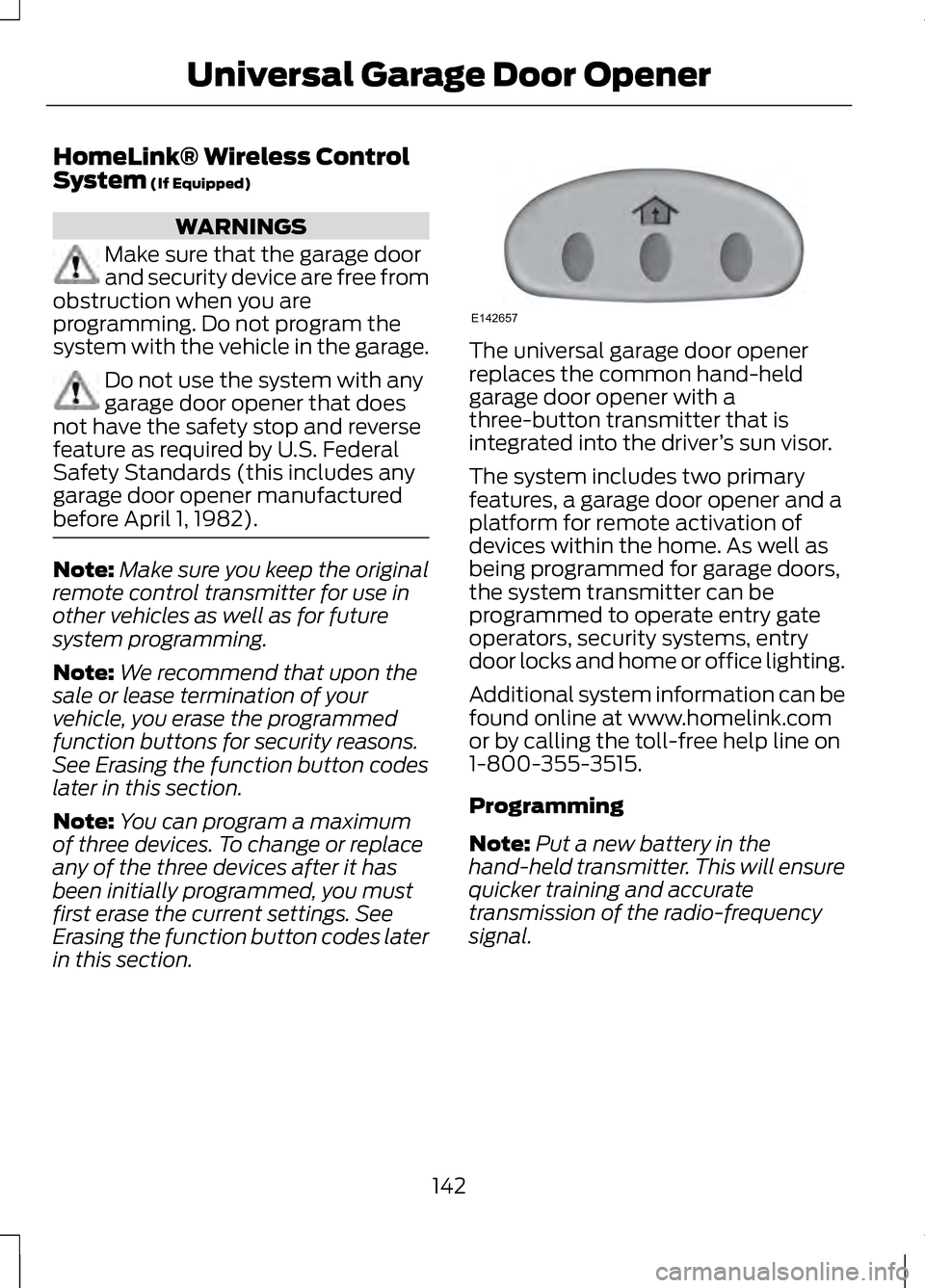
HomeLink® Wireless Control
System (If Equipped)
WARNINGS
Make sure that the garage door
and security device are free from
obstruction when you are
programming. Do not program the
system with the vehicle in the garage. Do not use the system with any
garage door opener that does
not have the safety stop and reverse
feature as required by U.S. Federal
Safety Standards (this includes any
garage door opener manufactured
before April 1, 1982). Note:
Make sure you keep the original
remote control transmitter for use in
other vehicles as well as for future
system programming.
Note: We recommend that upon the
sale or lease termination of your
vehicle, you erase the programmed
function buttons for security reasons.
See Erasing the function button codes
later in this section.
Note: You can program a maximum
of three devices. To change or replace
any of the three devices after it has
been initially programmed, you must
first erase the current settings. See
Erasing the function button codes later
in this section. The universal garage door opener
replaces the common hand-held
garage door opener with a
three-button transmitter that is
integrated into the driver
’s sun visor.
The system includes two primary
features, a garage door opener and a
platform for remote activation of
devices within the home. As well as
being programmed for garage doors,
the system transmitter can be
programmed to operate entry gate
operators, security systems, entry
door locks and home or office lighting.
Additional system information can be
found online at www.homelink.com
or by calling the toll-free help line on
1-800-355-3515.
Programming
Note: Put a new battery in the
hand-held transmitter. This will ensure
quicker training and accurate
transmission of the radio-frequency
signal.
142
Universal Garage Door OpenerE142657
Page 150 of 474

12 Volt DC Power Point
WARNING
Do not plug optional electrical
accessories into the cigar lighter
socket (if equipped). Improper use of
the lighter can cause damage not
covered by your warranty, and can
result in fire or serious injury. Note:
If used when the engine is not
running, the battery will discharge.
There may be insufficient power to
restart your engine.
Note: Do not insert objects other than
an accessory plug into the power point.
This will damage the outlet and blow
the fuse.
Note: Do not hang any type of
accessory or accessory bracket from
the plug.
Note: Do not use the power point over
the vehicle capacity of 12 volt DC 180
watts or a fuse may blow.
Note: Do not use the power point for
operating a cigar lighter element.
Note: Improper use of the power point
can cause damage not covered by your
warranty.
Note: Always keep the power point
caps closed when not in use.
Run the engine for full capacity use of
the power point. To prevent the
battery from being discharged: •
Do not use the power point longer
than necessary when the engine is
not running.
• Do not leave devices plugged in
overnight or when the vehicle is
parked for extended periods.
Locations
Power points may be found:
• in the front of the center console
• inside the center console storage
bin
• on the rear of the center console.
110 Volt AC Power Point (If
Equipped) WARNING
Do not keep electrical devices
plugged in the power point
whenever the device is not in use. Do
not use any extension cord with the
110 volt AC power point, since it will
defeat the safety protection design.
Doing so my cause the power point to
overload due to powering multiple
devices that can reach beyond the 150
watt load limit and could result in fire
or serious injury. Note:
Keep the engine running to use
the power point.
147
Auxiliary Power Points
Page 152 of 474

CENTER CONSOLE
WARNING
Use only soft cups in the
cupholder. Hard objects can
injure you in a collision. Your vehicle may be equipped with a
variety of features.
Front storage bin with
auxiliary power point
A
Cupholders
B
Storage compartment with
auxiliary power point and
media hub
C
Auxiliary power point, 110 volt
AC power point
D OVERHEAD CONSOLE Press near the rear edge of the door
to open it.
149
Storage CompartmentsE146582 E75193
Page 153 of 474

GENERAL INFORMATION
If you disconnect the battery, your
vehicle may exhibit some unusual
driving characteristics for
approximately 5 miles (8 kilometers)
after you reconnect it. This is because
the engine management system must
realign itself with the engine. You can
disregard any unusual driving
characteristics during this period.
WARNINGS
Extended idling at high engine
speeds can produce very high
temperatures in the engine and
exhaust system, creating the risk of
fire or other damage. Do not park, idle or drive your
vehicle on dry grass or other dry
ground cover. The emission system
heats up the engine compartment and
exhaust system, creating the risk of
fire. Do not start the engine in a
closed garage or in other
enclosed areas. Exhaust fumes can
be toxic. Always open the garage door
before you start the engine. If you smell exhaust fumes inside
your vehicle, have your vehicle
checked by your authorized dealer
immediately. Do not drive your vehicle
if you smell exhaust fumes. The powertrain control system meets
all Canadian interference-causing
equipment standard requirements
regulating the impulse electrical field
or radio noise. When you start the engine, avoid
pressing the accelerator pedal before
and during operation. Only use the
accelerator pedal when you have
difficulty starting the engine.
KEYLESS STARTING
WARNING
The keyless starting system may
not function if the key is close to
metal objects or electronic devices
such as mobile phones. Note:
A valid key must be located
inside your vehicle to switch the ignition
on and start the engine.
Switching the Ignition On
(Accessory Mode) Press the START button once. It is
located on the instrument panel near
the steering wheel. All electrical
circuits and accessories are
operational and the warning lamps
and indicators illuminate.
Starting Your Vehicle
Carry out the following steps to start
your vehicle:
1. Fully press the brake pedal.
150
Starting and Stopping the EngineE146431
Page 154 of 474

2.
Put the transmission in position P.
3. Press the START button.
The system does not function if:
• The key frequencies are jammed.
• The key battery has no charge.
If you are unable to start your vehicle,
do the following: 1.
Remove the rubber covering (A) in
the cupholder. Place the remote in
the backup slot (B) at the bottom
of the cupholder.
2. With the key in this position, press
the brake pedal, then the START
button to switch the ignition on
and start your vehicle.
Stopping the Engine When
Your Vehicle is Stationary
1. Put the transmission in position P.
2. Press the START button once.
Note: This switches off all electrical
circuits warning lamps and indicators.
Note: If the engine is left running
unattended for 30 minutes, the ignition
and engine automatically shut down. Stopping the Engine When
Your Vehicle is Moving
1. Press and hold the START button
for one second, or press it three
times within two seconds.
2. Move the transmission selector lever to position N and use the
brakes to bring your vehicle to a
safe stop.
3. When your vehicle has stopped, put the transmission in position
P
and switch the ignition off. WARNING
Switching off the engine when
the vehicle is still moving will
result in a loss of brake and steering
assistance. The steering will not lock,
but higher effort will be required.
When you switch the ignition off,
some electrical circuits, warning
lamps and indicators may also be off. Fast Restart
The fast restart feature allows you to
restart your vehicle within 20 seconds
of switching it off, even if a valid key
is not present.
Within 20 seconds of switching your
vehicle off, press the brake pedal and
press the start button. After 20
seconds have expired, you can no
longer start your vehicle without the
key present inside the vehicle.
151
Starting and Stopping the EngineE155835
Page 156 of 474

2. Put the transmission in position P
or N.
3. Press the START button. The engine may continue cranking for
up to 15 seconds or until it starts.
Note: If you cannot start the engine on
the first try, wait for a short period and
try again.
If you have difficulty starting the
engine when the temperature is below
-13°F (-25°C), press the accelerator
pedal slightly and try again.
If you cannot start the engine after
three attempts, wait 10 seconds and
follow this procedure:
1. Fully press the brake pedal.
2. Fully press the accelerator pedal and hold it there.
3. Put the transmission in position P.
4. Press the START button.
Guarding Against Exhaust
Fumes WARNING
If you smell exhaust fumes inside
your vehicle, have your vehicle
checked by your authorized dealer
immediately. Do not drive your vehicle
if you smell exhaust fumes. Carbon
monoxide is present in exhaust fumes.
Take precautions to avoid its
dangerous effects. Important Ventilating
Information
If you stop your vehicle and the leave
the engine idling for long periods, we
recommend that you do one of the
following:
•
Open the windows at least 1 inch
(2.5 centimeters)
• Set your climate control to outside
air.
ENGINE BLOCK HEATER
(IF
EQUIPPED) WARNINGS
Failure to follow engine block
heater instructions could result
in property damage or serious
personal injury. Do not use your heater with
ungrounded electrical systems
or two-pronged adapters. There is a
risk of electrical shock. Note:
The heater is most effective
when outdoor temperatures are below
0°F (-18°C).
The heater acts as a starting aid by
warming the engine coolant. This
allows the climate control system to
respond quickly. The equipment
includes a heater element (installed
in the engine block) and a wire
harness. You can connect the system
to a grounded 120 volt AC electrical
source.
153
Starting and Stopping the Engine
Page 158 of 474

SAFETY PRECAUTIONS
WARNINGS
Do not overfill the fuel tank. The
pressure in an overfilled tank
may cause leakage and lead to fuel
spray and fire. The fuel system may be under
pressure. If you hear a hissing
sound near the fuel filler door (Easy
Fuel capless fuel system), do not
refuel until the sound stops.
Otherwise, fuel may spray out, which
could cause serious personal injury. Automotive fuels can cause
serious injury or death if misused
or mishandled. The flow of fuel through a fuel
pump nozzle can produce static
electricity, which can cause a fire if
fuel is pumped into an ungrounded
fuel container. Fuel ethanol and gasoline may
contain benzene, which is a
cancer-causing agent. When refueling always shut the
engine off and never allow
sparks or open flames near the filler
neck. Never smoke while refueling.
Fuel vapor is extremely hazardous
under certain conditions. Care should
be taken to avoid inhaling excess
fumes. Observe the following guidelines
when handling automotive fuel: •
Extinguish all smoking materials
and any open flames before
refueling your vehicle.
• Always turn off the vehicle before
refueling.
• Automotive fuels can be harmful
or fatal if swallowed. Fuel such as
gasoline is highly toxic and if
swallowed can cause death or
permanent injury. If fuel is
swallowed, call a physician
immediately, even if no symptoms
are immediately apparent. The
toxic effects of fuel may not be
visible for hours.
• Avoid inhaling fuel vapors. Inhaling
too much fuel vapor of any kind
can lead to eye and respiratory
tract irritation. In severe cases,
excessive or prolonged breathing
of fuel vapor can cause serious
illness and permanent injury.
• Avoid getting fuel liquid in your
eyes. If fuel is splashed in the eyes,
remove contact lenses (if worn),
flush with water for 15 minutes and
seek medical attention. Failure to
seek proper medical attention
could lead to permanent injury.
155
Fuel and Refueling
Page 160 of 474

If you have run out of fuel:
•
You may need to cycle the ignition
from off to on several times after
refueling to allow the fuel system
to pump the fuel from the tank to
the engine. On restarting, cranking
time will take a few seconds longer
than normal. With keyless ignition,
just start the engine. Crank time
will be longer than usual.
• Normally, adding 1 gallon (3.8
liters) of fuel is enough to restart
the engine. If the vehicle is out of
fuel and on a steep grade, more
than 1 gallon (3.8 liters) may be
required.
• The service engine soon indicator
may come on.
Refilling With a Portable Fuel
Container WARNINGS
Do not insert the nozzle of
portable fuel containers or
aftermarket funnels into the capless
fuel system. This could damage the
fuel system and its seal, and may
cause fuel to run onto the ground
instead of filling the tank, which could
result in serious personal injury. Do not try to pry open or push
open the capless fuel system
with foreign objects. This could
damage the fuel system and its seal
and cause injury to you or others. Note:
Do not use aftermarket funnels;
they will not work with the capless fuel
system and can damage it. The
included funnel has been specially
designed to work safely with your
vehicle.
When filling the vehicle ’s fuel tank
from a portable fuel container, use the
funnel included with the vehicle. •
In vehicles equipped with a spare
tire, the funnel is located between
the rear seats and the spare tire
well. Fold down the rear seats and
lift the carpeted panel to access
the funnel. 157
Fuel and RefuelingE148854 E148856