2013 LINCOLN MKZ maintenance
[x] Cancel search: maintenancePage 293 of 474

All motor vehicles and their
components were engineered and
tested for reliable, regular driving.
Long term storage under various
conditions may lead to component
degradation or failure unless specific
precautions are taken to preserve the
components.
General
•
Store all vehicles in a dry,
ventilated place.
• Protect from sunlight, if possible.
• If vehicles are stored outside, they
require regular maintenance to
protect against rust and damage.
Body
• Wash vehicle thoroughly to
remove dirt, grease, oil, tar or mud
from exterior surfaces, rear-wheel
housing and underside of front
fenders.
• Periodically wash vehicles stored
in exposed locations.
• Touch-up raw or primed metal to
prevent rust
• Cover chrome and stainless steel
parts with a thick coat of auto wax
to prevent discoloration. Re-wax
as necessary when the vehicle is
washed.
• Lubricate all hood, door and trunk
lid hinges, and latches with a light
grade oil.
• Cover interior trim to prevent
fading.
• Keep all rubber parts free from oil
and solvents. Engine
•
The engine oil and filter should be
changed prior to storage, as used
engine oil contain contaminates
that may cause engine damage.
• Start the engine every 15 days. Run
at fast idle until it reaches normal
operating temperature
• With your foot on the brake, shift
through all the gears while the
engine is running.
Fuel system
• Fill the fuel tank with high-quality
fuel until the first automatic
shutoff of the fuel pump nozzle.
Note: During extended periods of
vehicle storage (30 days or more), fuel
may deteriorate due to oxidation. Add
a quality gas stabilizer product to the
vehicle fuel system whenever actual or
expected storage periods exceed 30
days. Follow the instructions on the
additive label. The vehicle should then
be operated at idle speed to circulate
the additive throughout the fuel
system.
Cooling system
• Protect against freezing
temperatures.
• When removing vehicle from
storage, check coolant fluid level.
Confirm there are no cooling
system leaks, and fluid is at the
recommended level.
290
Vehicle Care
Page 302 of 474

Each tire, including the spare
(if provided), should be
checked monthly when cold
and inflated to the inflation pressure
recommended by the vehicle
manufacturer on the vehicle placard
or tire inflation pressure label. (If your
vehicle has tires of a different size
than the size indicated on the vehicle
placard or tire inflation pressure label,
you should determine the proper tire
inflation pressure for those tires.)
As an added safety feature, your
vehicle has been equipped with a tire
pressure monitoring system (TPMS)
that illuminates a low tire pressure
telltale when one or more of your tires
is significantly under-inflated.
Accordingly, when the low tire
pressure telltale illuminates, you
should stop and check your tires as
soon as possible, and inflate them to
the proper pressure. Driving on a
significantly under-inflated tire causes
the tire to overheat and can lead to
tire failure. Under-inflation also
reduces fuel efficiency and tire tread
life, and may affect the vehicle ’s
handling and stopping ability.
Please note that the TPMS is not a
substitute for proper tire maintenance,
and it is the driver ’s responsibility to
maintain correct tire pressure, even if
under-inflation has not reached the
level to trigger illumination of the
TPMS low tire pressure telltale. Your vehicle has also been equipped
with a TPMS malfunction indicator to
indicate when the system is not
operating properly. The malfunction
indicator is combined with the low tire
pressure telltale. When the system
detects a malfunction, the telltale will
flash for approximately one minute
and then remain continuously
illuminated. This sequence will
continue upon subsequent vehicle
start-ups as long as the malfunction
exists.
When the malfunction indicator is
illuminated, the system may not be
able to detect or signal low tire
pressure as intended. TPMS
malfunctions may occur for a variety
of reasons, including the installation
of replacement or alternate tires or
wheels on the vehicle that prevent the
TPMS from functioning properly.
Always check the TPMS malfunction
telltale after replacing one or more
tires or wheels on your vehicle to
ensure that the replacement or
alternate tires and wheels allow the
TPMS to continue to function
properly.
The tire pressure monitoring system
complies with part 15 of the FCC rules
and with RSS-210 of Industry Canada.
Operation is subject to the following
two conditions: (1) This device may
not cause harmful interference, and
(2) This device must accept any
interference received, including
interference that may cause undesired
operation.
299
Wheels and Tires
Page 317 of 474
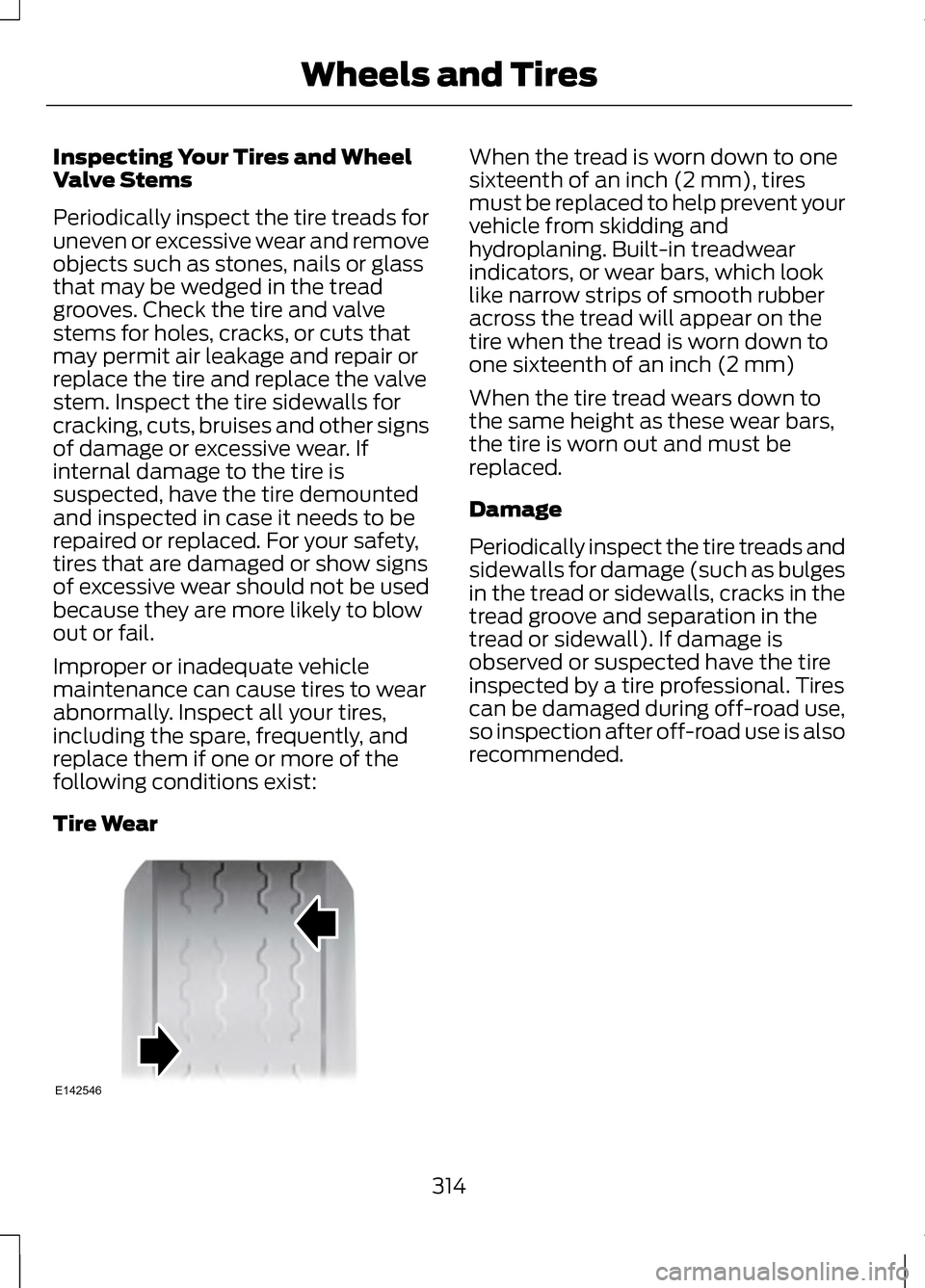
Inspecting Your Tires and Wheel
Valve Stems
Periodically inspect the tire treads for
uneven or excessive wear and remove
objects such as stones, nails or glass
that may be wedged in the tread
grooves. Check the tire and valve
stems for holes, cracks, or cuts that
may permit air leakage and repair or
replace the tire and replace the valve
stem. Inspect the tire sidewalls for
cracking, cuts, bruises and other signs
of damage or excessive wear. If
internal damage to the tire is
suspected, have the tire demounted
and inspected in case it needs to be
repaired or replaced. For your safety,
tires that are damaged or show signs
of excessive wear should not be used
because they are more likely to blow
out or fail.
Improper or inadequate vehicle
maintenance can cause tires to wear
abnormally. Inspect all your tires,
including the spare, frequently, and
replace them if one or more of the
following conditions exist:
Tire Wear When the tread is worn down to one
sixteenth of an inch (2 mm), tires
must be replaced to help prevent your
vehicle from skidding and
hydroplaning. Built-in treadwear
indicators, or wear bars, which look
like narrow strips of smooth rubber
across the tread will appear on the
tire when the tread is worn down to
one sixteenth of an inch (2 mm)
When the tire tread wears down to
the same height as these wear bars,
the tire is worn out and must be
replaced.
Damage
Periodically inspect the tire treads and
sidewalls for damage (such as bulges
in the tread or sidewalls, cracks in the
tread groove and separation in the
tread or sidewall). If damage is
observed or suspected have the tire
inspected by a tire professional. Tires
can be damaged during off-road use,
so inspection after off-road use is also
recommended.
314
Wheels and TiresE142546
Page 321 of 474

Tire Rotation
Note:
If your tires show uneven wear
ask an authorized dealer to check for
and correct any wheel misalignment,
tire imbalance or mechanical problem
involved before tire rotation.
Note: Your vehicle may be equipped
with a dissimilar spare wheel and tire
assembly. A dissimilar spare wheel and
tire assembly is defined as a spare
wheel and tire assembly that is
different in brand, size or appearance
from the road tires and wheels. If you
have a dissimilar spare wheel and tire
assembly it is intended for temporary
use only and should not be used in a
tire rotation.
Note: After having your tires rotated,
inflation pressure must be checked and
adjusted to the vehicle requirements.
Rotating your tires at the
recommended interval (as indicated
in the Scheduled Maintenance
chapter) will help your tires wear more
evenly, providing better tire
performance and longer tire life.
Front-wheel drive and all-wheel drive
vehicles (front tires on the left side of
the diagram) All vehicles with directional tires (front
tires on the left of the diagram)
Sometimes irregular tire wear can be
corrected by rotating the tires.
Summer Tires
Your Ford vehicle may be equipped
with summer tires to provide superior
performance on wet and dry roads.
Summer tires do not have the Mud
and Snow (M+S or M/S) tire traction
rating on the tire side wall. Since
summer tires do not have the same
traction performance as All-season
or Snow tires, Ford does not
recommend using summer tires when
temperatures drop to approximately
40°F (5°C) or below (depending on
tire wear and environmental
conditions) or in snow and ice
conditions. Like any tire, summer tire
performance is affected by tire wear
and environmental conditions. If you
must drive in those conditions, Ford
recommends using Mud and Snow
(M+S, M/S), All-season or Snow tires.
318
Wheels and TiresE142547 E147237
Page 329 of 474

3.7L V6 Engine
2.0L EcoBoost Engine
Component
BXT-96R-590 SP-520
SP-527
Spark plugs 3
FP-71
Cabin air filter
FS-104
Seat filter
WW-2700 (driver side)
Windshield wiper
blade WW-2601 (passenger side)
1 Failure to use the correct air filter element may result in severe engine damage.
The customer warranty may be void for any damage to the engine if the correct
air filter element is not used.
2 Only use the specified replacement oil filter. The use of a non-specified oil
filter can result in engine damage.
3 For spark plug replacement, see your authorized dealer. Replace the spark
plugs at the appropriate intervals. See Scheduled Maintenance (page 440).
Note: Replace the spark plugs with ones that meet Ford material and design
specifications for your vehicle, such as Motorcraft® or equivalent replacement
parts. The customer warranty may be void for any damage to the engine if such
spark plugs are not used.
326
Capacities and Specifications
Page 334 of 474

Ford Part Number
/ Ford Specifica- tion
Ford Part Name or
Equivalent
Capacity
Item
17.5 gal
(66.2 L)
2.0L EcoBoost engine
all-wheel drive fuel tank
17.5 gal
(66.2 L)
3.7L V6 engine front-
wheel drive or all-
wheel drive fuel tank
1 Use only Motorcraft® DOT 4 LV High Performance Brake Fluid or equivalent
meeting WSS-M6C65-A2 and ISO 4925 Class 6. Use of any fluid other than
the recommended fluid may cause brake system damage.
2 Approximate dry fill capacity. Actual amount may vary during fluid changes.
3 Automatic transmissions that require Motorcraft® MERCON® LV transmission
fluid should only use Motorcraft® MERCON® LV transmission fluid.
Use of any fluid other than the recommended fluid may cause transmission
damage.
Change the automatic transmission fluid and filter at the correct service interval.
See Scheduled Maintenance (page 440).
4 See your authorized dealer for fluid level checking or filling.
5 Use of synthetic or synthetic blend motor oil is not mandatory. Engine oil must
meet or exceed the requirements of Ford specification WSS-M2C946-A, SAE
5W-30 (2.0L engine) or WSS-M2C945-A, SAE 5W-20 (3.7L engine) and display
the API Starburst Certification Mark.
6 If the Ford specification is not shown on the oil container, the oil container must
display the API Starburst Certification Mark and the correct viscosity.
7 Add the coolant type originally equipped in your vehicle.
331
Capacities and Specifications
Page 338 of 474

Ford Extended Service Plan Can
Quickly Pay for Itself
One service bill – the cost of parts and
labor – can easily exceed the price of
your Ford Extended Service Plan
Service Contract. With a Ford Extend
Service Plan, you minimize your risk
for unexpected repair bills and rising
repair costs.
Avoid the Rising Cost of Properly
Maintaining Your Vehicle!
Ford Extended Service Plan also
offers a Premium Maintenance Plan
that covers items that routinely wear
out.
The coverage is prepaid, so you never
have to worry about affording your
vehicle maintenance. It covers regular
checkups, routine inspections,
preventive care and replacement of
items that require periodic attention
for normal wear:
•
Wiper blades
• Spark plugs (except California)
• Clutch disc
• Brake pads and linings
• Shock absorbers
• Belts and hoses Contact your selling Ford or Lincoln
dealership today so they can
customize a Ford Extended Service
Plan that fits your driving lifestyle and
budget.
Interest Free Finance Options
Available
Take advantage of our installment
payment plan, just a 10% down
payment will provide you with an
affordable no interest, no-fee
payment opportunity.
For More Information
PROTECT YOURSELF FROM THE
RISING COST OF VEHICLE REPAIRS
WITH A FORD EXTENDED SERVICE
PLAN.
To learn more, call our Ford ESP
specialists at 800-367-3377, and
don't forget to ask about our interest
free payment program, allowing you
all the security and benefits Ford ESP
has to offer while paying over time.
your pre-approved with no credit
checks, no hassles!
Or, complete the information below
and mail to:
Ford ESP
P.O. Box 8072
Royal Oak, MI 48068-0039
Name (PLEASE PRINT)
APT.#
ADDRESS
335
Ford Extended Service Plan (ESP)
Page 339 of 474

Name (PLEASE PRINT)
ZIP
STATE
CITY
E-MAIL
SERVICE PLANS (CANADA
ONLY)
You can get more protection for your
vehicle by purchasing a Ford Extended
Service Plan. Ford Extended Service
Plan is the only service contract
backed by Ford Motor Company of
Canada, Limited. Depending on the
plan you purchase, Ford Extended
Service Plan provides benefits such
as:
• Rental reimbursement
• Coverage for certain maintenance
and wear items
• Protection against repair costs
after your New Vehicle Limited
Warranty Coverage expires
• Roadside Assistance benefits
There are several Ford Extended
Service Plans available in various time,
distance and deductible
combinations. Each plan is tailored to
fit your own driving needs, including
reimbursement for towing and rental. When you purchase Ford Extended
Service Plan, you receive added
peace-of-mind protection throughout
Canada and the United States,
provided by a network of participating
Ford Motor Company dealers. The
Lincoln Maintenance Protection Plan
is honored at authorized Lincoln
dealers.
Note:
Repairs performed outside of
Canada and the United States are not
eligible for Ford Extended Service Plan
coverage.
This information is subject to change.
For more information, visit your local
Ford of Canada dealer or www.ford.ca
to find the Ford Extended Service Plan
that is right for you.
336
Ford Extended Service Plan (ESP)