2013 KIA CEED Auto
[x] Cancel search: AutoPage 965 of 1168
Driving your vehicle
40
5
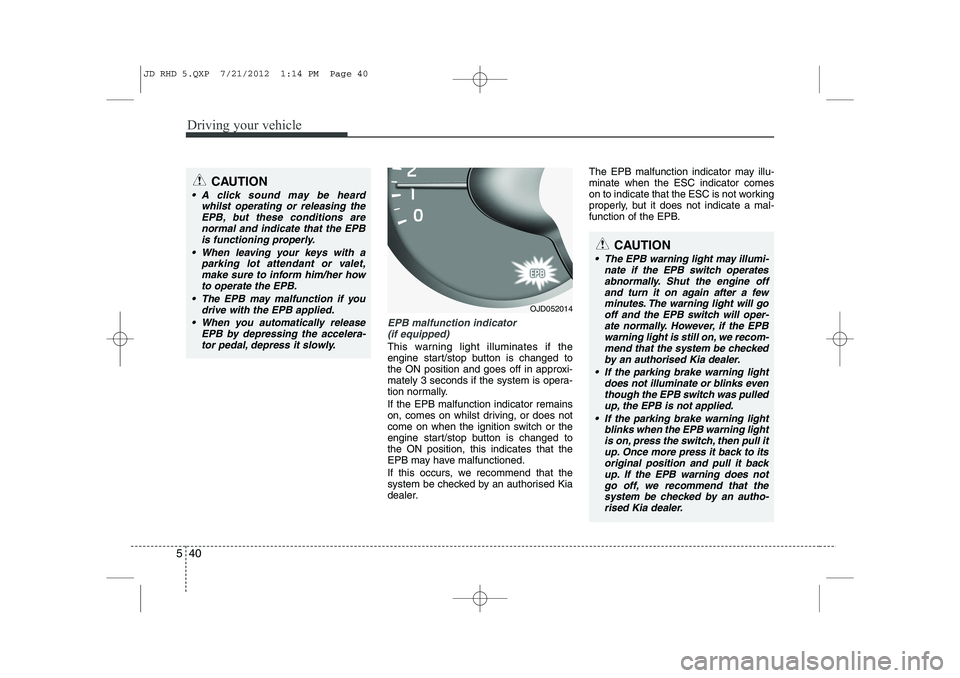
EPB malfunction indicator
(if equipped)
This warning light illuminates if the
engine start/stop button is changed to
the ON position and goes off in approxi-
mately 3 seconds if the system is opera-
tion normally. If the EPB malfunction indicator remains
on, comes on whilst driving, or does not
come on when the ignition switch or the
engine start/stop button is changed tothe ON position, this indicates that the
EPB may have malfunctioned.
If this occurs, we recommend that the
system be checked by an authorised Kia
dealer. The EPB malfunction indicator may illu-minate when the ESC indicator comes
on to indicate that the ESC is not working
properly, but it does not indicate a mal-
function of the EPB.
CAUTION
A click sound may be heard
whilst operating or releasing the
EPB, but these conditions arenormal and indicate that the EPBis functioning properly.
When leaving your keys with a parking lot attendant or valet,make sure to inform him/her howto operate the EPB.
The EPB may malfunction if you drive with the EPB applied.
When you automatically release EPB by depressing the accelera-tor pedal, depress it slowly.
OJD052014
CAUTION
The EPB warning light may illumi- nate if the EPB switch operates
abnormally. Shut the engine off and turn it on again after a fewminutes. The warning light will go off and the EPB switch will oper-
ate normally. However, if the EPB warning light is still on, we recom-mend that the system be checked
by an authorised Kia dealer.
If the parking brake warning light does not illuminate or blinks eventhough the EPB switch was pulled up, the EPB is not applied.
If the parking brake warning light blinks when the EPB warning lightis on, press the switch, then pull it up. Once more press it back to its original position and pull it back
up. If the EPB warning does not go off, we recommend that thesystem be checked by an autho- rised Kia dealer.
JD RHD 5.QXP 7/21/2012 1:14 PM Page 40
Page 970 of 1168

545
Driving your vehicle
ESC operation
ESC ON condition When the ignition is turnedON, ESC and ESC OFF indi-
cator lights illuminate for
approximately 3 seconds,
then ESC is turned on.
Press the ESC OFF button for at least half a second after
turning the ignition ON to turn
ESC off. (ESC OFF indicator
will illuminate). To turn theESC on, press the ESC OFF
button (ESC OFF indicatorlight will go off).
When starting the engine, you may hear a slight ticking
sound. This is the ESC per-
forming an automatic system
self-check and does not indi-
cate a problem. When operating
When the ESC is in operation,
ESC indicator light blinks.
When the Electronic StabilityControl is operating properly,
you can feel a slight pulsation
in the vehicle. This is only the
effect of brake control and indi-
cates nothing unusual.
When moving out of the mud or slippery road, the engine
rpm (revolution per minute)
may not increase even if you
press the accelerator pedal
deeply. This is to maintain the
stability and traction of the
vehicle and does not indicate
a problem.
ESC operation off
ESC OFF state
To cancel the engine man-agement system of ESC,
press the ESC OFF button forless than 3 seconds (ESCOFF indicator light illumi-
nates). The brake control
function still operates.
To cancel the engine man- agement and brake control
function of ESC, press the
ESC OFF button for morethan 3 seconds (ESC OFFindicator light illuminates).
If the ignition switch is turned to LOCK position when ESC
is off, ESC remains off. Upon
restarting the engine, the
ESC will automatically turnon again.
-
JD RHD 5.QXP 7/21/2012 1:14 PM Page 45
Page 973 of 1168

Driving your vehicle
48
5
Hill-start assist control (HAC) (if equipped)
A vehicle has the tendency to slip back
on a steep hill when it starts to go after
stopping. The Hill-start Assist Control
(HAC) prevents the vehicle from slipping
back by operating the brakes automati-
cally for about 1~2 seconds. The brakes
are released when the accelerator pedal
is depressed or after about 1~2 seconds.
✽✽
NOTICE
Page 974 of 1168

549
Driving your vehicle
Good braking practices Check to be sure the parking brake is
not engaged and that the parking
brake indicator light is out before driv-
ing away.
Driving through water may get the brakes wet. They can also get wet
when the vehicle is washed. Wet
brakes can be dangerous! Your vehicle
will not stop as quickly if the brakes are
wet. Wet brakes may cause the vehicle
to pull to one side.
To dry the brakes, apply the brakes
lightly until the braking action returns to
normal, taking care to keep the vehicle
under control at all times. If the braking
action does not return to normal, stop
as soon as it is safe to do so and we
recommend that you call an authorised
Kia dealer.
Do not coast down hills with the vehicle out of gear. This is extremely haz-
ardous. Keep the vehicle in gear at all
times, use the brakes to slow down,
then shift to a lower gear so that
engine braking will help you maintain a
safe speed. Do not "ride" the brake pedal. Resting
your foot on the brake pedal whilst driv-ing can be dangerous because it can
result in the brakes overheating and
losing their effectiveness. It also
increases the wear of the brake com-
ponents.
If a tyre goes flat whilst you are driving, apply the brakes gently and keep the
vehicle pointed straight ahead whilst
you slow down. When you are moving
slowly enough for it to be safe to do so,
pull off the road and stop in a safe
place.
If your vehicle is equipped with an automatic transaxle, do not let your
vehicle creep forward. To avoid creep-
ing forward, keep your foot firmly on
the brake pedal when the vehicle isstopped.
WARNING
Whenever you leave or park your vehicle, always set the parking
brake as far as possible and fully
engage the vehicle's transaxle
into the P (Park) position. If the
parking brake is not fully
engaged, the vehicle may move
inadvertently and injure yourself
and others.
All vehicles should always have the parking brake fully engaged
when parking to avoid inadver-
tent movement of the vehicle
which can injure occupants orpedestrians.
JD RHD 5.QXP 7/21/2012 1:14 PM Page 49
Page 975 of 1168

Driving your vehicle
50
5
Be cautious when parking on a hill.
Firmly engage the parking brake and
place the shift lever in P (automatic
transaxle) or in first or reverse gear
(manual transaxle). If your vehicle is
facing downhill, turn the front wheels
into the curb to help keep the vehicle
from rolling. If your vehicle is facing
uphill, turn the front wheels away from
the curb to help keep the vehicle from
rolling. If there is no curb or if it is
required by other conditions to keep
the vehicle from rolling, block the
wheels.
Under some conditions your parking brake can freeze in the engaged posi-
tion. This is most likely to happen when
there is an accumulation of snow or ice
around or near the rear brakes or if the
brakes are wet. If there is a risk that the
parking brake may freeze, apply it only
temporarily whilst you put the shift
lever in P (automatic transaxle) or in
first or reverse gear (manual transaxle)
and block the rear wheels so the vehi-
cle cannot roll. Then release the park-
ing brake. Do not hold the vehicle on the upgrade
with the accelerator pedal. This can
cause the transaxle to overheat.
Always use the brake pedal or parking
brake.
JD RHD 5.QXP 7/21/2012 1:14 PM Page 50
Page 977 of 1168

Driving your vehicle
52
5
Cruise control switch
O: Cancels cruise control operation.
: Turns cruise control system on oroff.
RES+: Resumes or increases cruise control speed.
SET-: Sets or decreases cruise control speed. To set cruise control speed:
1. Move the lever down ( ) on the
steering wheel, to turn the system on.
The cruise indicator light will illumi-
nate.
2. Accelerate to the desired speed, which must be more than 30 km/h (20 mph).
✽
✽ NOTICE - Manual transaxle
For manual transaxle vehicles, you
should depress the brake pedal at least
once to set the cruise control after start-ing the engine.
3. Move the lever down (to SET-), and
release it at the desired speed. The
cruise set indicator light will illuminate.
Release the accelerator pedal at the
same time. The desired speed willautomatically be maintained.
On a steep grade, the vehicle may slow
down or speed up slightly whilst goingdownhill.
OJD052016OJD052017OJD052018
JD RHD 5.QXP 7/21/2012 1:14 PM Page 52
Page 979 of 1168

Driving your vehicle
54
5
To cancel cruise control, do one
of the following:
Depress the brake pedal.
Depress the clutch pedal if equipped
with a manual transaxle.
Shift into N (Neutral) if equipped with an automatic transaxle.
Press the O (Cancel) button located on the steering wheel.
Decrease the vehicle speed lower than the memory speed by 20 km/h (12 mph).
Decrease the vehicle speed to less than approximately 30 km/h (20 mph).
Each of these actions will cancel cruise
control operation (the cruise setindicator
light will go off), but it will not turn the system off. If you wish to resume cruise
control operation, move up the lever (toRES+) located on your steering wheel. You will return to your previously presetspeed.
To resume cruising speed at
more than approximately 30 km/h(20 mph):
If any method other than the button
was used to cancel cruising speed and
the system is still activated, the mostrecent set speed will automatically
resume when the +RES switch ispushed.
It will not resume, however, if the vehicle
speed has dropped below approximately30 km/h (20 mph).
OJD052020OJD052019
JD RHD 5.QXP 7/21/2012 1:14 PM Page 54
Page 989 of 1168

Driving your vehicle
64
5
Hazardous driving conditions
When hazardous driving conditions are
encountered such as water, snow, ice,
mud, sand, or similar hazards, followthese suggestions:
Drive cautiously and allow extra dis-
tance for braking.
Avoid sudden braking or steering.
When braking with non-ABS brakes pump the brake pedal with a light up-
and-down motion until the vehicle isstopped.
If stalled in snow, mud, or sand, use second gear. Accelerate slowly to
avoid spinning the drive wheels.
Use sand, rock salt, tyre chains, or other non-slip material under the drive
wheels to provide traction when stalled
in ice, snow, or mud. Rocking the vehicle
If it is necessary to rock the vehicle to
free it from snow, sand, or mud, first turn
the steering wheel right and left to clear
the area around your front wheels. Then,
shift back and forth between 1 (First) and
R (Reverse) in vehicles equipped with a
manual transaxle or R (Reverse) and any
forward gear in vehicles equipped with
an automatic transaxle. Do not race the
engine, and spin the wheels as little as
possible. If you are still stuck after a few
tries, have the vehicle pulled out by a tow
vehicle to avoid engine overheating and
possible damage to the transaxle.
SPECIAL DRIVING CONDITIONS
WARNING
- Downshifting
Downshifting with an automatic
transaxle, whilst driving on slipperysurfaces can cause an accident.
The sudden change in tyre speed
could cause the tyres to skid. Be
careful when downshifting on slip-
pery surfaces.
WARNING - ABS
Do not pump the brake pedal on a
vehicle equipped with ABS.
CAUTION
Prolonged rocking may cause engine over-heating, transaxle dam-age or failure, and tyre damage.
JD RHD 5.QXP 7/21/2012 1:16 PM Page 64