2013 KIA CEED Auto
[x] Cancel search: AutoPage 33 of 1168
317
Safety system of your vehicle
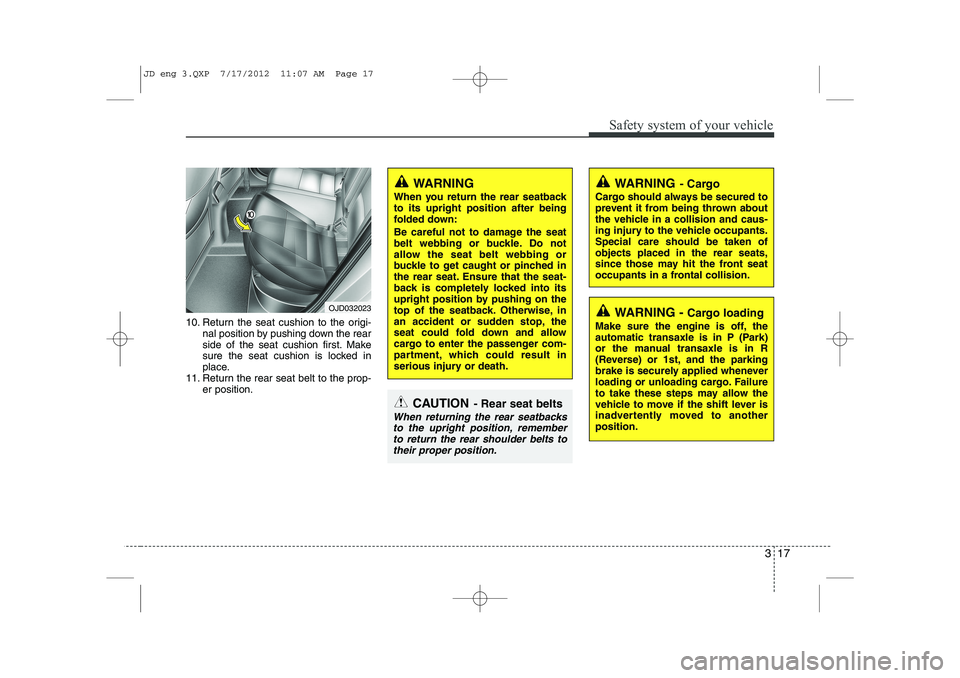
10. Return the seat cushion to the origi-nal position by pushing down the rear
side of the seat cushion first. Make
sure the seat cushion is locked in
place.
11. Return the rear seat belt to the prop- er position.
WARNING
When you return the rear seatback to its upright position after being
folded down:
Be careful not to damage the seat
belt webbing or buckle. Do not
allow the seat belt webbing or
buckle to get caught or pinched in
the rear seat. Ensure that the seat-
back is completely locked into its
upright position by pushing on the
top of the seatback. Otherwise, in
an accident or sudden stop, the
seat could fold down and allow
cargo to enter the passenger com-
partment, which could result in
serious injury or death.
CAUTION - Rear seat belts
When returning the rear seatbacks
to the upright position, remember
to return the rear shoulder belts totheir proper position.
WARNING - Cargo
Cargo should always be secured to
prevent it from being thrown about
the vehicle in a collision and caus-
ing injury to the vehicle occupants.Special care should be taken ofobjects placed in the rear seats,
since those may hit the front seat
occupants in a frontal collision.
WARNING - Cargo loading
Make sure the engine is off, the
automatic transaxle is in P (Park)
or the manual transaxle is in R
(Reverse) or 1st, and the parking
brake is securely applied whenever
loading or unloading cargo. Failure
to take these steps may allow the
vehicle to move if the shift lever is
inadvertently moved to anotherposition.OJD032023
JD eng 3.QXP 7/17/2012 11:07 AM Page 17
Page 38 of 1168
Safety system of your vehicle
22
3
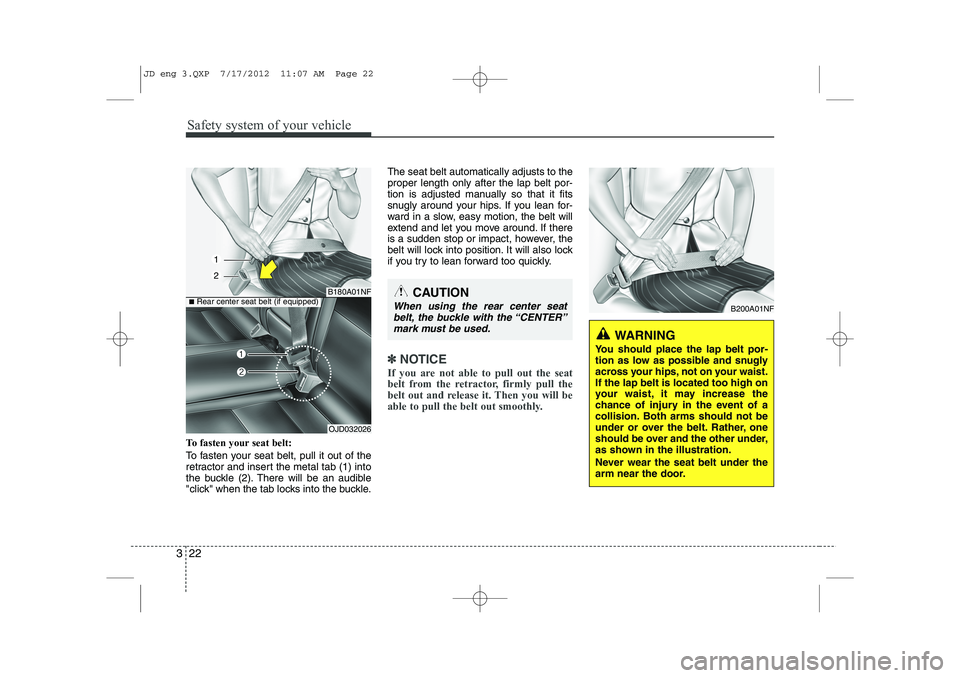
To fasten your seat belt:
To fasten your seat belt, pull it out of the
retractor and insert the metal tab (1) into
the buckle (2). There will be an audible
"click" when the tab locks into the buckle. The seat belt automatically adjusts to theproper length only after the lap belt por-
tion is adjusted manually so that it fits
snugly around your hips. If you lean for-
ward in a slow, easy motion, the belt will
extend and let you move around. If there
is a sudden stop or impact, however, the
belt will lock into position. It will also lock
if you try to lean forward too quickly.
✽✽
NOTICE
If you are not able to pull out the seat
belt from the retractor, firmly pull the
belt out and release it. Then you will be
able to pull the belt out smoothly.
B180A01NF
1
2
OJD032026
■ Rear center seat belt (if equipped)CAUTION
When using the rear center seat
belt, the buckle with the “CENTER”mark must be used.B200A01NF
WARNING
You should place the lap belt por-
tion as low as possible and snugly
across your hips, not on your waist.If the lap belt is located too high on
your waist, it may increase the
chance of injury in the event of a
collision. Both arms should not be
under or over the belt. Rather, one
should be over and the other under,
as shown in the illustration.
Never wear the seat belt under the
arm near the door.
JD eng 3.QXP 7/17/2012 11:07 AM Page 22
Page 39 of 1168
323
Safety system of your vehicle
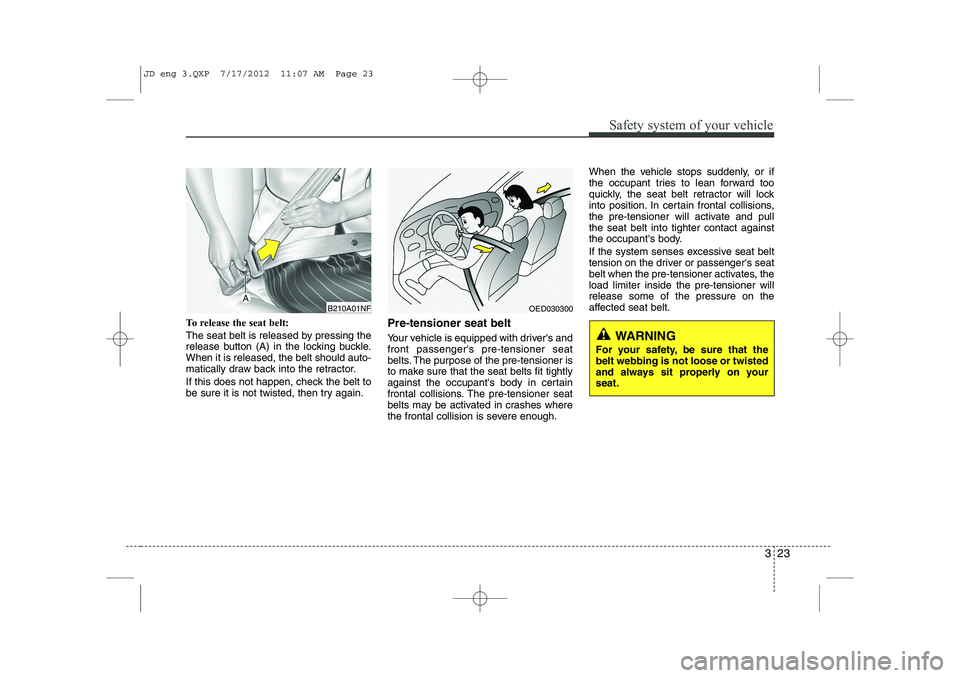
To release the seat belt:
The seat belt is released by pressing the
release button (A) in the locking buckle.When it is released, the belt should auto-
matically draw back into the retractor.
If this does not happen, check the belt to
be sure it is not twisted, then try again.Pre-tensioner seat belt
Your vehicle is equipped with driver's and front passenger's pre-tensioner seat
belts. The purpose of the pre-tensioner is
to make sure that the seat belts fit tightly
against the occupant's body in certain
frontal collisions. The pre-tensioner seat
belts may be activated in crashes where
the frontal collision is severe enough.When the vehicle stops suddenly, or if
the occupant tries to lean forward too
quickly, the seat belt retractor will lock
into position. In certain frontal collisions,
the pre-tensioner will activate and pullthe seat belt into tighter contact against
the occupant's body.
If the system senses excessive seat belt
tension on the driver or passenger's seat
belt when the pre-tensioner activates, theload limiter inside the pre-tensioner willrelease some of the pressure on the
affected seat belt.
B210A01NFA
WARNING
For your safety, be sure that the belt webbing is not loose or twisted
and always sit properly on yourseat.
OED030300
JD eng 3.QXP 7/17/2012 11:07 AM Page 23
Page 48 of 1168
Safety system of your vehicle
32
3
Installing a child restraint system by
lap/shoulder belt
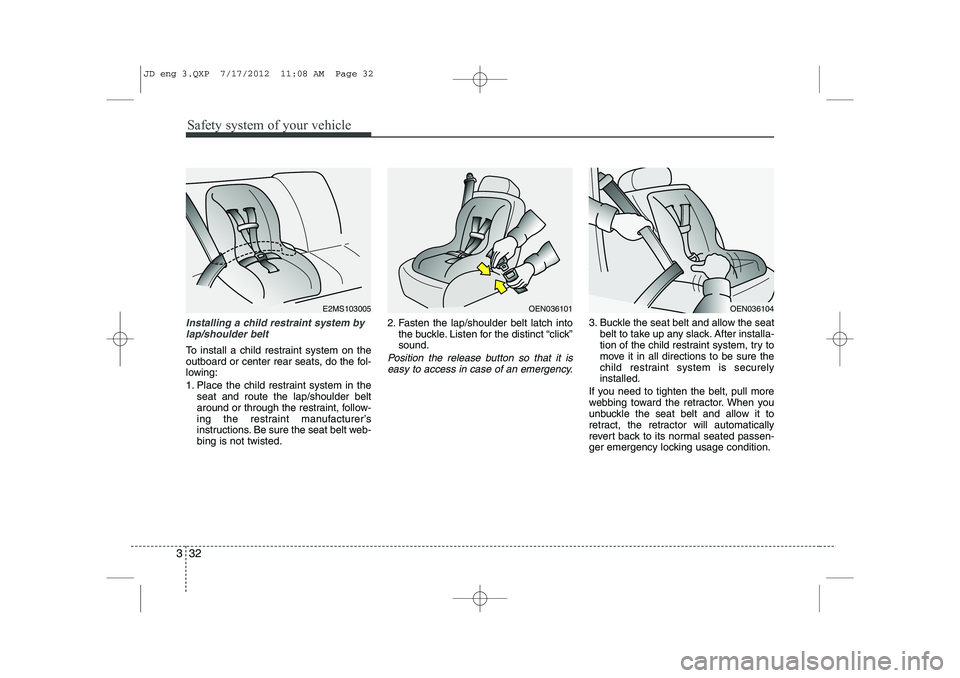
To install a child restraint system on the
outboard or center rear seats, do the fol-
lowing:
1. Place the child restraint system in the seat and route the lap/shoulder belt
around or through the restraint, follow-
ing the restraint manufacturer’s
instructions. Be sure the seat belt web-bing is not twisted. 2. Fasten the lap/shoulder belt latch into
the buckle. Listen for the distinct “click”sound.Position the release button so that it is
easy to access in case of an emergency.
3. Buckle the seat belt and allow the seat belt to take up any slack. After installa-
tion of the child restraint system, try to
move it in all directions to be sure the
child restraint system is securelyinstalled.
If you need to tighten the belt, pull more
webbing toward the retractor. When you
unbuckle the seat belt and allow it to
retract, the retractor will automatically
revert back to its normal seated passen-
ger emergency locking usage condition.
OEN036101OEN036104E2MS103005
JD eng 3.QXP 7/17/2012 11:08 AM Page 32
Page 62 of 1168
Safety system of your vehicle
46
3
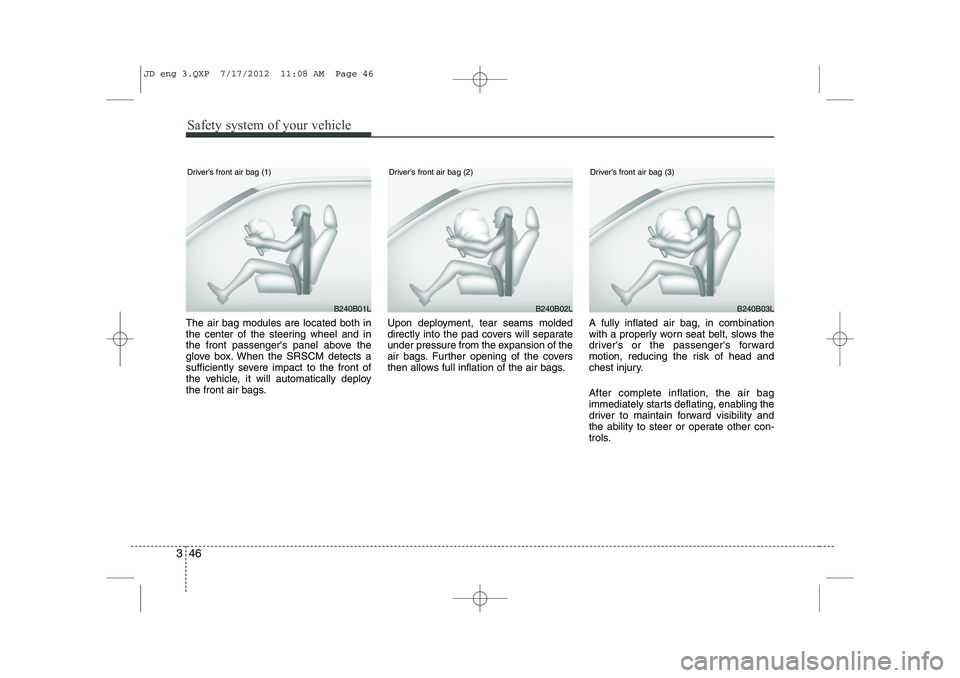
The air bag modules are located both in
the center of the steering wheel and in
the front passenger's panel above the
glove box. When the SRSCM detects a
sufficiently severe impact to the front of
the vehicle, it will automatically deploy
the front air bags. Upon deployment, tear seams molded
directly into the pad covers will separate
under pressure from the expansion of the
air bags. Further opening of the covers
then allows full inflation of the air bags.
A fully inflated air bag, in combination
with a properly worn seat belt, slows the
driver's or the passenger's forward
motion, reducing the risk of head and
chest injury. After complete inflation, the air bag
immediately starts deflating, enabling the
driver to maintain forward visibility and
the ability to steer or operate other con-
trols.
B240B02LB240B03L
Driver’s front air bag (2) Driver’s front air bag (3)B240B01L
Driver’s front air bag (1)
JD eng 3.QXP 7/17/2012 11:08 AM Page 46
Page 83 of 1168
Features of your vehicle
4
4
Record your key number
The key code number is stamped on the barcode tag attached to the
key set. Should you lose
your keys, we recom-
mend that you contact an authorized Kia
dealer. Remove the bar code tag and
store it in a safe place. Also, record the
code number and keep it in a safe and
handy place, but not in the vehicle. Key operations
• Used to start the engine.
Used to lock and unlock the doors.
Immobilizer system
Your vehicle may be equipped with an
electronic engine immobilizer system to
reduce the risk of unauthorized vehicle
use.
Your immobilizer system is comprised of
a small transponder in the key and elec-
tronic devices inside the vehicle.
Vehicles without smart key system
With the immobilizer system, whenever
you insert your ignition key into the igni-
tion switch and turn it to ON, it checks
and determines and verifies if the ignition
key is valid or not.
If the key is valid, the engine will start.
If the key is invalid, the engine will not
start.
To deactivate the immobilizer system:
Insert the ignition key into the key cylin-
der and turn it to the ON position.
To activate the immobilizer system:
Turn the ignition key to the OFF position.
The immobilizer system activates auto-
matically. Without a valid ignition key for
your vehicle, the engine will not start.
KEYS
WARNING
- Ignition key
Leaving children unattended in a
vehicle with the ignition key is dan-
gerous even if the key is not in the
ignition. Children copy adults and
they could place the key in the igni-
tion. The ignition key would enable
children to operate power windows
or other controls, or even make the
vehicle move, which could result in
serious bodily injury or even death.
Never leave the keys in your vehicle
with unsupervised children.
WARNING
We recommend that you use parts
for replacement from an authorized
Kia dealer. If an aftermarket key is
used, the ignition switch may not
return to ON after START. If this
happens, the starter will continue
to operate causing damage to the
starter motor and possible fire due
to excessive current in the wiring.
JD eng 4a(~168).qxp 7/17/2012 10:15 AM Page 4
Page 84 of 1168
45
Features of your vehicle
Vehicles with smart key system
Whenever the engine start/stop button is changed to the ON position, the immobi-
lizer system checks and verifies if the key
is valid or not.
If the key is valid, the engine will start.
If the key is invalid, the engine will not
start.
To deactivate the immobilizer system
Change the engine start/stop button to the ON position.
To activate the immobilizer system
Change the engine start/stop button to
the OFF position. The immobilizer sys-
tem activates automatically. Without a
valid smart key for your vehicle, the
engine will not start.
✽✽NOTICE
When starting the engine, do not use the
key with other immobilizer keys around.Otherwise the engine may not start or
may stop soon after it starts. Keep each
key separate in order to avoid a startingmalfuntioin. ✽
✽
NOTICE
If you need additional keys or lose your
keys, we recommend that you consult an
authorized Kia dealer.
CAUTION
The transponder in your ignition key is an important part of the
immobilizer system. It is designed to give years of trouble-free service,however you should avoid expo- sure to moisture, static electricity
and rough handling. Immobilizer system malfunction could occur.
CAUTION
Do not change, alter or adjust theimmobilizer system because it could cause the immobilizer sys-tem to malfunction. We recommend
that the system be serviced by anauthorized Kia dealer.
Malfunctions caused by improperalterations, adjustments or modifi- cations to the immobilizer system
are not covered by your vehicle manufacturer warranty.
WARNING
In order to prevent theft of your vehi-
cle, do not leave spare keys any-
where in your vehicle. Your immobi-
lizer password is a customer unique
password and should be kept confi-
dential. Do not leave this number
anywhere in your vehicle.
CAUTION
Do not put metal accessories near the ignition switch.
The engine may not start becausethe metal accessories may interrupt the transponder signal from nor-mally transmitting.
JD eng 4a(~168).qxp 7/17/2012 10:15 AM Page 5
Page 85 of 1168
Features of your vehicle
6
4
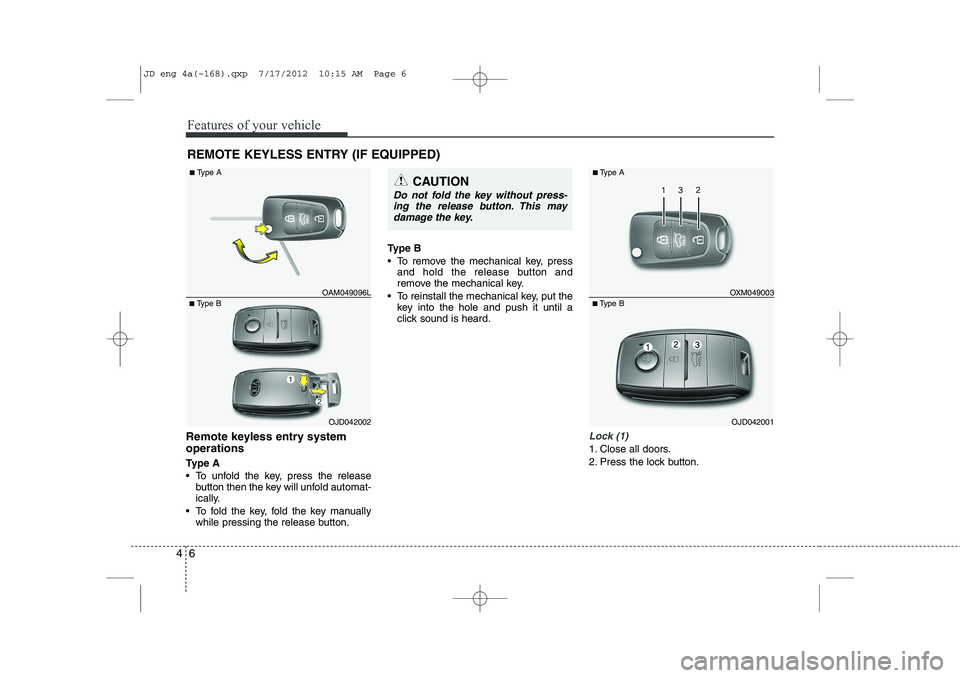
Remote keyless entry system operations
Ty p e A
To unfold the key, press the release
button then the key will unfold automat-
ically.
To fold the key, fold the key manually while pressing the release button. Type B
To remove the mechanical key, press
and hold the release button and
remove the mechanical key.
To reinstall the mechanical key, put the key into the hole and push it until a
click sound is heard.Lock (1)
1. Close all doors.
2. Press the lock button.
REMOTE KEYLESS ENTRY (IF EQUIPPED)
OJD042002
■
Type B OAM049096L
■
Type A
CAUTION
Do not fold the key without press-
ing the release button. This may
damage the key.
OJD042001
■
Type B OXM049003
■
Type A
JD eng 4a(~168).qxp 7/17/2012 10:15 AM Page 6