Page 14 of 655

▫ Programming Additional Transmitters ........26
▫ General Information ....................26
▫ Transmitter Battery Replacement ...........27
� REMOTE STARTING SYSTEM —
IF EQUIPPED ..........................28
▫ How To Use Remote Start ................28
� DOORS ..............................31
▫ Upper Half Door Window Removal — If
Equipped ............................31
▫ Upper Half Door Window Installation — If
Equipped ............................31
▫ Front Door Removal ....................32
▫ Rear Door Removal (Four-Door Models) ......34 � DOOR LOCKS .........................36
▫ Manual Door Locks ....................36
▫ Power Door Locks — If Equipped ..........38
▫ Child-Protection Door Lock System — Rear
Doors ...............................40
� WINDOWS ...........................41
▫ Power Windows — If Equipped ...........41
▫ Wind Buffeting .......................43
� REAR SWING GATE .....................44
� OCCUPANT RESTRAINTS ................45
▫ Lap/Shoulder Belts ....................48
▫ Rear Center Lap/Shoulder Belt Retractor
Lockout — Four-Door Models Only .........54
▫ Lap/Shoulder Belt Untwisting Procedure .....5512 THINGS TO KNOW BEFORE STARTING YOUR VEHICLE
Page 15 of 655

▫ Adjustable Upper Shoulder Belt Anchorage . . .55
▫ Seat Belts In Passenger Seating Positions ......56
▫ Automatic Locking Retractor Mode (ALR)
— If Equipped ........................57
▫ Energy Management Feature ..............58
▫ Seat Belt Pretensioners ..................59
▫ Enhanced Seat Belt Use Reminder System
(BeltAlert � ) ..........................59
▫ Seat Belts And Pregnant Women ...........61
▫ Seat Belt Extender .....................61
▫ Supplemental Restraint System (SRS)
— Air Bags ..........................62 ▫ Air Bag Deployment Sensors And Controls ....67
▫ Event Data Recorder (EDR) ...............75
▫ Child Restraints .......................76
� ENGINE BREAK-IN RECOMMENDATIONS ....98
� SAFETY TIPS ..........................99
▫ Transporting Passengers ..................99
▫ Exhaust Gas ........................ .100
▫ Safety Checks You Should Make Inside The
Vehicle ............................ .101
▫ Periodic Safety Checks You Should Make
Outside The Vehicle .................. .103
2 THINGS TO KNOW BEFORE STARTING YOUR VEHICLE 13
Page 17 of 655

3. Push the ignition key inward.
4. Turn the ignition key to the LOCK position, and
remove the key.
WARNING!• Before exiting a vehicle, always apply the parking
brake, shift the transmission into PARK, and re-
move the Key Fob from the ignition. When leaving
the vehicle, always lock your vehicle.
• Never leave children alone in a vehicle, or with
access to an unlocked vehicle.
• Allowing children to be in a vehicle unattended is
dangerous for a number of reasons. A child or
others could be seriously or fatally injured. Chil-
dren should be warned not to touch the parking
brake, brake pedal or the shift lever. (Continued) WARNING! (Continued)• Do not leave the Key Fob in or near the vehicle, and
do not leave the ignition in the ACC or ON/RUN
position. A child could operate power windows,
other controls, or move the vehicle.
• Do not leave children or animals inside parked
vehicles in hot weather. Interior heat build-up may
cause serious injury or death.
CAUTION!An unlocked car is an invitation to thieves. Always
remove key from the ignition and lock all doors
when leaving the vehicle unattended.
2 THINGS TO KNOW BEFORE STARTING YOUR VEHICLE 15
Page 31 of 655

WARNING! (Continued)• Keep Remote Keyless Entry (RKE) transmitters
away from children. Operation of the Remote Start
System, windows, door locks or other controls
could cause serious injury or death.
Remote Start Abort Message On Electronic Vehicle
Information Center (EVIC) — If Equipped
The following messages will display in the EVIC if the
vehicle fails to remote start or exits remote start pre-
maturely:
• Remote Start Aborted — Door Ajar
• Remote Start Aborted — Hood Ajar
• Remote Start Aborted — Fuel Low
• Remote Start Aborted — L/Gate Ajar
• Remote Start Aborted — System Fault The EVIC message stays active until the ignition is turned
to the ON/RUN position.
To Enter Remote Start
Press and release the REMOTE START button
on the RKE transmitter twice within five sec-
onds. The vehicle doors will lock, the parking
lights will flash and the horn will chirp twice
(if programmed). Then, the engine will start and the
vehicle will remain in the Remote Start mode for a
15-minute cycle.
NOTE:
• The park lamps will turn on and remain on during
Remote Start mode.
• For security, power window operation is disabled
when the vehicle is in the Remote Start mode. 2 THINGS TO KNOW BEFORE STARTING YOUR VEHICLE 29
Page 39 of 655
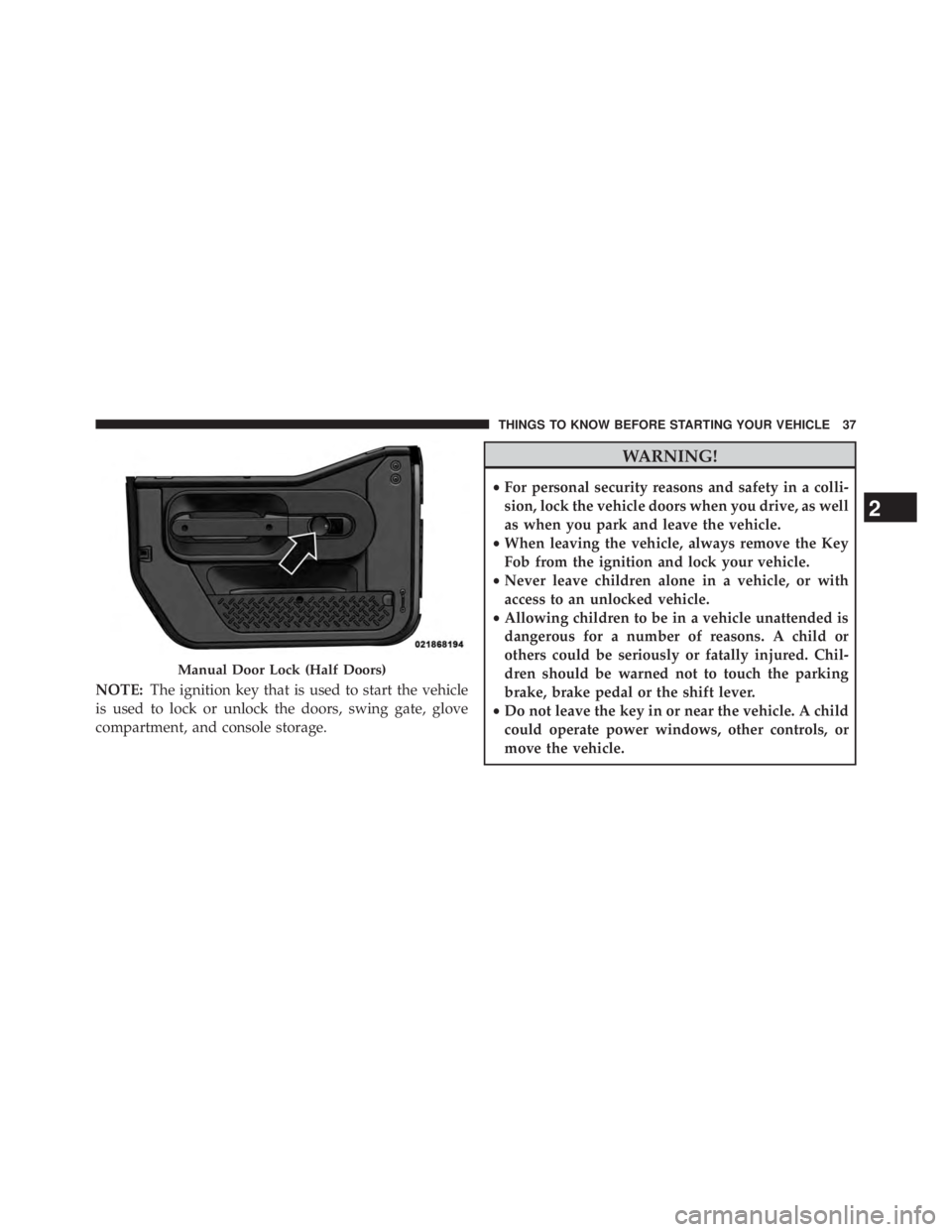
NOTE: The ignition key that is used to start the vehicle
is used to lock or unlock the doors, swing gate, glove
compartment, and console storage. WARNING!• For personal security reasons and safety in a colli-
sion, lock the vehicle doors when you drive, as well
as when you park and leave the vehicle.
• When leaving the vehicle, always remove the Key
Fob from the ignition and lock your vehicle.
• Never leave children alone in a vehicle, or with
access to an unlocked vehicle.
• Allowing children to be in a vehicle unattended is
dangerous for a number of reasons. A child or
others could be seriously or fatally injured. Chil-
dren should be warned not to touch the parking
brake, brake pedal or the shift lever.
• Do not leave the key in or near the vehicle. A child
could operate power windows, other controls, or
move the vehicle.Manual Door Lock (Half Doors)
2 THINGS TO KNOW BEFORE STARTING YOUR VEHICLE 37
Page 40 of 655
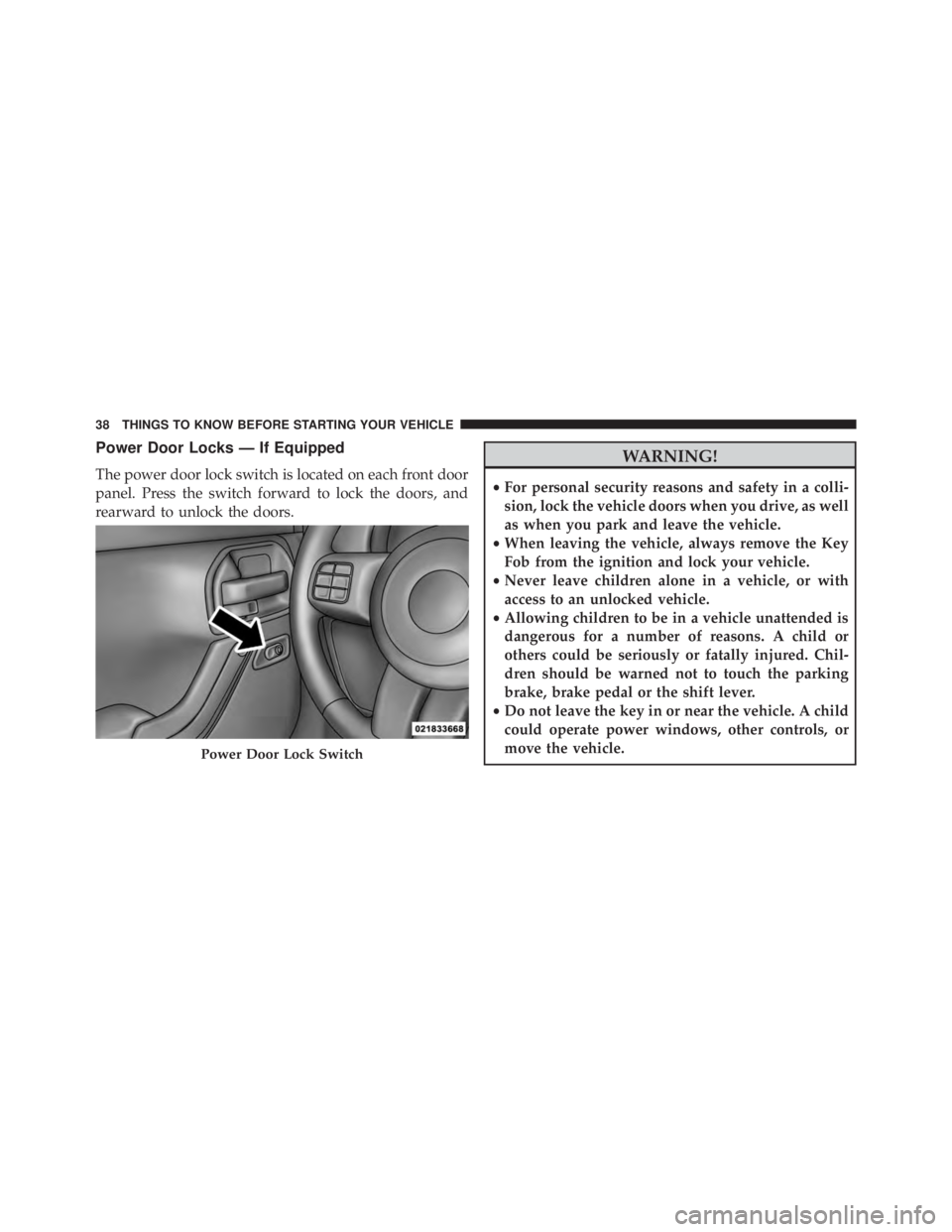
Power Door Locks — If Equipped
The power door lock switch is located on each front door
panel. Press the switch forward to lock the doors, and
rearward to unlock the doors.
WARNING!• For personal security reasons and safety in a colli-
sion, lock the vehicle doors when you drive, as well
as when you park and leave the vehicle.
• When leaving the vehicle, always remove the Key
Fob from the ignition and lock your vehicle.
• Never leave children alone in a vehicle, or with
access to an unlocked vehicle.
• Allowing children to be in a vehicle unattended is
dangerous for a number of reasons. A child or
others could be seriously or fatally injured. Chil-
dren should be warned not to touch the parking
brake, brake pedal or the shift lever.
• Do not leave the key in or near the vehicle. A child
could operate power windows, other controls, or
move the vehicle.Power Door Lock Switch38 THINGS TO KNOW BEFORE STARTING YOUR VEHICLE
Page 42 of 655
Child-Protection Door Lock System — Rear
Doors
To provide a safer environment for small children riding
in the rear seats, the rear doors are equipped with
Child-Protection Door Lock system.
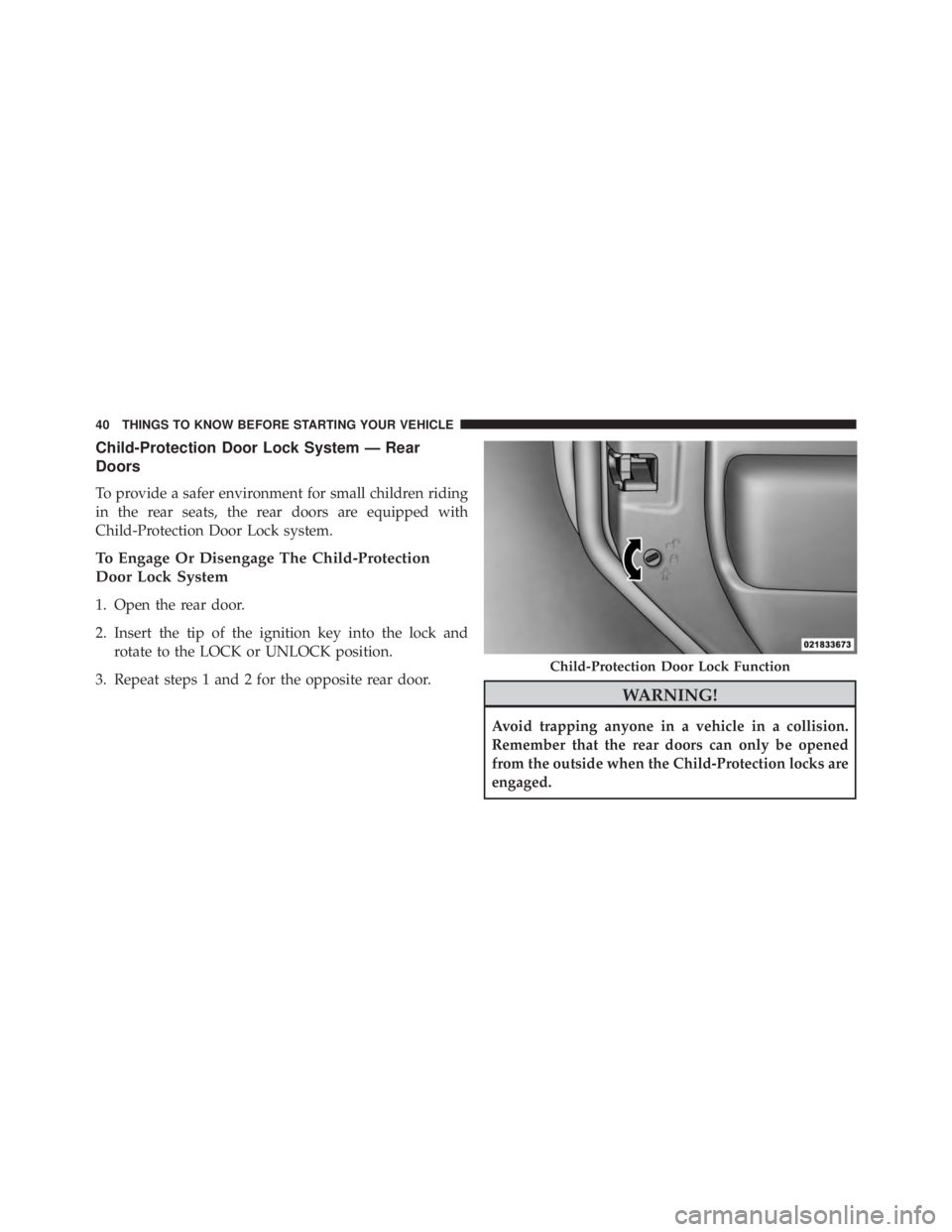
To Engage Or Disengage The Child-Protection
Door Lock System
1. Open the rear door.
2. Insert the tip of the ignition key into the lock and
rotate to the LOCK or UNLOCK position.
3. Repeat steps 1 and 2 for the opposite rear door.
WARNING!Avoid trapping anyone in a vehicle in a collision.
Remember that the rear doors can only be opened
from the outside when the Child-Protection locks are
engaged. Child-Protection Door Lock Function40 THINGS TO KNOW BEFORE STARTING YOUR VEHICLE
Page 47 of 655
OCCUPANT RESTRAINTS
Some of the most important safety features in your
vehicle are the restraint systems:
• Three-point lap and shoulder belts for the driver and
all passengers
• Advanced Front Air Bags for driver and front
passenger
• Supplemental Seat-Mounted Side Air Bags (SAB) — if
equipped
• An energy-absorbing steering column and steering
wheel
• Knee bolsters/blockers for front seat occupants
• Front seat belts incorporate pretensioners that may
enhance occupant protection by managing occupant
energy during an impact event • All seat belt systems (except the driver’s) include
Automatic Locking Retractors (ALRs), which lock the
seat belt webbing into position by extending the belt
all the way out and then adjusting the belt to the
desired length to restrain a child seat or secure a large
item in a seat — if equipped
Please pay close attention to the information in this
section. It tells you how to use your restraint system
properly, to keep you and your passengers as safe as
possible.
If you will be carrying children too small for adult-sized
seat belts, the seat belts or the Lower Anchors and Tether
for CHildren (LATCH) feature also can be used to hold
infant and child restraint systems. For more information
on LATCH, refer to Lower Anchors and Tether for
CHildren (LATCH). 2 THINGS TO KNOW BEFORE STARTING YOUR VEHICLE 45